

10 Best HR Software for Businesses Scaling from 50 to 1,000 Employees in 2026


-
AuthorRuchika Rajput
-
 Last Updated
August 13, 2026
Last Updated
August 13, 2026
-
 Reading Time
31 Mins
Reading Time
31 Mins
Imagine a company with 60 employees. HR can still manage payroll, leave, and attendance manually, or with spreadsheets, without too much pain. It mostly works, for now.
But as the company grows to 200, 500, or 1,000 employees, those same spreadsheets start breaking. Payroll errors creep in, compliance filings get missed, and managers keep pinging HR for basic employee data.
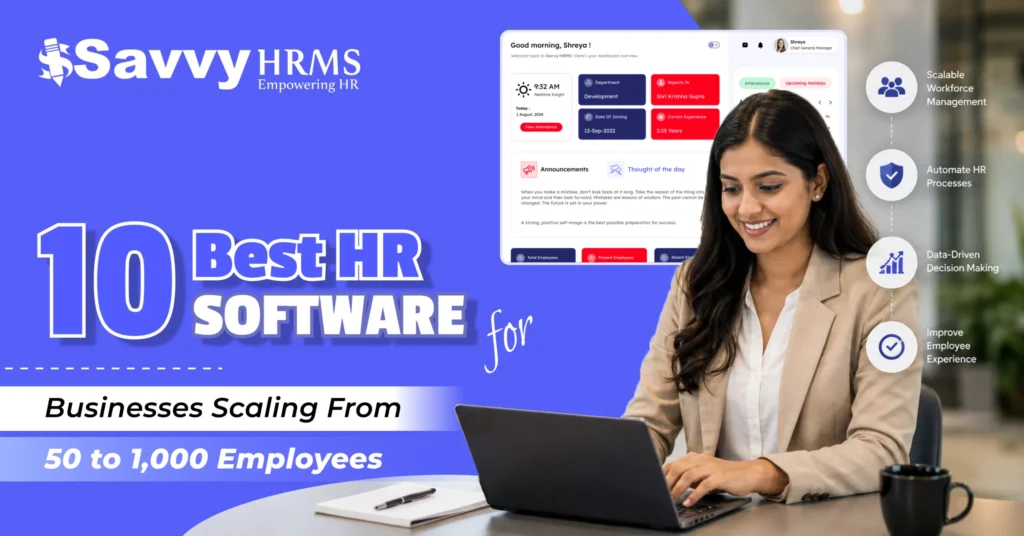
Best HR software for businesses scaling from 50 to 1,000 employees is exactly what solves this transition. This guide compares Savvy HRMS, Darwinbox, Keka, greytHR, Zoho People, Zimyo, factoHR, Qandle, Kredily, and Deel, with Savvy HRMS emerging as the strongest fit for this exact growth stage.
What Is HR Software?
HR software is a digital system that helps businesses manage employee-related processes, from hiring to payroll to performance, in one place instead of scattered spreadsheets and paper files. It replaces manual, repetitive HR work with automated, trackable workflows.
You will often hear the terms HR software, HRMS, HRIS, and HCM used almost interchangeably, and in practice, most vendors blur the lines between them. Broadly, HRIS (Human Resource Information System) refers to systems focused on storing and organizing employee data. HRMS (Human Resource Management System) usually adds process automation on top- think payroll, attendance, and leave. HCM (Human Capital Management) tends to describe more strategic, enterprise-scale platforms that also cover talent management, workforce planning, and analytics.
For a growing business, the label matters less than the substance. What matters is whether the platform can bring employee management, payroll, attendance, leave, recruitment, performance, analytics, compliance, and employee self-service together into a single, connected system, instead of 10 disconnected tools that don’t talk to each other.
What Are the Benefits of Using HR Software for Businesses Scaling From 50 to 1,000 Employees?
HR software reduces manual HR work, minimizes payroll and compliance errors, and gives leadership real-time visibility into workforce data, benefits that grow more valuable as headcount increases.
1. Payroll and Compliance Automation
Payroll automation removes manual salary calculations, tax deductions, and reimbursements, cutting down on errors that multiply as employee count rises. Compliance management becomes critical at scale, since statutory filing mistakes at 1,000 employees carry far higher financial and legal risk than at 50.
2. Attendance and Leave Management
- Biometric, GPS, or facial-recognition attendance replaces manual muster rolls
- Automated leave approval workflows prevent requests from getting lost in email threads
- Real-time attendance data works across multiple locations and shifts
- Leave balances, carry-forwards, and encashment are tracked without manual reconciliation
3. Employee Self-Service
Self-service portals let staff check payslips, apply for leave, and update their own details, which matters especially when HR can no longer field every individual query personally. This alone frees up significant HR bandwidth as teams grow.
4. Recruitment and Onboarding
- Standardizes hiring workflows instead of improvising a new process per hiring batch
- Speeds up candidate tracking, interview scheduling, and offer management
- Digital onboarding reduces paperwork and speeds up new-hire productivity
- Keeps hiring consistent across departments and locations as headcount grows
5. Performance Management
Performance management modules standardize appraisals across departments so evaluation criteria stay consistent as the organizational chart grows more complex. Without this, larger organizations often end up with inconsistent, manager-dependent review standards.
6. HR Analytics and Workforce Visibility
- Gives leadership visibility into attrition, headcount cost, and productivity trends
- Surfaces patterns invisible in spreadsheets once headcount crosses a few hundred
- Supports faster, data-backed workforce planning decisions
- Helps HR, finance, and department heads work from the same numbers
7. Centralized Employee Data
Centralized employee data means records aren’t scattered across spreadsheets, emails, and paper files. As businesses scale past a few hundred employees, this single source of truth becomes essential rather than optional.
8. Scalability and Workflow Automation
- Reduces manual work that would otherwise require proportionally more HR staff
- Automates repetitive workflows like approvals, reminders, and document routing
- Adapts to added locations, departments, or business units without a system overhaul
- Supports growth without forcing a platform switch mid-scale
9. Integration With Other Business Systems
Integration with accounting, ERP, and communication tools prevents duplicate data entry and keeps HR data consistent with the rest of the business. Together, these benefits compound, each one saving hours that would otherwise go into firefighting instead of building a better workplace.
What HR Needs Look Like at Different Business Sizes
| Business Size | Key HR Needs | Recommended HR Capabilities |
| 50 – 100 employees | Organizing scattered spreadsheets, basic payroll accuracy, simple leave tracking | Core HR, automated payroll, attendance, leave management, employee self-service |
| 100 – 250 employees | Reducing manual HR workload, standardizing onboarding, tracking attendance across teams | Recruitment workflows, onboarding automation, performance tracking, mobile attendance |
| 250 – 500 employees | Managing multiple departments/locations, consistent performance reviews, deeper compliance | Multi-location attendance, structured performance management, analytics dashboards, statutory compliance automation |
| 500 – 1,000 employees | Enterprise-grade compliance, workforce planning, integration with finance/ERP systems | Advanced analytics, workflow automation, role-based access, integrations, dedicated implementation support |
As you can see, requirements don’t just grow in volume; they grow in complexity. A tool that works fine at 80 employees can genuinely fall apart operationally at 800.
Our Evaluation Methodology
Each of the 10 platforms below was evaluated specifically against the needs of businesses scaling from 50 to 1,000 employees, not against the needs of a 10-person startup or a 50,000-person multinational. That growth range shapes which capabilities matter most.
We looked at scalability, payroll, attendance and leave management, core HR functionality, recruitment, performance management, employee self-service, HR analytics, India statutory compliance, integrations, ease of use, customer support, implementation experience, and pricing or value transparency. Information was drawn from official vendor websites, published pricing pages, product documentation, and independent software review platforms. We have not personally conducted hands-on testing of every module across all 10 platforms, and pricing or capabilities may change; always confirm current details directly with each vendor before purchasing.
Full Comparison of the 10 Best HR Software
| HR Software | Best For | Strengths | Limitations | Modules | Support & Implementation | Pricing |
| Savvy HRMS | Indian businesses scaling from 50 to 1,000+ employees across single or multiple locations | 20+ integrated modules, strong attendance and payroll depth, built for manufacturing and multi-location workforces, mobile app | Smaller brand recognition outside India | Core HR, payroll, attendance, leave, recruitment, onboarding, performance, LMS, travel & expense and more | Dedicated onboarding support; long-standing India client base | Fully customizable according to the needs of the particular organization |
| Darwinbox | Large, complex, multi-country enterprises | AI-driven analytics, strong configurability, mobile-first UX, used by major enterprises | Can be more platform than a 50 – 200 employee company needs; setup and configuration take time | Core HR, payroll, talent, performance, engagement, workforce analytics | Enterprise-grade implementation; some users note a learning curve | Custom pricing tiered by employee bands (under 500, 500 – 2,500, 2,500 – 10,000, 10,000+) |
| Keka | Mid-sized companies (roughly 50 – 500 employees) wanting a modern, employee-centric UX | Clean interface, strong payroll accuracy claims, OKRs, biometric and geo-fenced attendance | Plans are capped by employee count; costs rise as you move up tiers; may need enterprise plan beyond 500 | Payroll, attendance, leave, performance, recruitment, expense | Free trial available; setup requires policy and workflow configuration | Plans reported from roughly $85 – $169/month depending on employee cap and features |
| greytHR | Indian SMBs and mid-market companies needing rock-solid statutory compliance | Long India track record (since the 1990s), strong PF/ESI/PT/TDS automation, free starter tier | Interface seen as more traditional; fewer advanced performance/OKR features than newer platforms | Core HR, payroll, statutory compliance, attendance, leave, employee self-service | Free implementation and training reported for new clients | Plans reported from around ₹3,495 to ₹7,495/month depending on tier |
| Zoho People | Businesses already using the Zoho software ecosystem | Deep customization, wide integrations with Zoho apps, flexible per-user pricing tiers | Native payroll is limited to select countries; UI can feel dense for new users | Core HR, attendance, leave, performance, learning, engagement | 30-day free trial; self-service documentation and support tiers by plan | Tiered per-user pricing reported from roughly $1.50 to $10/user/month |
| Zimyo | Cost-conscious businesses wanting a wide module set | 40+ modules covering HR, payroll, engagement, and recruitment at competitive per-employee pricing | Some users report occasional bugs in engagement features; module depth varies | HR & payroll, attendance, performance, recruitment, engagement | Phone, email, and ticket-based support reported | Per-employee pricing reported from roughly ₹60 to ₹250/employee/month with minimum billing thresholds |
| factoHR | Mid-size to large Indian businesses with field or shop-floor workforces | Strong biometric and contactless attendance options, detailed PF/ESI/PT/TDS handling including PF trust variants | Pricing requires a sales conversation rather than transparent self-serve plans | Payroll, attendance, leave, recruitment, performance, expense | Free trial reported; implementation typically involves a vendor consultation | Custom/quote-based pricing; not publicly listed |
| Qandle | Startups to mid-size businesses wanting an affordable hire-to-retire platform | Budget-friendly entry pricing, good automation for core HR tasks | Some specialized modules (timesheets, rostering) are paid add-ons; fewer third-party integrations | Core HR, payroll, attendance, leave, recruitment, performance | Vendor-assisted onboarding reported | Plans reported from around ₹2,450–₹4,999/month plus per-employee charges above the base |
| Kredily | Startups and very small businesses on a tight budget | Free-forever plan covering core payroll, attendance, leave, and basic compliance | Better suited to smaller headcounts; may lack the depth larger, more complex organizations need | Payroll, attendance, leave, core HR, compliance basics | Community/self-serve support on the free tier; more support on paid tiers | Free forever plan available; paid tiers reported from roughly ₹1,249 – ₹1,749/month plus per-user charges |
| Deel | Companies hiring and managing distributed, international teams | Employer of Record and global payroll in 150+ countries, modular HR pricing, strong compliance across borders | Not primarily built around India-specific statutory depth; EOR and global modules can be costly for a purely domestic India workforce | Core HR, global payroll, EOR, contractor management, recruiting, performance | Dedicated country-specific support reported for EOR/payroll customers | Core HR reported from $5/employee/month; global payroll from $29/employee/month; EOR from $599/employee/month |
Pricing figures above are as published by third-party review sites and vendor pages at the time of research; always confirm current pricing directly with each vendor, as plans and rates change.
How We Evaluated and Ranked These HR Software Solutions
| Factor | Weight |
| Scalability | 20% |
| Payroll | 15% |
| Attendance & Leave | 10% |
| Core HR & Employee Management | 10% |
| India Statutory Compliance | 10% |
| Recruitment & Onboarding | 8% |
| Performance Management | 7% |
| Analytics & Reporting | 5% |
| Integrations | 5% |
| Employee Self-Service & User Experience | 5% |
| Support & Implementation | 5% |
This weighting isn’t arbitrary; it’s built specifically for the 50-to-1,000-employee growth journey. Scalability carries the heaviest weight (20%) because the single biggest risk at this stage is choosing a tool that has to be replaced again at 300 or 700 employees. Payroll (15%) matters because payroll errors get more expensive and more visible as headcount grows. India Statutory Compliance (10%) is weighted deliberately high because Indian businesses in this size range are past the point where compliance mistakes go unnoticed, but haven’t yet built large in-house compliance teams.
We did not adjust this framework to favor any particular vendor. Instead, we designed it around what actually determines success for a company growing through this specific range, which naturally rewards platforms with strong scalability, payroll depth, and India-specific compliance handling.
10 Best HR Software for Businesses Scaling From 50 to 1,000 Employees
1. Savvy HRMS
Savvy HRMS is a cloud-based HRMS built around the full employee lifecycle, with more than 20 integrated modules covering attendance, payroll, recruitment, and performance. For a business scaling from 50 to 1,000 employees, its combination of depth and configurability means teams don’t need to switch platforms mid-growth, unlike many tools designed for a narrower size band.
Core Services
- Core HR and centralized employee database covering the complete hire-to-retire employee lifecycle
- Automated payroll processing designed to handle salary calculations and statutory compliance requirements
- Attendance management with GPS, geo-fencing, and facial recognition for real-time, location-aware tracking
- Leave management with configurable policies, approvals, and carry-forward or encashment rules
- Recruitment and applicant tracking to manage job postings, candidates, and hiring pipelines
- Digital onboarding with offer letters, e-signatures, and structured task-based onboarding workflows
- Performance appraisal tools for documenting, reviewing, and evaluating employee performance over time
- Employee self-service portal giving staff control over their own profile, requests, and documents
- Travel and expense management alongside workflow automation tools like the Dynamic Request Workflow
India-Specific Compliance & HR Localization
- Supports state-specific compliance handling, relevant for businesses operating across multiple Indian states
- Payroll processing designed to accommodate statutory deduction requirements as part of standard payroll runs
- Contractor management and compliance modules aimed at manufacturing and multi-location workforces
- Multi-shift and rotating schedule support suited to factories, plants, and 24/7 operations
- Centralized, auditable attendance and payroll records to support statutory reporting needs
- ISO 27001 and ISO 9001 certified, reflecting formal information security and quality management standards
- Aligned with India’s Digital Personal Data Protection Act (DPDPA) for employee data handling
Who Is This Built For?
At 50 – 100 employees, Savvy HRMS helps businesses move off spreadsheets without over-investing in enterprise complexity they don’t yet need. At 100 – 250 employees, its recruitment, onboarding, and performance modules help standardize processes that start breaking down under manual management. At 250 – 500 employees, multi-shift scheduling and location-aware attendance become genuinely useful rather than optional; at 500 – 1,000 employees, and especially for multi-location or manufacturing-heavy businesses, the platform’s compliance, contractor management, and reporting depth support the operational complexity that larger Indian organizations face.
Pricing Structure
- Pricing is organization-specific and generally quote-based rather than fully self-serve
- Third-party listings report starting rates in the range of ₹4,500 to ₹6,000 per month for core plans
- Pricing appears to scale with deployment type, feature selection, and total user count
- A free trial is reported as available for prospective customers to explore the platform
- Additional modules, such as travel and expense management, may be priced separately from the core plan
- Contact the vendor directly for a quote tailored to your employee count and required modules
Implementation and Support Reality
- Onboarding generally involves configuring modules, policies, and workflows to match existing HR processes.
- Data migration from spreadsheets or legacy systems is part of standard implementation support.
- Training and webinars are offered to help HR teams and employees adopt the platform smoothly.
- Support is available via phone, email, and online channels for ongoing operational questions.
Final verdict: For a business specifically navigating the 50-to-1,000-employee growth stage in India, Savvy HRMS offers a rare combination: enough depth and compliance capability to handle real operational complexity, without the enterprise-only positioning that makes some competitors overkill for this range. It’s the platform on this list most explicitly built around this exact growth journey.
2. Darwinbox
Darwinbox is a cloud-based, end-to-end HCM platform covering the full employee lifecycle, built primarily for large, complex, and often multi-country enterprises with sophisticated HR requirements.
Core Services
- AI-driven recruitment and applicant tracking across sourcing, screening, and onboarding
- Configurable performance management with goal cascading and assessment frameworks
- Payroll and compensation modeling supporting multiple tax systems and pay structures
- Geofencing and facial recognition attendance tracking for distributed workforces
- Manpower budgeting and position management for complex organizational structures
- Employee engagement tools including surveys and internal social features
India-Specific Compliance & HR Localization
- Supports Indian tax systems and configurable statutory compliance workflows
- Used by large Indian enterprises across IT, manufacturing, retail, and banking sectors
- Audit trails and compliance documentation suited to regulated industries
- Configurable pay grades and benefits structures adaptable to Indian payroll norms
Who Is This Built For?
Darwinbox is best suited to larger organizations, generally at the higher end of the 500 – 1,000 employee range or beyond, especially those with multiple business units, complex approval hierarchies, or multi-country operations. Smaller companies at 50 – 150 employees may find its depth exceeds what they currently need.
Pricing Structure
- Pricing is custom and tiered by employee bands: under 500, 500 – 2,500, 2,500 – 10,000, and 10,000+
- Uses a pay-per-user-per-month subscription model based on employee count
- No long-term contracts are required, based on vendor-reported terms
- Full module access is reportedly included within each pricing tier
- Pricing is not publicly listed; contact the vendor for a quote
- Enterprise custom pricing is available for larger or more complex deployments
Implementation and Support Reality
- Implementation for large enterprises typically involves detailed requirements gathering and configuration.
- Some users report a learning curve for advanced reporting and workflow configuration.
- Onboarding support is structured around enterprise deployment timelines and complexity.
- Ongoing support quality is generally rated positively, though response times vary by region.
3. Keka
Keka is a modern HR and payroll platform built for growing companies, known for its clean, employee-centric interface and strong payroll accuracy claims.
Core Services
- Payroll processing with statutory compliance calculations for PF, ESI, PT, and TDS
- Biometric and geo-fenced mobile attendance tracking for distributed teams
- Leave management with configurable policies and approval workflows
- Performance reviews, OKRs, and goal tracking on higher-tier plans
- Recruitment and applicant tracking integrated with onboarding workflows
- Expense tracking and reimbursement management within the core platform
India-Specific Compliance & HR Localization
- Native automation of Provident Fund (PF), ESI, Professional Tax, and TDS calculations
- Designed around Indian statutory payroll requirements as a core feature, not an add-on
- SOC 2 Type II and ISO 27001 certifications reported for data security
- GDPR compliance maintained alongside India-specific statutory handling
Who Is This Built For?
Keka fits companies roughly in the 50 – 500 employee range well, particularly those that value a modern, self-service-heavy employee experience. Its plan structure, capped by employee count, means larger organizations approaching 1,000 employees may need to move to a higher tier or evaluate enterprise alternatives.
Pricing Structure
- Reported plans start around $85/month for up to 100 employees (Foundation tier)
- A mid-tier plan around $120 – $139/month is reported for up to roughly 200 employees
- A higher tier around $169/month is reported for up to roughly 500 employees, adding OKRs and API access
- Pricing is not publicly guaranteed to remain fixed; contact the vendor to confirm current rates
- A free trial is reported as available before committing to a paid plan
- Costs scale with both employee count and feature tier selected
Implementation and Support Reality
- Initial setup involves configuring payroll rules, policies, and custom workflows carefully.
- Some reporting and performance features are gated behind higher-priced plans.
- Implementation support is included with paid plans, per vendor documentation.
- Larger teams report that configuration takes more time than for smaller deployments.
4. greytHR
greytHR is one of India’s longest-standing cloud HR and payroll platforms, built by Bangalore-based Greytip Software, with a strong reputation for statutory compliance accuracy.
Core Services
- Payroll processing with pre-built computation for PF, professional tax, income tax, and ESI
- Core HR employee database with centralized records and HR analytics reporting
- Leave and attendance management with self-onboarding for new employees
- Applicant tracking and hiring workflow management for recruitment teams
- Exit and offboarding management available on higher-tier plans
- Expense claims management available as part of enterprise-tier plans
India-Specific Compliance & HR Localization
- Automatic updates to statutory compliance rules as government regulations change
- Handles PF (EPFO), ESI, and state-specific Professional Tax rates across Indian states
- Generates statutory reports including Form 16 and other compliance documentation
- Serves a large reported base of Indian organizations, indicating deep India-market focus
Who Is This Built For?
greytHR is well suited to Indian small businesses and mid-market companies, with some sources specifically citing the 100 – 1,000 employee range as a strong fit, particularly for organizations where payroll compliance accuracy is the top priority over advanced performance or engagement features.
Pricing Structure
- A free Starter tier is reported for smaller teams, with feature limitations
- Essential plan reported starting around ₹3,495/month
- Growth plan reported starting around ₹5,495/month, adding features like exit management
- Enterprise plan reported starting around ₹7,495/month, adding SSO and API access
- Per-employee add-on charges may apply on top of the base monthly fee
- Contact the vendor to confirm current pricing, as plans are periodically updated
Implementation and Support Reality
- Free implementation and training are reported for the first months after signup.
- Webinars on payroll best practices are offered to help teams adopt the platform.
- Some users describe the interface as more traditional than newer competitors.
- Support is generally rated as responsive, particularly for compliance-related queries.
5. Zoho People
Zoho People is a cloud-based, highly customizable HR platform that works especially well for businesses already using other Zoho applications.
Core Services
- Core HR with custom forms, fields, and modules for organization-specific workflows
- Attendance tracking and leave management with configurable policy rules
- Performance and learning management including appraisals and course tracking
- Recruitment support through integration with Zoho Recruit
- Employee self-service portal for requests, documents, and profile updates
- HR helpdesk and employee query management tools
India-Specific Compliance & HR Localization
- Integrates with greytHR for payroll and statutory compliance workflows in India
- Data security measures designed to support regulatory compliance requirements
- Available in Hindi alongside other regional and international languages
- Configurable workflows can be adapted to Indian leave, attendance, and HR policy norms
Who Is This Built For?
Zoho People suits growing businesses of varying sizes, especially those already invested in the Zoho ecosystem (Zoho Books, Zoho CRM, Zoho Payroll where available). Its per-user pricing model scales reasonably from smaller teams up through mid-size organizations.
Pricing Structure
- Tiered per-user pricing reported: Essential HR (~$1.50/user), Professional (~$2.50/user), Premium (~$3.50/user), Enterprise (~$5/user), and People Plus (~$10/user)
- A free tier is reported for very small teams with basic functionality
- A 30-day free trial is reported as available across plans
- Annual billing generally offers lower rates than monthly billing
- Native payroll processing is limited to specific countries; confirm availability for India
- Contact the vendor to confirm current tier pricing and included features
Implementation and Support Reality
- Setup involves configuring custom modules, forms, and workflows to match business needs.
- Reviewers note occasional bugs and a learning curve for advanced customization.
- Support is available via phone, chat, and ticketing, with some regional inconsistency reported.
- Integration setup with other Zoho or third-party apps is generally described as straightforward.
6. Zimyo
Zimyo is a broad HR-tech platform offering a large number of modules at competitive, budget-conscious pricing, aimed at cost-sensitive growing businesses.
Core Services
- HR and payroll management covering salary processing and employee records
- Time and attendance tracking with detailed reporting on attrition and retention
- Performance management and talent acquisition tools within a unified platform
- Employee engagement features including recognition and internal communication tools
- Document management and self-service for employee-initiated requests
- Learning management system for training and skill development tracking
India-Specific Compliance & HR Localization
- Payroll module designed around Indian statutory deduction requirements
- Multi-location and multi-department centralized HR management support
- Primarily tailored for the Indian market, with compliance features built around it
- Customization options available for organizations with region-specific policy needs
Who Is This Built For?
Zimyo works well for cost-conscious businesses that want a wide breadth of modules without a large budget, spanning from smaller teams into the mid-market range, though very large or highly complex organizations may find some modules less deep than specialist alternatives.
Pricing Structure
- Reported per-employee pricing across tiers: roughly ₹60 (Basic), ₹120 (Standard), and ₹250 (Enterprise) per employee per month
- Minimum billing thresholds reported around 40 employees per plan
- A 14-day trial period is reported, without requiring payment details upfront
- Discounts are reported for half-yearly or annual billing commitments
- Pricing model described as pay-per-use with flexibility to change plans
- Contact the vendor to confirm current per-employee rates and minimums
Implementation and Support Reality
- Onboarding includes access to a limited feature set during the initial trial period.
- Ongoing contact from the vendor is reported to support adoption after signup.
- Some users report occasional bugs in engagement-related features and messaging.
- Support is available via phone, email, live chat, and ticketing channels.
7. factoHR
factoHR is a mobile-friendly HR and payroll platform known for its depth in biometric attendance and detailed statutory payroll handling, particularly for larger or field-heavy Indian workforces.
Core Services
- End-to-end payroll processing designed for accurate, on-time salary payments
- Time and attendance tracking with face recognition and contactless options
- Shift and roster planning including change-shift request workflows
- Recruitment support to help HR teams engage and track candidates
- Interconnected modules where updates in one module reflect in others automatically
- Chatbot-assisted employee support alongside standard self-service tools
India-Specific Compliance & HR Localization
- Detailed handling of PF, ESI, Professional Tax, and TDS calculations
- Reported support for exempted and unexempted PF trusts, gratuity, and superannuation
- Suited to older or larger Indian establishments running their own PF trust structures
- Compliance depth positioned toward mid-size to large Indian organizations
Who Is This Built For?
factoHR is best suited to mid-size and larger Indian businesses, particularly those with field, shop-floor, or plant-based workforces that need strong biometric attendance alongside deep statutory payroll handling.
Pricing Structure
- Pricing is not publicly listed; the vendor requires a sales conversation for quotes
- A free trial is reported as available to explore core features
- An “essential” paid plan is referenced, covering onboarding, attendance, and mobile access
- Pricing appears to scale with company size and selected modules
- Contact the vendor directly for a quote tailored to your organization
- Confirm current plan structures directly, as public pricing details are limited
Implementation and Support Reality
- Implementation generally starts with a trial before a sales-led pricing discussion.
- Setup is geared toward mid-size to large companies with more complex needs.
- Some reviewers note fewer AI-driven features compared to newer competitors.
- The interface is generally described as user-friendly once configured.
8. Qandle
Qandle is a hire-to-retire HR platform positioned around affordability, offering core HR functionality at competitive entry-level pricing.
Core Services
- Core HR with employee database and hire-to-retire lifecycle tracking
- Payroll processing with statutory compliance calculations built in
- Attendance and leave management with configurable approval workflows
- Recruitment and applicant tracking for hiring pipeline management
- Performance management tools for goal setting and reviews
- Timesheet and roster management available as specialized add-ons
India-Specific Compliance & HR Localization
- Statutory compliance features reported for PF, ESI, Professional Tax, and TDS
- Positioned as suited to Indian startups through larger enterprises
- Good automation reported specifically for core compliance-related workflows
- Compliance handling included as part of core plans rather than a separate module
Who Is This Built For?
Qandle fits startups and mid-size businesses looking for an affordable entry point into structured HR software, particularly those that don’t need every specialized module (like advanced rostering) from day one and are comfortable adding them later.
Pricing Structure
- Entry pricing reported around ₹2,450/month for up to 50 employees, plus roughly ₹49 per additional employee
- A professional plan reported around ₹4,999/month for around 100 employees, plus roughly ₹40 per additional employee
- Specialized modules such as timesheets and roster management are reported as paid add-ons
- Pricing is not publicly listed; contact the vendor to confirm current rates
- Flexibility reported for businesses wanting to avoid large upfront contracts
- Confirm add-on costs separately, as they are not always included in base pricing
Implementation and Support Reality
- Vendor-assisted onboarding is reported to help configure core HR workflows.
- Some users note fewer third-party integrations compared to larger competitors.
- Specialized modules may require additional setup once purchased as add-ons.
- Support channels and response quality vary by plan tier, per user reports.
9. Kredily
Kredily is a cloud-based HR and payroll platform best known for its free-forever plan, aimed at making HR software accessible to startups and small businesses in India.
Core Services
- Payroll automation with compliance-ready processing on the free plan
- Attendance tracking including AI-powered face recognition features
- Leave management with configurable rules for approvals and balances
- Core HR employee data management and centralized records
- Mobile-first attendance tracking suited to hybrid and remote teams
- Basic compliance automation included even on the free tier
India-Specific Compliance & HR Localization
- Compliance automation reported for PF, ESI, Professional Tax, and TDS
- Free plan reportedly includes compliance-ready payroll for unlimited employees
- Positioned specifically for Indian MSMEs and startups needing low-cost compliance
- AI-based attendance tools designed with Indian hybrid/remote work patterns in mind
Who Is This Built For?
Kredily is best suited to startups and small businesses, typically under roughly 100 – 200 employees, that need genuine core payroll and compliance functionality without licensing costs. Larger organizations approaching the upper end of the 50 – 1,000 range may find they need more depth than the free or entry-level paid tiers offer.
Pricing Structure
- A free-forever plan is reported, covering payroll, attendance, leave, and compliance for unlimited employees under an active-usage policy
- A paid tier reported around ₹1,249/month for up to 25 employees, plus roughly ₹40 per additional employee
- A professional tier reported around ₹1,749/month for up to 25 users, plus roughly ₹60 per additional user
- An Enterprise tier is available with custom pricing for larger organizations
- An annual maintenance charge is reported separately for certain sync features
- Confirm current plan terms directly, as free-tier conditions can change
Implementation and Support Reality
- The free plan is largely self-serve, with limited hands-on implementation support.
- Paid tiers reportedly include wider support access and more advanced modules.
- Setup is generally described as straightforward for small, single-location teams.
- Larger or multi-entity businesses may need more configuration than the platform easily supports.
10. Deel
Deel is a global HR and payroll platform built primarily for companies hiring and managing distributed international teams, combining Employer of Record (EOR), global payroll, and core HR into one system.
Core Services
- Employer of Record services for hiring employees in countries without a local entity
- Global payroll processing across 150+ countries with local compliance built in
- Core HR including worker profiles, time off, and people analytics
- Contractor management and compliance tools for international freelancers
- Modular add-ons for recruiting, performance, and workforce planning
- Immigration and visa support for internationally distributed hires
India-Specific Compliance & HR Localization
- Supports India as one of many countries within its global payroll and EOR network
- Not primarily built around India-specific statutory depth the way India-first platforms are
- Local compliance is handled per-country as part of the global payroll product
- Best suited to India-based teams that also need to hire internationally, not as a standalone India payroll system
Who Is This Built For?
Deel fits companies that need to hire and pay employees or contractors across multiple countries, including Indian businesses expanding internationally. For a company whose HR needs are purely domestic India payroll and compliance, more India-focused platforms on this list are typically a better and more cost-effective fit.
Pricing Structure
- Core HR (HRIS) reported starting around $5/employee/month, free for smaller teams on some plans
- Global payroll reported starting around $29/employee/month, plus a reported per-entity implementation fee
- Employer of Record (EOR) reported starting around $599/employee/month
- Contractor management reported starting around $49/contractor/month
- Additional modules like recruiting and performance are priced separately and can be added modularly
- Confirm current pricing directly, as Deel’s modular pricing structure updates periodically
Implementation and Support Reality
- Dedicated country-specific support is reported for EOR and global payroll customers.
- Onboarding for EOR involves local legal and compliance setup per country.
- Help documentation is reported to skew toward contractor use cases over admin workflows.
- Implementation complexity is generally higher than single-country HR platforms.
What India Compliance Capabilities Should HR Software Provide?
HR software should automate the calculation, deduction, and reporting for India’s core statutory requirements, EPF, ESI, Professional Tax, and TDS, while generating the documentation businesses need for audits and filings. That said, the employer remains legally responsible for compliance, even when software handles the calculations.
Key areas HR software should support include:
- EPF / EPFO: Automated calculation of employer and employee provident fund contributions
- ESI: Employee State Insurance contribution calculations for eligible employees
- Professional Tax: State-specific PT calculations, since rates vary across Indian states
- TDS: Tax Deducted at Source calculations integrated into payroll processing
- Form 16: Generation of annual tax certificates for employees
- Statutory payroll reports: Reports formatted for filing with relevant authorities
- Labour law requirements: Support for record-keeping obligations under applicable labour laws
- State-specific compliance: Handling variations in rules across states for multi-location businesses
- Compliance documentation: Audit-ready records of payroll and statutory filings
Good HR software reduces the manual effort and error risk involved in these calculations, and many platforms update their systems when government rules change. But software is a tool, not a substitute for professional compliance advice; businesses should still consult a qualified CA or compliance professional, particularly during major regulatory changes such as updates connected to the Labour Codes’ implementation timeline.
When Do Businesses Actually Need HR Software?
Businesses typically need HR software when manual processes start consuming more time than they save, and when the risk of errors, payroll mistakes, missed compliance deadlines, and lost employee records starts outweighing the cost of a proper system.
Common signals include:
- HR depends heavily on spreadsheets that different people update inconsistently
- Payroll processing takes days instead of hours each month
- Employee count is growing rapidly, and manual tracking can’t keep pace
- Attendance data from multiple sources is difficult to reconcile
- Managers repeatedly ask HR for basic employee information that should be self-service
- Leave approvals happen informally through WhatsApp or email threads
- Payroll errors are increasing as headcount grows
- Statutory compliance is becoming harder to track accurately
- HR uses multiple disconnected systems that don’t share data
- Employees are asking for self-service access to their own records
- Management needs better, faster HR reporting for decision-making
At 50 employees, manual processes may still feel manageable, even if imperfect. At 300 or 500 employees, those same processes can become a serious operational burden, one that quietly costs far more in errors, rework, and compliance risk than the price of good HR software.
How to Implement the Best HR Software in Your Business
1. Identify HR Pain Points
Talk to HR, finance, and department heads about where time is genuinely being lost today. Honest input here shapes every decision that follows, so don’t skip it.
2. Define Requirements
List the modules and capabilities your business genuinely needs now, plus what you’ll likely need over the next one to two years of growth.
3. Audit Existing Employee Data
Clean up spreadsheets and records before migration begins. Messy source data creates messy new systems, so fix duplicates and gaps first, not after go-live.
4. Select Modules
Choose the specific HR, payroll, and compliance modules that match your requirements. Avoid paying for advanced features you won’t realistically use for another year.
5. Configure Workflows
Set up approval chains, leave policies, and attendance rules to match how your business actually operates today, not how a generic template assumes it should.
6. Migrate Employee Data
Move employee records into the new system carefully, with validation checks at every stage. Rushed migrations are where most long-term data errors quietly originate.
7. Set Up Payroll and Compliance
Configure statutory deduction rules and verify calculations against manual records before go-live. Run at least one parallel payroll cycle to confirm accuracy first.
8. Integrate Relevant Systems
Connect accounting, ERP, or communication tools where needed to avoid duplicate data entry. Fewer disconnected systems means fewer reconciliation headaches for HR and finance.
9. Train HR and Managers
Make sure the people running the system daily understand its workflows, not just the admins. Manager buy-in determines whether adoption actually sticks company-wide.
10. Launch Gradually
Consider a phased rollout, starting with one department or location before going company-wide. This surfaces configuration issues early, while the blast radius is small.
11. Monitor Adoption
Track whether employees and managers are actually using self-service features as intended. Low adoption usually signals a training gap or workflow, not a tool problem.
12. Continuously Optimize
Revisit configuration and workflows periodically as your headcount and processes evolve. What worked at 100 employees may need adjustment by the time you reach 500.
Conclusion
Scalability matters because the cost of switching HR software mid-growth. Migrating data, retraining teams, and disrupting payroll is far higher than choosing the right platform upfront. As businesses grow from 50 toward 1,000 employees, HR software becomes less of a convenience and more of an operational necessity, particularly around payroll accuracy and India-specific statutory compliance.
Every business’s needs differ based on industry, location spread, and growth pace, which is why evaluating software against your specific growth stage, not just feature lists, matters more than chasing the biggest brand name. Among the 10 platforms compared here, Savvy HRMS stands out as the strongest fit specifically for businesses scaling from 50 to 1,000 employees, thanks to its depth across payroll, attendance, compliance, and multi-location support without the enterprise-only complexity some competitors carry.
If your business is somewhere on that growth curve, it’s worth taking a closer look. Explore what Savvy HRMS offers, book a demo, or talk to the team about your specific HR requirements; a short conversation now can save a lot of operational pain later.

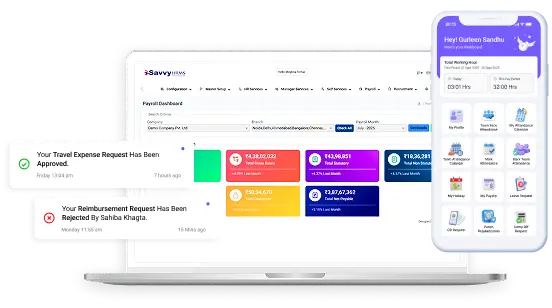









Ready to scale your HR without scaling the complexity?
Explore Savvy HRMS today, book a personalized demo, and discover how you can manage payroll, attendance, compliance, and your growing workforce, all in one powerful platform.
Which is the best HR software for businesses in 2026?
Among the platforms compared here, Savvy HRMS stands out as the strongest overall choice for businesses scaling from 50 to 1,000 employees, thanks to its payroll depth, compliance handling, and multi-location support.
How much does HR software cost for businesses in India?
Pricing varies by employee count, modules, and vendor:
– Small teams: free-forever plans available (e.g., Kredily)
– Mid-market: roughly ₹2,000 – ₹8,000/month (e.g., Savvy HRMS, greytHR, Qandle, Zimyo)
– Enterprise: custom pricing based on scale (e.g., Savvy HRMS, Darwinbox)
– Global/EOR: $29 – $599 per employee/month (e.g., Deel)
Can one HR software handle both payroll and compliance for Indian businesses?
Yes, most India-focused HR platforms, including Savvy HRMS, greytHR, Keka, and factoHR, combine payroll processing with statutory compliance features like EPF, ESI, Professional Tax, and TDS in a single system.
How long does it take to implement new HR software?
A typical implementation includes:
– Data audit and cleanup
– Module selection and configuration
– Employee data migration with validation
– Payroll setup and parallel-run testing
– Team training and phased rollout
Most mid-sized businesses complete this in a few weeks to a few months.
Is HR software worth it for a company with only 50-100 employees?
Yes, in most cases. Manual payroll and attendance processes start producing errors even at this size, and starting with a scalable platform early avoids a costly, disruptive switch later.