




Whether you are hiring new employees, planning annual appraisals, or reviewing compensation budgets, knowing the average salary in India can help you make better decisions. Salary expectations are changing quickly in 2026, and both HR teams and business owners need reliable market benchmarks to stay competitive.
For employees, salary trends help them understand whether they are being paid fairly. For employers, they help in attracting and retaining skilled talent without overspending. The challenge is that salaries vary largely by industry, city, experience level, and role.
In this blog, we will look at the average salary in India 2026, compare salaries across industries, explore the highest-paying cities, explain CTC vs in-hand salary, and discuss how salary benchmarking and HRMS software can support smarter compensation planning.
What Is the Average Salary in India in 2026?
The average salary in India in 2026 is estimated to be around ₹6 – 8 lakh per year for salaried professionals across various industries. This figure includes employees working in IT, manufacturing, banking, healthcare, retail, and other organized sectors.
However, the average salary can vary significantly based on:
- Industry: IT and BFSI generally pay more than retail or hospitality.
- City: Bengaluru, Mumbai, and Delhi NCR offer higher salaries due to demand and cost of living.
- Experience: A senior professional may earn 2 – 4 times more than a fresher.
- Skills: Specialized skills in AI, cloud computing, analytics, and finance command premium salaries.
| Category | Average Salary (2026) |
| Average Annual Salary | ₹6 – 8 lakh per annum |
| Average Monthly Salary | ₹50,000 – ₹65,000 per month |
| Average Salary in Metro Cities | ₹7 – 12 lakh per annum |
| Average Salary in Tier-2 Cities | ₹4 – 7 lakh per annum |
These are broad market estimates and should be used as reference points for salary benchmarking rather than fixed salary standards.
What Is the Average Industry-Wise Salary in India?
Different industries have very different compensation levels. The table below shows approximate average annual salaries for organized-sector employees in 2026.
| Industry | Average Annual Salary (LPA) | Key Salary Highlights |
| IT & Software | ₹6 to ₹35+ LPA | Professionals with expertise in AI, cloud computing, cybersecurity, and software development generally earn the highest salaries, making this one of India’s best-paying industries. |
| Healthcare & Pharmaceuticals | ₹4 to ₹12 LPA | Medical professionals, specialists, and experienced healthcare practitioners often receive significantly higher compensation than the industry average. |
| Engineering & Manufacturing | ₹4 to ₹10 LPA | This sector continues to offer stable career opportunities, with skilled engineers and technical experts seeing consistent salary growth. |
| BFSI (Banking, Financial Services & Insurance) and Fintech | ₹5 to ₹20+ LPA | Roles in investment banking, financial analysis, risk management, and data science remain among the highest-paying positions in this industry. |
| Retail & E-commerce | ₹3 to ₹8 LPA | Compensation generally varies based on job role and experience, with managerial and supply chain positions offering better earning potential. |
| Education & EdTech | ₹3 to ₹7 LPA | While average salaries remain moderate, experienced educators, academic leaders, and professionals in specialized EdTech roles can command higher pay packages. |
The IT industry continues to lead because of strong demand for cloud, cybersecurity, AI, and software development skills. Banking and financial services also offer attractive compensation, especially for specialized roles in analytics, risk management, and investment operations.
Which Indian City Offers the Highest Average Salary?
Among various Indian cities, Bengaluru generally offers the highest average salaries due to its concentration of technology companies, startups, and global capability centers.
| City | Average Annual Salary |
| Bengaluru | ₹10 – 15 lakh |
| Mumbai | ₹9 – 14 lakh |
| Delhi NCR | ₹8 – 13 lakh |
| Hyderabad | ₹8 – 12 lakh |
| Pune | ₹7 – 11 lakh |
| Chennai | ₹7 – 10 lakh |
Why Bengaluru pays more:
- Large presence of multinational technology firms
- Strong startup ecosystem
- High demand for digital and engineering talent
- Greater competition for skilled professionals
That said, a higher salary does not always mean higher savings. Cost of living, housing, and transportation expenses also need to be considered when comparing cities.
How Does Work Experience Affect Average Salaries in India?
Experience is one of the biggest factors influencing compensation. Salaries generally rise as employees gain domain knowledge, leadership skills, and business impact.
| Experience Level | Average Annual Salary |
| 0 – 2 Years (Freshers) | ₹3 – 5 lakh |
| 3 – 7 Years | ₹6 – 10 lakh |
| 8 – 15 Years | ₹12 – 20 lakh |
| 15+ Years | ₹20 lakh+ |
For example, a software engineer with 1 year of experience may earn around ₹4 – 5 lakh annually, while someone with 8 – 10 years of experience can earn ₹15 lakh or more, especially in high-demand technology domains.
Continuous learning matters. Employees who upgrade their skills in areas such as AI, cloud computing, data analytics, and cybersecurity often see faster salary growth than those who depend only on years of experience.
CTC vs In-Hand Salary in India: What’s the Difference?
| Aspect | CTC (Cost to Company) | In-Hand Salary (Take-Home Salary) |
| Meaning | The total annual cost incurred by the employer for an employee. | The actual amount credited to the employee’s bank account after deductions. |
| Includes | Basic salary, allowances, bonuses, employer PF contribution, gratuity, insurance, and other benefits. | Basic salary and allowances after deducting taxes, employee PF, professional tax, and other applicable deductions. |
| Purpose | Represents the overall compensation package offered by the employer. | Reflects the employee’s monthly take-home earnings. |
| Deductions | No deductions are made from CTC itself, but it includes employer-paid benefits and statutory contributions. | Includes deductions such as Employee Provident Fund (EPF), Tax Deducted at Source (TDS), professional tax, and other applicable deductions. |
| Amount | Always higher than the in-hand salary because it includes additional employer costs and benefits. | Lower than the CTC as it excludes employer contributions and accounts for mandatory deductions. |
| Frequency | Usually expressed as an annual compensation package. | Generally received as a monthly salary payment. |
| Importance | Helps employers define the total compensation offered to employees. | Helps employees understand the actual amount they receive each month for their expenses and savings. |
Salary Increment Trends in India for 2026: What to Expect?
Companies are expected to continue moderate but steady salary increases in 2026. Average increments are likely to remain in the 8 – 10% range across organized sectors.
| Industry | Expected Average Salary Increment (2026) |
| IT & Digital | 10% – 12% |
| Banking & Finance | 8% – 10% |
| Manufacturing | 7% – 9% |
| Healthcare | 8% – 11% |
| Retail | 6% – 8% |
Key drivers of salary growth:
- Demand for digital skills
- Competition for experienced talent
- Business expansion
- Inflation and cost-of-living adjustments
- Performance-based reward programs
Employees with critical skills and strong performance ratings are likely to receive higher increments than the market average.
Why Is Salary Benchmarking Important for HR and Business Owners?
Salary benchmarking means comparing your compensation structure with market standards. It helps organizations offer competitive salaries while maintaining internal fairness.
Benefits of salary benchmarking:
- Attract better candidates
- Reduce offer rejections
- Improve employee retention
- Plan compensation budgets more accurately
- Support fair pay decisions
Example: If the market average for a payroll executive is ₹5.5 lakh and your company offers ₹4 lakh, you may face higher attrition and hiring challenges.
For growing businesses, benchmarking becomes especially important during annual appraisals, expansion, and leadership hiring.
How Can HRMS Software Help with Salary Benchmarking and Compensation Planning?
Managing compensation through spreadsheets becomes difficult as teams grow. This is where HRMS software becomes valuable.
A modern HRMS can help you:
- Centralize employee salary data in one place
- Track salary revisions and increments
- Generate compensation reports instantly
- Compare pay across departments and locations
- Support data-driven salary decisions for HR leaders
- Integrate payroll software and compensation planning for better accuracy
Example Workflow:
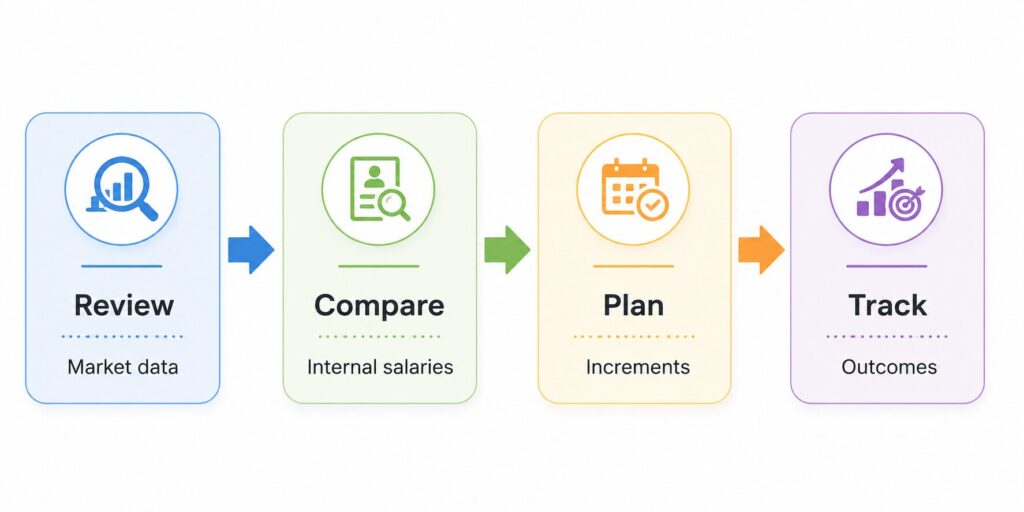
This saves time, reduces manual errors, and gives HR teams better visibility into compensation trends across the organization.
Conclusion
The average salary in India in 2026 varies widely by industry, city, experience, and skill set. IT, banking, and healthcare continue to offer some of the highest average salaries, while cities such as Bengaluru, Mumbai, and Delhi NCR remain strong compensation hubs.
For HR professionals and business owners, salary decisions should not be based on guesswork. Salary benchmarking, market data, and structured compensation planning are essential for attracting talent, improving retention, and controlling payroll costs.
Savvy HRMS can help organizations simplify salary benchmarking, compensation planning, payroll management, and employee data tracking through one centralized platform. Instead of managing multiple spreadsheets, HR teams can make faster and more informed decisions using real-time insights.











Ready to simplify compensation planning?
Explore how Savvy HRMS can help your business manage salaries, payroll, and HR operations more efficiently.