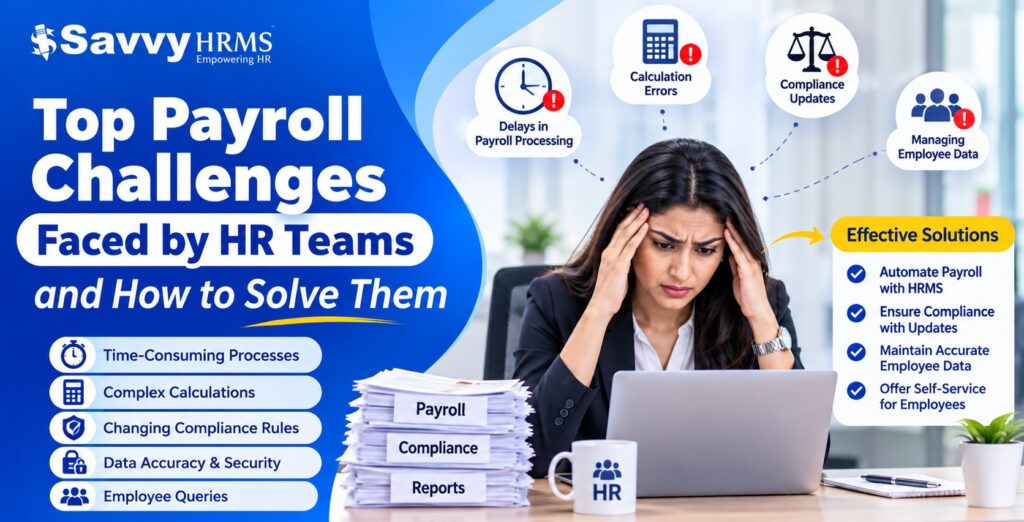
Top Payroll Challenges Faced by HR Teams and How to Solve Them


-
AuthorRaghvendra Bhardwaj
-
 Last Updated
November 11, 2026
-
 Reading Time
18 Mins
TL;DR
Payroll challenges are problems HR teams face while calculating salaries, managing deductions, maintaining compliance and processing employee payments. The most common payroll problems and their solutions include:
- Manual payroll processing: Automate salary calculations and repetitive tasks to reduce manual errors.
- Statutory compliance: Monitor applicable PF, ESI, Professional Tax and TDS requirements, along with regulatory updates and filing deadlines.
- Incorrect employee information: Keep employee details, bank information and salary records accurate and updated.
- Attendance and leave discrepancies: Integrate approved attendance, overtime and leave records with payroll.
- Complex salary structures: Standardise salary components, allowances, incentives and deductions.
- TDS calculation errors: Verify employee tax declarations and review taxable salary calculations.
- Delayed payroll approvals: Set clear payroll deadlines and establish structured approval workflows.
- Multi–location payroll: Configure location-specific policies and applicable state-level requirements.
- Payroll reconciliation issues: Match salary registers with bank transactions and accounting records.
Payroll processing involves more than calculating employee salaries and transferring payments. HR teams must manage attendance records, leave deductions, salary structures, tax calculations, statutory contributions and monthly approvals while ensuring employees are paid accurately and on time.
However, handling these activities manually or across disconnected systems can create several payroll challenges. Incorrect employee information, changing compliance requirements and delayed approvals can lead to calculation errors, additional administrative work and employee dissatisfaction.
Understanding the common payroll problems and their causes can help your business to improve accuracy and maintain consistent processes. This guide covers the major payroll challenges faced by HR teams, practical ways to solve them and how payroll management software can simplify the process.
What Are the Common Payroll Challenges Faced by HR Teams?
Payroll challenges are problems that HR and finance teams encounter while calculating salaries, managing deductions, processing payments and maintaining payroll compliance. They can arise from manual processes, inaccurate employee information, disconnected HR systems, changing regulations and delayed approvals.
These challenges can increase administrative work, create salary discrepancies, delay payroll activities and affect employee trust.
The following table highlights nine common payroll challenges faced by HR teams, their common causes and how they affect business operations.
| Payroll challenge | Common causes | Impact on businesses |
| Manual payroll processing | Spreadsheet dependency, repetitive calculations and disconnected systems | Calculation errors, increased workload and payroll delays |
| Statutory compliance and changing regulations | Regulatory changes, incorrect contribution calculations and missed filing deadlines | Compliance risks, penalties and additional administrative work |
| Incorrect or outdated employee information | Inaccurate bank details, outdated salary records and missing employee information | Incorrect salary calculations, failed payments and payroll corrections |
| Attendance and leave management discrepancies | Missing punches, incorrect leave records and inaccurate overtime data | Wrong salary deductions, overtime discrepancies and payment errors |
| Complex salary structures and deductions | Multiple salary components, variable pay, allowances and frequent salary revisions | Incorrect gross salary, net salary and deductions |
| TDS calculation and tax management errors | Incorrect tax declarations, outdated salary information and calculation errors | Tax discrepancies and incorrect deductions |
| Delayed payroll approvals and last-minute changes | Pending approvals, delayed payroll inputs and unclear responsibilities | Delayed salary processing and repeated corrections |
| Multi-location payroll management | State-specific statutory requirements and different location-based policies | Complex payroll administration and inconsistent calculations |
| Payroll reconciliation and reporting difficulties | Mismatched payroll registers, bank transactions and accounting records | Financial discrepancies and inaccurate payroll reports |
Major Payroll Challenges Faced by HR Teams and How to Solve Them
Payroll management involves more than calculating salaries and transferring money to employees’ bank accounts. HR teams must manage employee information, attendance records, statutory deductions, tax calculations, approvals and salary payments every month.
As organizations grow, these activities become more difficult to manage, especially when teams depend on spreadsheets or disconnected systems. Even a small mistake in employee data or salary calculations can lead to incorrect payments, compliance issues and employee dissatisfaction.
Let’s look at common payroll challenges faced by HR teams and how businesses can overcome them.
1. Manual Payroll Processing and Repetitive Calculations
Manual payroll processing is one of the most common payroll challenges, especially in organizations that still rely on spreadsheets and separate records.
Core HR teams often spend hours in collecting attendance data, calculating working days, checking deductions, processing reimbursements and preparing payslips. As the number of employees increases, managing these tasks manually becomes even more difficult.
Why does manual payroll processing happen?
- Employee information is stored in different spreadsheets.
- Salary calculations depend on manual formulas.
- The same employee details are entered repeatedly.
- Payroll inputs come from multiple departments.
- Attendance and payroll systems are not connected.
How does it affect businesses?
Manual calculations increase the chances of errors, duplicate entries and missed information. They also consume valuable time and can delay monthly payroll processing.
For example, if an employee receives a salary revision but HR forgets to update the spreadsheet, then the employee may receive an incorrect salary.
How can HR teams solve it?
HR teams can solve it by:
- Automate regular salary calculations and deductions.
- Maintain employee and salary information in one place.
- Connect attendance, leave and payroll records.
- Follow a standard payroll processing workflow.
- Review salary calculations before approving payments.
Using payroll automation helps reduce repetitive work and makes monthly salary processing faster and more consistent.
2. Managing Statutory Compliance and Changing Regulations
Keeping up with statutory requirements is another major payroll management challenge in India. Employers must calculate applicable contributions, deduct the correct amounts and complete the required filings within prescribed timelines.
Depending on employee eligibility and applicable laws, payroll may involve Provident Fund (PF), Employee State Insurance (ESI), Professional Tax, Tax Deducted at Source (TDS) and other statutory requirements.
Why is payroll compliance challenging?
Statutory requirements can vary depending on factors such as employee eligibility, salary components and the state in which an establishment operates. Regulatory changes also require HR and payroll teams to review their existing processes and update calculations when necessary.
How does it affect businesses?
- Incorrect statutory deductions and contribution calculations.
- Delays in statutory deposits or filings.
- Increased risk of non-compliance and penalties.
- Additional administrative work for HR and finance teams.
- Difficulty maintaining accurate compliance records.
How can HR teams solve it?
- Regularly check official notifications for regulatory updates.
- Maintain accurate employee, wage and eligibility records.
- Configure payroll according to applicable statutory requirements.
- Verify contribution calculations before filing.
- Maintain challans, returns and supporting documents.
- Conduct regular payroll compliance reviews.
For example, a business operating in Maharashtra and Karnataka should not apply the same Professional Tax rules across both locations. The payroll team must check the applicable state requirements before calculating deductions.
A well-organized compliance process helps businesses manage their statutory responsibilities and avoid preventable payroll errors.
3. Incorrect or Outdated Employee Information
Accurate payroll processing starts with accurate employee information. Even a small mistake in an employee’s bank details, salary records or personal information can create problems during salary processing.
Some common employee data errors include:
- Incorrect bank account numbers or IFSC codes.
- Outdated PAN or other required employee details.
- Incorrect joining dates or employment status.
- Salary revisions that have not been updated.
- Missing information required for payroll calculations.
- Incorrect employee classification or work location.
Why does this happen?
Employee information changes regularly as someone may change their bank account, receive a promotion, move to another location or have their salary revised.
If these changes are not communicated to HR or updated in the payroll records on time, the team may continue working with outdated information.
How does it affect businesses?
Incorrect employee details can lead to wrong salary calculations, failed bank transfers, incorrect deductions and repeated payroll corrections.
For example, an employee may update their bank account but forget to inform HR. If the payroll team uses the old details, the salary transfer may fail or get delayed.
How can HR teams solve it?
HR teams can solve it by:
- Maintain a centralized employee database.
- Verify employee information during onboarding.
- Create a clear process for updating personal and banking details.
- Allow employees to submit changes through an employee self-service system.
- Verify approved salary revisions and employment changes before payroll processing.
Regularly updating employee information helps HR teams avoid unnecessary corrections and maintain accurate payroll records.
4. Attendance and Leave Management Discrepancies
Attendance and leave records play an important role in salary calculations. Missing punches, incorrect working hours, unapproved leave and overtime discrepancies can directly affect the final salary payable to employees.
This becomes particularly challenging for businesses managing shift-based employees, remote teams, field staff and multiple office locations.
What are the common attendance and leave-related problems?
- Missing attendance punches.
- Proxy attendance or buddy punching.
- Incorrect late arrivals and early departures.
- Pending or unapproved leave requests.
- Incorrect leave balances.
- Missing overtime records.
- Incorrect shift and holiday information.
How do these problems affect payroll?
When attendance and leave records are inaccurate, HR teams may calculate payable working days incorrectly. This can result in incorrect salary deductions, overtime payments or leave adjustments.
For example, an employee’s leave may be approved by their manager but not updated in the attendance records. As a result, the payroll team may treat the approved absence as unpaid leave and deduct the amount from the employee’s salary.
How can HR teams solve it?
- Integrate attendance and leave management with payroll.
- Use reliable attendance tracking systems.
- Establish clear attendance correction and approval processes.
- Verify overtime and shift records before payroll processing.
- Match approved leave records with payroll inputs.
- Set clear deadlines for attendance regularization.
Connecting attendance, leave and payroll helps HR teams to work with approved information instead of collecting the same data from multiple sources.
5. Managing Complex Salary Structures and Deductions
Managing employee salaries is not always straightforward as different employees may have different compensation packages, allowances, incentives and benefits.
A salary structure may include basic salary, House Rent Allowance (HRA), special allowances, bonuses, incentives and other components. HR teams must also account for applicable deductions and adjustments.
What makes salary structures difficult to manage?
- Different salary structures across employee categories.
- Frequent salary revisions and promotions.
- Variable pay and performance-based incentives.
- Employee loans and salary advances.
- Reimbursements and other eligible adjustments.
- Incorrect treatment of salary components for tax and statutory purposes.
How does it affect payroll?
Incorrectly configured salary components can result in wrong gross salary, net salary, deductions and tax calculations.
For example, an employee receives a promotion with a revised compensation package, but the previous salary structure remains in the payroll records which can lead to an incorrect salary calculation.
How can HR teams solve it?
HR teams should:
- Create standard salary structures for different employee categories.
- Keep compensation records updated.
- Define clear rules for allowances and deductions.
- Update approved salary revisions before the payroll cut-off.
- Review incentives, variable pay and reimbursements separately.
- Automate calculations using verified salary components.
Maintaining well-defined salary structures makes it easier to manage employee compensation and reduces confusion during payroll processing.
6. TDS Calculation and Tax Management Errors
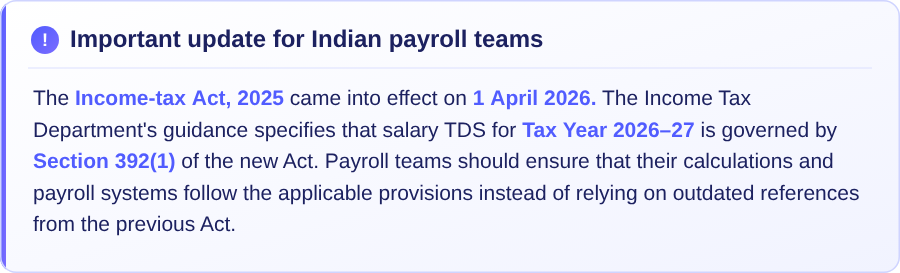
Calculating Tax Deducted at Source (TDS) on salary is another important responsibility for payroll teams. Employers must estimate employees’ taxable income, consider applicable tax provisions and deduct the required tax from their salaries.
However, even small mistakes in employee declarations or tax calculations can create problems.
What are the common TDS-related challenges?
- Incorrect employee investment declarations.
- Changes in an employee’s selected tax regime.
- Incorrect estimation of annual taxable salary.
- Missing or delayed supporting documents.
- Incorrect treatment of taxable allowances and perquisites.
- Failure to adjust excess or short deductions made earlier.
How does it affect businesses?
Incorrect TDS calculations can lead to tax discrepancies, employee complaints and additional corrections during the financial year.
For example, when an employee receives a salary increase or additional taxable income, the payroll team may need to revise the estimated annual taxable income and adjust the subsequent TDS deductions.
How can HR teams solve it?
HR teams should:
- Collect employee tax declarations at the appropriate time.
- Verify the required supporting documents.
- Keep salary and taxable income information updated.
- Review tax calculations whenever salary or employee declarations change.
- Reconcile TDS deductions throughout the financial year.
- Clearly communicate tax deductions to employees.
7. Delayed Payroll Approvals and Last-Minute Changes
Payroll processing involves several people and departments, including HR, finance, employees and reporting managers. When approvals or payroll inputs are delayed, the entire salary processing schedule can get affected.
What commonly causes payroll approval delays?
- Pending attendance regularization requests.
- Delayed leave approvals.
- Unapproved reimbursements.
- Last-minute salary revisions.
- Delayed incentive and overtime information.
- Unclear responsibilities between departments.
How do delayed approvals affect payroll?
When HR teams do not receive complete and approved information before the payroll deadline, they may have to delay calculations or make repeated corrections.
For example, if a manager approves an employee’s reimbursement after the payroll cut-off, HR may need to process it separately or include it in the next payroll cycle, depending on the company’s policy.
How can HR teams solve it?
HR teams should:
- Prepare a monthly payroll calendar.
- Set clear deadlines for submitting payroll inputs.
- Assign approval responsibilities to specific managers.
- Use automated approval workflows.
- Send reminders for pending requests.
- Maintain records of approved salary changes and adjustments.
A clearly defined payroll calendar helps everyone understand their responsibilities and reduces last-minute confusion.
8. Managing Payroll Across Multiple Locations
Managing payroll becomes more challenging when a business has employees working across different offices, branches or states.
Although salary processing can follow a centralized approach, statutory requirements, employee policies, holidays and working arrangements may differ by location.
What are the common multi-location payroll challenges?
- State-specific Professional Tax requirements.
- Different Labour Welfare Fund requirements.
- Location-based attendance and holiday policies.
- Different shift structures and allowances.
- Managing employee transfers between locations.
- Maintaining consistent payroll records across branches.
How does it affect businesses?
When payroll is managed through separate spreadsheets or disconnected systems then it becomes difficult to maintain consistency and track salary expenses across locations.
For example, a business with offices in Maharashtra and Karnataka must account for the applicable Professional Tax requirements in each state instead of applying one common deduction rule.
How can HR teams solve it?
HR teams should:
- Maintain location-wise employee records.
- Configure applicable state-specific payroll rules.
- Use a centralized payroll management system.
- Establish standard payroll policies across branches.
- Generate location-wise payroll reports.
- Update employee transfers and location changes before processing salaries.
A centralized payroll system with location-specific configurations helps businesses manage salaries more consistently across different branches.
9. Payroll Reconciliation and Reporting Difficulties
Payroll reconciliation means checking whether salary calculations, deductions, bank payments and accounting entries match. It helps HR and finance teams to identify discrepancies before closing the payroll cycle.
However, this process can become difficult when payroll information is maintained across different systems.
What are the common payroll reconciliation problems?
- Differences between payroll registers and bank payment files.
- Incorrect salary or deduction entries.
- Mismatched employee records.
- Missing reimbursement or incentive entries.
- Incorrect accounting entries.
- Incomplete payroll reports.
How does it affect businesses?
Unresolved payroll differences can affect financial reporting, employee salary records and the accuracy of payroll expenses. They can also make it difficult to identify why an employee received an incorrect payment.
For example, the payroll register may show that an employee’s salary has been processed, but the corresponding bank transaction may have failed. Without proper reconciliation, this difference may go unnoticed.
How can HR teams solve it?
- Compare payroll registers with bank payment records.
- Review gross salary, deductions and net salary calculations.
- Verify reimbursement, bonus and incentive entries.
- Match payroll information with accounting records.
- Investigate unusual differences before closing the payroll cycle.
- Maintain monthly reconciliation reports.
Regular reconciliation helps HR and finance teams to keep payroll records accurate and gives them better visibility into salary payments and expenses.
Best Practices to Avoid Common Payroll Problems
Businesses can avoid common payroll problems by maintaining accurate employee records, automating repetitive tasks, following a fixed payroll schedule and reviewing salary calculations regularly. HR and finance teams should also establish clear approval processes and monitor applicable statutory requirements.
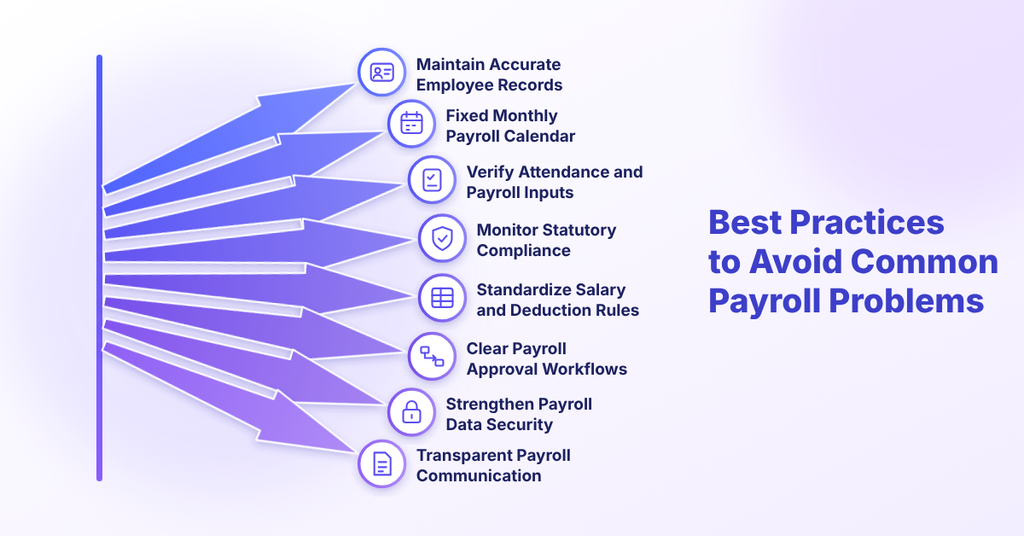
Let’s see some of the payroll best practices that can help improve accuracy, reduce processing delays and simplify payroll management.
1. Maintain Accurate and Updated Employee Records
Try to keep employee details, bank information, salary structures, tax declarations and employment records updated. Always verify changes such as promotions, transfers and salary revisions before the next payroll cycle to avoid incorrect calculations and payment failures.
2. Establish a Fixed Monthly Payroll Calendar
Create a payroll calendar with specific deadlines for attendance submissions, leave approvals, reimbursements, payroll review and salary disbursement. Communicate these deadlines to HR, finance and reporting managers to prevent delayed inputs and last-minute changes.
3. Verify Attendance and Payroll Inputs Before Processing
Review attendance records, approved leaves, overtime hours, incentives, salary revisions and deductions before calculating salaries. Resolve missing or incorrect information early to reduce payroll errors and avoid repeated corrections.
4. Monitor Statutory Compliance Requirements
Regularly review applicable updates related to EPF, ESI, Professional Tax, TDS and other statutory requirements. Maintain accurate employee eligibility and wage records, verify contribution calculations and complete required filings within the prescribed timelines.
5. Standardize Salary Structures and Deduction Rules
Define clear rules for basic salary, allowances, bonuses, incentives, reimbursements and deductions. Because updated compensation records for different employee categories to ensure consistent calculations and reduce discrepancies in gross and net salaries.
6. Introduce Clear Payroll Approval Workflows
Assign specific responsibilities to HR, finance teams and reporting managers for reviewing attendance, leave, reimbursements and salary changes. Use structured approval workflows to track pending requests and ensure payroll inputs are approved before the processing deadline.
7. Strengthen Payroll Data Security
Protect confidential employee information through role-based access controls, secure data storage and regular access reviews. Additionally, maintain audit trails for important payroll changes and restrict salary and banking information to authorized personnel.
8. Maintain Transparent Payroll Communication
Provide employees with clear, itemised payslips explaining salary components, deductions, tax amounts and net pay. Establish a process for handling payroll queries so employees can understand their earnings and get discrepancies resolved promptly.
Following these payroll best practices helps HR teams to improve salary accuracy, maintain compliance, reduce administrative work and build a more reliable payroll process.
How Savvy HRMS Supports Payroll Management
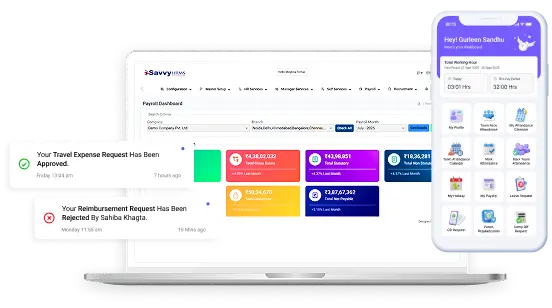
For businesses looking to reduce manual payroll work, Savvy HRMS offers payroll software that brings salary processing, verification, statutory calculations and payroll reporting into one system.
Its payroll capabilities include:
- Salary structure management: Configure multiple salary components and structures, assign them individually or in bulk, and set up formula-based or non-formula-based calculations.
- Salary processing and verification: Review payroll, export data for verification, and lock or hold monthly salaries based on approvals.
- Loans and advances: Manage employee loans, interest calculations, EMI deductions and loan statements.
- Variable pay management: Configure incentives, allowances, perquisites and reimbursements.
- Statutory compliance: Support calculations and reporting for applicable PF, ESI, Professional Tax and LWF requirements, along with TDS calculations and tax computation sheets.
- Payroll integrations: Easily connect with systems such as SAP, Oracle and Tally through available integrations.
- Payroll analytics: You can access salary registers, overtime registers and reports covering reimbursements, incentives and allowances.
By connecting payroll with attendance and other HR processes, Savvy HRMS can help businesses to manage payroll inputs more systematically. Businesses can explore Savvy HRMS Payroll Software to review its features or book a free demo to understand how it can fit their payroll requirements.
Conclusion
Overall, Payroll management involves several interconnected activities, from maintaining employee information and calculating salaries to managing statutory requirements and processing payments. Even small errors in these activities can affect salary accuracy, compliance and employee confidence.
Therefore, businesses should focus on maintaining accurate payroll records, establishing clear approval processes, monitoring applicable regulations and regularly reviewing payroll transactions. Integrating attendance, leave, employee management and payroll can also help reduce disconnected workflows.
With the right processes and HRMS support, HR teams can manage payroll more efficiently, minimise avoidable errors and ensure a more consistent salary-processing experience for employees.
Frequently Asked Questions About Payroll Challenges
1. What are the most common payroll challenges faced by HR teams?
Some common payroll challenges include manual salary calculations, statutory compliance, incorrect employee information, attendance discrepancies, complex salary structures, TDS errors, delayed approvals, failed salary payments and payroll data security. These issues can affect payroll accuracy, timely salary disbursement and employee satisfaction.
2. What are the main causes of payroll errors?
Payroll errors can occur due to incorrect employee information, outdated salary records, manual calculations, inaccurate attendance data, incorrect tax deductions and delayed approval of payroll inputs. Disconnected HR systems and insufficient payroll reviews can also increase the likelihood of errors.
3. How can businesses reduce payroll processing errors?
Businesses can reduce payroll errors by maintaining accurate employee records, automating salary calculations, integrating attendance and leave management, verifying deductions and establishing payroll approval workflows.
4. Why is payroll compliance challenging in India?
Payroll compliance can be challenging because businesses must manage applicable central and state-level requirements, employee eligibility conditions, contribution calculations and filing deadlines. Requirements may also vary based on employee wages, establishment type and location. Regular monitoring of official regulatory updates is therefore important.
5. How does HRMS software help overcome payroll challenges?
HRMS software helps streamline payroll by connecting employee records, attendance, leave and salary information. It can automate recurring calculations, support statutory compliance workflows, generate payslips, manage approvals and provide payroll reports. This reduces disconnected processes and helps HR teams manage payroll more efficiently.
6. What happens when payroll is processed incorrectly?
Incorrect payroll processing can result in underpayments, overpayments, incorrect deductions, failed salary transfers and tax discrepancies. It may also create additional administrative work, employee dissatisfaction and compliance risks. Businesses should investigate discrepancies and make appropriate corrections promptly.