

Payroll Automation: How It Works and Why Indian Businesses Need It


-
AuthorS.K. Gupta
-
 Last Updated
September 22, 2026
Last Updated
September 22, 2026
-
 Reading Time
16 Mins
Reading Time
16 Mins
Payroll is one of the most important functions in every organization because employees expect their salaries to be calculated accurately and paid on time. However, managing payroll manually can become complicated as employee numbers, salary structures, attendance records, deductions, taxes, and compliance requirements increase.
Payroll automation uses software to handle repetitive payroll activities with less manual intervention. From collecting employee and attendance data to calculating salaries, deductions, taxes, and generating payslips, an automated payroll system can make the entire payroll process faster and more consistent.
For Indian businesses, payroll automation is particularly useful because payroll involves several statutory and organization-specific requirements. This blog explains what payroll automation is, how it works, its benefits, compliance considerations, implementation process, best practices, and how businesses can choose the right payroll automation software.
What Is Payroll Automation in India?
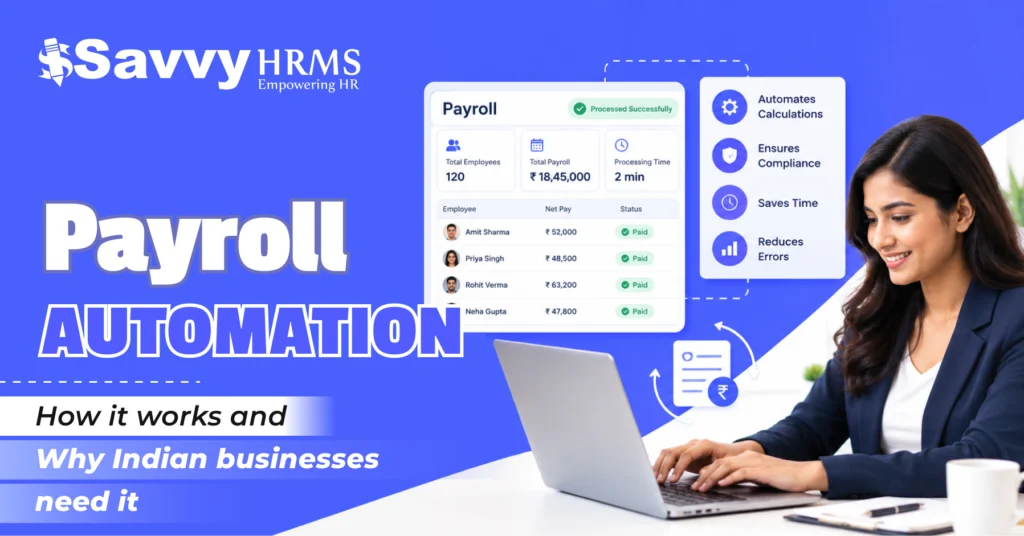
Payroll automation in India is the use of software to manage salary calculations, attendance inputs, deductions, taxes, payslips, and payroll reports with minimal manual effort. It replaces repetitive spreadsheet-based processes with automated calculations and workflows, helping HR teams process payroll faster and accurately.
An automated payroll system can connect employee information with attendance, leave, salary structures, statutory deductions, and tax calculations. For Indian businesses, payroll automation also helps manage applicable requirements such as PF, ESI, Professional Tax, and TDS through standardized and controlled payroll processes.
How Does Payroll Automation Work?
Think of payroll automation as a system that takes employee information and payroll inputs, processes them according to predefined rules, and produces the final salary with minimal manual calculation. Instead of HR teams collecting data from different spreadsheets, checking attendance, calculating deductions, and preparing payslips separately, the software brings these activities together in one simplified workflow.
The process usually starts with employee data and attendance information. The payroll system then considers salary structures, working days, leave, overtime, incentives, deductions, taxes, and applicable statutory contributions before calculating the final payable amount.
A general payroll automation flow looks like this:
Employee Data → Attendance & Leave → Payroll Inputs → Salary Calculation → Deductions & Taxes → Compliance Checks → Payroll Review → Approval → Payslip Generation → Salary Processing
Here is what happens at each stage:
- Employee data: Employee salary structure, bank details, joining date, and statutory information are maintained in the system.
- Attendance & leave: Attendance, approved leave, overtime, and loss of pay information are captured automatically or through integration.
- Salary calculation: The system calculates earnings such as basic salary, allowances, incentives, bonuses, and overtime.
- Deductions & taxes: Applicable deductions, PF, ESI, Professional Tax, TDS, loans, advances, and other deductions are calculated based on configured rules.
- Payroll review: HR and payroll teams review calculations, identify exceptions, and make approved corrections where required.
- Approval & processing: Once payroll is approved, payslips and reports are generated, and the salary processing workflow can be completed.
The biggest advantage is that payroll automation connects these steps instead of treating them as separate tasks. For example, when attendance and leave data are integrated with payroll, the system can automatically consider payable days and loss of pay while calculating an employee’s salary. This reduces repetitive data entry and makes the payroll process more consistent.
Why Is Payroll Automation Important for Indian Businesses?
Payroll involves much more than simply calculating monthly salaries. HR teams also manage attendance, leave, deductions, taxes, reimbursements, and statutory requirements. As businesses grow, handling these activities manually can become time-consuming and increase the chances of payroll errors.
Payroll automation helps Indian businesses simplify these repetitive activities through software-driven calculations and workflows. It provides a more organized way to manage payroll while helping HR teams save time, improve accuracy, and handle increasing payroll complexity.
Why is payroll automation important?
- Reduces manual work
- Improves payroll accuracy
- Saves processing time
- Supports statutory compliance
- Handles growing employee numbers
- Simplifies payroll reporting
- Improves employee experience
With the right payroll automation system, businesses can create a smoother and more consistent payroll process. HR teams can spend less time on repetitive calculations and more time focusing on payroll review, employee support, and strategic HR activities.
What Are the Benefits of Payroll Automation?
Payroll automation offers benefits across HR teams, payroll administrators, finance departments, business leaders, and employees. The most important benefits include:
1. Reduces Payroll Errors
Payroll automation reduces errors caused by manual calculations, incorrect formulas, and duplicate data entry. Automated rules help calculate salaries, deductions, taxes, and other payroll components more consistently.
2. Saves Time and Effort
Automated payroll software handles repetitive calculations and administrative tasks quickly. This allows HR and payroll teams to spend less time processing salaries and more time on important employee-related activities.
3. Improves Payroll Accuracy
By using predefined salary structures and payroll rules, automation helps maintain consistent calculations across employees. It can improve accuracy while reducing the dependency on manually maintained spreadsheets and formulas.
4. Supports Payroll Compliance
Payroll automation can help businesses manage applicable PF, ESI, Professional Tax, TDS, and other statutory calculations. Updated software configurations can also make compliance-related payroll processes more organized and manageable.
5. Simplifies Payslip Generation
Automated systems can generate employee payslips after payroll processing, showing earnings, deductions, taxes, and net salary. Employees can often access these documents directly through an employee self-service portal.
6. Scales With Business Growth
As employee numbers increase, payroll becomes more complex. Payroll automation helps businesses process larger volumes of employee data without increasing manual payroll work at the same rate.
7. Improves Employee Experience
Accurate salary processing, timely payslips, transparent deductions, and easy access to payroll information create a smoother employee experience while reducing routine payroll queries directed toward HR teams.
What Payroll Tasks Can Be Automated?
Modern payroll automation software can automate many repetitive activities across the payroll cycle. The exact features vary by software, but common payroll automation tasks include:
- Employee payroll data management
- Salary structure management
- Attendance data integration
- Leave and holiday calculations
- Working-day calculations
- Loss of Pay calculations
- Overtime calculations
- Allowance calculations
- Incentive and bonus calculations
- Loan and salary advance deductions
- Provident Fund calculations
- ESI calculations
- Professional Tax calculations
- TDS calculations
- Other applicable deductions
- Net salary calculations
- Payslip generation
- Payroll reports
- Statutory reports
- Payroll approval workflows
- Full and final settlement calculations
- Payroll data exports
- Employee payroll self-service
The biggest advantage is that these activities can work together instead of being handled as isolated tasks.
For example, if an employee’s approved leave affects payable days, the attendance and leave data can flow into payroll. The payroll system can then calculate the applicable salary adjustment without requiring the HR team to manually update multiple spreadsheets.
Similarly, when employee salary information changes, the payroll system can use the updated salary structure during the applicable payroll cycle, subject to organizational approval and configuration.
How Does Automated Payroll Processing Work Step by Step?
A general automated payroll processing workflow can be divided into the following steps:
Step 1: Maintain Employee Information
The process starts with accurate employee master data. This can include employee details, salary structure, department, designation, joining date, bank information, tax information, and applicable statutory details.
Step 2: Collect Attendance and Leave Data
The payroll system collects relevant attendance, leave, shift, overtime, and working-day information. Integration with attendance management systems can reduce duplicate data entry.
Step 3: Validate Payroll Inputs
Before salary calculation, HR or payroll administrators should review important changes such as new joiners, resignations, promotions, salary revisions, unpaid leave, overtime, bonuses, and deductions.
Step 4: Calculate Earnings
The system calculates applicable salary components based on the employee’s configured salary structure. These may include basic salary, HRA, allowances, incentives, overtime, bonuses, and other earnings.
Step 5: Calculate Deductions
Applicable deductions are then calculated. These may include employee contributions, tax deductions, loans, advances, loss of pay, and other authorized deductions.
Step 6: Calculate Statutory Components
The payroll system applies configured statutory rules and calculations relevant to the organization and employee. This may include PF, ESI, Professional Tax, and TDS, depending on applicability.
Step 7: Calculate Net Salary
After adding applicable earnings and subtracting deductions, the system calculates the employee’s net salary.
A simplified formula is:
Net Salary = Gross Earnings − Employee Deductions − Applicable Taxes − Other Authorized Deductions
Step 8: Review and Approve Payroll
Payroll administrators review the payroll results, identify unusual changes, check exceptions, and obtain required approvals before finalization.
Step 9: Generate Payslips and Reports
Once payroll is approved, the system can generate payslips and payroll reports. Employees can receive or access their payslips through the employee portal if available.
Step 10: Complete Payroll Records and Compliance Activities
The final stage involves completing applicable salary payments, accounting entries, statutory records, filings, and payroll documentation according to organizational processes and legal requirements.
This step-by-step workflow demonstrates why payroll automation is more than simply calculating salaries. It connects multiple payroll activities into one controlled process.
How Does Payroll Automation Help With Compliance in India?
Payroll automation can support Indian payroll compliance by applying configured statutory rules, maintaining payroll records, generating reports, and creating a consistent process for payroll-related calculations. However, businesses should not assume that software alone guarantees compliance.
Payroll compliance in India can involve several areas depending on the organization, employee category, location, and applicable laws. Common payroll-related areas include Provident Fund, Employees’ State Insurance, Professional Tax, TDS, gratuity, wages, and other applicable statutory requirements.
1. Provident Fund
Eligible establishments and employees may be covered under the Employees’ Provident Funds and Miscellaneous Provisions Act, 1952. Payroll software can help calculate applicable employee and employer contributions based on configured rules and generate relevant reports.
2. Employees’ State Insurance
ESI is another important payroll consideration for covered establishments and eligible employees. ESIC documentation describes the ESI scheme as a social insurance system covering areas such as sickness, maternity, disablement, and employment injury.
The applicable ESI contribution rates have also changed historically, so businesses should ensure that payroll software is maintained with current rules rather than depending on outdated configurations. ESIC material records the current contribution structure as 3.25% employer contribution and 0.75% employee contribution following the 2019 rate change.
3. Professional Tax
Professional Tax is a state-level tax applicable in certain states and subject to the relevant state’s rules. Payroll automation can help apply configured Professional Tax rules based on employee location and applicable salary slabs.
4. TDS on Salary
Salary TDS is an important part of payroll processing. Employers need accurate employee income information, eligible declarations, deductions, exemptions, and applicable tax calculations.
For the 2026 transition, the Income Tax Department states that salary paid up to March 2026 follows the applicable provisions of the earlier law, while salary paid from April 2026 onward is governed by the relevant salary TDS provisions under the Income Tax Act, 2025.
The Income Tax Department also identifies Form 16 as the certificate containing salary, deductions or exemptions, and TDS details for employees.
5. Compliance Reporting
Payroll automation can help organize payroll reports and records needed for statutory processes. For example, the Income Tax Department states that employers deducting salary TDS are required to file the applicable quarterly salary TDS statement, now referred to as Form 138 under the new framework.
Because Indian payroll regulations can change, businesses should regularly update payroll configurations and verify statutory rules with official government notifications or qualified compliance professionals.
Manual Payroll vs Automated Payroll: What Is the Difference?
Manual payroll and automated payroll differ mainly in how payroll data is collected, calculated, reviewed, and processed.
| Factor | Manual Payroll | Automated Payroll |
| Data entry | Mostly manual | Reduced through integrations |
| Salary calculations | Spreadsheet/manual formulas | System-driven calculations |
| Attendance inputs | Often entered separately | Can integrate with attendance systems |
| Leave calculations | Manual verification | Can be automated |
| Deductions | Manually calculated or spreadsheet-based | Rule-based calculations |
| Payslips | Manually prepared or uploaded | Automatically generated |
| Compliance calculations | Requires regular manual effort | Can use configured statutory rules |
| Reporting | Manual report preparation | Automated reports |
| Error risk | Higher with repetitive work | Lower when data and rules are correctly configured |
| Scalability | Difficult as workforce grows | More scalable |
| Employee access | Often dependent on HR | Can provide employee self-service |
| Processing time | Generally higher | Generally faster |
Manual payroll may appear simple initially, but it can become difficult to manage as employee numbers and payroll complexity increase.
Automated payroll, on the other hand, creates a more structured process by connecting employee data, attendance, salary calculations, deductions, compliance, approvals, and reporting.
How to Implement Payroll Automation in Your Organization?
Successful payroll automation requires more than purchasing payroll software. Organizations should first understand their existing payroll process, identify repetitive activities, clean their data, configure payroll rules, test calculations, and establish appropriate approval controls.
1. Evaluate Your Current Payroll Process
Start by understanding how your payroll is currently managed. Identify manual tasks, spreadsheets, calculation methods, approval processes, attendance inputs, and compliance activities that consume the most HR and payroll team time.
2. Identify Tasks That Can Be Automated
Focus first on repetitive payroll activities that can be handled through software.
- Salary calculations
- Attendance and leave inputs
- Overtime and loss of pay
- Tax and statutory deductions
- Payslip generation
- Payroll reports
3. Clean and Organize Employee Data
Before implementing payroll automation, make sure employee information is accurate and complete. Review salary structures, bank details, attendance records, tax information, statutory details, joining dates, and other payroll-related data.
4. Choose the Right Payroll Software
Select payroll automation software based on your organization’s employee strength, salary structures, compliance requirements, integrations, reporting needs, security, scalability, and employee self-service capabilities. The system should fit your current and future payroll requirements.
5. Test and Validate the Payroll System
Run test payrolls before completely switching to automation. Compare automated calculations with previous payroll results and carefully check salary, deductions, taxes, statutory contributions, net pay, and payslips to identify discrepancies.
6. Train Teams and Monitor Payroll
Once the system is implemented, train HR and payroll teams on daily operations, approvals, corrections, reports, and compliance settings. Regularly monitor payroll results and update configurations whenever business policies or statutory requirements change.
What Are the Best Practices for Payroll Automation in India?
Payroll automation can make salary processing faster and more organized, but the results depend on how well the system is configured and managed. Following the right practices helps businesses maintain accuracy, compliance, security, and consistency throughout every payroll cycle.
Key payroll automation best practices
- Keep employee data accurate: Regularly update salary structures, bank details, attendance, leave, tax information, and statutory records.
- Keep compliance rules updated: Regularly review applicable PF, ESI, Professional Tax, TDS, and other payroll-related requirements.
- Integrate HR systems: Connect payroll with attendance, leave, employee management, and other HRMS modules to reduce duplicate data entry.
- Set clear payroll cut-off dates: Define deadlines for attendance, leave, salary revisions, new joiners, exits, incentives, and other payroll inputs.
- Use approval workflows: Establish proper review and approval processes before finalizing monthly payroll.
- Apply role-based access: Give employees access only to the payroll information and functions relevant to their responsibilities.
- Perform payroll validation: Check unusual salary changes, deductions, missing information, new employees, and exit cases before processing.
- Protect payroll data: Use appropriate access controls, authentication, backups, audit trails, and other security measures to protect sensitive employee information.
Finally, payroll automation should be treated as an ongoing process rather than a one-time implementation. Regular audits, system reviews, employee feedback, and timely configuration updates can help businesses maintain a reliable and efficient payroll process.
How to Choose the Right Payroll Automation Software?
Choosing the right payroll automation software requires looking beyond basic salary calculation. Businesses should evaluate whether the platform can handle their workforce size, salary structures, locations, compliance requirements, integrations, reporting needs, and employee experience.
1. Payroll Calculation & Compliance
Choose software that can handle different salary structures, allowances, deductions, incentives, bonuses, overtime, arrears, reimbursements, loans, advances, full and final settlements, and applicable Indian payroll compliance requirements.
2. HRMS, Attendance & Leave Integration
Look for payroll software that integrates with employee management, attendance, leave, recruitment, onboarding, and other HRMS modules. This reduces duplicate data entry and ensures payroll calculations use accurate employee information.
3. Employee Self-Service
An employee self-service portal allows employees to access payslips, tax documents, payroll information, and other HR services independently, reducing routine payroll queries and improving the overall employee experience.
4. Reporting & Payroll Analytics
Evaluate the availability of payroll reports for HR, finance, management, and compliance purposes. Detailed reports and analytics can help businesses understand payroll costs, identify discrepancies, and support better workforce decisions.
5. Security & Access Controls
Payroll contains sensitive employee and salary information, so security is essential. Look for role-based access, authentication, audit trails, secure backups, and appropriate controls to prevent unauthorized access or changes.
6. Scalability & Ease of Implementation
Choose software that can support increasing employee numbers, multiple departments, locations, and salary structures. Also consider data migration, configuration, implementation support, integrations, training, and ongoing customer assistance.
7. Pricing & Total Cost of Ownership
Consider more than the software subscription price. Evaluate implementation, integrations, customization, training, support, maintenance, and future scalability to understand the software’s overall cost and long-term value.
Conclusion
Payroll automation helps Indian businesses replace repetitive payroll work with a more structured, accurate, and scalable process. By connecting employee data, attendance, leave, salary calculations, deductions, compliance, payslips, approvals, and reporting, automation can simplify payroll management.
The right payroll automation software can also help HR teams spend less time on manual calculations and more time on employee support and strategic work. Businesses should focus on accurate data, updated compliance rules, strong security, proper testing, and regular payroll reviews to achieve the best results from automation.

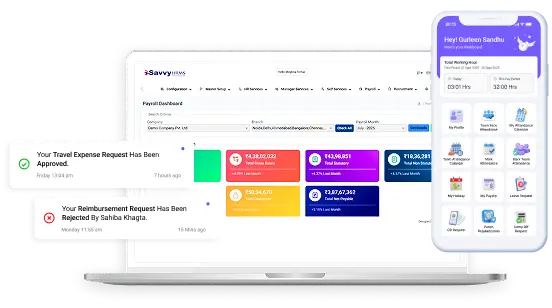









Looking for a smarter way to manage payroll?
Explore Savvy HRMS for simplified payroll automation.
Frequently Asked Questions (FAQs)
1. Is There a Way to Automate Payroll?
Yes, businesses can automate payroll using payroll software or an HRMS platform. These systems can automate salary calculations, deductions, taxes, attendance inputs, payslip generation, payroll reports, and other repetitive payroll activities.
2. What Does Payroll Automation Mean?
Payroll automation means using software to automatically manage repetitive payroll activities such as salary calculations, attendance inputs, deductions, taxes, compliance-related calculations, payslips, and payroll reporting with minimal manual intervention.
3. How Does Payroll Automation Work?
Payroll automation collects employee, attendance, leave, and salary information and applies predefined payroll rules to calculate earnings, deductions, taxes, and net salary. After review and approval, the system can generate payslips and payroll reports.
4. What Are the Benefits of Payroll Automation?
Payroll automation can reduce manual work, reduce calculation errors, save processing time, simplify payroll reporting, support compliance, improve data accuracy, and provide employees with faster access to payslips and payroll information.
5. Can Payroll Automation Help With Compliance in India?
Yes, payroll automation can help businesses manage applicable payroll requirements such as PF, ESI, Professional Tax, and TDS. However, businesses should ensure that their payroll software uses current statutory rules and configurations.
6. How Do I Choose the Right Payroll Automation Software?
Consider payroll calculation capabilities, Indian compliance support, HRMS integration, attendance and leave integration, employee self-service, reporting, security, scalability, implementation support, and the software’s overall cost before making a decision.