10 Common Performance Appraisal Problems and How HR Can Solve Them


-
AuthorS.K. Gupta
-
 Last Updated
November 11, 2026
-
 Reading Time
20 Mins
TL;DR
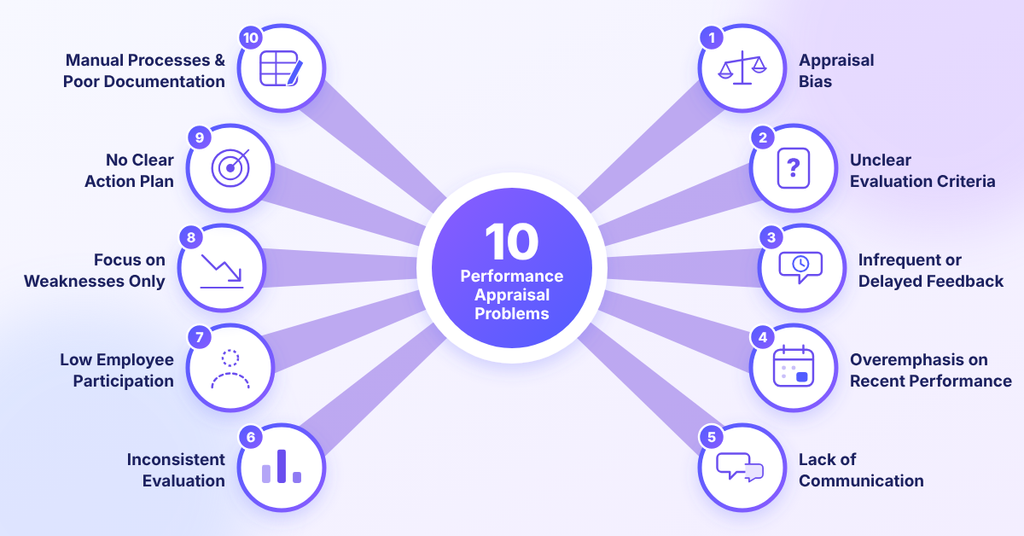
Performance appraisal problems can affect the fairness and effectiveness of employee evaluations. Here are 10 common challenges and how HR teams can address them:
- Appraisal bias: Personal opinions can influence employee ratings. Use objective evaluation criteria and involve multiple reviewers where needed.
- Unclear evaluation criteria: Vague expectations can confuse employees. Set clear, measurable and role-specific goals.
- Delayed feedback: Infrequent feedback can slow employee improvement. Schedule regular performance discussions.
- Recency bias: Recent achievements or mistakes can overshadow overall performance. Maintain performance records throughout the appraisal cycle.
- Poor communication: One-way discussions can lead to misunderstandings. Encourage open, two-way feedback between managers and employees.
- Inconsistent evaluations: Different evaluation standards can result in unfair ratings. Follow common guidelines across departments.
- Low employee participation: Employees may feel left out of the process. Include self-assessments and collaborative goal-setting.
- Focus on weaknesses: Ignoring employee achievements can affect motivation. Balance constructive feedback with recognition.
- No action plan: Feedback without clear next steps may not lead to improvement. Create individual development plans with measurable goals.
- Manual processes: Spreadsheets and paperwork can make appraisals difficult to manage. Use a digital Performance Management System to organize evaluations and track progress.
Performance appraisals help organizations to evaluate employee contributions, identify skill gaps and make better decisions about training, promotions and career development. However, when the appraisal process is unclear, inconsistent or biased, it can create frustration among employees and make performance evaluations less effective.
Many HR teams face challenges such as appraisal bias, unclear performance criteria, delayed feedback, inconsistent ratings and poor documentation. These problems can affect employee motivation, trust and overall workplace performance. Therefore, it is important to identify these challenges and take practical steps to address them.
In this blog, we will explore 10 common performance appraisal problems, explain why they occur and discuss how HR teams can overcome them to create a fairer and more effective evaluation process.
Quick Overview of 10 Common Performance Appraisal Problems
Before looking at each problem in detail, here is a quick overview of the 10 common performance appraisal problems and how HR can address them.
This summary will help you understand the key challenges and their possible solutions at a glance.
| No. | Performance Appraisal Problem | How HR Can Solve It |
| 1 | Appraisal Bias and Personal Preferences | Use objective evaluation criteria, manager training and multiple reviewers. |
| 2 | Unclear Performance Evaluation Criteria | Define role-specific KPIs and measurable performance goals. |
| 3 | Infrequent or Delayed Performance Feedback | Introduce regular feedback sessions and quarterly check-ins. |
| 4 | Overemphasis on Recent Performance | Maintain performance records throughout the appraisal cycle. |
| 5 | Lack of Communication Between Managers and Employees | Encourage two-way feedback and regular performance discussions. |
| 6 | Inconsistent Evaluation Across Departments | Use standardized rating scales and appraisal calibration meetings. |
| 7 | Lack of Employee Participation | Introduce self-assessments and collaborative goal-setting. |
| 8 | Focusing Only on Weaknesses Instead of Achievements | Recognize employee contributions alongside improvement areas. |
| 9 | No Clear Action Plan After Performance Reviews | Create individual development plans and track improvement goals. |
| 10 | Manual Appraisal Processes and Poor Documentation | Adopt a digital Performance Management System to streamline appraisals. |
What Are Performance Appraisal Problems?
Performance appraisal problems refer to the challenges and limitations organizations face when assessing employee performance. These problems can arise from unclear expectations, subjective judgments, inadequate communication, inconsistent evaluation methods or poorly managed appraisal processes.
For example, a manager may evaluate an employee based on their recent achievements instead of considering their performance throughout the year. Similarly, two employees performing similar roles may receive different ratings because their managers follow different evaluation standards.
Such issues can make an Employee Performance Evaluation less reliable and create doubts about whether appraisal decisions are based on actual contributions.
Performance appraisal problems generally affect three important areas:
- Employees: They may feel undervalued, misunderstood or unfairly assessed, which can affect their motivation and engagement.
- Managers: They may struggle to provide objective feedback or evaluate employees without sufficient performance records.
- HR teams: They may find it difficult to maintain consistency, resolve appraisal disputes and ensure that evaluation policies are followed across departments.
Therefore, identifying these challenges is important for building an appraisal process that supports both employee development and organizational goals.
What Are the 10 Common Performance Appraisal Problems and How Can HR Solve Them?
Performance appraisals help organizations understand how employees are performing and where they need support. However, the process can become ineffective when evaluations are influenced by personal opinions, unclear expectations or poor communication.
Let’s look at 10 common performance appraisal problems and how HR teams can address them.
1. Appraisal Bias and Personal Preferences
Appraisal bias is one of the most common challenges in employee performance evaluations. It occurs when managers allow personal opinions, relationships or preferences to influence how they rate employees.
For example, a manager may give a higher rating to an employee they work closely with, even when another team member has achieved similar or better results. Similarly, one recent mistake may affect an employee’s overall rating, despite their consistent performance throughout the year.
Some common types of appraisal bias include:
- Halo effect: A manager allows one positive quality or achievement to influence their overall assessment of an employee.
- Horn effect: A single mistake or negative incident affects the manager’s entire evaluation.
- Recency bias: Managers give more importance to recent achievements or mistakes than to performance throughout the review period.
- Leniency bias: A manager gives employees higher ratings than their actual performance justifies.
- Strictness bias: A manager consistently gives lower ratings, even when employees meet or exceed expectations.
- Similarity bias: A manager favors employees who share similar interests, backgrounds or working styles.
These biases can lead to unfair ratings and make employees feel performance evaluations reflect favoritism rather than actual contributions.
How HR Can Solve It
The core HR team must establish clear evaluation standards and train managers to recognize common appraisal biases. Some practical steps include:
- Use measurable KPIs and role-specific performance indicators to support evaluation decisions.
- Involve multiple reviewers when individual assessments may be subjective.
- Train managers to recognize personal biases and avoid letting them influence ratings.
- Conduct appraisal calibration meetings to maintain consistency across teams.
- Maintain records of employee achievements, feedback and performance gaps throughout the review period.
For example, instead of relying on whether a manager considers an employee a good performer, HR can encourage evaluations based on project completion, work quality, productivity and achievement of assigned goals.
2. Unclear Performance Evaluation Criteria
Employees need to know what their organization expects from them and how their performance will be measured. However, some organizations begin appraisal cycles without clearly defining performance expectations, measurable targets or evaluation standards.
When these criteria are unclear, managers may assess employees differently, even when they perform similar roles.
For instance, one manager may consider an employee successful because they complete assigned tasks on time, while another may expect additional contributions such as teamwork, problem-solving and initiative. Without clearly defined expectations, employees may struggle to understand what is required to receive a good performance rating.
This can lead to confusion, inconsistent evaluations and disagreements during appraisal discussions.
How HR Can Solve It
HR should establish clear and measurable performance criteria based on individual job responsibilities and organizational goals.
Some effective practices include:
- Define KPIs according to employees’ roles and responsibilities.
- Set SMART goals (Specific, Measurable, Achievable, Relevant and Time-bound).
- Communicate evaluation standards to employees and managers before the appraisal cycle.
- Explain how performance will be measured and how ratings will be assigned.
- Review goals periodically and update them when job responsibilities change.
For example, a sales employee may be evaluated based on revenue generated, customer acquisition and conversion rates. A customer support employee, on the other hand, may be assessed based on response time, issue resolution and customer satisfaction.
This ensures that employees are evaluated against expectations relevant to their actual responsibilities.
3. Infrequent or Delayed Performance Feedback
Providing feedback only once a year can make performance appraisals less effective. When managers wait until the annual review to discuss performance issues, employees may miss valuable opportunities to understand their mistakes and improve their work.
Delayed feedback can also make it difficult for employees to recall specific situations and understand what needs to change.
For example, if an employee repeatedly misses project deadlines in March but receives feedback only during the annual appraisal in December, several opportunities to address the issue may have already passed.
Similarly, employees who perform well may not receive timely recognition for their contributions.
How HR Can Solve It
HR should encourage managers to provide regular feedback instead of relying entirely on annual performance reviews.
Here are some ways to improve the process:
- Schedule regular one-on-one meetings between managers and employees.
- Conduct monthly or quarterly performance check-ins.
- Share feedback soon after important achievements or performance issues.
- Discuss employee progress against previously established goals.
- Document feedback and agreed improvement actions for future reference.
For instance, managers can conduct monthly discussions to review employee progress, understand challenges and suggest improvements. This allows employees to address issues before their next formal appraisal.
Regular feedback makes performance management an ongoing process rather than a once-a-year activity.
4. Overemphasis on Recent Performance
Sometimes, managers focus more on an employee’s recent achievements or mistakes than on their overall performance during the appraisal period. This is another common challenge that can affect the accuracy of performance evaluations.
This problem is closely related to recency bias.
For example, an employee may have consistently achieved their targets for the first nine months of the year but missed a target during the final quarter because of unexpected business challenges. If the manager focuses mainly on this recent shortfall, the employee may receive a lower rating than their overall performance deserves.
Similarly, an employee who performs exceptionally well just before the appraisal may receive a higher rating despite inconsistent performance throughout the year.
How HR Can Solve It
HR should encourage managers to consider employee performance across the entire appraisal period rather than focusing only on recent events.
They can take the following steps:
- Maintain monthly or quarterly performance records.
- Review progress against goals at regular intervals.
- Document employee achievements and performance gaps as they occur.
- Consider project outcomes, individual contributions and changing work conditions.
- Use performance information from different stages of the appraisal cycle.
For example, managers can maintain a quarterly performance summary for every employee. During the annual appraisal, they can review all four quarters instead of relying only on their most recent observations.
This provides a more balanced view of employee contributions and helps reduce the influence of recency bias.
5. Lack of Communication Between Managers and Employees
Effective communication is essential for a meaningful performance appraisal. However, some organizations treat appraisals as one-way discussions where managers share ratings and decisions without giving employees an opportunity to explain their achievements, challenges or concerns.
This can create misunderstandings and leave employees feeling that their opinions are not valued.
For example, a manager may give an employee a low rating for missing a project deadline without knowing that the delay was caused by resource shortages or dependencies on another department.
When employees cannot share their perspectives, they may disagree with appraisal outcomes and lose confidence in the evaluation process.
How HR Can Solve It
HR must encourage open communication between managers and employees throughout the appraisal cycle.
The following practices can help:
- Make appraisal discussions two-way rather than limiting them to manager feedback.
- Encourage employees to share their achievements, challenges and suggestions.
- Introduce self-assessment forms before formal performance reviews.
- Train managers to listen actively and provide clear, constructive feedback.
- Establish a process through which employees can raise concerns or request a review of their ratings.
For instance, before finalizing an appraisal, managers can ask employees to discuss their key accomplishments, challenges faced during the year and the support they need to improve.
This helps managers to understand the employee’s perspective and makes performance discussions more transparent.
6. Inconsistent Evaluation Across Departments
In large organizations, different departments may follow different appraisal methods and rating standards. As a result, employees performing similar roles may receive different ratings depending on which manager evaluates them.
For example, a manager in the sales department may consider achieving 80% of a target satisfactory, while another manager may give a similar level of performance a poor rating. Without common evaluation guidelines, employees may question the fairness of the appraisal process.
Inconsistent evaluations can also make it difficult for HR to compare performance across departments and make informed decisions about promotions, compensation and employee development.
How HR Can Solve It
HR should introduce a standardized appraisal framework that provides consistent evaluation guidelines across the organization while accounting for differences in job responsibilities.
Some useful measures include:
- Develop common rating scales and clear evaluation guidelines.
- Establish role-specific performance criteria using consistent assessment principles.
- Conduct appraisal calibration meetings with managers from different departments.
- Review rating patterns to identify unusually high or low evaluations.
- Ensure managers understand how performance ratings should be assigned.
For example, HR can introduce a five-point rating scale with clearly defined descriptions for each rating. Managers can then apply the same rating principles while evaluating employees against their respective job responsibilities.
This helps maintain consistency across departments without treating different roles as identical.
7. Lack of Employee Participation in the Appraisal Process
Performance appraisals should not be limited to managers evaluating employees. Employees should also have an opportunity to discuss their achievements, challenges and development goals.
However, some organizations follow a top-down approach in which managers make evaluation decisions without actively involving employees.
As a result, employees may feel disconnected from the process and struggle to understand why they received a particular rating.
For example, an employee may have taken on additional responsibilities and completed several important tasks during the appraisal period. However, these contributions may go unnoticed if the employee does not get an opportunity to discuss them.
How HR Can Solve It
HR should make the appraisal process more collaborative by encouraging employees to participate in their evaluations.
Some practical approaches include:
- Introduce employee self-assessment forms before manager reviews.
- Allow employees to document their achievements and completed goals.
- Encourage employees to identify their strengths and areas for improvement.
- Involve employees in setting future performance goals.
- Allow employees to discuss feedback and raise concerns.
For instance, employees can complete a self-assessment highlighting their major accomplishments, challenges and learning experiences before their formal appraisal meeting.
Managers can then review these inputs alongside their own observations and discuss any differences. This gives employees a greater sense of involvement and makes performance evaluations more meaningful.
8. Focusing Only on Weaknesses Instead of Achievements
Performance appraisals help identify areas where employees need to improve. However, focusing only on mistakes and weaknesses can make the evaluation process discouraging.
When managers overlook employee achievements, employees may feel that their hard work and contributions are not being recognized.
For example, an employee may have completed several important projects, supported new team members and consistently met deadlines. However, if the appraisal discussion focuses only on one missed target, the employee may feel undervalued.
An effective appraisal should recognize employee strengths while also addressing areas that need improvement.
How HR Can Solve It
HR should encourage managers to maintain a balanced approach when evaluating employee performance.
Some useful practices include:
- Recognize individual achievements and contributions during appraisal discussions.
- Provide constructive feedback on areas that need improvement.
- Identify employee strengths and opportunities to use them more effectively.
- Recommend training and development programs based on identified skill gaps.
- Connect employee achievements with recognition and career development opportunities.
For example, if an employee demonstrates strong problem-solving skills but needs to improve communication, the manager can acknowledge their ability to resolve complex issues while recommending relevant communication training.
This makes feedback more constructive and helps employees understand how they can develop their skills.
9. No Clear Action Plan After Performance Reviews
A performance appraisal must not end with assigning ratings or discussing past performance. It should also help employees understand what they need to do next.
However, some organizations fail to create clear action plans after appraisal discussions. Employees may receive feedback about their weaknesses without getting specific guidance, training or measurable goals to help them improve.
For example, a manager may ask an employee to improve their communication skills but fail to suggest relevant training, practical activities or a timeline for reviewing progress.
Without follow-up actions, performance reviews can become routine administrative exercises rather than meaningful opportunities for employee development.
How HR Can Solve It
HR must ensure that appraisal discussions lead to specific and achievable improvement actions wherever necessary.
Some effective steps include:
- Prepare individual development plans based on appraisal outcomes.
- Set clear improvement goals with measurable timelines.
- Recommend relevant training, mentoring or coaching programs.
- Schedule follow-up meetings to review employee progress.
- Track improvements against previously agreed goals.
For instance, if an employee needs to improve presentation skills, the manager can recommend a relevant training program, provide opportunities to lead team presentations and review progress after three months.
This connects performance evaluations with continuous learning and employee development plans.
10. Manual Appraisal Processes and Poor Documentation
Many organizations still rely on spreadsheets, paper forms and email communication to manage employee performance appraisals. While these methods may work for smaller teams, they can become difficult to manage as the workforce grows.
Manual processes can create several challenges, including:
- Missing or incomplete employee performance records.
- Delays in collecting appraisal forms and manager feedback.
- Difficulty tracking review completion across departments.
- Errors during manual data entry and report preparation.
- Limited visibility into employee performance history.
- Difficulty maintaining consistent appraisal documentation.
For example, an HR team managing 500 employees through spreadsheets may need to follow up with multiple managers, collect evaluation forms and consolidate ratings manually. This increases administrative work and makes it harder to complete appraisals on time.
How HR Can Solve It
Businesses can use a digital Performance Management System to simplify appraisal administration and maintain centralized employee performance records.
HR teams should consider solutions that offer the following capabilities:
- Automated appraisal workflows: Schedule reviews, send reminders and manage approval processes.
- Centralized employee records: Maintain employee goals, feedback, appraisal history, and evaluation documents in one place.
- Performance tracking: Monitor employee progress against assigned goals and KPIs.
- Self-assessment tools: Allow employees to submit their performance assessments digitally.
- Performance reports: Generate reports to review evaluation outcomes and identify performance trends.
- Development tracking: Record improvement plans, training requirements and follow-up activities.
For example, HR can use a Performance Management System to initiate an appraisal cycle, assign evaluation forms to managers, collect employee self-assessments and track review completion across departments.
This reduces dependence on manual follow-ups, improves record management and gives HR better visibility into the appraisal process.
How Can HR Overcome Performance Appraisal Problems?
Addressing individual appraisal challenges is important, but HR teams also need a consistent approach to improve the overall evaluation process.
Instead of treating performance reviews as an annual activity, organizations should establish a structured system that connects employee performance, feedback and development goals.
Below are eight practical steps HR can follow to overcome performance appraisal problems.
1. Establish Transparent Appraisal Policies
HR should define clear appraisal policies that explain how employees will be evaluated, which criteria will be used and how ratings will be assigned.
These policies must be communicated to employees and managers before the appraisal cycle begins. This helps reduce confusion and ensures everyone understands the evaluation process.
2. Set Measurable and Role-Specific Goals
Performance expectations should be based on individual job responsibilities rather than generic standards.
HR and managers should work together to establish measurable goals and KPIs that help employees understand what successful performance looks like.
3. Train Managers to Conduct Objective Evaluations
Managers play an important role in employee performance evaluations. Therefore, they should receive proper training on providing constructive feedback, recognizing appraisal bias and assessing employees against established criteria.
Regular training can help managers to conduct more consistent and meaningful performance discussions.
4. Introduce Continuous Feedback Mechanisms
HR should encourage managers to provide feedback throughout the year instead of waiting for annual reviews.
Monthly check-ins, quarterly discussions and regular progress updates help employees understand their performance and make improvements when needed.
5. Encourage Employee Participation
Employees should have an opportunity to discuss their achievements, challenges and career goals during the appraisal process.
Self-assessments and two-way feedback discussions can help HR and managers gain a better understanding of individual performance.
6. Standardize Evaluation Methods Across Departments
Organizations should use consistent appraisal guidelines, rating scales and evaluation principles across departments.
HR can also conduct calibration meetings to review ratings and identify significant differences in how managers assess employees.
7. Connect Appraisals With Employee Development
Performance reviews should lead to practical development opportunities. HR can use appraisal outcomes to identify skill gaps, recommend training programs, create individual development plans and track employee improvement over time.
8. Use Technology to Manage Appraisal Activities
Managing appraisals through spreadsheets and manual documentation can become difficult as organizations grow.
A digital Performance Management System can help HR automate review workflows, maintain performance records, track goals and monitor appraisal completion across departments.
This allows HR teams to spend less time managing paperwork and more time improving employee performance and development.
Conclusion:
Overall, Performance appraisals are important for understanding employee contributions, identifying improvement areas and supporting professional development. However, problems such as appraisal bias, unclear expectations, delayed feedback and inconsistent evaluation methods can reduce their effectiveness.
HR teams can address these challenges by establishing transparent appraisal policies, setting measurable goals, encouraging regular communication and involving employees in the evaluation process.
As organizations grow, managing these activities manually can become increasingly difficult. A structured Performance Management System can help simplify appraisal workflows, maintain accurate records and track employee progress.
Ultimately, an effective appraisal process should go beyond assigning performance ratings. It should help employees understand their strengths, improve their capabilities and contribute more effectively to organizational goals.
1. What are the most common performance appraisal problems?
The most common performance appraisal problems include appraisal bias, unclear evaluation criteria, delayed feedback, recency bias, poor communication, inconsistent ratings, lack of employee participation, excessive focus on weaknesses, missing improvement plans and manual appraisal processes.
2. What are the major problems of performance appraisal?
Major problems of performance appraisal generally arise from subjective evaluations, inconsistent assessment standards, inadequate documentation and a lack of regular feedback. These challenges can make employee ratings less reliable and affect employee trust in the evaluation process.
3. How to overcome performance appraisal problems?
Organizations can overcome performance appraisal problems by establishing clear evaluation criteria, using measurable KPIs, training managers, encouraging employee participation and providing continuous feedback. A structured Performance Management System can also help streamline appraisal workflows and maintain accurate performance records.
4. What is appraisal bias, and how can HR reduce it?
Appraisal bias occurs when personal opinions, preferences or recent experiences influence an employee’s performance rating instead of objective evaluation criteria. HR can reduce it through manager training, standardized rating scales, documented performance records and appraisal calibration meetings.
5. How does a Performance Management System improve employee evaluation?
A Performance Management System helps organizations manage employee goals, schedule performance reviews, collect feedback, maintain appraisal records and track development plans. It improves the organization of evaluation activities and gives HR better visibility into employee performance.
6. How often should employee performance evaluations be conducted?
The frequency depends on organizational requirements, job responsibilities and business goals. Many organizations conduct formal annual or semi-annual appraisals supported by monthly or quarterly performance check-ins. Regular feedback helps employees address performance gaps without waiting for the next formal review.
7. How can HR make performance appraisals more objective and fair?
HR can make appraisals fairer by using measurable performance indicators, communicating expectations clearly, maintaining consistent rating standards and training managers to recognize evaluation bias. Employee self-assessments and multiple feedback sources can also provide a more balanced view of performance.