



TL;DR
- ESOP stands for Employee Stock Option Plan and gives eligible employees an opportunity to acquire company shares at a predetermined price.
- ESOPs generally follow grant → vesting → exercise → share ownership → sale.
- Vesting determines when employees earn the right to exercise their options.
- ESOP value depends on factors such as share value, exercise price, vested options, valuation, dilution, and liquidity.
- In India, ESOPs can have tax implications at exercise and when shares are eventually sold, depending on the applicable rules.
- ESOPs can help employers attract and retain talent and give employees potential long-term wealth creation opportunities.
- Employees should check the vesting schedule, exercise price, tax implications, exit terms, dilution, and liquidity options before accepting an ESOP.
- For employers, effective ESOP administration requires accurate employee records, grant tracking, vesting records, documentation, and compliance.
Imagine joining a growing company and being offered something beyond your salary and bonus: the opportunity to own a small part of the company. That is where an ESOP, or Employee Stock Option Plan, comes in. Instead of simply receiving cash compensation, eligible employees may receive the right to buy company shares at a predetermined price in the future.
But ESOPs can feel confusing at first. What exactly does an ESOP mean? When do you actually get the shares? What is vesting? How much are your ESOPs worth? And, perhaps most importantly, when do you have to pay tax on ESOPs in India?
This guide breaks it all down in simple terms. From ESOP meaning and ESOP full form to how ESOPs work, how their value is calculated, taxation in FY 2026-27, benefits and risks, and the costs involved, you will get a complete picture of employee stock options in India.
What Is an ESOP? Understanding the ESOP Meaning and ESOP Full Form
ESOP stands for Employee Stock Option Plan.
An ESOP is a company benefit that gives eligible employees the right to purchase or subscribe to company shares at a predetermined price, usually after meeting certain conditions such as completing an authorizing period.
Under the Companies Act framework, an employee stock option is essentially a right given to eligible directors, officers, or employees to purchase or subscribe to company shares at a future date at a predetermined price.
In simple words:
“An ESOP gives an employee the opportunity to become a shareholder in the company, subject to the terms of the ESOP plan.”
For example, suppose a company grants you 2,000 ESOPs with an exercise price of ₹100 per share.
If the company’s share value later rises to ₹300, your theoretical value before taxes and transaction costs could look like this:
₹300 − ₹100 = ₹200 potential value per option
For 2,000 options:
₹200 × 2,000 = ₹4,00,000
However, this does not mean you immediately receive ₹4 lakh. You generally need to understand the guaranteeing conditions, exercise process, taxes, liquidity, and other plan rules first.
ESOP meaning
ESOP means a structured employee compensation arrangement through which eligible employees receive an opportunity to acquire company shares at a predetermined exercise price, subject to the plan’s terms.
ESOP vs actual shares
One of the most important things to understand is that an ESOP is generally an option, not an immediate shareholding.
There can be several stages:
Grant → Vesting → Exercise → Share ownership → Sale
That distinction becomes particularly important when calculating the value and taxation of ESOPs.
How Does an Employee Stock Option Plan (ESOP) Work?
The easiest way to understand an ESOP is to look at it as a journey rather than a single transaction.
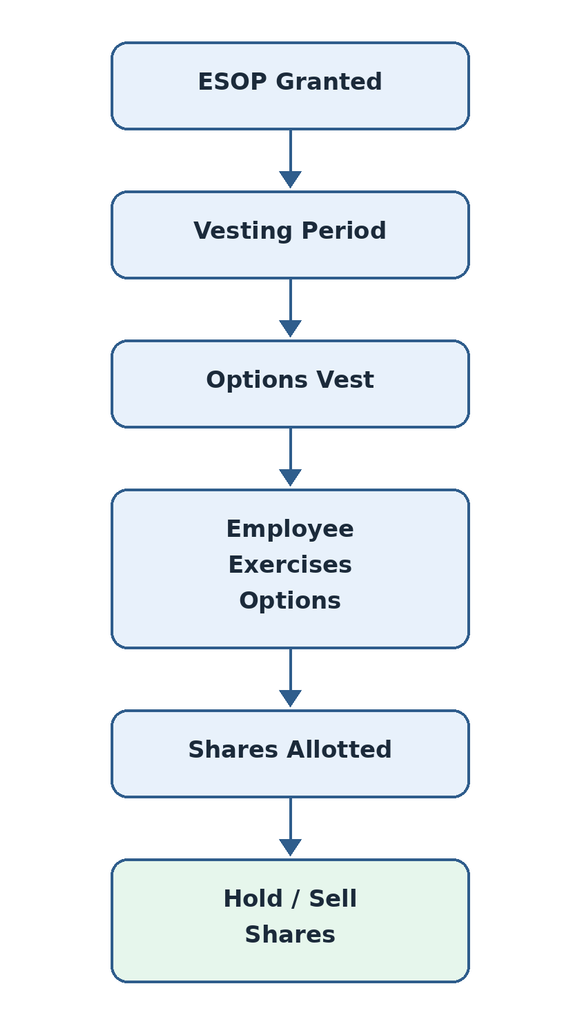
Step 1: ESOP grant
The company first grants a certain number of stock options to an eligible employee.
For example:
- Options granted: 5,000
- Exercise price: ₹50 per share
- Vesting period: 4 years
The employee does not necessarily own 5,000 shares immediately. They have been granted options subject to the plan’s conditions.
Step 2: Vesting
Vesting is the process through which the employee earns the right to exercise the options.
A company may, for example, use a four-year vesting schedule.
A simplified example could look like:
| Year | Options Vesting |
| Year 1 | 1,250 |
| Year 2 | 1,250 |
| Year 3 | 1,250 |
| Year 4 | 1,250 |
| Total | 5,000 |
Some companies may also have a cliff, meaning an employee must remain with the company for a particular initial period before the first portion of options vests.
The actual schedule depends entirely on the company’s ESOP policy.
Step 3: Exercise
Once options have vested, the employee may have the right to exercise them.
Exercise means using the option to purchase the shares at the agreed exercise price.
Suppose:
- Vested options = 1,250
- Exercise price = ₹50
The exercise cost would be:
1,250 × ₹50 = ₹62,500
Step 4: Shares are allotted
After the applicable exercise process and requirements are completed, the employee may receive the corresponding shares.
At this point, the employee has moved from simply holding an option to holding shares, subject to the applicable company and legal framework.
Step 5: Hold or sell
If the shares are transferable and there is a suitable liquidity opportunity, the employee may eventually sell them.
The difference between the relevant acquisition cost and sale price can create a capital gain or capital loss, depending on the circumstances.
How Is ESOP Value Calculated?
One of the most common questions employees ask is:
“How much are my ESOPs actually worth?”
The answer depends on where you are in the ESOP lifecycle.
A simple way to estimate the potential value is:
Basic ESOP value formula
| Potential ESOP value = (Current share value − Exercise price) × Number of vested options |
For example:
- Current estimated share value = ₹500
- Exercise price = ₹100
- Vested options = 2,000
Therefore:
(₹500 − ₹100) × 2,000 = ₹8,00,000
So, the theoretical spread is ₹8 lakh.
But remember: this is not necessarily the amount you can immediately take home.
Taxes, transaction costs, restrictions, liquidity, dilution, and the actual sale price can all affect the final outcome.
ESOP calculation formulas
| Calculation | Formula |
| Exercise cost | Vested options × Exercise price |
| Potential spread | (FMV − Exercise price) × Vested options |
| Sale proceeds | Number of shares sold × Sale price |
| Capital gain | (Sale value − FMV on Exercise Date) X No. of shares sold |
| Potential pre-tax gain | (Sale price − Exercise price) × number of shares, subject to tax treatment |
| Ownership percentage | (Employee shares ÷ Total outstanding shares) × 100 |
Example: ESOP value calculation
Suppose an employee has:
- Total options granted: 10,000
- Options vested: 6,000
- Exercise price: ₹80
- Estimated current FMV: ₹250
Exercise cost:
6,000 × ₹80 = ₹4,80,000
Estimated spread:
(₹250 − ₹80) × 6,000 = ₹10,20,000
The employee therefore has an estimated ₹10.2 lakh spread between the assumed FMV and exercise cost.
However, this should not be interpreted as guaranteed profit. If the company’s valuation falls, the economic value of the options can also fall.
What Determines the Value of an ESOP?
Several factors can influence ESOP value:
1. Exercise price
The lower the exercise price compared with the eventual share value, the larger the potential spread.
2. Fair market value
The fair market value (FMV) of the shares is important for both valuation and tax calculations.
3. Number of vested options
An employee may have 10,000 options granted but only 4,000 vested.
Therefore, it is important to distinguish:
Granted ≠ Vested ≠ Exercised ≠ Sold
4. Company valuation
For private companies and startups, valuation can change substantially between funding rounds, secondary transactions, or other valuation events.
5. Dilution
When a company issues additional shares, an employee’s percentage ownership can decrease even if the number of shares they hold remains unchanged.
6. Liquidity
A valuable private-company ESOP may still be difficult to convert into cash if there is no IPO, acquisition, buyback, or secondary sale opportunity.
ESOP Value at Different Stages
A useful way to understand ESOP economics is to separate the stages:

This distinction is especially important for employees of startups. A high company valuation on paper does not automatically mean an employee can immediately realize the same amount in cash.
How Is ESOP Taxed in India in FY 2026-27?
ESOP taxation is one of the most important parts of the entire topic.
For FY/Tax Year 2026-27, India is operating under the Income-tax Act, 2025, which came into force from 1 April 2026. The new Act replaces the Income-tax Act, 1961 for tax years beginning from that date and introduces the “Tax Year” terminology.
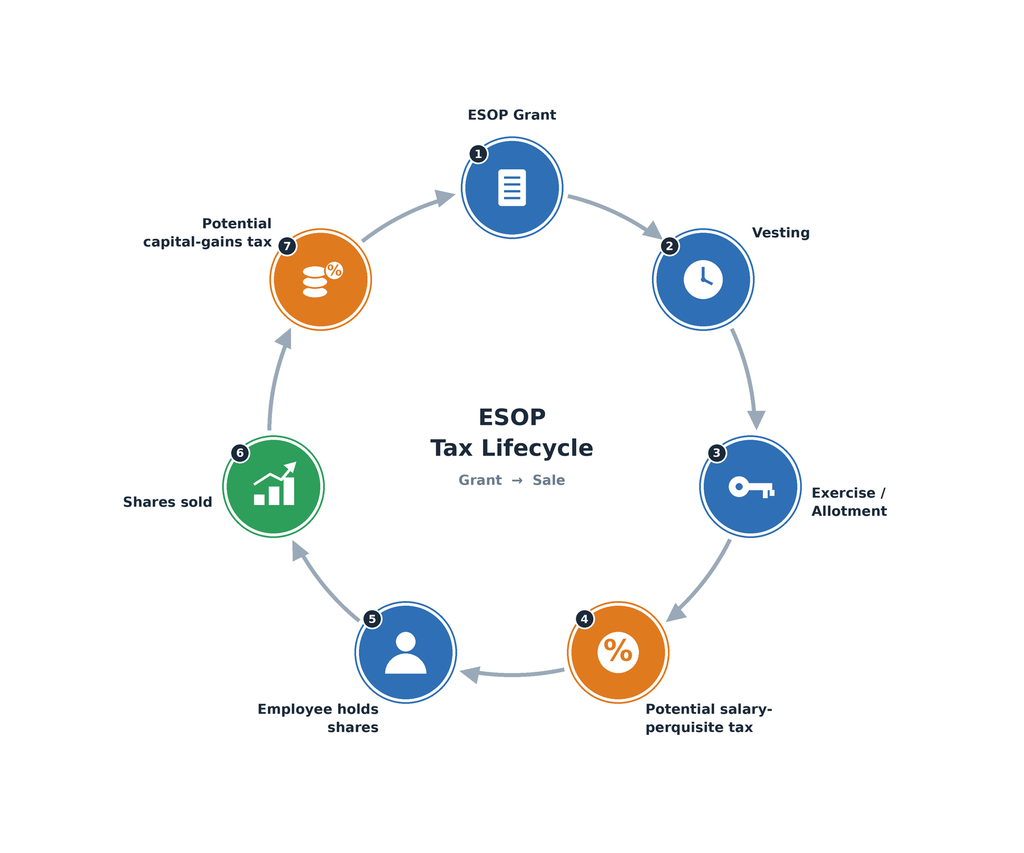
For practical understanding, ESOP taxation can broadly involve two separate tax points:
- Tax when the option is exercised/allotted, depending on the applicable rules
- Capital gains tax when the resulting shares are sold
The exact treatment can vary based on the type of employer, listed/unlisted status, employee circumstances, valuation, and applicable provisions.
Stage 1: Tax at exercise/allotment
In the conventional ESOP tax framework, the benefit represented by the difference between the applicable fair market value and exercise price is treated as a taxable salary perquisite.
A simplified calculation is:
ESOP perquisite = FMV on the relevant exercise/allotment date − Exercise price
Then:
Taxable ESOP perquisite = Perquisite per share × Number of shares
Example
Suppose:
- Exercise price = ₹100
- FMV = ₹400
- Shares = 2,000
Perquisite value:
(₹400 − ₹100) × 2,000 = ₹6,00,000
This ₹6 lakh is the illustrative taxable benefit before applying the employee’s applicable tax treatment.
The important point is that tax can arise even before the employee sells the shares.
Stage 2: Tax when shares are sold
When the employee eventually sells the shares, the subsequent increase or decrease in value may be considered under capital-gains rules.
A simplified framework is:
Capital gain = Sale value − applicable cost of acquisition
Where the amount already recognized as a perquisite may form part of the relevant cost basis under the applicable rules.
For example:
- FMV at exercise = ₹400
- Sale price = ₹650
- Shares sold = 2,000
Illustrative capital gain:
(₹650 − ₹400) × 2,000 = ₹5,00,000
The actual tax rate depends on factors such as whether the shares are listed or unlisted and the applicable holding period and provisions.
Indicative ESOP tax stages
| Stage | What happens | General tax concept |
| Grant | Options are awarded | Usually not the same as receiving taxable cash income |
| Vesting | Rights become exercisable according to the plan | Tax treatment depends on the applicable framework |
| Exercise/allotment | Employee acquires shares | Perquisite taxation can arise |
| Sale | Employee sells shares | Capital gains taxation can arise |
| Startup deferral | Certain eligible startup employees may qualify for deferred tax treatment | Subject to statutory eligibility and conditions |
What about ESOPs from eligible startups?
Special provisions can apply to employees receiving ESOPs from qualifying eligible startups. The Income Tax Department continues to recognize specific startup tax benefits and eligibility conditions, so employees should not assume that the standard timing applies identically to every startup ESOP.
The Income Tax Department’s filing guidance also specifically identifies taxpayers with deferred ESOP tax as subject to different ITR eligibility considerations, reinforcing that deferred ESOP taxation needs separate handling.
A simple ESOP tax timeline
Important FY 2026–27 point
Because the Income-tax Act, 2025 applies from 1 April 2026, older articles that refer only to sections of the Income-tax Act, 1961 may not be the best reference for transactions governed by the new framework. The Income Tax Department explicitly states that the 1961 Act was repealed from 1 April 2026, with transitional provisions preserving the old framework for earlier tax years.
So, before filing or calculating ESOP taxes for FY 2026-27, employees and employers should check the current provisions, applicable valuation rules, TDS requirements, and their specific transaction dates.
This section is educational, not tax advice. For an actual ESOP transaction, consult a qualified tax professional.
What Are the Benefits and Risks of ESOPs?
ESOPs can be valuable for both companies and employees, but they are not risk-free.
The benefits can look very different depending on which side of the table you are sitting on.
Benefits of ESOPs for Employers
1. Attracting talent
Companies can use ESOPs as part of a broader compensation package, particularly when competing for skilled professionals.
For a startup that cannot always match the cash compensation offered by a larger company, equity participation can become one component of the overall employee value proposition.
2. Improving employee retention
Vesting schedules encourage employees to remain with the organization for longer periods.
For example, a four-year vesting schedule creates a longer-term incentive than a one-time bonus.
3. Aligning employees with business growth
Employees who hold or may acquire company shares can have a direct economic interest in the company’s long-term performance.
This can help connect employee incentives with broader business outcomes.
4. Supporting startup compensation strategies
Startups often operate under tight cash-flow constraints.
An ESOP program can form part of a compensation strategy that combines:
Salary + Bonus + Benefits + Equity Opportunity
5. Building an ownership culture
ESOPs can help companies communicate the idea that employees have a stake in the organization’s long-term journey.
Benefits of ESOPs for Employees
1. Potential wealth creation
If the company’s value increases significantly, employees may benefit from the difference between their exercise price and eventual share value.
2. Ownership opportunity
ESOPs can give employees an opportunity to become shareholders, subject to exercising the options and the applicable terms.
3. Additional compensation component
ESOPs can complement fixed salary and variable pay.
4. Long-term incentive
Unlike a one-time incentive, an ESOP may be linked to a multi-year vesting schedule.
5. Participation in company growth
If the company performs well and the shares appreciate, employees can potentially participate in that growth.
What Are the Risks of ESOPs?
It is equally important to understand what ESOPs do not guarantee.
Risk 1: Share value can fall
An ESOP’s potential value depends on the company’s equity value. If valuation decreases, the potential financial benefit may decrease as well.
Risk 2: Illiquidity
A private company’s shares may not have an active market.
You could theoretically hold shares worth ₹20 lakh on paper but still have no immediate way to sell them.
Risk 3: Tax liability before cash realization
Depending on the applicable tax rules, taxation can arise at exercise/allotment even if the employee has not yet sold the shares.
This creates an important cash-flow consideration.
Risk 4: Vesting conditions
If an employee leaves before options vest, some or all of the unvested options may lapse depending on the plan.
Risk 5: Dilution
Future funding or share issuance can reduce an employee’s percentage ownership.
Risk 6: Complex plan terms
ESOP agreements can contain clauses relating to vesting, exercise windows, termination, lock-ins, buybacks, liquidity events, and other conditions.
That is why employees should never look only at the headline number of options.
What Should You Check Before Accepting or Issuing ESOPs?
Whether you are an employee considering an ESOP offer or an employer creating an ESOP plan, the details matter.
For employees: check these 10 things
1. Number of options
Know exactly how many options are being granted.
2. Exercise price
Check how much you will need to pay to exercise each option.
3. Vesting schedule
Understand how quickly your options become exercisable.
4. Cliff period
Check whether there is an initial period during which nothing vests.
5. Exercise window
Find out how long you have to exercise vested options, especially after leaving the company.
6. Current valuation
Ask what valuation or FMV is being used and when it was determined.
7. Fully diluted ownership
Do not look only at the number of options.
Ask:
“What percentage of the company do these options represent on a fully diluted basis?”
8. Liquidity opportunities
Ask whether employees have historically been able to sell shares through:
- Buybacks
- Secondary sales
- IPOs
- Acquisitions
- Other liquidity events
9. Tax implications
Understand potential tax at exercise/allotment and later sale.
10. Exit terms
Read what happens to vested and unvested options if you resign, are terminated, retire, or the company is acquired.
For employers: check these areas
Employers should consider:
- Eligibility criteria
- Total option pool
- Grant methodology
- Vesting schedule
- Exercise price
- Board/shareholder approvals
- Valuation
- Documentation
- Employee communication
- Tax and payroll treatment
- Statutory compliance
- ESOP records
- Exercise tracking
- Option lapses
- Share allotments
- Reporting and audit requirements
Companies also need proper records. The Companies Rules provide for a Register of Employee Stock Options (Form SH-6) containing information such as options granted, vesting, exercise, exercise price, shares arising from exercise, lapses, and other details.
This is where disciplined HR and finance processes become important.
What Are the ESOP Initial Costs and Distributions?
When people talk about ESOP costs, they often focus only on the employee’s exercise price. In reality, there can be several different costs depending on whether you are an employee or employer.
Initial costs for employees
The main potential upfront cost is the exercise cost.
Exercise cost formula
Number of options exercised × Exercise price
Example:
- Options exercised = 3,000
- Exercise price = ₹75
3,000 × ₹75 = ₹2,25,000
The employee may also need to consider applicable taxes, transaction charges, and other costs.
This creates an important distinction:
“ESOP value is not the same as ESOP cash in hand.”
An employee could have a theoretical ESOP value of ₹15 lakh but still need ₹2.25 lakh or more to exercise the options and may also face tax obligations depending on the circumstances.
Potential employer costs
For employers, ESOPs can involve costs related to:
- Legal documentation
- Valuation
- Plan design
- Regulatory compliance
- Accounting
- Payroll/TDS administration
- Record keeping
- Employee communication
- Technology or software
- Audit and professional fees
The accounting treatment of share-based payments can also create a financial reporting impact, depending on the applicable accounting framework.
What does “ESOP distribution” mean?
The word distribution can mean different things in different ESOP structures.
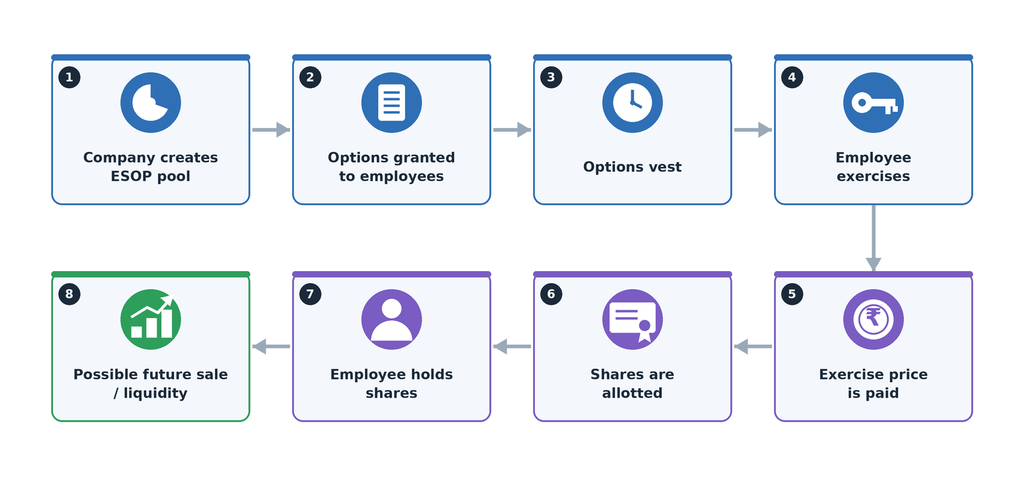
For a general Indian employee stock option plan, the process is usually not a cash “distribution” like a salary bonus.
Instead, the employee generally receives an option, later exercises it if eligible, and may ultimately receive shares.
So the practical lifecycle is:
If the shares subsequently generate dividends, those dividends are a separate shareholder-level matter and should not be confused with the ESOP grant itself.
ESOP Numbers: A Simple Example
Let’s put everything together.
Suppose an employee receives:
- 10,000 options
- ₹50 exercise price
- 4-year vesting
- 6,000 options vested
- ₹250 assumed FMV
Step 1: Exercise cost
6,000 × ₹50 = ₹3,00,000
Step 2: Illustrative spread
(₹250 − ₹50) × 6,000 = ₹12,00,000
Step 3: If shares later sell at ₹400
Potential sale value:
6,000 × ₹400 = ₹24,00,000
Illustrative increase from the ₹250 FMV:
(₹400 − ₹250) × 6,000 = ₹9,00,000
The actual tax treatment and final cash outcome will depend on the applicable tax rules, valuation, transaction structure, and costs.
ESOP value journey
| Stage | Example |
| Options granted | 10,000 |
| Options vested | 6,000 |
| Exercise price | ₹50 |
| Exercise cost | ₹3 lakh |
| Assumed FMV | ₹250 |
| Illustrative spread at exercise | ₹12 lakh |
| Later sale price | ₹400 |
| Illustrative sale value | ₹24 lakh |
ESOP at a Glance: Key Numbers to Track
A simple ESOP dashboard can help HR, finance, and employees understand the entire lifecycle.
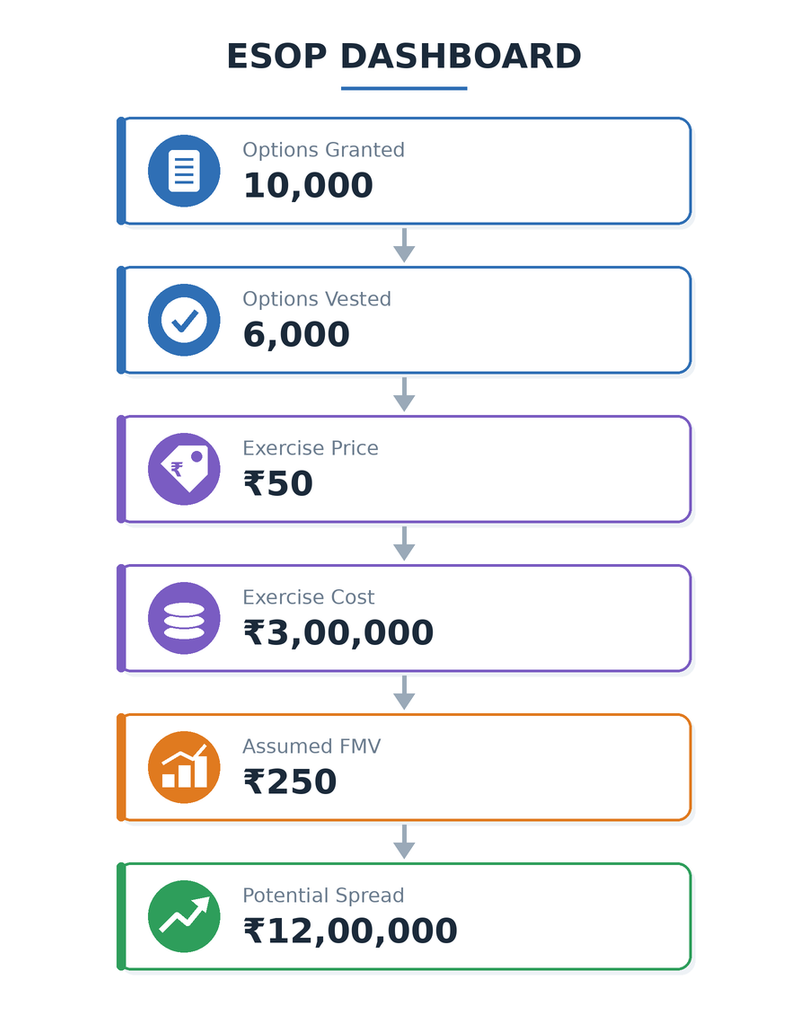
This type of structured tracking is useful because ESOP administration involves much more than simply storing a number of options.
Why ESOP Administration Can Become Difficult for HR Teams
As companies grow, managing ESOPs manually can become increasingly complicated.
Imagine a company with:
- 500 employees
- 150 ESOP holders
- 4-year vesting schedules
- Multiple grant dates
- Different exercise prices
- Employees joining and leaving throughout the year
- Different tax and payroll requirements
- Multiple valuation dates
Maintaining all of this through disconnected spreadsheets can create avoidable administrative work.
HR teams may need to track:
Employee → Grant → Vesting → Exercise → Shares → Tax → Documents → Status
This is where HR technology can become useful.
An HRMS can help centralize employee information and connect ESOP-related information with the broader employee lifecycle, depending on the organization’s setup and the capabilities of its HR technology stack.
Conclusion
An ESOP (Employee Stock Option Plan) can give employees an opportunity to participate in the future growth of the company while helping employers build longer-term compensation and retention strategies. But an ESOP is not simply “free company shares.” Grant terms, vesting, exercise price, valuation, taxation, dilution, and liquidity can all influence its eventual value.
The most important thing is to look at the complete ESOP lifecycle rather than focusing on one number. Whether you are an employee evaluating an ESOP offer or an employer designing an ESOP program, understanding the mechanics, costs, risks, and tax implications can help you make more informed decisions.
For HR teams, keeping track of grants, vesting, employee records, documents, and the broader employee lifecycle can become increasingly complex as the organization grows. A centralized HR platform such as Savvy HRMS can help businesses bring employee information and HR processes together in one place, making workforce administration more organized and easier to manage.










Looking to simplify employee data and HR processes?
Explore how Savvy HRMS can help your organization manage its growing workforce more efficiently.
Frequently Asked Questions (FAQs)
1. What is the full form of ESOP?
ESOP stands for Employee Stock Option Plan. It is an employee benefit that gives eligible employees the right to purchase or subscribe to company shares at a predetermined exercise price, subject to the terms and conditions of the ESOP plan.
2. How does an ESOP work?
An ESOP generally works through five stages: grant, vesting, exercise, share allotment, and sale. Employees first receive options, earn them over the vesting period, and can then exercise eligible options to acquire shares according to the company’s plan.
3. How is ESOP taxed in India?
ESOP taxation in India can occur at different stages. Tax may apply when an employee exercises the options and receives shares, while a subsequent sale of those shares may result in capital gains taxation. The applicable treatment depends on factors such as the type of company, valuation, transaction date, and the employee’s circumstances.
4. How is the value of an ESOP calculated?
A simple way to estimate the potential value of vested ESOPs is:
Potential ESOP value = (Current share value − Exercise price) × Number of vested options
For example, if the share value is ₹300, the exercise price is ₹100, and 1,000 options are vested, the potential spread would be ₹2,00,000, before considering taxes, costs, liquidity, and other factors.
5. What happens to ESOPs when an employee leaves the company?
The treatment of ESOPs after an employee leaves depends on the company’s ESOP policy. Unvested options may lapse, while vested options may remain exercisable for a specified period, subject to the applicable terms. Employees should check the exercise window and exit provisions before leaving the organization.