

Labour Laws in Bihar: Important Acts Every HR Professional Should Know



-
AuthorS.K. Gupta
-
 Last Updated
August 14, 2026
Last Updated
August 14, 2026
-
 Reading Time
10 Mins
Reading Time
10 Mins
Imagine this: it’s a Monday morning, and your HR inbox is already on fire. A construction contractor in Patna wants to know if he needs a licence for his 25-strong labour team. Your finance head is asking why professional tax hasn’t been deducted this month. And a new employee in your Muzaffarpur branch is asking about her maternity leave entitlement. If any of this sounds familiar, welcome to the everyday reality of managing HR compliance in Bihar.
Bihar’s labour law landscape isn’t just paperwork; it’s the backbone of how you treat your people, and how the state judges whether you’re treating them fairly. Get it wrong, and you’re looking at penalties, disputes, and reputational damage.
This blog breaks down every major labour law in Bihar that HR professionals absolutely need on their radar, minus the legal jargon, plus the practical compliance actions that actually matter on the ground.
Labour Laws Applicable in Bihar and Their Compliance Requirements
Bihar follows a mix of central labour legislation and state-specific rules, and every HR team operating here needs to know which ones apply to their establishment. Let’s go through them one by one.
1. Factories Act, 1948
If your business runs a factory in Bihar, this is the law that shapes your entire shop floor. The Factories Act governs working hours, rest intervals, overtime, leave, health, safety, and welfare of factory workers; basically, it’s the rulebook for keeping your workforce safe and your operations legal.
Applicability: Any premises employing 10 or more workers with power-aided manufacturing processes, or 20 or more workers without power, fall under this Act.
What HR needs to track: Registration of the factory, maintaining registers for working hours and overtime, ensuring safety equipment and first-aid facilities, and complying with maximum working hour limits (usually 48 hours a week, 9 hours a day).
2. Employees’ State Insurance Act, 1948
ESI is your employees’ safety net when life throws a curveball- sickness, maternity, or a workplace injury. It’s a social security scheme that provides medical and cash benefits, funded jointly by employer and employee contributions.
Applicability: Factories and establishments employing 10 or more people (with wages below the prescribed ceiling) need to register.
Compliance checklist:
- Register your establishment on the Shram Suvidha Portal to get an employer code
- Maintain accurate muster rolls, wage records, and contribution accounts
- Report any change in business address, ownership, or employee count to ESIC within 15 days
- Notify accidents or occupational illnesses within 24 hours
3. Payment of Bonus Act, 1965
Every year, employees look forward to their bonus, and this Act makes sure it’s not a matter of employer goodwill, but a legal obligation tied to profits and productivity.
Applicability: Establishments employing 20 or more people, where employees earn wages up to the prescribed limit, must comply.
What HR must do:
- File the annual bonus return within 30 days of the accounting year closing
- Pay the bonus within 8 months of the year-end (or within a month of any award/settlement)
- Keep audited financial statements and bonus computation sheets ready for inspection
4. Payment of Wages Act, 1936
Despite the commonly used year “1963” floating around, this central law actually dates back to 1936, and it exists purely to protect employees from unfair wage practices, delayed payments, arbitrary deductions, or payment in kind instead of currency.
Applicability: Covers all employed persons in factories, specified industries, and establishments notified under the Act, with authority and thresholds varying by state.
Key compliance points:
- Wages must be disbursed on time, with the wage period never exceeding one month
- Any deductions (for damages, loss, or advances) must be properly recorded
- Maintain a register of wages paid, and file Form V as the annual return
- Provide an annual compliance certificate confirming adherence to wage provisions
5. Professional Tax
Professional tax is one of those small but easily missed line items that can cause big compliance headaches if ignored. It’s a tax the Bihar state government levies on individuals earning through employment, profession, trade, or calling.
Applicability: Salaried employees, professionals, and self-employed individuals in Bihar are all liable, based on their income slab.
HR’s role: Deduct professional tax correctly from employee salaries each month based on the applicable slab, deposit it with the state treasury within the due date, and file periodic returns. Since PT slabs and periodicity can be revised by the state, HR teams should verify the current rates directly with the Bihar Commercial Taxes Department before running payroll.
6. Shop and Establishment Act
If you run a shop, commercial office, or establishment in Bihar, this Act is your go-to compliance reference. It governs everything from working hours and leave entitlements to record-keeping and workplace conditions.
Applicability: Applies to all shops and commercial establishments operating in areas notified by the Bihar government.
Compliance essentials:
- Register your establishment, generally within 60 to 90 days of commencing operations
- Maintain a clean, safe, and hygienic workplace
- Keep employee records and display statutory notices as required
Here’s a quick reference table HR teams often need handy:
| Type of Leave | Entitlement | Remarks |
| Sick Leave (SL) | 12 days/year | Half wages payable, subject to a medical certificate |
| Casual Leave (CL) | 12 days/year | Full pay |
| Earned/Privilege Leave (EL/PL) | 18 days/year | Applicable after 240 days of continuous service |
| Working Hours | 9 hours/day or 48 hours/week | As per standard limits |
| Rest Interval | 30 minutes | Mandatory after every 5 hours of continuous work |
Keeping this table close by makes leave approvals and payroll calculations far less of a guessing game.
7. Contract Labour (Regulation and Abolition) Act, 1970
This Act exists to protect contract workers from exploitation while giving businesses the flexibility to engage them for specific, non-core tasks. It regulates how contract labour is employed and, in certain conditions, allows for its elimination altogether.
Applicability: Establishments engaging 20 or more contract workers, subject to certain exemptions.
What to watch for: Both the principal employer and the contractor need registration/licensing, and HR must ensure contractors provide statutory benefits like wages, safety measures, and welfare amenities to the contract workforce.
8. Employees’ Provident Fund and Miscellaneous Provisions Act, 1952
EPF is the retirement safety net every HR professional deals with almost daily. It builds a corpus for employees through provident fund, pension, and insurance contributions, securing them against retirement, disability, or death.
Applicability: Factories and establishments in Bihar employing 20 or more persons (including those who were employed on any day in the preceding 12 months).
Compliance essentials:
- Register with EPFO and enrol every eligible employee promptly
- Deposit monthly PF contributions through the EPFO portal without fail
- Maintain accurate records for audits and inspections, since EPFO scrutiny is routine, not occasional
9. Building and Other Construction Workers Act, 1996
Construction sites come with their own unique risks, and this Act is designed to protect the workers who build Bihar’s roads, bridges, and buildings, often the most vulnerable and least protected segment of the workforce.
Applicability: Establishments with 10 or more construction workers.
Compliance highlights:
- Register the establishment within 60 days of starting work, or within 30 days of hiring a construction worker
- Contractors with 20+ construction workers must obtain a licence
- Employers can levy up to 2% of construction costs toward worker welfare cess
10. Inter-State Migrant Workmen (ISMW) Act, 1979
Bihar has one of the largest populations of migrant workers in India, many of whom travel across state lines for employment. This Act was created precisely to prevent their exploitation and ensure fair treatment, whether they’re leaving Bihar for work elsewhere or arriving to work here.
Applicability: Establishments employing 10 or more inter-state migrant workers in the preceding 12 months.
What HR should ensure: Proper registration of the establishment, licensing of recruiting contractors, and equal wages, displacement allowances, and journey allowances for migrant employees, just as applicable to local workers.
11. Payment of Gratuity Act, 1972
Gratuity is the employer’s way of saying “thank you” to long-serving employees, and it’s a legal entitlement, not a discretionary perk.
Applicability: Every establishment with 10 or more employees, extended to employees who’ve completed at least 5 years of continuous service.
Compliance note: HR must calculate gratuity correctly at the time of an employee’s exit (retirement, resignation, or termination) and ensure timely disbursal, since delays or miscalculations are among the most common sources of post-employment disputes.
Why Staying Compliant Matters More Than Ever?
Let’s be honest, compliance isn’t the most exciting part of HR. But in Bihar’s fast-growing business landscape, it’s quickly becoming one of the most important.
Labour departments are watching more closely than they used to. Audits are more frequent. Employees are more aware of their rights. And one missed filing or one delayed payment, can snowball into something much bigger than a paperwork issue.
Here’s what’s really at stake when compliance slips through the cracks:
- Penalties and legal action: fines add up fast, and repeated lapses can invite an inspection you don’t want
- Employee trust takes a hit: nothing erodes morale faster than delayed wages, unpaid bonuses, or denied leave
- Reputation damage: word travels, especially in tighter industrial hubs like Patna, Muzaffarpur, or Bhagalpur
- Operational disruption: sudden inspections or notices pull your HR team away from actual people-first work
On the other side, when compliance is handled well, something interesting happens, it stops feeling like a burden and starts working in your favour.
- Employees feel secure, knowing their PF, ESI, gratuity, and leave entitlements are always on time
- Your organisation builds a reputation as a fair, dependable employer
- HR spends less time firefighting and more time actually improving the workplace
At the end of the day, compliance isn’t just about ticking legal boxes. It’s about showing your workforce, and the state, that you take their well-being seriously.
Conclusion
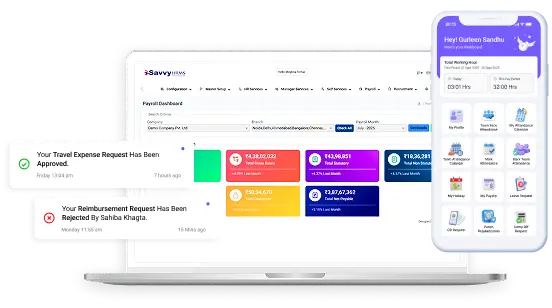
Keeping up with labour laws in Bihar manually, across spreadsheets, registers, and scattered notifications, is a recipe for missed deadlines and compliance risk. This is exactly where a smart, automated HRMS becomes indispensable, quietly tracking PF, ESI, bonus, gratuity, and leave rules so your HR team doesn’t have to chase them one by one.
Savvy HRMS doesn’t just simplify payroll; it keeps your organisation audit-ready every single day, flags compliance gaps before they become penalties, and frees up your HR team to focus on people, not paperwork.










Stay Compliant. Stay Stress-Free with Savvy HRMS
Simplify payroll, automate compliance, and keep your HR operations audit-ready.
Frequently Asked Questions (FAQs)
1. What are the minimum wages in Bihar?
The minimum wages in Bihar vary according to the category of employment and skill level. From 1 April 2026, the reported rates are ₹436 per day for unskilled workers, ₹452 for semi-skilled workers, ₹551 for skilled workers, and ₹672 for highly skilled workers. Employers should verify the latest government notification before processing payroll.
2. Which labour laws are applicable to businesses in Bihar?
Businesses in Bihar may need to comply with various central and state labour laws depending on their industry, workforce size, and operations. Key laws include the Factories Act, ESI Act, EPF Act, Payment of Bonus Act, Payment of Gratuity Act, and Contract Labour Act.
3. Is professional tax applicable in Bihar?
Professional tax provisions may apply to individuals earning through employment, profession, trade, or calling in Bihar. Employers should ensure applicable deductions, payments, and returns are handled correctly and verify the latest state requirements.
4. When are EPF and ESI applicable in Bihar?
EPF generally applies to covered establishments employing 20 or more employees, while ESI applies to covered establishments meeting the prescribed employee-count and wage-ceiling conditions. Employers must register eligible establishments and employees and deposit contributions within the prescribed timelines.
5. How can businesses ensure labour law compliance in Bihar?
Businesses should regularly track wages, attendance, leave, PF, ESI, bonus, gratuity, professional tax, statutory records, registrations, and filing deadlines. An HRMS can automate several of these processes, reduce manual errors, and help keep the organisation audit-ready.