

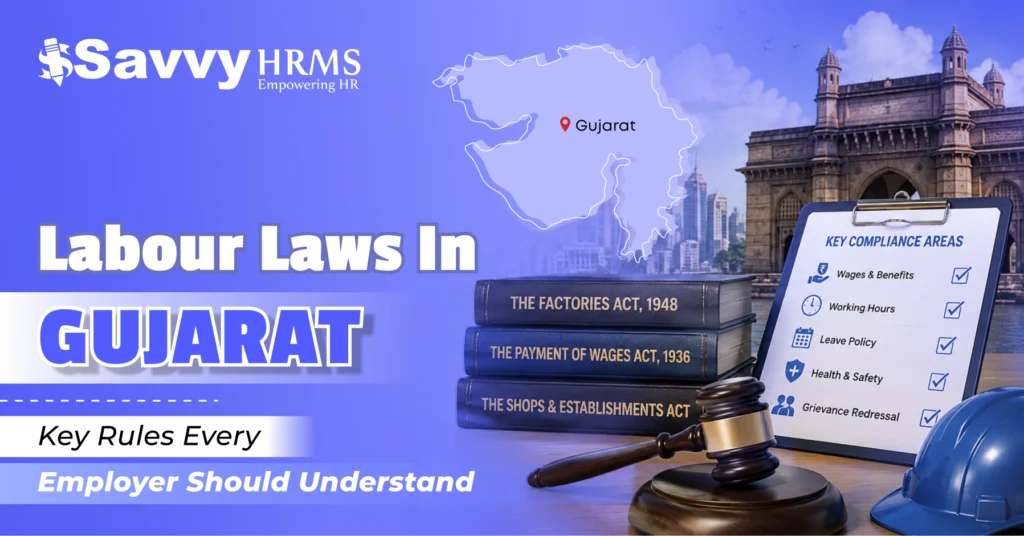
Labour Laws in Gujarat: Key Rules Every Employer Should Understand


-
AuthorS.K. Gupta
-
 Last Updated
August 11, 2026
Last Updated
August 11, 2026
-
 Reading Time
9 Mins
Reading Time
9 Mins
Imagine running a growing business in Gujarat and suddenly receiving a notice for non-compliance with a labour regulation you were unaware of. What looked like a minor oversight can quickly turn into penalties, legal disputes, and operational disruptions.
As Gujarat continues to attract businesses across manufacturing, retail, pharmaceuticals, textiles, and technology sectors, understanding labour laws in Gujarat has become important for every employer. Staying compliant not only helps avoid legal risks but also creates a fair, productive, and employee-friendly workplace.
Let’s begin by understanding the major labour laws in Gujarat and how they impact employers across different industries.
Labour Laws and Compliance Requirements in Gujarat
Businesses operating in Gujarat must comply with several Central and State labour laws governing wages, working conditions, employee benefits, social security, workplace safety, and dispute resolution. Understanding the applicability of these laws helps employers maintain legal compliance while protecting employee rights.
The table below provides a quick overview of the most important labour laws in Gujarat that employers should understand.
| Labour Law | Purpose | Applicability |
| Contract Labour (Regulation and Abolition) Act, 1970 | Regulates contract labour employment | Establishments and contractors employing 20 or more contract workers |
| Employees’ Compensation Act, 1923 | Compensation for work-related injuries or death | Employers not covered under ESI or specific categories |
| Industrial Disputes Act, 1947 | Resolution of industrial disputes | Industrial establishments and workers |
| Minimum Wages Act, 1948 | Ensures minimum wage payment | Scheduled employments notified by government |
| Factories Act, 1948 | Workplace safety and welfare | Factories employing prescribed worker limits |
| Payment of Bonus Act, 1965 | Annual bonus payment | Establishments with 20 or more employees |
| Payment of Gratuity Act, 1972 | Retirement and service benefits | Establishments with 10 or more employees |
| Professional Tax | State tax on employment | Employers and salaried employees in Gujarat |
| Equal Remuneration Act, 1976 | Equal pay for equal work | All employers |
| Gujarat Shops & Establishments Act, 2019 | Regulation of commercial establishments | Shops, offices, and commercial establishments |
1. Contract Labour (Regulation and Abolition) Act, 1970
The Contract Labour (Regulation and Abolition) Act, 1970 regulates the employment of contract workers and ensures their welfare. It applies to establishments and contractors employing 20 or more contract workers.
Under this law, principal employers must register their establishments, while contractors must obtain valid licenses before engaging contract labour. Employers are also responsible for ensuring payment of wages, sanitation facilities, drinking water, restrooms, and other welfare measures.
For businesses that depend heavily on outsourced manpower, compliance with this Act is crucial to avoid penalties and legal complications.
2. Employees’ Compensation Act, 1923
The Employees’ Compensation Act, 1923 provides financial compensation to employees or their dependents in cases of injury, disability, or death arising out of employment.
The Act aims to protect workers who suffer occupational injuries while performing their duties. Compensation is determined based on factors such as wages, age, and the extent of disability.
Employers must understand their obligations under this law and ensure proper workplace safety measures to reduce occupational risks and liabilities.
3. Industrial Disputes Act, 1947
The Industrial Disputes Act, 1947 establishes mechanisms for preventing and resolving disputes between employers and employees.
The Act covers matters such as layoffs, retrenchment, strikes, lockouts, and industrial disputes. It provides procedures for conciliation, arbitration, and adjudication to maintain industrial harmony.
For employers, understanding this legislation is important because non-compliance during termination, layoffs, or workforce restructuring can result in legal disputes and financial consequences.
4. The Minimum Wages Act, 1948
The Minimum Wages Act, 1948 ensures that employees receive wages not below the minimum rates notified by the government.
The Gujarat Government periodically revises minimum wage rates based on employee skill categories such as unskilled, semi-skilled, skilled, and highly skilled workers. Employers must pay at least the prescribed minimum wages and maintain proper wage records.
Failure to comply can lead to penalties, claims from employees, and reputational risks. Businesses should regularly monitor wage notifications issued by the state government.
For more info, visit: Minimum Wages in Gujarat
5. Factories Act, 1948
The Factories Act, 1948 governs health, safety, welfare, and working conditions in factories.
The Act applies to factories employing workers with or without power, subject to specified thresholds. It includes provisions relating to:
- Working hours
- Overtime
- Safety measures
- Welfare facilities
- Occupational health
- Leave with wages
Employers operating manufacturing facilities in Gujarat must maintain compliance through proper documentation, safety training, inspections, and workplace infrastructure.
6. Payment of Bonus Act, 1965
The Payment of Bonus Act, 1965 requires eligible employers to pay annual bonuses to employees based on profits or productivity.
The Act generally applies to establishments employing 20 or more persons. Eligible employees earning wages within prescribed limits are entitled to receive a statutory bonus.
The bonus amount is calculated according to the provisions of the Act, with minimum and maximum percentages prescribed by law. Employers must maintain records related to bonus calculations and payments.
7. Payment of Gratuity Act, 1972
The Payment of Gratuity Act, 1972 provides a lump-sum benefit to employees upon retirement, resignation, death, or permanent disablement after completing the required period of continuous service.
The Act applies to establishments employing 10 or more persons. Gratuity is an important social security benefit that recognizes long-term employee service.
Employers must calculate gratuity accurately and ensure timely payment to avoid legal claims and penalties.
8. Professional Tax
Professional Tax is a state-level tax imposed on salaried employees, professionals, and businesses operating in Gujarat.
Employers are responsible for:
- Obtaining Professional Tax registration
- Deducting tax from employee salaries where applicable
- Depositing tax with the authorities
- Filing periodic returns
Non-compliance can result in penalties and interest. Businesses should maintain accurate payroll records to ensure timely compliance with Professional Tax requirements.
9. Equal Remuneration Act, 1976, and Gujarat Rules, 1976
The Equal Remuneration Act, 1976 promotes gender equality in the workplace by ensuring equal pay for men and women performing the same or similar work.
The Act prohibits discrimination during recruitment, promotion, training, and compensation practices.
Employers in Gujarat must maintain fair wage structures and ensure that employment policies support equal opportunities for all employees regardless of gender.
Compliance with equal remuneration principles also strengthens employer branding and workplace diversity initiatives.
10. Gujarat Shops & Establishments (Regulation and Conditions of Service) Act, 2019 and Rules, 2020
The Gujarat Shops and Establishments (Regulation of Employment and Conditions of Service) Act, 2019 governs shops, commercial establishments, offices, hotels, restaurants, and service businesses operating in the state.
The Act covers:
- Registration requirements
- Working hours
- Overtime provisions
- Weekly holidays
- Leave entitlements
- Employment conditions
- Record maintenance
The legislation modernized the state’s regulatory framework and introduced more flexibility while safeguarding employee rights.
Every business operating a commercial establishment in Gujarat should understand its obligations under this Act to maintain compliance.
Additional Labour Laws Applicable in Gujarat
Apart from the major labour laws discussed above, employers in Gujarat may also need to comply with several other labour and social security regulations depending on the nature and size of their business.
Some important laws include:
1. Employees’ Provident Funds and Miscellaneous Provisions Act, 1952
This Act provides retirement benefits through Provident Fund, Pension Scheme, and Employee Deposit Linked Insurance (EDLI). It generally applies to establishments employing 20 or more employees.
2. Employees’ State Insurance Act, 1948
The ESI Act provides medical, sickness, maternity, and disability benefits to eligible employees. Covered establishments must contribute to the ESI scheme and ensure timely compliance.
3. Maternity Benefit Act, 1961
This Act protects the employment rights of women employees during pregnancy and maternity. Employers must provide maternity leave and related benefits as prescribed by law.
4. Child and Adolescent Labour (Prohibition and Regulation) Act, 1986
The law prohibits the employment of children in specified occupations and regulates working conditions for adolescents.
5. Sexual Harassment of Women at Workplace (Prevention, Prohibition and Redressal) Act, 2013
Commonly known as the POSH Act, it requires organizations to establish an Internal Committee and implement mechanisms to prevent workplace harassment.
6. Occupational Safety, Health and Working Conditions Code, 2020
As labour reforms continue to evolve, employers should stay informed about labour codes and future compliance requirements that may impact their operations.
Why Labour Law Compliance Matters for Employers in Gujarat
Compliance with labour laws in Gujarat is not merely a legal obligation; it is a strategic business necessity.
When employers maintain proper compliance, they can:
- Avoid penalties and legal disputes
- Improve employee satisfaction
- Build a positive employer reputation
- Reduce operational risks
- Enhance workforce productivity
- Strengthen business sustainability
- Improve audit readiness
- Support business expansion and investment opportunities
A compliant workplace creates trust among employees, customers, investors, and regulatory authorities.
Managing Labour Law Compliance with HR Technology
As labour regulations become more complex, manual compliance management can be time-consuming and error-prone.
Modern HR and payroll software can help businesses:
- Automate payroll calculations
- Track statutory deductions
- Manage attendance and overtime
- Generate compliance reports
- Maintain employee records
- Monitor leave policies
- Reduce compliance errors
- Simplify audit preparation
For growing organizations, automation significantly reduces administrative burden while improving compliance accuracy.
Conclusion
Understanding labour laws in Gujarat is important for every employer operating in the state. From minimum wages and gratuity to contract labour regulations and professional tax compliance, each law plays an important role in creating a fair, safe, and legally compliant workplace.
Keeping track of changing regulations, maintaining accurate records, and ensuring timely statutory compliance can be challenging. This is where a comprehensive HR and payroll solution can make a significant difference.
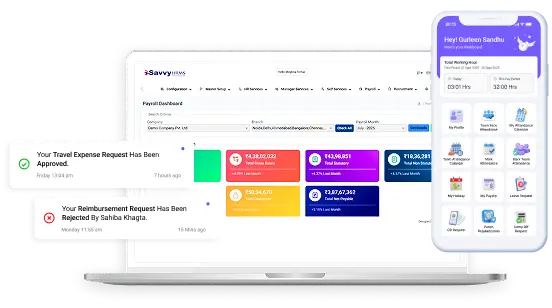
Savvy HRMS helps businesses simplify payroll processing, attendance management, statutory compliance, employee records, leave management, and workforce administration through a single integrated platform. By automating critical HR processes, organizations can reduce compliance risks and focus on business growth with confidence.










Ready to simplify labour law compliance in Gujarat?
Book a free demo of Savvy HRMS today and discover how intelligent HR and payroll automation can help your business stay compliant, efficient, and future-ready.
Frequently asked questions (FAQs)
1. What are the major labour laws applicable in Gujarat?
Key labour laws in Gujarat include the Minimum Wages Act, Factories Act, Payment of Bonus Act, Payment of Gratuity Act, Gujarat Shops & Establishments Act, Professional Tax, Contract Labour Act, and Industrial Disputes Act.
2. What is the minimum wage in Gujarat in 2026?
The minimum wage in Gujarat for 2026 varies depending on the industry, skill category (unskilled, semi-skilled, skilled, or highly skilled), and the latest government notification. Employers must pay at least the notified minimum wage rates.
3. Who needs to register under the Gujarat Shops & Establishments Act?
• Shops and retail businesses
• Commercial establishments
• Offices
• Hotels and restaurants
• Service businesses
• Other eligible establishments operating in Gujarat
4. Why is labour law compliance important for employers in Gujarat?
Labour law compliance helps businesses avoid penalties, maintain statutory obligations, improve employee satisfaction, reduce legal risks, strengthen workplace transparency, and build a positive employer reputation while supporting sustainable business growth.
5. How can HR and payroll software help with labour law compliance?
• Automates payroll processing
• Tracks statutory deductions
• Manages attendance and overtime
• Generates compliance reports
• Maintains employee records
• Reduces manual errors and audit risks
6. Which additional labour laws should employers in Gujarat be aware of?
Apart from the major state laws, employers may also need to comply with EPF, ESI, the Maternity Benefit Act, the POSH Act, the Child and Adolescent Labour Act, and the Occupational Safety, Health and Working Conditions Code, depending on their business.