




Wondering whether your employees are entitled to a statutory bonus or if your business must comply with the Payment of Bonus Act, 1965? You’re not alone. The Payment of Bonus Act, 1965 is one of India’s most important labour laws, yet many employers and employees are still unsure about its applicability, eligibility criteria, and bonus calculation rules.
Whether you’re an HR professional, payroll manager, business owner, or employee, understanding the Payment of Bonus Act, 1965 is important to ensure legal compliance and avoid costly mistakes. In this blog, we’ll explain everything from the meaning of a bonus to the latest rules, eligibility, applicability, and bonus calculation under the Act.
What Is a Bonus? Meaning and Types
A bonus is an additional payment made by an employer to employees over and above their regular salary or wages. It serves as a reward for an employee’s contribution to the organization’s success and is often linked to the company’s profits or overall performance.
While many organizations voluntarily offer bonuses as incentives, certain bonuses are mandatory under Indian labour laws. The Payment of Bonus Act, 1965 ensures that eligible employees receive a minimum statutory bonus, irrespective of whether an employer chooses to offer additional performance-based incentives.
Common Types of Bonus
1. Statutory Bonus
A statutory bonus is the bonus that employers are legally required to pay under the Payment of Bonus Act, 1965, provided the organization and employee satisfy the conditions laid down in the Act.
2. Performance Bonus
Performance bonuses are awarded based on an individual’s or team’s achievements, productivity, or target completion. These bonuses are entirely at the employer’s discretion and are not governed by the Bonus Act.
3. Festival Bonus
Many companies provide festival bonuses during occasions such as Diwali or other regional festivals. Unless specifically covered under statutory requirements, these bonuses are voluntary.
4. Ex-Gratia Bonus
An ex-gratia payment is offered as a goodwill gesture by an employer. It is not a statutory obligation and may be given even when the employee is not covered under the Payment of Bonus Act, 1965.
Why Is Bonus Important?
A well-designed bonus system benefits both employers and employees. It helps organizations appreciate employee contributions while motivating individuals to perform better.
Some key benefits include:
- Improves employee motivation and morale.
- Increases employee retention.
- Encourages higher productivity.
- Promotes employee satisfaction.
- Strengthens employer-employee relationships.
- Supports better workplace engagement.
Understanding the difference between statutory and discretionary bonuses is important because only statutory bonuses are regulated by the Payment of Bonus Act, 1965.
What Is the Payment of Bonus Act, 1965?
The Payment of Bonus Act, 1965 is an important labour legislation enacted by the Government of India to ensure that eligible employees receive a fair share of an establishment’s profits in the form of a statutory bonus.
Before the introduction of this law, bonus payments varied significantly across industries, and there was no uniform framework governing employee entitlement. The Act established clear rules regarding bonus eligibility, bonus calculation, minimum and maximum bonus limits, employer obligations, and employee rights.
The primary objective of the Payment of Bonus Act, 1965 is to create a balanced relationship between employers and employees by ensuring that workers benefit from the financial success of an organization while providing employers with a structured mechanism for bonus payments.
Today, the Act continues to play an important role in payroll compliance across India and is an integral part of every HR and payroll management process.
Objectives of the Payment of Bonus Act, 1965
The Act was introduced with several important objectives, including:
- Ensuring eligible employees receive a statutory annual bonus.
- Providing a uniform legal framework for bonus payments.
- Reducing disputes between employers and employees regarding bonus entitlement.
- Promoting industrial harmony and employee welfare.
- Encouraging employees to contribute towards organizational growth.
- Defining employer responsibilities related to bonus payments and compliance.
Key Features of the Payment of Bonus Act, 1965
Some of the most significant provisions under the Payment of Bonus Act, 1965 include:
- Defines establishments covered under the Act.
- Specifies employee eligibility conditions.
- Prescribes minimum and maximum bonus limits.
- Provides a standard formula for bonus calculation.
- Introduces the concept of Set-On and Set-Off for allocable excess.
- Specifies timelines for bonus payment.
- Provides penalties for non-compliance.
- Requires employers to maintain prescribed records and registers.
Why Is the Payment of Bonus Act Important?
For employers, compliance with the Payment of Bonus Act, 1965 is more than just fulfilling a legal obligation. Proper bonus management helps build employee trust, reduces compliance risks, and strengthens employer branding.
For employees, the Act guarantees a minimum financial benefit even during years when organizational profits are relatively low, subject to the provisions of the law.
In a modern, developing regulatory landscape, HR teams and payroll professionals must stay updated with the latest Payment of Bonus Act rules, notifications, and amendments to ensure accurate payroll processing and statutory compliance.
The use of modern HRMS and payroll software has made it significantly easier for organizations to automate bonus calculations, determine employee eligibility, generate statutory reports, and maintain compliance with the Bonus Act.
As we move further into this blog, we’ll explore the Bonus Act applicability, who is covered under the law, employee eligibility criteria, minimum bonus payable, and how bonus is calculated under the Payment of Bonus Act, 1965, including the changes introduced through the 2015 Amendment.
Who Does the Payment of Bonus Act, 1965 Apply To?
One of the most common questions employers ask is, “Does the Payment of Bonus Act, 1965 apply to my business?” The answer depends on the type of establishment and the number of employees working there.
Bonus Act Applicability
Under Section 1 of the Payment of Bonus Act, 1965, the Act applies to:
- Every factory employing 10 or more employees on any day during an accounting year.
- Every other establishment employing 20 or more employees on any day during an accounting year.
This means that if your organization crosses the employee threshold even for a single day during the accounting year, the bonus act applicability may continue in subsequent years unless the establishment falls below the prescribed conditions under the law.
Which Establishments Are Covered?
The Payment of Bonus Act, 1965 generally covers:
- Manufacturing units
- IT and software companies
- Retail businesses
- Trading establishments
- Service organizations
- Warehouses and logistics companies
- Educational institutions (in certain cases, depending on legal interpretation and notifications)
- Hospitality businesses
Which Establishments Are Exempt?
Certain categories are exempt from the Payment of Bonus Act, 1965, including:
- The Life Insurance Corporation of India (LIC)
- Seamen as defined under the Merchant Shipping Act
- Employees of the Reserve Bank of India
- Certain government establishments
- Employees engaged through specific statutory schemes
What Happens If Employee Count Fluctuates?
Suppose a company had 22 employees for three months and later reduced the workforce to 18 employees. Since the establishment employed 20 or more employees during the accounting year, the Payment of Bonus Act applicability is triggered.
This is a crucial compliance point that many startups and growing businesses overlook.
Accounting Year Under the Bonus Act
For most companies, the accounting year is the financial year from 1 April to 31 March. Bonus eligibility and calculation are generally determined with reference to this accounting period.
Why Understanding Applicability Matters
Incorrectly assuming that the Payment of Bonus Act, 1965 does not apply can lead to:
- Non-payment of statutory bonus
- Employee disputes
- Labour department notices
- Penalties under the Act
- Reputational and compliance risks
That is why HR and payroll teams should review employee strength at least once every financial year.
Eligibility Criteria Under the Payment of Bonus Act, 1965
Even if an establishment is covered under the Payment of Bonus Act, 1965, not every employee automatically becomes eligible for bonus.
Basic Eligibility Conditions
An employee becomes eligible for bonus if they satisfy the following conditions:
1. The employee must be employed in a covered establishment
The organization should fall under the bonus act applicability provisions discussed earlier.
2. The employee must have worked for at least 30 working days
As per the Payment of Bonus Act, 1965, an employee must have worked for not less than 30 working days in an accounting year to qualify for statutory bonus.
This is one of the most important eligibility conditions.
Example
- Joined on: 1 January
- Worked till: 31 March
- Total working days: 65
Since the employee worked for more than 30 working days, they are eligible for bonus subject to salary limits and other provisions.
Salary Eligibility Under the Bonus Act
The Payment of Bonus Act, 1965 provides a salary threshold for eligibility.
An employee whose salary or wage does not exceed ₹21,000 per month is eligible for statutory bonus.
This limit was revised through the Payment of Bonus (Amendment) Act, 2015.
Important Distinction: Eligibility vs Calculation Ceiling
Many employers confuse these two concepts.
So, an employee earning ₹18,000 per month is eligible for bonus, but the bonus may be calculated on ₹7,000 or the applicable minimum wage, whichever is higher.
Who Is Considered an Employee?
The Payment of Bonus Act, 1965 covers employees engaged on:
- Monthly wages
- Daily wages
- Piece-rate basis
- Time-rate basis
Apprentices engaged under the Apprentices Act, 1961 are generally excluded.
Can New Employees Get Bonus?
Yes. A newly joined employee can receive a bonus if they complete 30 working days during the accounting year.
Can Contract Employees Get Bonus?
This is a very practical HR question.
If contract employees are working in a covered establishment and meet the eligibility conditions, they may be entitled to bonus. Responsibility for payment usually lies with the contractor, but the principal employer may have compliance exposure if the contractor fails to pay.
Disqualification for Bonus
An employee may be disqualified from receiving a bonus if they are dismissed for:
- Fraud
- Violent behavior
- Theft
- Misappropriation of company property
Proper disciplinary procedure and documentation are essential before denying bonus on these grounds.
Minimum Bonus Payable Under the Payment of Bonus Act, 1965
The Payment of Bonus Act, 1965 ensures that eligible employees receive a minimum statutory bonus even when the employer has inadequate profits.
What Is the Minimum Bonus?
Under Section 10 of the Act, every eligible employee is entitled to a minimum bonus of 8.33% of salary or wages earned during the accounting year.
Alternatively, the employee must receive ₹100, whichever is higher.
For employees below 15 years of age, the minimum amount is ₹60.
Why 8.33%?
The figure of 8.33% is equivalent to one month’s salary out of twelve months.
Calculation:
1 ÷ 12 × 100 = 8.33%
This represents the statutory minimum share payable to eligible employees.
Is Minimum Bonus Payable Even Without Profits?
Yes, in most cases.
One of the unique features of the Payment of Bonus Act, 1965 is that the minimum bonus is generally payable even if the establishment has no allocable surplus for that year, subject to the provisions relating to newly established undertakings and set-off.
Example of Minimum Bonus
Suppose an employee’s bonus calculation salary is ₹7,000 per month.
Annual salary for bonus purposes:
₹7,000 × 12 = ₹84,000
Minimum bonus:
₹84,000 × 8.33% = ₹6,997.20
So, the employee would receive approximately ₹6,997 as statutory minimum bonus.
Maximum Bonus Under the Act
While this section focuses on minimum bonus, it is important to remember that the Payment of Bonus Act, 1965 also prescribes a maximum bonus of 20% of salary or wages.
The actual percentage payable depends on the allocable surplus available with the establishment.
When Must Bonus Be Paid?
Bonus must generally be paid within eight months from the close of the accounting year.
For companies following the April-March financial year, bonus is usually payable by 30 November, unless an extension is granted by the appropriate government.
Timely payment is a critical part of Payment of Bonus Act compliance and should be monitored closely by payroll and finance teams.
Bonus Calculation Under the Payment of Bonus Act, 1965 (As Per the 2015 Amendment)
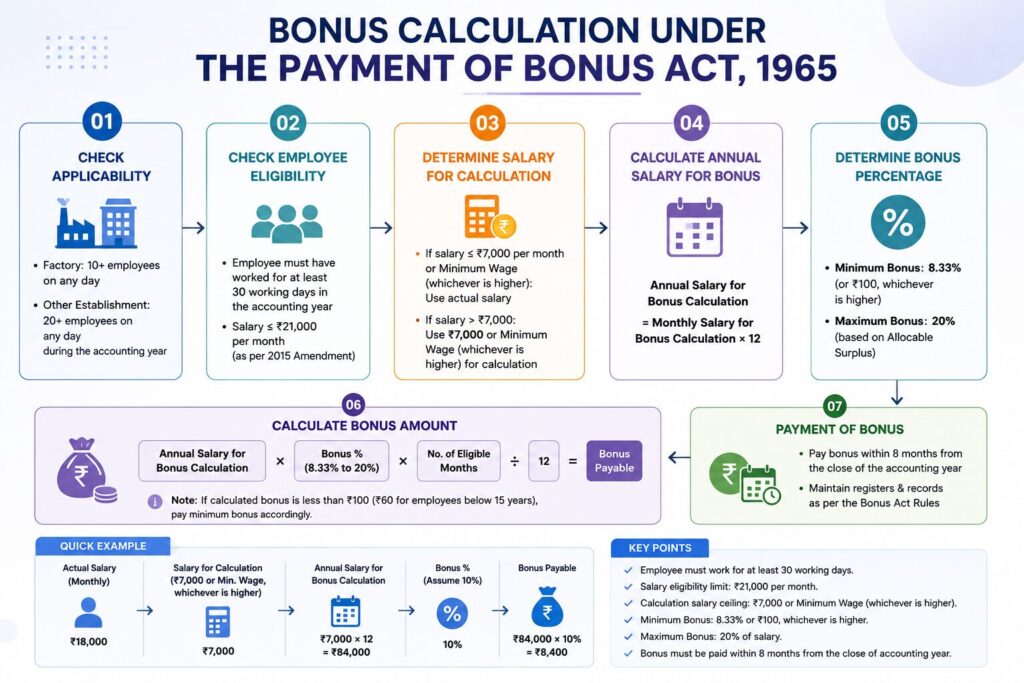
Understanding how bonus is calculated is one of the most important aspects of the Payment of Bonus Act, 1965. While the calculation may seem complicated at first, it becomes much easier once you understand the salary limits, calculation ceiling, and the minimum and maximum bonus percentages prescribed under the Act.
The Payment of Bonus (Amendment) Act, 2015 introduced significant changes to employee eligibility and the salary ceiling for bonus calculation, making it important for employers and payroll professionals to follow the updated provisions.
Salary Eligibility and Calculation Ceiling
The 2015 amendment revised the salary eligibility limit from ₹10,000 to ₹21,000 per month. This means employees earning up to ₹21,000 per month are eligible to receive statutory bonus under the Payment of Bonus Act, 1965, provided they satisfy the other eligibility conditions.
However, bonus is not always calculated on the employee’s actual salary.
As per Section 12 of the Act, where an employee’s salary exceeds ₹7,000 per month or the minimum wage fixed by the appropriate government for the scheduled employment (whichever is higher), the bonus must be calculated on ₹7,000 or the applicable minimum wage, whichever is higher, rather than on the actual salary.
This distinction is one of the most commonly misunderstood provisions under the Bonus Act.
Formula for Bonus Calculation
The basic formula for calculating bonus is:
Bonus = (Salary for Bonus Calculation × Bonus Percentage × Number of Eligible Months) ÷ 12
The bonus percentage can range from:
- Minimum Bonus: 8.33%
- Maximum Bonus: 20%
The exact percentage depends on the allocable surplus available with the employer after considering the provisions of the Act.
Example 1: Employee Earning ₹18,000 per Month
Let’s understand this with a practical example.
Suppose an employee earns ₹18,000 per month and has worked throughout the accounting year.
Since the employee earns less than ₹21,000 per month, they are eligible for bonus under the Payment of Bonus Act, 1965.
Assume the applicable calculation ceiling is ₹7,000 per month.
Annual salary for bonus calculation:
₹7,000 × 12 = ₹84,000
If the employer declares the minimum bonus of 8.33%:
₹84,000 × 8.33% = ₹6,997
Therefore, the employee will receive approximately ₹6,997 as statutory bonus.
Example 2: Employee Covered by Higher Minimum Wages
Suppose an employee earns ₹20,000 per month, but the applicable minimum wage notified by the government is ₹9,500 per month.
Since ₹9,500 is higher than ₹7,000, the bonus will be calculated on ₹9,500.
Annual salary for calculation:
₹9,500 × 12 = ₹1,14,000
If the company declares a 10% bonus, the employee will receive:
₹1,14,000 × 10% = ₹11,400
This example highlights why employers must always check the applicable minimum wages before calculating bonus.
Example 3: Maximum Bonus
Assume the company has sufficient allocable surplus and declares the maximum bonus of 20%.
Annual salary for calculation:
₹84,000
Maximum bonus:
₹84,000 × 20% = ₹16,800
Thus, the employee would receive ₹16,800 as statutory bonus.
What Is Allocable Surplus?
The percentage of bonus payable under the Payment of Bonus Act, 1965 is determined based on the allocable surplus available with the employer.
In simple terms, allocable surplus refers to the portion of an establishment’s profits that can legally be distributed as bonus after making the deductions specified under the Act.
The higher the allocable surplus, the higher the percentage of bonus an employer may declare, subject to the statutory maximum of 20%.
Understanding Set-On and Set-Off
The Payment of Bonus Act, 1965 also introduces the concepts of Set-On and Set-Off to ensure fair distribution of bonus across different financial years.
- Set-On: If an employer has excess allocable surplus after paying the maximum bonus of 20%, the remaining surplus can be carried forward for up to four accounting years. This amount may be used for bonus payments in future years when profits are lower.
- Set-Off: If there is insufficient allocable surplus to pay the minimum bonus, the deficiency can be carried forward and adjusted against future surpluses, as permitted under the Act.
These provisions help maintain consistency in bonus payments despite fluctuations in business profits.
Employer Responsibilities Under the Payment of Bonus Act, 1965
Compliance with the Payment of Bonus Act, 1965 involves more than simply paying bonus. Employers are expected to:
- Determine whether the establishment falls under the bonus act applicability provisions.
- Verify employee eligibility based on salary and working days.
- Calculate bonus accurately using the prescribed formula.
- Consider the applicable minimum wage while calculating bonus.
- Maintain statutory registers and records.
- Pay bonus within the prescribed time limit.
- Ensure compliance with the latest rules, amendments, and government notifications.
Many organizations now use HRMS and payroll software to automate statutory bonus calculations, reduce manual errors, and simplify compliance with the Payment of Bonus Act, 1965.
Conclusion
Managing statutory bonus doesn’t have to be complicated. By understanding the Payment of Bonus Act, 1965, including its applicability, eligibility criteria, and calculation rules, businesses can ensure timely bonus payments, remain compliant with labour laws, and build stronger employee trust.
With Savvy HRMS, managing bonus calculations and statutory compliance becomes simple and hassle-free. From automated payroll processing to accurate bonus calculations and compliance management, Savvy HRMS helps businesses save time, reduce errors, and stay fully compliant with the Payment of Bonus Act, 1965.











Take the complexity out of statutory bonus compliance with Savvy HRMS.
Manage bonus calculations, payroll processing, and labour law compliance accurately, all from a single platform.
Frequently Asked Questions (FAQs)
1. What are the rules for the Payment of Bonus Act, 1965?
Under the Payment of Bonus Act, 1965, eligible employees must receive an annual bonus based on their salary and the company’s profits. The minimum bonus is 8.33% of eligible wages, while the maximum is 20%, subject to the Act’s provisions.
2. What is the ₹21,000 limit under the Payment of Bonus Act?
The ₹21,000 per month limit is the salary eligibility threshold under the Payment of Bonus Act. Employees earning up to ₹21,000 per month are eligible for statutory bonus, provided they meet the prescribed service conditions.
3. Is bonus payable on ₹7,000 or minimum wages?
Bonus is calculated on ₹7,000 per month or the applicable minimum wage for the scheduled employment, whichever is higher, even if the employee’s actual salary is higher (subject to the Act’s eligibility provisions).
4. What is the eligibility limit for payment of bonus?
To qualify for bonus under the Act, an employee must:
• Earn up to ₹21,000 per month.
• Have worked for at least 30 working days in the accounting year.
• Be employed in an establishment covered under the Payment of Bonus Act, 1965.