

Paid Leave: A Complete Guide for Employees and Employers


-
AuthorRuchika Rajput
-
 Last Updated
June 18, 2026
Last Updated
June 18, 2026
-
 Reading Time
9 Mins
Reading Time
9 Mins
Imagine planning a family vacation or dealing with an unexpected personal situation while worrying about losing your salary. Sounds stressful, right? That’s exactly why paid leave has become one of the most valued employee benefits today.
Employees don’t just look for a good salary anymore; they also want workplaces that support their well-being and understand the importance of taking time off. For employers, offering paid leave isn’t simply about compliance; it’s about creating a positive work culture, preventing burnout, and keeping employees motivated and productive.
In this blog, we’ll break down everything you need to know about paid leave, including its meaning, types, legal provisions in India, and the benefits it brings to both employees and organizations.
What is Paid Leave and Why Does It Matter?
The term paid leave implies that the employee takes days off but still receives his or her salary. As opposed to unpaid leave, employees do not experience financial loss when taking time off.
Paid leave is primarily about maintaining balance. Work is significant, but rest, wellness, and personal matters are essential too. If there is no appropriate leave system in place, employees may find themselves overworked, causing stress and poor performance.
But why does it matter so much?
- It guarantees financial stability for employees on days off.
- It promotes better health conditions both mentally and physically.
- It increases employee satisfaction and loyalty.
- It complies with labour laws and regulations.
In the modern workplace, paid leave is a component of a more comprehensive paid time off (PTO) policy, allowing for the efficient management of various leave types.
What Are the Benefits of Paid Leave for Employees and Employers?
Paid leave is not only advantageous for employees, but it also benefits organizations. If implemented successfully, it brings mutual gain for both parties.
For Employees
1. Maintains Work-Life Balance
With paid leave, workers can take time off without fear of reduced pay, resulting in balanced work and personal life.
2. Improved Health and Well-being
It ensures that workers do not neglect their health needs by availing sick leave whenever required.
3. Financial Security
Workers do not face loss of income whether they take leave for maternity, paternity, or simply because they are ill.
4. Increased Job Satisfaction
Workers feel valued when the organization takes care of their welfare by offering employee benefits.
For Employers
1. Increased Productivity
Employees who get enough rest are productive. Periodic breaks result in higher efficiency and concentration.
2. Stronger Employee Retention
A proper leave management system decreases employee turnover rates. Employees tend to stay with organizations that understand the value of personal time.
3. Positive Workplace Atmosphere
A proper leave management policy helps build trust and promotes healthy workplace environments.
4. Compliance with Labour Laws
Leave management facilitates compliance with Indian labour laws.
Different Types of Paid Leave of Absence
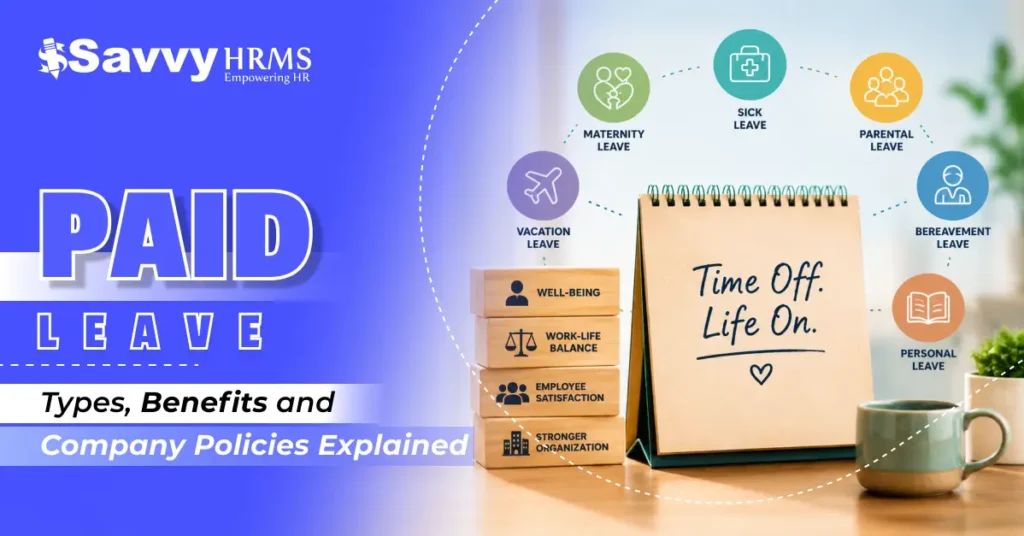
Organizations offer different types of paid leave depending on their policy and legal requirements. Here are the most common ones:
1. Casual Leave (CL)
Casual leave is taken when there is some urgent personal work that the employee wishes to attend to. Casual leave is usually restricted by numbers annually.
2. Sick Leave (SL)
Sick leave is taken when the employee is unwell due to health reasons. In some organizations, it might be necessary to provide medical proof in case of long sick leaves.
3. Privilege Leave (PL) / Earned Leave
Also referred to as earned leave, privilege leave is one which is accumulated over time by the employee depending on the number of working days.
4. Maternity Leave
Maternity leave is granted to female employees both pre-birth and post-birth. Maternity leave in India provides up to 26 weeks of paid leave for eligible employees.
5. Paternity Leave
Paternity leave is a special leave which gives male employees an opportunity to look after their wife and child during the initial stages after birth. It is not necessarily mandatory under all labour laws.
6. Bereavement Leave
This leave can be taken by employees when there is a death in their family, thus giving them time to cope with their bereavement.
7. Paid Time Off (PTO)
In some cases, companies combine various leaves and give them under one policy called PTO.
8. Leave Encashment
In most companies, privileges that remain unused can be turned into cash. This process is termed leave encashment.
What is the Difference Between Paid Leave and Unpaid Leave?
Here’s a clear comparison to understand the difference:
| Aspect | Paid Leave | Unpaid Leave |
| Salary | Employee receives full salary | No salary is paid |
| Purpose | For planned or approved absence | Usually, for extended or special cases |
| Types | Sick leave, casual leave, maternity leave, privilege leave | Vacation, long-term personal leave |
| Employee Benefits | Included as part of employee benefits | Not generally included |
| Approval Process | Easier approval within policy limits | Requires special approval |
| Impact on Work-Life Balance | Supports balance and well-being | May cause financial stress |
| Compliance | Often governed by labour laws | Depends on company policy |
How Does Paid Leave Work for Employees?
Paid leave isn’t just about taking days off; it involves a structured process within organizations.
1. Leave Accrual
Some types of leaves, like privilege leaves, are collected over time. This is where paid leave accrual comes into play. For example, a staff member can accumulate 1.5 leaves per month.
2. Leave Application
Leave applications by employees take place through HR software tools according to organizational rules and management schedules.
3. Leave Balance
Organizations keep tabs on leave balances, including utilised, available, and leave carried forward.
4. Leave Encashment
Leaves that are not taken can be encashed at year-end or resignation period based on organizational rules.
5. Leave Payroll and Taxation
Leave pay is included in the payroll process. In certain instances, leave encashment is taxable as per Indian laws.
What Are the Paid Leave Rules in India?
Paid leave in India is governed by particular labour laws that define how much leave employees are entitled to, how it is calculated, and how it should be managed by employers. While policies may vary across companies, they must align with these legal frameworks.
Below is the list of legislation and guidelines related to leave benefits:
1. Factories Act, 1948 (Earned / Privilege Leave)
The legislation mainly deals with factory workers and provides provisions on privileged leave:
- One leave day is earned per 20 working days
- Leave can be encashed under certain circumstances
- Leave can be carried forward
- Proper leave records have to be maintained by the employer
This legislation forms the cornerstone for computing paid leave in many organizations.
2. Shops and Establishments Act (State-wise Leave Rules)
This is the most relevant law for employees working in offices, IT companies, and commercial establishments.
While the state varies on the details of leave, generally:
- Casual leave: 7 to 12 days in a year
- Sick leave: 10 to 12 days per year
- Privilege (earned) leave: 12 to 21 days in a year
Policies need to conform to the minimum requirements of the state
3. Maternity Benefit Act, 1961 (Maternity Leave)
It covers paid maternity leave for female employees as follows:
- Paid maternity leave of up to 26 weeks
- For organizations having at least 10 employees
- Also covers adopted mothers
- The paid leave should be provided entirely
This ensures job security and work-life balance.
4. Sick Leave (State Law)
No central legislation exists for sick leave; it can be considered under:
- Shops and Establishments Acts (based on state level)
- Company policies
Important facts:
- Employees are entitled to a certain number of paid sick leaves
- Sometimes, medical certification could be necessary for prolonged periods
- Regarded as an integral component of employee perks
5. Leave Encashment (Laws & Taxes)
Leave encashment involves a monetary payment for unused leave.
- Covered under labour laws + Income Tax Act
- Primarily restricted to privileged leave
- Taxes applicable while still employed
- Tax breaks could be available on termination/retirement
6. Industrial Employment (Standing Orders) Act, 1946
The Act makes sure that organizations provide details about the leave policy within the organization:
- Employers should specify all types of leaves, such as casual leaves, sickness leaves, privilege leaves, etc.
- All rules regarding leaves should be written and communicated
7. Minimum Compliance Requirements for Employers
Organizations should make sure they comply with labour laws by doing the following:
- Offering minimum mandated paid leaves
- Keeping accurate leave records
- Using appropriate calculation procedures for paid leaves
Conclusion
Paid leave is not only about having some days off, but a significant aspect of creating a healthy, productive and legal working environment. The positive impact of an excellent leave policy may help not only employers but employees, too.
The administration of various leaves, proper paid leave calculation and compliance with labour laws is always complicated for any HR team. This is when intelligent HR systems become extremely useful.
Savvy HRMS allows organizations to easily manage leaves, approve them automatically, monitor leave balances and take care of payroll management without effort. All this ensures efficient human resources management processes along with better experiences of employees.
Are you ready to make leave management easy and effective?
Try Savvy HRMS now and change your leave management for the better!
Book a Demo TodayFAQ
1. What is paid leave?
Paid leave is leave taken by an employee while still receiving their regular salary from the company. It allows employees to take time off without losing pay.
2. What is the rule for paid leave?
Paid leave rules depend on company policy and labor laws. Employees usually need approval before taking leave and must have sufficient leave balance available.
3. What is PL leave?
PL stands for Privilege Leave or Earned Leave. It is earned over time and is mainly used for vacations, long breaks, or planned personal leave.
4. What is another name for paid leave?
Paid leave is also known as Earned Leave (EL), Privilege Leave (PL), Annual Leave, Vacation Leave, or Paid Time Off (PTO) in many organizations.
5. What is the difference between CL and PL?
CL is meant for short-term urgent needs and usually cannot be carried forward. PL is earned over time, can often be carried forward, and used for long vacations.