

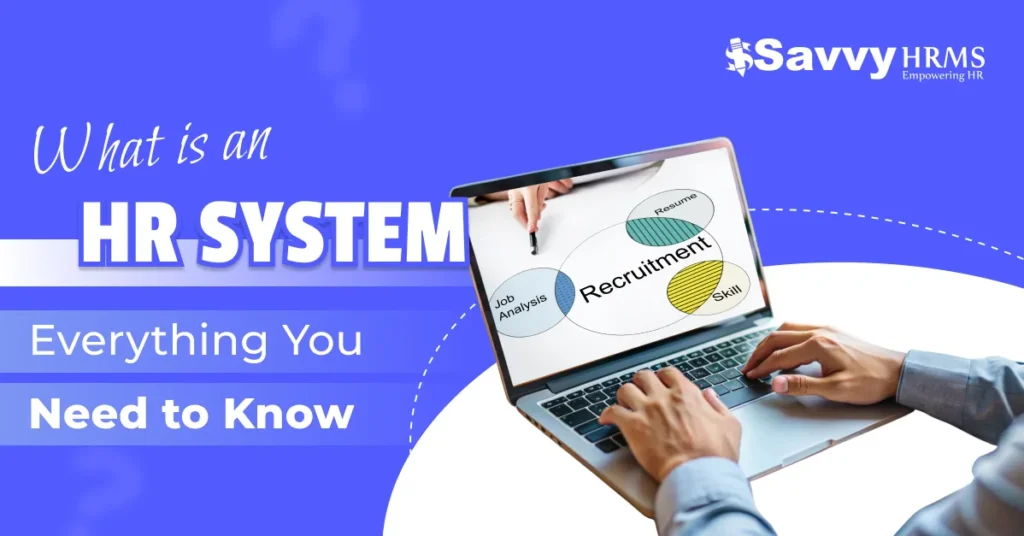
What Is an HR System? Everything You Need to Know


-
AuthorRuchika Rajput
-
 Last Updated
May 12, 2026
Last Updated
May 12, 2026
-
 Reading Time
14 Mins
Reading Time
14 Mins
The HR function today includes much more than just paperwork, policies, and payroll. It also focuses on building a connected, data‑driven workforce that can adapt to the rapid development of our current business landscape. However, far too often, HR teams are obstructed by dependence on spreadsheets, email chains, or other outdated tools, which block workflow and create a frustrating user experience for employees.
Is your HR team still utilizing manual processes?
Between tracking employee attendance, processing payroll, hiring, onboarding, and conducting performance reviews, disorganized systems and disconnected data create significant workloads in even simple HR functions. Not only does this impact time within HR, but it also can negatively affect the employee experience, HR compliance, and managerial decision-making.
The Solution? A modern HR System.
Modern-day HR systems use one centralized source of employee data to automate HR’s day-to-day tasks, and ultimately enable HR to drive complete results to the business. A modern HRMS solution enables users to have real-time data, allowing them to focus on strategic priorities rather than chasing after files or records. Whether you are an emerging business or a large organization, the right HR system will transform how your business hires, manages, and empowers its employees.
Ready to learn about how far HR technology has progressed, and how to select the best HR system for your organization? Let’s begin with this guide.
What is an HR system?
An HR System is a digital platform for storing and managing employee data and automating HR functions such as payroll, time and attendance, leave management, hiring, performance management, and benefits administration. An HR system (also known as HRIS or human resources information system, or HCM or human capital management) is generally the primary system of record for all HR-related information and workflows.
In addition to performing administrative tasks, new-generation HR systems often provide dashboards, analytics, and self-service portals, allowing employees and managers to perform many HR functions independently. This decreases the amount of time spent on HR tasks for HR and increases the visibility and experience of these types of transactions.
As a result, HR systems are now considered an important part of an organization’s overall infrastructure alongside financial and customer relationship management (CRM) systems in organizations with digitally mature businesses.
Why HR systems matter today?
HR departments are feeling the stress to be as efficient and productive with fewer resources. A modern HR System will help relieve any financial burden put upon them for maintaining a hybrid workforce; provide compliance by using technology to offer an excellent employee experience; simplify payroll, leave, and other business processes by centralizing data; and help make timely data-driven decisions by providing access to reliable data in real time, all through the use of technology.
This blog post will teach you:
- Definition of an HR system.
- The evolution of HR technology from record-keeping systems to artificial intelligence (AI) based HR systems that predict employee turnover, automate decision-making, etc.
- The difference between traditional HR systems and next-generation HR systems.
- The ‘Must Haves’ for an HRMS checklist and how to select the best HRMS for your organization.
How have HR Systems Have Developed Beyond Traditional HR Systems?
HR management systems are no longer just repositories but have developed into complete digital platforms utilizing cloud services, mobility, and AI. This represents a complete transformation from paper records to managed systems.
1. From Paper Files to Spreadsheets
Manual files, paper records, registers, and manual processing (such as payroll, attendance, and employee records) were historically slow and error-prone. Traditional spreadsheet applications improved the organization and calculation of data, but continued to leave data errors, version issues, and confidentiality concerns.
2. Rise of on‑premise HRIS and HRMS
Information and management systems offered a central repository of employee information and administrative automation for payroll, benefit management, and basic time tracking, but required a low level of financial investment, with the cost being high; they lack easily accessible customizations; required significant input from IT to make any modifications or upgrades.
3. Moving to Cloud‑Based HCM Platforms
Cloud-Based HCM and HR Platforms provide access to HR systems from anywhere, reduce infrastructure costs, and provide an opportunity for quicker implementation of solutions. Using a cloud-based HR system means having integrated modules for recruitment, performance management, learning & development, and employee planning on one system with self-service and mobile access.
4. The Rise of AI in the HR & Analytics Space
Today’s HR systems have AI and advanced analytics that provide capabilities beyond basic automation and reporting. With these capabilities, utilities built into the system can expect turnover rates, automate workflows, verify the accuracy of submitted information, and provide real-time analysis to support HR leaders and help them make more informed, timely decisions.
What are the Types of HR systems businesses use?
HR systems used by modern organizations broadly fall into two categories: completely manual HR management on one side and AI‑powered HRMS platforms on the other, with many organizations currently transitioning between the two.
Traditional HR systems: manual HR management
Manual HR management depends on paper files, spreadsheets, emails, and basic tools to run daily HR tasks, making processes slow, error‑prone, and difficult to scale as the organization grows.
1. Record-keeping via paper files
All the employees’ records, including information, contracts, and policies that relate to them, are stored in physical files. Keeping track of these records and filing them when they need to be accessed, updated, or audited can be time-consuming, and this can also present a risk due to the likelihood of documents getting lost or damaged.
2. Using Spreadsheets for Employee Data
Core HR data, such as salary, leave, attendance, and performance are stored in multiple spreadsheets. This can result in issues as well as duplicate entries, increasing the likelihood of data entry errors.
3. Scattered Emails for Approvals & Communication
Approvals for leave requests, expense claims, and employee HR queries are done via various email threads, and as such, tracking these communications, following up on items, and assuring accountability can be a challenge and also confusing.
4. Processing Payroll
HR teams calculate payroll manually or semi-manually, calculating salaries, deductions, overtime, and tax, which results in a high risk of errors as well as delayed payment and non-compliance with regulations.
5. Limited Reporting & Visibility
Generating reports on head count, turnover, attendance trends, and costs requires manual collection from different sources, which significantly slows down decision-making by HR and management.
6. Compliance by Checklists
Both statutory compliance and adherence to policies are tracked using checklists, reminders, and manual follow-up processes, which creates a substantial risk of deadlines being missed and documentation not being completed.
7. Heavy Reliance on Individual HR Staff
Knowledge of HR-related processes and related data is generally held by a few important individuals. This means that any absence or loss of any of these individuals will result in disruption and lack of continuity in the HR function.
AI‑powered HR systems: intelligent HRMS platforms
AI‑powered HRMS platforms digitize and centralize all HR processes while using artificial intelligence to automate tasks, surface analytics, and deliver a smarter, more personalized employee and employer experience.
1. Centralized Real-Time HR database
The HRMS stores employee records such as payroll information, attendance, performance, etc., into a single secure HRMS that is updated in real-time and can be accessed with the correct permissions.
2. Smart Automation of Routine Tasks
The system automates many of the repetitive day-to-day processes required by HR that would otherwise require significant amounts of manual work and human errors.
3. Use of AI to automate recruitment and onboarding
Artificial Intelligence is used to process large amounts of applications, rate the applicants, set up interviews, and assist with the digital onboarding process to allow for faster and more precise hiring of new employees with less manual effort.
4. Real-time attendance and payroll
The use of integrated attendance management will automatically flow to payroll for processing of employee pay, and AI will automatically point out any disturbances, missing punches, or any suspicious behavior prior to the processing and distribution of employee pay.
5. Predictive Analytics for workforce retention and skills
HRMS offers a predictive analytics engine that captures and analyzes trends in performance, engagement, and turnover, and through predictive analytics “proactively inform” HR on the risk of attrition, skill gaps, and hiring needs.
6. Personalized employee experience
Employees will receive customized learning recommendations, career paths, and suggestions that will take into consideration the employee’s role, performance, and interests, which will help in engagement and professional development.
7. AI Self-service portals for employees and managers
Employees and managers will have the capability to address Day-to-Day HR functions and inquiries through the use of self-service dashboards and chatbots that are available to perform these functions 24/7, thereby reducing the volume of tickets and improving the response times to HR inquiries.
What is the difference between traditional and AI‑powered HR systems?
| Dimension | Traditional HR system (HRIS/HRMS) | AI‑powered modern HR system |
| Core purpose | HR records will become digitized and centralized, and basic transactions (for example, payroll and attendance) could be automated. | Revolutionize the entire employee lifecycle through predictive analytics, automation, and intelligence. |
| Automation level | Rule-based workflows allow for limited support for standard processes and approvals. | Self-learning automation that adapts over time (like smart routing, AI chatbots, and automatic classification of requests). |
| Analytics | Standard reporting and some dashboards are mostly descriptive in nature and usually historical. | Advanced real-time analytics with prescriptive and predictive insights (e.g., attrition prediction, hiring efficiency, trends in engagement). |
| Employee experience | Basic self-service will be available and include limited personalization options. | Hyper-personalized experiences: conversational interfaces, customized learning paths, approaches, and recommendations. |
| Decision support | HR will be able to utilize systems efficiently, although managers tend to primarily use their intuition when making decisions. | Data-driven support to assist HR and leaders in making decisions based on predictive modeling and AI-driven insights. |
| Scalability & flexibility | New policies and processes will require customization and significant support from IT. | Highly configurable, modular, and cloud-based; new policies can be implemented rapidly with minimal dependency on IT. |
| Compliance & risk | Compliance reports are available in standard formats, but there will be limited efforts to proactively identify and reduce potential compliance risk violations. | Automated compliance (against regulatory violations) as well as alerts regarding abnormal behavior (e.g., attendance fraud, policy violations). |
| Technology stack | Most HR systems are on-premise or use older web implementations and have long update cycles. | Cloud native, mobile first, leveraging APIs, AI, and ML, and integrations with other business systems. |
What Are the Must-Have HR System Features for Today’s Organizations?
A modern HR system, whether traditional or AI‑based, should at a minimum offer these capabilities:
1. Centralized Employee Database
A central system for maintaining every employee’s information (such as personal data, job roles, and salaries), allowing for secure access based on roles.
2. Payroll & Statutory Compliance
Ability to automate payroll calculations, including taxes, benefits, bonuses, arrears, and all important reporting requirements, and can reduce errors & penalties.
3. Time, Attendance & Leave Management
Ability to manage shift schedules, track employee attendance (biometric, geo-fencing, or AI), and have visibility around leave workflows and policies.
4. Recruitment & Onboarding
Ability to support the hiring process by posting jobs, tracking candidates, screening candidates, generating offers, and the onboarding process (ideally with AI-assisted screening and scheduling).
5. Performance Management & Talent Management
Ability to set goals (OKR and KPI), request feedback, conduct performance appraisals, develop succession plans, and provide learning management systems to develop a high-performing culture.
6. Employee Self-Service and Manager Self-Service
Employee portals and mobile applications for employees to manage their profiles, request leaves, view payslips, submit expenses, and allow managers to approve and manage actions taken within their teams.
7. Data & Reporting
Prebuilt and customizable reporting dashboards include reporting against headcount, turnover, attendance, payroll costs, recruitment funnel performance indicators, and compliance measures.
8. Security, Access Control & Audit Trail Levels
Strong authentication (including single sign-on, multi-factor authentication, and facial recognition when applicable), particular role-based access control, and complete log files to support audit trails and data protection.
9. Integration & Ecosystem Support
Application programming interfaces (API) or connectors to accounting, enterprise resource planning (ERP), job boards, electronic signature (eSignature), background checks, and collaboration tools provide a smooth set of HR technology solutions.
How to choose the best HR system for your modern organization?
Selecting the right HR system is a strategic decision that affects every employee and manager. A simple, practical approach includes:
1. Understand what your HR and business needs are
Identify what your primary concerns are: payroll errors, lack of true visibility on attendance, manual onboarding, lack of complete analytics, and compliance risks. Identify if your focus will be primarily on transactional or strategic talent management, or both methods of implementation.
2. Outline features for must-have vs nice-to-have basis
Using the above list, identify which important features are needed at the point of implementation (payroll, leave, attendance) versus future release phases (advanced analytics, succession). This will ensure you do not purchase complex modules you will not immediately use.
3. Think about your organization size, sector, and geography
Smaller organizations might want to implement a more ‘lightweight’ alternative HR system, while mid and larger size organizations and multiple location businesses will require strong HCM alternatives with the ability to customize them further based on their business needs, including multi-policy support and localization, such as adhering to specific compliance requirements related to India.
4. Assess the user experience and adoption
Employees will not utilize a powerful system if they consider it hard to use. Look at the intuitive user interface, mobile versions of the application, the ability for employees to act autonomously, and the role-based dashboards for HRs, managers, and employee groups.
5. Evaluate AI & analytics capability
When planning for a more data-driven HR approach, identify solutions that provide analytics capabilities with integrated workforce analytics, actionable predictive insights, and automation powered by AI. Ask potential vendors to provide various examples of AI use cases (such as attrition forecasting, attendance metrics).
6. Verify scalability, configuration, and integration
Ensure that your HR system can grow with you, providing support for multiple sites, entities, policies, and modules without having to spend excessive time on periodic custom development. Check that the vendor’s HR solution integrates well with your existing payroll, ERP, and communication systems to avoid creating additional data errors.
7. Verify vendor credibility and support level
Assess both the vendor’s current customer base, their implementation support, training, support level agreements, and product innovation updates. Independent rating, case studies, and industry recognition should all help to verify a vendor’s trustworthiness.
Why Savvy HRMS is a strong choice?
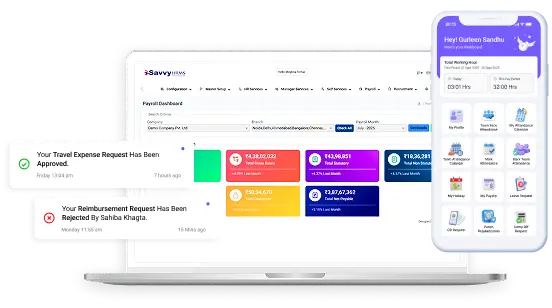
Savvy HRMS is a fully cloud-based HR and payroll system that helps to simplify HR processes from the beginning to the end of employment. The software allows you to hire and retire with greater efficiency through the use of multiple customizable modules for tracking your employees’ information, whether it be attendance, leaves of absence, payroll, recruiting, performance, training, expenses, or meeting compliance obligations.
For modern AI-enabled companies using AI-enabled systems, there are many benefits to using Savvy HRMS, such as:
- A highly configurable cloud-based platform.
- An AI-enabled workforce management solution that improves the employee experience.
- Multiple self-service roles and dashboards that provide easy access to your employees’ information.
- Complete automation of your HR and payroll processes.
- Demonstrated effectiveness in the marketplace.
Conclusion
Modern HR systems are no longer just back‑office tools; they act as the automated system of your workforce, influencing how people are hired, paid, developed, and retained. As HR technology shifts from traditional hr system to AI‑driven platforms, organizations that invest in data‑driven HR gain real benefits in agility, compliance, and employee experience.
When comparing HR systems, focus less on long feature lists and more on results: reduced manual work, faster and better decisions, and happier, more engaged employees. If you need an HR platform that combines deep HR and payroll automation with AI‑powered intelligence to support the future of work, Savvy HRMS is a strong partner for your HR transformation journey. Ready to see it in action?
Ready to grow your HR career?
Schedule a free demo of Savvy HRMS today and experience how an intelligent, cloud‑based HR system can simplify HR, improve productivity, and elevate your employee experience.
Book a Demo Today