




The payroll period begins, and the entire HR department starts juggling through spreadsheet calculations, attendance sheets, and other tasks. Time is running out, and mistakes start appearing. The manual nature of payroll processing becomes a major obstacle, slowing down the process of payroll processing and making it difficult to calculate salaries.
Besides wasting time, such a system creates compliance risks, payroll mistakes, and reduces the level of employee satisfaction. Delays in payment or even their inaccuracy may have a negative impact on the efficiency and productivity of the overall company. Companies lacking in innovative payroll solutions will experience difficulty in expanding their payroll operations due to inaccuracy and possible violations of legal regulations.
In this blog, we are going to analyze the way to save up to 85% of time using automated HRMS for payroll management.
How Does Traditional Payroll Processing Impact HR Efficiency?
The manual process of payroll takes a lot of time on the part of HR staff due to recurring actions such as data entry, data verification, and calculation. The activities require constant engagement, making it difficult for HR professionals to engage in strategic actions, thereby slowing down all HR activities within the organization.
With rising workload comes rising inefficiency, which results in errors, delays, and even mistakes. As such, it becomes difficult for HR to meet their deadline, negatively affecting employee productivity and efficiency levels. Ultimately, this lowers productivity and keeps HR from pursuing growth-focused efforts.
What is the Real Cost of Manual Payroll Processing Time?
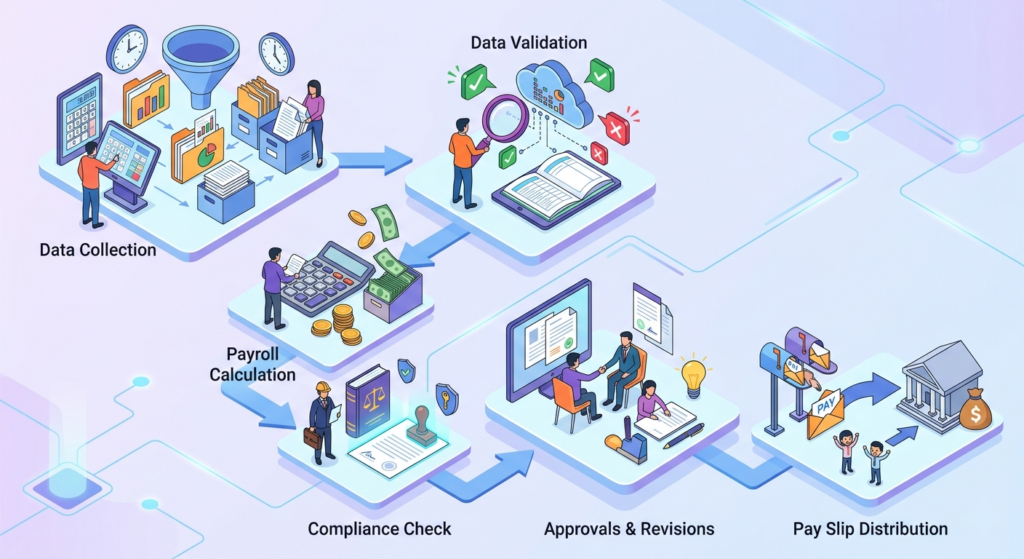
Manual payroll management not only involves time wastage, but it also results in inefficiency during various phases of the payroll cycle.
1. Data Collection (10-12 Hours):
Collecting data from multiple sources regarding employee attendance, leaves, and salaries consumes much time and energy in manual payroll management.
2. Data Validation (8-9 Hours):
Validation of data regarding attendance, overtime hours, and salary deductions is a manual procedure that is highly error-prone. Multiple validations waste valuable time.
3. Payroll Calculation (7-6 Hours):
Calculation of payrolls involving salaries, taxes, and other deductions consumes much time if done manually. Any errors in calculations mean further losses of time due to recalculations.
4. Compliance Check (6-5 Hours):
Manual checking for compliance with labor laws and regulations for making tax deductions consumes much time. Failure to comply means extra pressure and work.
5. Approvals & Revisions (4-3 Hours):
Involvement of multiple contributors in the approval process makes manual payroll management unmanageable and time-consuming because of frequent revisions.
6. Pay Slip Distribution (2-3 Hours):
Distribution of pay slips after their calculation manually requires time and effort and is an important aspect of payroll management.
What Are the Common Issues That Slow Down Payroll Operations?
Issue 1: Manually Entering Employee Data
Manually entering data related to employees from different sources takes time and causes mistakes. This process hinders the timely completion of the payroll process and creates unnecessary burdens for HR leaders.
Issue 2: Incorrect Attendance Records
Incorrect records of attendance of employees affect the timely completion of the payroll process. It is because HR leaders have to manually verify leaves, shifts, and overtime pay.
Issue 3: Complex Regulatory Environment
Following the constantly changing legislation on labor laws and taxes has become increasingly difficult. Such compliance procedures take time and increase the risk of making mistakes during the payroll process.
Issue 4: Non-integrated Software Systems
The lack of integration between systems dealing with HR, payroll, and finance makes the payroll process inefficient and increases its duration because data has to be transferred manually.
Issue 5: Various Changes During Payrolls
Changes in salaries and other variables during payroll calculations make the whole process time-consuming and stretch the time needed for their completion.
How Can HRMS Improve Payroll Processing Efficiency?

Having problems with inefficient payroll cycles and frequent errors? An HRMS helps make complicated activities easy by eliminating the need to perform repetitive procedures manually. Time saving, accuracy, and smooth operation guaranteed.
Imagine being able to perform your payroll operations quickly and with little intervention. All of your attendance, leave, and salary information can be stored in one database through an HRMS.
The outcome: timely information updates and efficient handling of payroll tasks.
Why stick to inefficient procedures when you can automate and make your processes faster and easier? An HRMS makes sure that all your payroll activities are performed efficiently, consistently, and with speed.
Elements That Make This Transition Possible:
1. Automated Data Consolidation
The HRMS tool integrates all systems related to attendance, leaves, and payroll systems. This means that there is no need to manually enter information, and it helps to eliminate any kind of duplication.
2. Automatic Payroll Calculations
With HRMS tools, calculations become automatic, ensuring higher accuracy. The HRMS tool allows instant processing of the information, thereby avoiding any potential inaccuracies that would come from manual payroll calculations.
3. Regulatory Compliance
It becomes easy to keep all the processes compliant with the statutory regulations, because HRMS tools take care of updating all the regulatory requirements and tax laws automatically.
4. Workflow Automation
Processes related to approvals become automated, meaning that decisions happen quicker and there is less need for HR intervention.
5. Access to Employee Portals
HRMS tools make it possible to introduce employee self-service portals. Employees will be able to view their payslips and perform other related actions, thus reducing the workload on HR managers.
6. Consolidated Data Access
All data related to payroll is contained in one system, which ensures better accessibility and reduces any mistakes that would arise from having broken data sources.
What Are the Steps to Reduce Payroll Processing Time by 85%?
Step 1: Start with Automating Data Entry
Still manually collecting data from different sources? It takes up most of your time. Automating attendance records, leave, and salary entry guarantees accurate and instant input, freeing you from manual tasks.
Step 2: Consolidate All Payroll Systems
Consistent payroll systems make your work smooth and flawless:
- No scattered information
- A single platform
- Instant synchronization
- Fewer errors
- Greater transparency
- More efficient access
Step 3: Establish Standard Procedures for Payroll Processing
Does your payroll system vary each month? Simplifying procedures eliminates dependency and creates uniformity, allowing your team to follow an unchanging procedure.
Step 4: Automation of Approvals and Processes
Time will be saved as there will be no more delays in processing due to manual follow-up of approvals:
- Fast approvals
- Without manual follow-ups
- Hierarchical structure
- Immediate notifications
- Low dependence
- Faster completion
Step 5: Use Real-Time Calculations
Why do manual calculations take you hours, when real-time payroll calculations can help you process all deductions and taxes instantly.
Step 6: Give Your Employees Self-Service Capabilities
Your employees can get payslips, make updates to personal data, and manage their leaves without assistance from HR. This helps save time on responding to queries and processing payroll data.
Step 7: Use Automation for Compliance
Afraid of compliance problems? Don’t be, automation ensures that your payroll remains compliant with rules without any issues or errors.
Which Features in HRMS Drive Maximum Payroll Time Savings?
1. Automated Data Integration
HRMS brings together attendance, leaves, and payroll information into one integrated system, thus reducing the need for manually inputting this information.
Using automated data integration ensures that less effort goes into correcting mistakes when data from different sources is matched in payroll systems.
2. Real-Time Payroll Processing
HRMS uses automated calculations for paying employees, calculating taxes, and making deductions in seconds without any human effort. The processing is done very quickly and accurately.
This feature reduces the processing time and the time wasted trying to make adjustments to payroll data.
3. Compliance Automation
Using HRMS ensures that payroll processes comply with tax laws and statutory obligations, as the HRMS updates itself regarding these matters.
By using automated compliance in HRMS, the risks associated with non-compliance are eliminated, and no time is spent verifying compliance.
4. Workflow Automation
Payroll processes can be automated through HRMS. This involves designing workflows that ensure approval happens automatically and quickly.
This removes the delay that would otherwise occur due to manual reminders and follow-ups by HR personnel.
5. Employee Self-Service Portal
Through an employee portal, employees can download payslips and perform other basic functions like updating personal information or requesting leave.
This minimizes the workload placed on HR personnel in payroll processes.
6. Centralized Management of Payroll Information
The HRMS stores all payroll information in one single place, thus making it easier for the HR department to access and manage it effectively.
Centralized management of payroll information can help the HR team avoid any confusion caused by accessing information from several sources.
7. Automatic Detection of Errors
The HRMS automatically detects any errors, thus notifying the HR department before completing the payroll process.
Automatic error detection will prevent any delays caused by the process of correcting errors made during payroll processing.
8. Reporting and Analysis of Payroll Data
The HRMS has powerful reporting capabilities that can help generate reports on payroll data quickly.
Reporting and analysis of payroll data will help organizations understand payroll trends and improve their payroll processing efficiency.
Real-World Results: How Companies Reduced Payroll Processing Time
Theory sounds good, but what really matters are outcomes. Let’s look at how companies actually reduced payroll processing time and transformed HR efficiency using automation and HRMS.
Small and Mid-Sized Company Success: From 22 Hours to Just 3 Hours
1. Company Profile
A medium-sized manufacturing company with about 165 employees had been using spreadsheets and manual approval methods for its payroll process.
2. The Problem
Payroll required almost 22 hours per payroll cycle. Data collection, calculation, error correction, and compliance checks slowed down the process. The month-end was always a hectic period, with various errors and continuous revisions being made.
3. What did They Improve?
Rather than continue with the existing payroll methods, they opted for an HRMS that emphasizes automation. Their attendance, payroll, and approval processes were integrated into one smooth solution.
4. The Outcomes
Within a couple of months, payroll processing time was cut down to 3 hours. Most processes were automated, errors were minimized, and approvals were quickened by electronic workflow methods.
5. Beyond Payroll Benefits
They managed to free up their payroll process time and could concentrate on more HR-related activities such as employee engagement, recruitment, and training programs.
Large Organization Transformation: Scaling Payroll Efficiency
1. Company Overview
The company was a big player in the field of health care and had more than 4,000 employees spread out at multiple locations, each having its own separate system for attendance, leaves, and payroll.
2. The Challenge
The payroll department required a lot of effort each month since it took a long time to collect the necessary information manually and make sense of it.
3. What did they improve?
The company adopted an effective and well-planned HRMS solution that brought about automation and integration among its various departments, mainly focusing on accuracy.
4. The Outcomes
The processing time of payroll was cut by more than 85%. The salary distribution was now consistent and error-free. Employee queries went down remarkably.
5. Beyond Payroll Benefits
Apart from saving a lot of time, the company received many other unintended benefits, such as cost transparency and greater audit readiness.
Conclusion
It does not have to remain difficult to process payroll. There are ways through which an organization can be able to save a lot of time and money while processing their payroll without having errors and without involving the HR department.
A company can consider adopting a solution like Savvy HRMS for all its payroll needs. In doing so, there will be a lot of benefits realized within the organization.
Are you ready to save 85% of your payroll processing time?
Book a Demo Today