



Have you ever asked yourself why some organizations find it easy to recruit the most competent individuals, whereas others find it difficult to keep their top performers? The difference is mostly due to their capacity to keep up with popular trends in HR management.
HR management has moved beyond basic recruitment and payroll processing in the ever-developing world of business. It has taken a strategic dimension as a means of developing organizational culture and increasing productivity. This blog will discuss the current trends in HR management.
How Is Human Resource Management Developing Today?

The field of HR Management is transforming from being an administrative department to being a strategic one. Companies are increasingly paying attention to employee experience, technological innovations, and evidence-based solutions to remain competitive in the rapidly transforming workplace environment.
1. Role of Artificial Intelligence and Automation
AI and automation are helping HR professionals automate routine activities such as resume review, onboarding processes, and payroll calculations, leaving them free to think strategically about organizational issues.
2. Flexible Working Models
The flexible working model allows employees to work in hybrid or remote formats without sacrificing their efficiency, teamwork, and work-life integration.
3. Employee Experience and Well-Being
Companies are placing more emphasis on creating a positive atmosphere in the workplace through employee satisfaction and psychological well-being.
4. Upskilling and Reskilling
Businesses are providing continuous learning training to equip their staff with the skills to change their jobs and adjust to technological changes, thus contributing to future development.
5. Data-Driven HR Strategies
The HR department is using data analytics in its decision-making process concerning recruitment, performance, and retention to improve the process and meet organizational objectives.
6. Diversity, Equity, and Inclusion (DEI)
Businesses are enhancing diversity and inclusion in the workplace to encourage creativity, improve employee happiness, and provide everyone with equal growth prospects.
7. Employee Retention Efforts
Organizations are focusing on retaining their employees through effective retention strategies that promote engagement, development, and positive workplace relations.
8. HR Technology and Cloud-Based Systems
Cloud-based HR systems are revolutionizing HR functions through improved processes, accessibility, and smooth collaboration within the organization.
What Are the Current Trends in Human Resource Management in 2026?
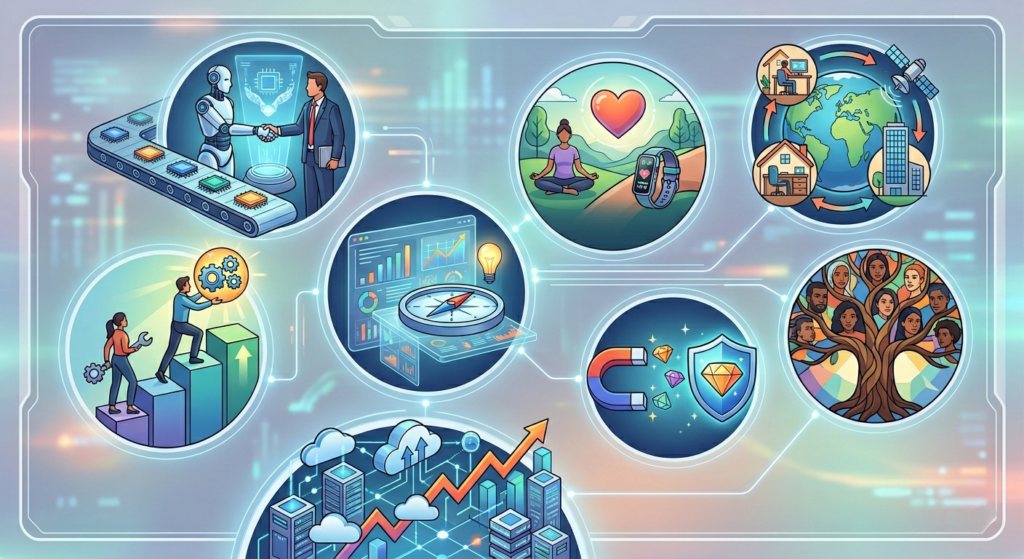
1. AI and Automation in HR
The use of artificial intelligence in screening applications is making the recruitment process more accurate, faster, and effective.
Automation in HR is making processes easier, quicker, and more efficient by removing the need for manual work, giving HR time for strategy formation.
2. Remote and Hybrid Working Models
Working remotely has allowed employees to strike a better balance between professional life and personal commitments.
Hybrid working models include working from the office and working from home, and are helping industries attract and retain their best talent.
3. Employee Experience and Wellness
Employee experience is becoming an important component and plays an important role in engagement and the success of the organization.
Workplaces today are focusing on providing better employee experience by creating supportive environments and investing in wellness programs.
4. Upskilling and Reskilling
With rapid changes in technologies, upskilling and reskilling have become important components of professional life.
Organizations are providing opportunities for continuous learning and skill development through various online and offline training programs.
5. Data-Driven Human Resource Decisions
HR analytics is being used to make predictions about employee behavior and improve recruitment and workforce planning processes.
Data-driven decisions improve HR effectiveness and eliminate biases by aligning HR goals with the business objectives.
6. DEI 2.0 (Diversity, Equity, and Inclusion) Initiatives
DEI is moving from a policy framework to a results-driven approach, with an emphasis on making a difference in organizational culture and leadership.
Inclusion and equality of opportunity are being achieved through data analysis and accountability measures in the organization.
7. Employee Retention
Employee retention efforts are becoming more personalized, addressing the needs of individual employees.
Organizations are providing employees with growth opportunities and benefits to reduce turnover.
8. HR Technologies and Cloud Solutions
HR technologies are incorporating artificial intelligence, analytics, and automation to offer the best experience to employees.
The cloud computing model provides flexible HR management systems.
Why Is It Important to Stay Updated with Current Trends in HR Management?
Staying informed about the current trends in HR Management is important for any organization to keep up with competition, hire talented individuals, and cater to evolving workforce needs. It is equally important for companies to enhance their performance, maintain compliance, and develop future-oriented human resource policies.
Here is why it really does matter:
1. Enables You To Be Competitive in Recruitment
Incorporating contemporary human resource management trends assists organizations in attracting talented individuals with better experiences, shorter recruitment periods, and unique recruitment strategies.
Example: Organizations employing artificial intelligence-based recruitment platforms save valuable time during the recruitment process.
2. Facilitates You To Respond To Evolving Employee Requirements
With employee requirements constantly evolving, HR needs to adapt and respond to new trends in the field.
Suggestion: Provide flexible work options for employees.
3. Enhances Your Application of HR Technology and Automation
Technology usage helps make the process more efficient and less prone to errors.
Trend: Cloud-based HR management software is now conventional among organizations.
4. Increases Employee Engagement and Retention
Contemporary HR approaches emphasize engagement, motivation, and well-being, which help in retaining staff and enhancing their productivity.
Example: The use of regular feedback mechanisms enhances worker satisfaction and loyalty.
5. Ensures Compliance with New Laws and Regulations
Remaining current allows you to comply with changing laws and regulations, thus avoiding penalties.
Tip: Ensure that you conduct HR policy audits to comply with new laws.
6. Fosters Innovation in HR Practices
Remaining current makes you more innovative and creative in your HR approach, thus giving you an edge over your competitors.
Trend: The application of data analytics to HR practices is transforming decision-making.
What HR Practices Are Likely to Become Outdated Soon?
As organizations continue to change, there will be a need to change some of the HR practices that have been traditionally used in most businesses.
Here are some HR practices that will soon become outdated:
1. Manual HR Practices
Using spreadsheets and paper records to manage information about employees has become less efficient than using HR software, which automates some tasks in the organization.
2. Fixed Working Hours
The 9-to-5 working culture, where employees have to report to their offices at certain times, has been overtaken by flexible working arrangements that focus on output rather than time.
3. General Employee Policies
HR strategies that are too general and cannot be personalized based on the unique needs of each employee are becoming increasingly ineffective in many organizations.
4. Performance Appraisals
Instead of conducting annual performance appraisals for employees, continuous performance feedback should be used in modern organizations.
5. Employee Training Programs
A lack of employee training programs and the failure to develop them is a sure way of lagging in any business environment.
6. Employee Well-being Neglect
Failing to consider the well-being of the workforce results in high employee turnover.
Conclusion
Current trends in HR Management indicate a movement towards technology, employee-friendly approaches, and data-driven decisions. By following this trend, an organization stands to benefit by being more efficient, having the best talent in its ranks, and enhancing a positive corporate culture.
One such HR solution for a modern business is Savvy HRMS. With this approach, businesses will be able to capitalize on innovation and stay relevant in the market through HR process automation.
Ready to take your HR practices to the next level? Try using current HR trends with Savvy HRMS now!
Book a Demo TodayFAQ
1. What are the latest trends in HR management?
The current trends in HR management involve designing a flexible and people-oriented work environment. The trends are as follows:
– Remote and hybrid work arrangements
– Artificial intelligence and automation in HR operations
– Promoting employee well-being and mental health
– Data-oriented HR management (People Analytics)
– Inclusion, diversity, and equity policies
– Continual learning and professional development opportunities
– Employee experience is a core aspect
2. What are the 7 pillars of HR?
The seven pillars of HR encompass the essential components needed for human resource management. They are:
– Recruitment and selection process
– Learning and development programs
– Performance appraisal and management
– Compensation and benefit packages
– Employee relations and communications
– Compliance and legal framework
– HR technology and analytics
3. What are the 2026 HR trends?
The future trends in HR for 2026 are driven by technology and employee-focused strategies. Key trends include:
– AI-driven recruitment and workforce management
– Skill-based hiring instead of degree-based hiring
– Hyper-personalization of employee experience
– ESG-focused HR practices
– Growth of gig and freelance workforce
– HR automation and self-service systems
– Focus on culture and purpose
4. What are the 7 C’s of HR?
The 7 C’s of HR focus on the attributes necessary for successful HR management:
Competence: Possession of appropriate skills and knowledge
Communication: Effective communication
Commitment: Commitment towards organizational objectives
Credibility: Gaining credibility in the organization
Collaboration: Effective collaboration
Creativity: Thinking outside the box
Compassion: Showing empathy towards employees