


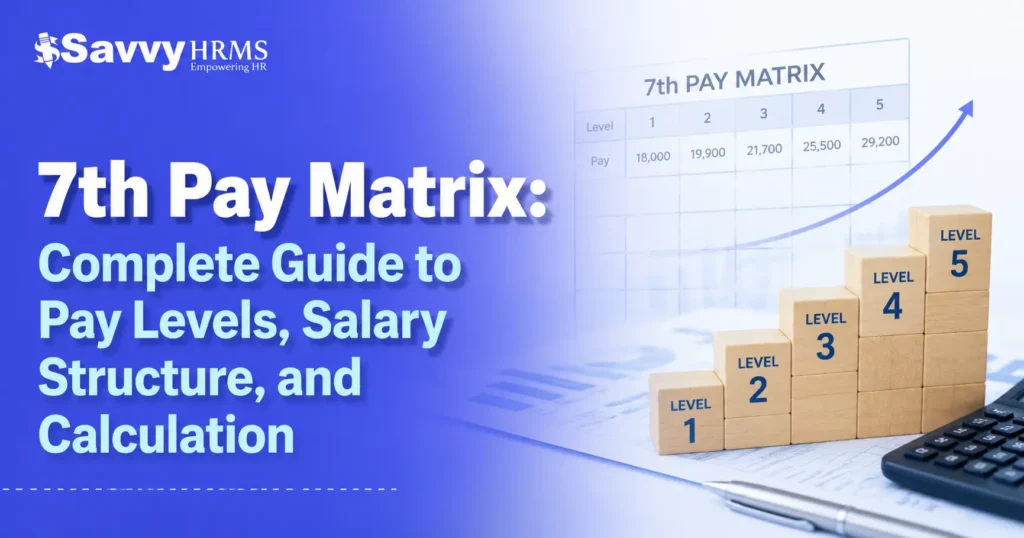

The 7th Pay matrix makes government salaries easier to understand by organising pay into clear levels and steps. This guide breaks down the matrix so HR teams and employees can quickly grasp pay structure, increments, and basic calculations.
Instead of old grade-pay rules, the 7th CPC links pay to level-based progression, giving predictable raises and clearer promotion impacts. Read on for simple examples, common implementation pitfalls, and how Savvy HRMS helps automate payroll, MACP, DA updates, and compliance.
Want to know how the 7th pay matrix actually affects your salary and HR processes?
Keep reading; this blog will walk you through pay levels, salary calculations, common implementation challenges, and practical tips to make payroll error-free.
What is the 7th pay matrix?
The 7th Pay Matrix, introduced by the Seventh Central Pay Commission (7th CPC), organizes pay into levels for central government employees. It replaces pay bands and grade pay with a matrix-based salary structure.
How it works
- Each post is assigned a pay level (1 – 18) that reflects responsibility and seniority.
- Every pay level contains multiple cells (steps) showing fixed basic pay amounts.
- New recruits start at the entry cell of their level; annual increments move them rightwards.
- Promotions move employees to the appropriate higher level with pay fixation rules applied.
- MACP and other upgrades shift employees to higher levels after set service periods.
- Dearness Allowance and allowances (HRA, TA) are calculated on the matrix basic pay.
Structure of the 7th pay matrix
Use this quick snapshot to understand the structure of the 7th pay matrix:
1. Pay levels and cells
Pay levels (1 – 18) represent job hierarchy; each level contains multiple cells showing step-wise basic pay increases across an employee’s career path.
2. Entry pay principle
Entry pay equals the minimum cell of the designated level; recruits start at cell 1 or an assigned entry level, with annual increments thereafter.
3. Level-based indexing
Level numbers reflect responsibility and seniority, replacing old pay band and grade pay taxonomy to provide clearer equivalence across departments and posts.
4. Matrix table format
The 7th pay matrix table lists basic pay for every cell in each level, providing a ready lookup for payroll and pay fixation exercises.
5. Indexation and pension link
Basic pay from the matrix affects pension calculations and DA indexing; accurate recording is essential for retirement benefits and long-term liabilities.
6. Promotion and hierarchy mapping
Positions map to levels via recruitment rules and hierarchy; promotions often lead to higher levels with specific pay fixation rules and possible financial upgradation.
How does salary progression work under the 7th pay matrix?
Use this quick guide to see how salary progressed within the 7th pay matrix:
1. Annual increment
Employees get an annual increment, moving one cell to the right in their level; this raises basic pay predictably year-on-year unless at the maximum cell.
2. Increment rate
Standard increment effectively equals about 3% of basic pay as a cell-to-cell movement, though the percentage varies slightly across levels and pay values.
3. Promotion effect
Promotion moves an employee to a higher level; pay fixation rules set new basic pay, ensuring the employee’s post-promotion pay is fair and often higher.
4. MACP and financial upgradation
Modified Assured Career Progression (MACP) awards financial upgradation to higher cells or levels after specified service durations to ensure career growth for long-serving staff.
5. Performance and promotions
Merit-based promotions or performance-linked schemes can accelerate level changes; such movements still follow pay fixation and organizational promotion guidelines.
6. Pay fixation rules
On promotion or recruitment, pay fixation applies the 7th CPC formula, fitment to the next appropriate cell, ensuring not less than the previous pay plus increment.
7. DA and allowances
Dearness Allowance, HRA, and other allowances are calculated on the basic pay specified in the pay matrix; DA revisions alter gross and take-home pay.
What is the pay level in the 7th pay matrix?
The 7th Central Pay Commission (CPC) Pay Matrix is a structured salary framework introduced for Central Government employees. It consists of 19 pay levels, each linked to a specific rank, designation, and level of responsibility. Every pay level includes 40 vertical cells, representing annual salary increments throughout an employee’s career progression.
The minimum basic pay under the 7th CPC Pay Matrix starts at ₹18,000, which applies to entry-level Central Government positions.
7th CPC Pay Matrix: Pay Levels and Salary Ranges
| Pay Level | Pay Range (₹) | Applicable Posts / Rank Examples |
| Level 1 | 18,000 – 56,900 | MTS, Peon |
| Level 2 | 19,900 – 63,200 | LDC, Driver |
| Level 3 | 21,700 – 69,100 | UDC, Steno |
| Level 4 | 25,500 – 81,100 | Junior Assistants, Stenographers |
| Level 5 | 29,200 – 92,300 | Head Clerks |
| Level 6 | 35,400 – 1,12,400 | Senior Auditors, Assistants |
| Level 7 | 44,900 – 1,42,400 | Inspectors, Section Officers, Assistant Accounts Officers |
| Level 8 | 47,600 – 1,51,100 | Assistant Section Officers |
| Level 9 | 53,100 – 1,67,800 | Senior Technical Assistants, Foreman |
| Level 10 | 56,100 – 1,77,500 | Scientific Officers, Assistant Professors, Captains |
| Level 11 | 67,700 – 2,08,700 | Deputy Superintendents, Majors |
| Level 12 | 78,800 – 2,09,200 | Junior Administrative Grade (JAG) Officers |
| Level 13 | 1,23,100 – 2,15,900 | Directors |
| Level 14 | 1,44,200 – 2,18,200 | Joint Secretaries, Senior Professors |
| Level 19 | 2,50,000 (Fixed) | Apex Positions (e.g., Cabinet Secretary) |
Note: Levels 15 to 18 are reserved for senior administrative positions and are not generally represented through standard incremental pay bands. High-ranking officials such as Secretaries and Principal Accountant Generals are placed within these higher pay levels.
Salary Growth Under the 7th CPC Pay Matrix
The Pay Matrix offers two primary methods of salary progression:
1. Annual Increment:
Employees advance vertically within their existing pay level each year. This movement generally results in a salary increase of approximately 3%.
2. Promotion-Based Progression:
When an employee is promoted, they move horizontally to a higher pay level. Their revised salary is then fixed at the next available higher cell in the promoted level, ensuring financial growth along with career advancement.
This structured approach makes the 7th CPC Pay Matrix transparent and easier to understand, while providing clear pathways for both annual increments and promotional benefits.
Key benefits of the 7th pay matrix for HR and employees
1. Simplified payroll management
Matrix standardizes pay levels and cells, enabling clear payroll rules and easier automation, reducing manual calculations and recurring errors in salary processing.
2. Transparent progression
Employees clearly see their level and cell progression; predictable increments and promotion impacts enhance trust and reduce pay-related disputes.
3. Consistent fixation rules
Uniform pay fixation rules on promotion or appointment remove subjective adjudication, simplifying HR decisions and reducing grievance incidence.
4. Integrated with pension
Matrix basic pay directly links to pension computation, simplifying retirement benefit calculations and ensuring consistent service-end entitlement records.
5. Easier allowance computation
Allowances such as HRA and DA derive from matrix basic pay, simplifying allowance formulas and making reconciliation during DA revisions straightforward.
6. Supports automation
The structured matrix fits HRMS well, allowing automated pay fixation, increment calculation, MACP triggers, and statutory compliance workflows.
7. Improved employee engagement
Clear career ladders and assured progression improve morale and retention, as employees understand timelines for increments and promotions.
Who is covered under the 7th pay matrix?
The 7th Pay Matrix is applicable to a wide range of Central Government employees, providing a standardized framework for determining salaries, increments, promotions, and retirement benefits. It covers personnel working in various government departments as well as members of the defence and paramilitary services.
The implementation of the 7th Pay Matrix is primarily for Central Government employees. However, many State Governments adopt similar pay structures or modify them according to their own policies and financial considerations.
The following categories are generally covered under the 7th Pay Matrix:
1. Civil Servants
This category includes government officers, administrative personnel, clerical staff, and employees working across different ministries, departments, and public offices under the Central Government.
2. Defence Personnel
Members of the Indian Army, Indian Navy, and Indian Air Force are covered under the 7th Pay Matrix. The pay structure helps determine their basic pay, annual increments, and promotional salary revisions.
3. Paramilitary Forces
Personnel serving in Central Armed Police Forces and other paramilitary organizations are also included under the pay matrix system. This includes employees of forces such as CRPF, BSF, CISF, and ITBP.
4. Pensioners
The benefits of the 7th Pay Matrix are not limited to active employees. The pay matrix framework is also used for calculating and revising pensions for retired Central Government personnel, ensuring consistency in post-retirement benefits.
Overall, the 7th Pay Matrix serves as a comprehensive salary and pension framework for Central Government employees, defence personnel, paramilitary forces, and pensioners, helping maintain a transparent and structured compensation system across different levels of government service.
Practical examples and calculation (brief)
To illustrate, consider an employee at pay level 7, cell 10 with basic pay of ₹44,900 (example value). Annual increment moves them to cell 11 per matrix. If DA is 40% and HRA is 24%, compute allowances on basic:
DA = ₹17,960
HRA = ₹10,776
Gross = basic + DA + HRA + statutory allowances (example)
On promotion to level 8, pay fixation rules apply, HR must calculate a new basic not less than prior pay plus increment, then place the employee in the appropriate higher cell.
Implementation checklist for HR teams
1. Review Applicable Pay Levels
- Identify the employee categories covered under the 7th Pay Matrix.
- Map existing positions to the appropriate pay levels.
- Verify salary structures against the latest government guidelines.
2. Complete Pay Fixation
- Calculate revised basic pay for all eligible employees.
- Ensure correct placement within the pay matrix.
- Double-check calculations to avoid pay discrepancies.
3. Update Payroll Systems
- Configure payroll software according to the new pay structure.
- Update salary components, deductions, and allowances.
- Test the system before processing payroll.
4. Revise Employee Records
- Update employee salary details and pay levels.
- Maintain proper documentation of salary revisions.
- Keep records ready for audits and compliance reviews.
5. Review Pension and Retirement Benefits
- Recalculate pension-related benefits where applicable.
- Ensure retirement benefits align with revised pay levels.
- Verify accuracy before implementation.
6. Communicate Changes to Employees
- Inform employees about salary revisions and pay levels.
- Share FAQs and explanatory documents.
- Address employee concerns and queries promptly.
7. Monitor Compliance
- Ensure implementation follows applicable government rules.
- Conduct periodic reviews to identify errors.
- Maintain compliance records for future reference.
8. Handle Grievances Efficiently
- Establish a process for resolving pay-related issues.
- Track employee complaints and resolution status.
- Take corrective action wherever necessary.
9. Conduct Final Verification
- Audit salary calculations and payroll outputs.
- Confirm that all updates have been implemented correctly.
- Obtain necessary approvals before final rollout.
Conclusion
The 7th CPC Pay Matrix has transformed the way salaries are structured for Central Government employees by introducing a transparent, level-based system that simplifies pay fixation, annual increments, promotions, and pension calculations. By replacing the earlier pay band and grade pay framework, it provides greater clarity for both employees and HR professionals.
Understanding pay levels, salary progression, allowances, and implementation requirements is essential for ensuring accurate payroll management and compliance. While organizations may face challenges such as pay fixation complexities, system upgrades, and administrative workload, these can be effectively managed through proper planning and automation.
For HR teams, leveraging a modern HRMS can significantly simplify 7th Pay Matrix implementation by automating salary calculations, managing increments, tracking promotions, and ensuring regulatory compliance. With the right processes and tools in place, organizations can improve payroll accuracy, reduce manual effort, and deliver a better employee experience.
Make payroll management faster, more accurate, and hassle-free with a modern HRMS platform.
Book a Demo Today