



Training of employees is no longer an option for any organization these days. Today’s organization needs to have capable employees to cope with changes in technology, processes, and the demands of the market. That is why it is important to know about the requirements of employee training.
A lot of organizations conduct training programs, but it doesn’t mean that all the training sessions are effective. Sometimes organizations conduct training of their employees when they actually don’t require that training. This causes a waste of time, effort, and other resources. Therefore, organizations first understand skill gaps before conducting any learning program.
Here comes the relevance of the TNA full form, that is, Training Needs Analysis. It helps organizations to know the type of training that employees need. This is necessary so that the learning and development activities conducted by organizations may be consistent with business objectives. In this blog post, we will find out about the meaning of TNA, its significance, objectives, methods, advantages, and HRMS software.
What is the TNA Full Form?
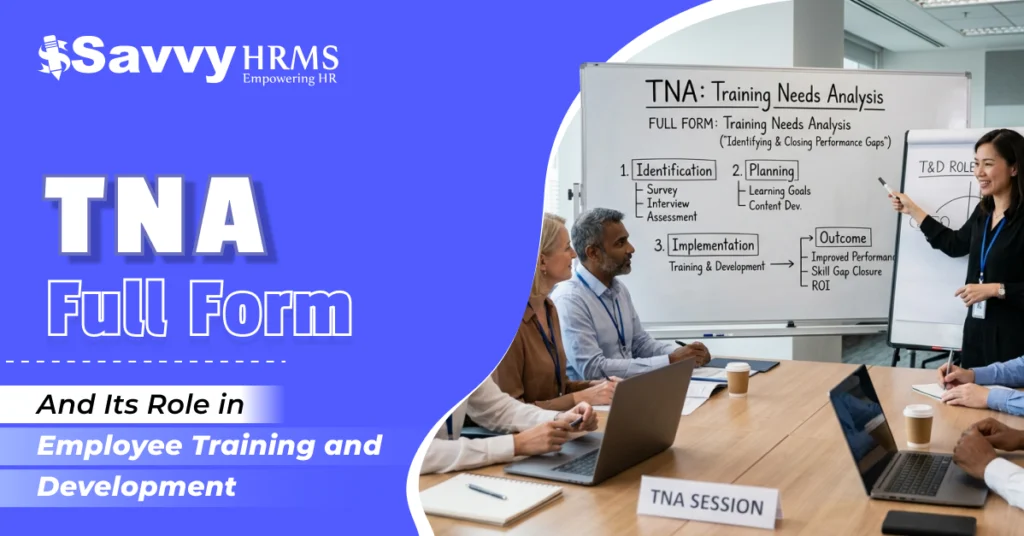
TNA Full Form stands for Training Needs Analysis. It is a method of analysis used to determine the difference between existing skills and knowledge of employees and the skills needed to do the job well.
To put it more simply, the Training Needs Analysis allows companies to understand:
- What skills do employees have now?
- What skills are lacking?
- What kind of training is needed?
- For whom and when?
This will help the company develop training programs that will help employees to grow professionally and help the business to succeed.
Why is TNA Important in Employee Training and Development?
Training without proper analysis often results in ineffective learning. TNA ensures that employees receive the right training at the right time.
Some reasons why TNA is important include:
1. Identifies Skill Gaps
Through TNA, the gaps in skill or knowledge required for the effective performance of an employee’s role can be determined. With TNA, organizations will have an opportunity to train employees based on what they lack.
2. Aligns Training with Business Goals
TNA enables organizations to align employee training programs with the goals set by the organization. Such alignment will help the organization to achieve its objectives and goals.
3. Improves Employee Performance
With relevant training, the performance of employees is bound to improve. Relevant training boosts the confidence of the employees, hence improving their performance.
4. Optimizes Training Investments
TNA helps organizations to allocate their money to training areas that are important for their business. This ensures that organizations do not incur losses through irrelevant training.
5. Supports Continuous Learning
Continuous learning is facilitated through TNA, which encourages employees to develop continuously through regular training.
Objectives of Training Needs Analysis (TNA)
The primary objectives of Training Needs Analysis are:
- Identify skill and knowledge gaps.
- Improve employee productivity.
- Enhance job performance.
- Support career growth and development.
- Increase employee engagement.
- Ensure efficient use of training budgets.
- Prepare employees for future roles and responsibilities.
- Strengthen organizational competitiveness.
By achieving these objectives, businesses can create a more capable and future-ready workforce.
Different Types of Training Needs Analysis
Training Needs Analysis can be divided into three major categories.
1. Organizational Analysis
This type focuses on identifying training requirements based on organizational goals, strategies, and future business needs.
For example, if a company plans to implement new technology, employees may require technical training.
2. Task Analysis
Task analysis examines specific job roles and determines the knowledge and skills required to perform those tasks effectively.
It helps organizations understand what competencies are essential for each position.
3. Individual Analysis
Individual analysis evaluates employee performance to identify personal skill gaps.
Performance reviews, assessments, and manager feedback are commonly used to determine individual training requirements.
Steps Involved in Conducting a Training Needs Analysis
An effective Training Needs Analysis involves several steps.
1. Identify Business Objectives
Organizations start by knowing what their business objectives are and how the training of the staff can be beneficial in achieving them.
2. Current Skills Assessment
A company evaluates the skills, performance, and knowledge of its employees in order to identify their strengths and weaknesses.
3. Skill Gap Identification
By comparing the skills and knowledge of employees and their desired job skills, organizations are able to identify the skill gaps in the company.
4. Prioritization of Training Requirements
Not all skill gaps have an equal priority for the organizations and hence require prioritization.
5. Designing Training Programs
In response to the identified skill gaps, organizations develop training programs and workshops that help improve the skills and knowledge of employees.
6. Implementation of Training
Staff members undergo the training, which is aimed at improving their skills and job performance.
7. Measuring Outcomes
The effectiveness of training programs is measured through the evaluation of changes in the performance of employees.
Role of TNA in Employee Training and Development
Training Needs Analysis plays a significant role in building an efficient workforce.
1. Helps Employees Acquire Relevant Skills
Training Needs Analysis ensures employees receive the right training based on their responsibilities, helping them develop skills that directly improve job performance.
2. Enhances Productivity
Well-trained employees can complete tasks more efficiently and accurately, leading to higher productivity and contributing to overall organizational growth and success.
3. Supports Career Development
TNA identifies opportunities for employee growth and helps prepare individuals for future responsibilities, leadership roles, and long-term career advancement.
4. Increases Employee Engagement
Employees feel more valued when organizations invest in their development, which boosts motivation, job satisfaction, and overall workplace engagement.
5. Promotes Succession Planning
By identifying required competencies, organizations can prepare high-potential employees for leadership positions and ensure smooth transitions in critical roles.
6. Builds a Learning Culture
Continuous skill development encourages employees to embrace learning, adapt to change, and contribute to innovation and long-term organizational success.
What are the Methods Used for Training Needs Analysis?
Organizations use various methods to conduct Training Needs Analysis effectively.
1. Employee Surveys
Through employee surveys, organizations can collect information on learning needs, skill deficiencies, and expectations, allowing HR teams to plan better training programs.
2. Interviews
Interviews are held by managers and HR specialists in order to learn about employee difficulties, career goals, and skills development needs.
3. Performance Appraisals
Information collected through performance appraisals can be very helpful in understanding what strengths and weaknesses employees have and where they might need training.
4. Observation
Observation by supervisors of employees working helps to understand their weaknesses and find areas of possible skill development and improvement.
5. Skills Assessment
Through testing and assessment, organizations can get a clear idea of what skills employees already have and where there might be a gap in them.
6. Feedback and Reports
Information received through customer feedback, manager evaluations, and productivity reports can be useful for identifying training needs and improving employee performance.
What are the Benefits of TNA for Organizations?
Implementing Training Needs Analysis provides several advantages.
1. Improved Employee Performance
Training Needs Analysis helps employees develop relevant skills and knowledge, enabling them to perform their responsibilities more effectively and achieve better results.
2. Better Return on Training Investment
Organizations can allocate resources to meaningful training programs, ensuring maximum value while avoiding unnecessary expenses on ineffective learning initiatives.
3. Increased Employee Satisfaction
Providing learning and development opportunities boosts employee morale, engagement, and job satisfaction, creating a more positive workplace environment.
4. Higher Productivity
Skilled employees complete tasks more efficiently and accurately, helping organizations improve productivity and achieve better business outcomes.
5. Reduced Skill Gaps
TNA enables organizations to identify and address competency gaps continuously, ensuring employees possess the skills required for their roles.
6. Enhanced Organizational Growth
A well-trained workforce helps businesses adapt to changing market demands, improve efficiency, and support long-term organizational growth.
7. Stronger Competitive Advantage
Continuous learning and employee development allow organizations to stay ahead of competitors and respond effectively to evolving industry trends.
How HRMS Software Supports Training Needs Analysis
Managing employee training manually can become challenging, especially as organizations grow. HRMS software simplifies the process by providing data-driven insights and helping HR teams identify learning requirements more efficiently. It ensures that training initiatives are aligned with employee performance and business goals.
Some ways HRMS software supports Training Needs Analysis include:
- Performance tracking helps identify areas where employees need additional training.
- Skill and competency management make it easier to detect skill gaps.
- Centralized employee records provide easy access to performance management and qualification data.
- Learning and development tools simplify training assignments and monitoring.
- Real-time reports and analytics support better decision-making.
- Workforce planning helps prepare employees for future roles and responsibilities.
- Automation reduces administrative work and improves efficiency.
- Training effectiveness can be measured through performance insights and reports.
Modern solutions like Savvy HRMS make Training Needs Analysis more organized and efficient, helping organizations build a skilled and future-ready workforce.
Conclusion
Understanding the TNA full form, which stands for Training Needs Analysis, is essential for every organization that wants to build a strong and capable workforce. TNA helps businesses identify skill gaps, design effective learning programs, and improve employee performance.
By conducting Training Needs Analysis regularly, organizations can ensure that employees receive the right training at the right time, leading to increased productivity, higher engagement, and long-term business success.
Modern solutions like Savvy HRMS further simplify training management by providing data-driven insights, performance tracking, and workforce development tools, making employee learning more effective and organized.











Looking to simplify employee training and workforce development?
Discover how Savvy HRMS can help you identify skill gaps, simplify learning processes, and build a future-ready workforce.