




Provident Fund is one of the most important retirement benefits available to salaried employees in India. Yet, many employees and employers are still unsure about how the PF contribution rate works and how much is actually contributed every month. Understanding these contributions can help employees plan their savings better and ensure businesses stay compliant with EPF regulations.
If you have ever wondered why a certain amount is deducted from your salary or how your employer contributes to your EPF account, you’re not alone. From contribution percentages to wage ceilings and tax benefits, there are several aspects that influence your Provident Fund savings.
In this blog, we will break down the current PF contribution rate, explain how EPF calculations work, and explore how businesses can simplify EPF compliance with modern payroll software.
What Are the Current PF Contribution Rates in 2026?
Under the Employees’ Provident Fund (EPF) scheme, both employees and employers contribute 12% of the employee’s basic salary plus dearness allowance (DA).
Employee Contribution
- 12% of Basic Salary + DA goes directly to the EPF account.
Employer Contribution
The employer’s 12% contribution is divided into:
- 3.67% towards EPF.
- 8.33% towards the Employees’ Pension Scheme (EPS).
In some specified industries, the contribution rate may be 10% instead of 12%, depending on EPFO regulations.
Understanding the PF contribution rate helps employees know how much is being invested for their retirement every month.
How is the employer’s PF Contribution Split Between EPF and EPS?
Although employers contribute 12%, the entire amount does not go to the EPF account.
Here’s the breakup:
| Component | Percentage |
| EPF Contribution | 3.67% |
| EPS Contribution | 8.33% |
| Total Employer Contribution | 12% |
The EPS contribution is subject to a wage ceiling of ₹15,000, meaning the maximum monthly contribution towards EPS is ₹1,250.
Apart from this, employers also contribute towards EDLI and administrative charges.
How Is EPF Contribution Calculated? Step-by-Step Process
Understanding how EPF contributions are calculated can help employees verify salary deductions and give employers clarity on their statutory obligations. The PF contribution rate is calculated on an employee’s Basic Salary and Dearness Allowance (DA) and is shared by both the employee and the employer.
Here’s a step-by-step breakdown of the process.
Step 1: Determine PF Wages
EPF contributions are calculated on:
- Basic Salary
- Dearness Allowance (DA)
- Retaining Allowance (if applicable)
For example, suppose an employee has:
- Basic Salary: ₹25,000
- Dearness Allowance: ₹5,000
Total PF Wages = ₹30,000
Step 2: Calculate the Employee’s Contribution
Employees contribute 12% of their basic salary + DA to the EPF account.
Employee Contribution = 12% × ₹30,000 = ₹3,600
This entire amount is deposited into the employee’s EPF account.
Step 3: Calculate the Employer’s Contribution
Employers also contribute 12%, but this amount is split between EPF and EPS.
- 8.33% goes to the Employees’ Pension Scheme (EPS) (subject to a wage ceiling of ₹15,000).
- The remaining amount goes to the EPF account.
In this example:
- EPS Contribution = 8.33% × ₹15,000 = ₹1,250
- EPF Contribution = ₹3,600 − ₹1,250 = ₹2,350
Step 4: Determine the Total Monthly Contribution
| Contribution Type | Amount |
| Employee Contribution | ₹3,600 |
| Employer EPF Contribution | ₹2,350 |
| Employer EPS Contribution | ₹1,250 |
| Total Monthly Contribution | ₹7,200 |
This means ₹7,200 is being invested every month toward the employee’s retirement benefits.
For Example:
Suppose an employee earns a Basic Salary + DA of ₹30,000:
- Employee EPF Contribution: ₹3,600
- Employer EPF Contribution: ₹2,350
- Employer EPS Contribution: ₹1,250
- Total Contribution Every Month: ₹7,200
By understanding this calculation, employees can better track their retirement savings, while employers can ensure accurate payroll processing and compliance with EPFO regulations.
What Components of Salary Are Considered for PF Contribution?
PF contributions are calculated on:
- Basic Salary
- Dearness Allowance (DA)
- Retaining Allowance (if applicable)
The following components are generally excluded:
- House Rent Allowance (HRA)
- Bonus
- Conveyance Allowance
- Overtime
- Incentives
- Medical Allowance
This distinction is important because PF contribution rates apply only to eligible wage components.
What Is the Current PF Wage Ceiling, and Are Any Changes Expected?
Currently, the EPF wage ceiling is ₹15,000 per month.
This means:
- EPS contributions are capped at ₹15,000.
- Maximum EPS contribution by employer = ₹1,250 per month.
However, many organizations voluntarily contribute to higher salaries to provide greater retirement benefits to employees.
There have been discussions about increasing the wage ceiling, but any changes would depend on future EPFO notifications.
Can Employees Contribute More Than the Mandatory 12% Through VPF?
Yes.
Employees can opt for Voluntary Provident Fund (VPF), which allows them to contribute more than the mandatory 12%.
Key features of VPF:
- Contribution can go up to 100% of basic salary and DA.
- Employer contribution remains unchanged.
- VPF earns the same interest rate as EPF.
- Contributions qualify for tax benefits under Section 80C.
VPF is an excellent option for employees who want to build a larger retirement collection with low risk.
What Are the Tax Benefits of EPF Contributions?
EPF offers attractive tax advantages.
1. Employee Contributions
Employee contributions to EPF are eligible for tax deductions under Section 80C of the Income Tax Act, helping individuals reduce their taxable income while building retirement savings.
2. Interest Earned
The interest accrued on EPF balances is generally tax-free, provided certain conditions are met, allowing employees to grow their retirement collection efficiently.
3. Maturity Amount
EPF withdrawals made after completing five years of continuous service are generally exempt from tax, making EPF a highly beneficial long-term investment option.
4. Why EPF Is Tax-Efficient
With tax deductions on contributions, tax-free interest, and tax-exempt withdrawals, EPF offers a combination of benefits that makes it a tax-efficient savings instrument.
What Should Employers Include in Their EPF Compliance Checklist?
For employers, EPF compliance is crucial.
A proper checklist should include:
- EPFO registration.
- UAN generation for employees.
- Accurate PF contribution calculations.
- Monthly ECR filing.
- Timely payment of PF dues.
- Maintaining employee records.
- Handling employee exits and transfers.
- Ensuring compliance with EPFO guidelines.
Failure to comply can result in penalties and legal complications.
How Does Payroll Software Help Automate EPF Compliance?
Managing PF contributions manually can be time-consuming and prone to errors.
Modern payroll software simplifies the entire process by automating:
1. PF Contribution Calculations
Payroll software automatically calculates employee and employer PF contributions based on applicable rules, reducing manual errors and ensuring accurate deductions every month.
2. Salary Processing
Automated salary processing simplifies payroll activities by calculating earnings, deductions, and net pay, helping organizations ensure timely and accurate salary disbursement.
3. Monthly ECR Generation
Payroll software simplifies monthly Electronic Challan cum Return (ECR) generation, enabling employers to submit EPF contributions accurately and comply with EPFO requirements.
4. UAN Management
Efficient UAN management helps maintain employee records, track contributions, and simplify processes related to employee onboarding, transfers, and exits.
5. Compliance Reporting
Automated compliance reporting provides businesses with timely and accurate statutory reports, helping HR teams stay compliant with labor and payroll regulations.
6. Statutory Deductions
Payroll systems automatically manage statutory deductions such as EPF, ESI, and professional tax, ensuring compliance and minimizing the risk of errors.
7. Payroll Records and Audits
Digital payroll records and audit trails improve transparency, simplify documentation, and make it easier for organizations to handle internal and external audits.
This reduces manual work and ensures greater accuracy.
Conclusion
Understanding the PF contribution rate is important for both employees and employers. From knowing how much is deducted from salary to understanding employer contributions, tax benefits, wage ceilings, and VPF options, having clarity about EPF helps in better financial planning and regulatory compliance.
For businesses, staying compliant with EPF requirements doesn’t have to be complicated. With an automated payroll solution like Savvy HRMS, organizations can simplify PF calculations, ensure timely compliance, and manage payroll operations with confidence.

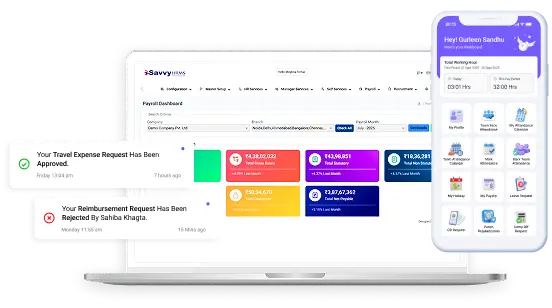









Ready to simplify payroll and EPF compliance?
Discover how Savvy HRMS can automate your payroll processes and help your business stay compliant effortlessly.