



If you deal with the calculation of payrolls, HR compliance, or even manage your own business in Andhra Pradesh, then knowing about the minimum wages in Andhra Pradesh 2026 is necessary for you.
The most recent revision came into effect from April 1, 2026, after which the government introduced changes only in the Variable Dearness Allowance (VDA). This will ensure that the employees can manage with the cost of living and inflation.
What’s more, this time, the change was introduced in the VDA itself rather than in the entire wages system. Thus, the employer should calculate their employee’s salary very carefully.
Here we will provide you with all the necessary information in a straightforward manner so that you can avoid confusion and maintain compliance.
What is the Minimum Wage in Andhra Pradesh?
Let’s start with the basics.
The minimum wage in Andhra Pradesh is the minimum remuneration employers must provide to employees in exchange for their work. The minimum wage varies depending on:
- Type of industry (Construction, factory workers, shop workers)
- Skill of employee (Unskilled, Semi-skilled, Skilled, Highly skilled)
- Zone (Urban and Rural areas)
Andhra Pradesh has revised its minimum wage for the year 2026 through an official circular dated April 1, 2026, covering 70+ Scheduled Employment categories, including changes to the VDA component.
Highlights of the revision in 2026:
- Increases mainly in VDA rates (basic wage remains unchanged)
- Approximate increase rates: 1.6%-2% for most industries and 3%-4% in the Security Services category
- Effective for all scheduled industries
- Stays within the scope of the Minimum Wages Act, 1948 (Transitional Period)
Essentially, wage revisions have taken place, but not significantly, yet compliance continues to remain crucial.
What are the Andhra Pradesh Zones Division for Minimum Wage Purposes?
Now, here’s something many employers overlook: zones.
Minimum wage rates vary from one area to another within Andhra Pradesh. The division is made based on zones that account for differences in the cost of living.
Zone Category:
Zone I (Urban/High Cost Areas)
Zone I comprises major urban areas where living expenses are quite high. The employees are paid better minimum wages to cover higher expenditures on rent, transportation, and other costs.
Zone II (Semi-Urban Areas)
Zone II includes municipalities and emerging towns with average living costs. The rate of pay is slightly lower compared to urban zones.
Zone III (Rural/Low Cost Areas)
Zone III consists of rural areas and underdeveloped regions with relatively low costs of living. The minimum wage rate is calculated accordingly.
For example:
A security guard who works in Zone I will be better off than one working in Zone III, even if the positions are the same.
What are the Current Minimum Wages for Shops and Establishments in Andhra Pradesh?
Let’s dive into the actual numbers. We will start with one of the most common sectors, shops and commercial establishments.
This category includes:
1. Retail shops
This category includes all retail businesses that directly sell products to consumers, and the workers involved in sales, billing, inventory, and consumer transactions.
2. Offices
These consist of all office setups where the employees execute administrative, managerial, and coordination duties.
3. IT jobs
This involves all jobs related to system maintenance, technical problem solving, software and hardware management, and ensuring proper functioning in the digital domain for all types of businesses.
4. Administrative personnel
This includes all people who manage organizational activities like record keeping, coordination, scheduling, and communication.
The salaries paid in this sector have been categorized according to job descriptions and not strictly according to skills.
1. Minimum Wages in Andhra Pradesh for Shops & Commercial Establishments
| Role | Skill Level | Zone | Basic (₹) | VDA (₹) | Total (₹) |
| Manager / Programmer | Highly Skilled | Zone I | 5,557 | 8,947 | 14,504 |
| Clerk / Assistant | Semi-Skilled | Zone I | ~4,102 | 8,947 | ~13,049 |
| Peon / Helper | Unskilled | Zone I | 3,700 | 8,947 | 12,647 |
- Increase vs 2025: ~1.6% – 1.9%
2. Andhra Pradesh Minimum Wages for Security Services
| Role | Skill | Zone | Basic (₹) | VDA (₹) | Total (₹) |
| Security Officer | Highly Skilled | Zone I | 7,500 | 8,998 | 16,498 |
| Security Guard | Unskilled | Zone III | 4,000 | 8,998 | 12,998 |
- Increase: ~3% – 4% (higher than other sectors)
3. Minimum Wages in Andhra Pradesh for Construction & Road Works
| Role | Skill | Basic (₹) | VDA (₹) | Total (₹) |
| Mason / Electrician | Skilled | 4,938 | 8,947 | 13,885 |
| Mazdoor / Labour | Unskilled | 3,370 | 8,947 | 12,317 |
4. Minimum Wages in Andhra Pradesh for Metal Foundries & Engineering
| Role | Skill | Basic (₹) | VDA (₹) | Total (₹) |
| Foreman | Highly Skilled | 6,050 | 8,668 | 14,718 |
| Helper | Unskilled | 3,263 | 8,668 | 11,931 |
5. Minimum Wages in Andhra Pradesh for Factory Workers
| Role | Skill | Basic (₹) | VDA (₹) | Total (₹) |
| Engineer / Manager | Highly Skilled | 10,322 | 13,073 | 23,395 |
| Helper / Watchman | Unskilled | 5,822 | 7,371 | 13,193 |
Wage Trend Insight (Bar Graph Representation)
Here’s a simplified trend showing how wages increased:
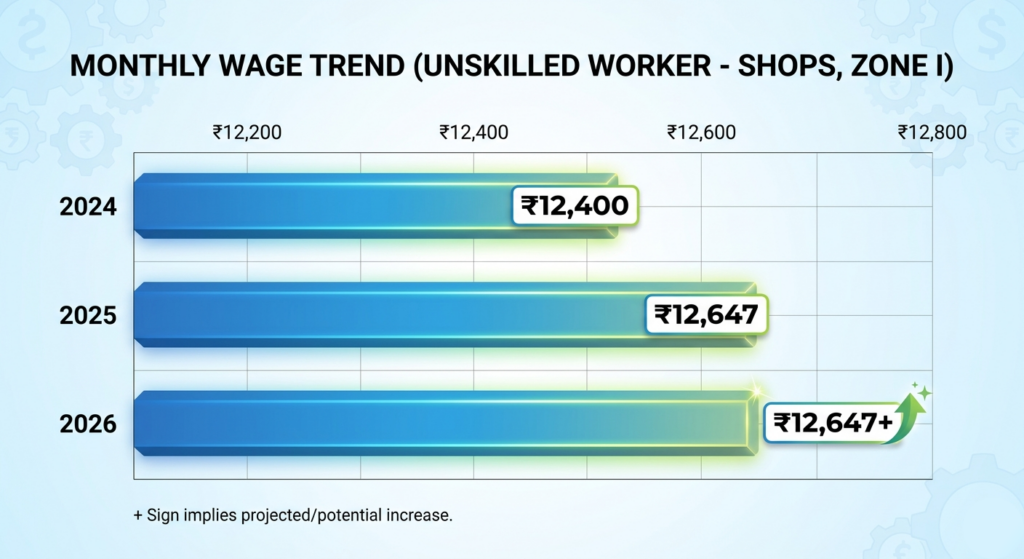
When speaking about “steady and not steep” growth, we refer to the fact that the increment of the minimum wages in Andhra Pradesh in 2026 does not involve any drastic jumps in the salaries payable by employers. Incrementation is slow and takes place at the rate of 1.6-2% per year in most industries. Thus, neither employees nor businesses will experience any significant changes. Payroll management will be smooth as usual.
However, “VDA-driven increments dominate” implies one particular feature of salary revisions in Andhra Pradesh. Namely, unlike in previous years when minimum wages had been revised with the purpose of adding something extra to the employees’ pay, in 2026, the government left the basic salary untouched while raising the VDA.
To explain this point better, one can conclude that:
- Incrementations are related to the rate of inflation
- Cost of living is taken into account while revising salary frameworks
- Basic wages are not revised on purpose to ensure the uniformity of the salary system
Thus, from the employers’ perspective, payroll management in 2026 will be easier because there is no need to revise salary structures. All that is required is to update the part of the salary framework associated with the VDA.
How is VDA Calculated and Why Does It Matter?
Understanding VDA will go a long way in helping you understand the importance of payroll management. Let us now understand how VDA is computed.
Calculation of VDA
VDA is directly proportional to the Consumer Price Index (CPI). The government makes periodic observations on CPI trends and then makes suitable revisions to the rate of VDA.
Basically, VDA calculation depends on the following:
- Fixed base CPI at the time of fixing of salary or wages
- An increase in CPI above the base results in an increase in the rate of VDA
- This increase is based on a predetermined rate for each CPI point
Therefore,
- If there is an increase in inflation → Increase in VDA
- If there is no change in inflation → Minimal change in VDA
- If there is a decrease in inflation → No change in VDA
VDA for Andhra Pradesh is usually revised twice a year, once in April and again in October.
Notably, the VDA is more than an accounting process; the process helps in ensuring that employees are compensated effectively while at the same time allowing employers to comply legally.
1. Safeguard Against Inflation
When prices for basic needs such as food, accommodation, and transport rise, VDA guarantees that employees’ salaries do not depreciate in value due to increased costs.
2. Maintains Currency of Salaries
Without necessarily undergoing a full review, which may take several years, salaries will always be up to date in relation to economic conditions through regular VDA updates.
3. Affects Overall Salary Significantly
For most occupations, including those in Andhra Pradesh, VDA constitutes a significant share of total salaries; sometimes the sum may even exceed base salary.
4. Legal Requirement
Updating the VDA rate is compulsory, and if the VDA is not updated regularly, there can be:
- Compliance issues
- Claims of inadequate salary by employees
5. Simplicity in Conducting Pay Reviews
Rather than conducting a full salary structure reorganisation, it is only important to update the VDA element.
What are the Working Hours, Overtime & Legal Rules in Andhra Pradesh?
Wages are just one aspect of compliance; many more areas require attention, such as the working hours, overtime payments, and even provisions related to weekly rest days.
Standard Working Hours
The standard working hours in Andhra Pradesh are up to 9 hours daily and 48 hours a week. Employers need to manage the working schedule in a way that their employees do not exceed these working hours. It is particularly relevant in sectors like retail, manufacturing, or even security services, wherein long shifts are prevalent.
Overtime Regulations
Any time worked by employees above the prescribed hours would be considered overtime, and overtime payments must be made. Overtime payments vary based on the industry:
- Twice the ordinary rate for general industrial operations
- 1.5 times the wage rate in agricultural operations
Proper record keeping of the overtime hours is necessary, as non-compliance or underpayments for overtime are some of the most frequent violations in labor regulations.
Weekly Off Day
Each employee must get at least one day off a week. In case the employees are required to work on their day off, the employer should either provide another day off or make the overtime payment.
Important: Even if wages are correct, wrong overtime calculation = a violation.
Looking to transform your HR through data analysis? Book a free demo with Savvy HRMS today!
Contract Labour Wages in Andhra Pradesh 2026
Contract workers are treated slightly differently.
Key Rules to Consider:
- Must receive wages equal to the minimum wages
- If doing similar work → equal pay to permanent employees
| Category / Role | Skill Level | Basic Wage (₹/month) | VDA (₹/month) | Total Wage (₹/month) |
| Supervisor / Foreman / Chargeman / Draftsman / Programmer | Highly Skilled | 10,079 | 12,750.6 | 22,829.6 |
| Technician / Operator | Skilled | ~6,500 – 7,000 | ~8,000 – 8,947 | ~14,500 – 15,500+ |
| Clerk / Assistant | Semi-Skilled | 8,947.20 | ~₹15,484 | |
| Helper / Attender / Watchman / Hamali / Ayah | Unskilled | 5,579 | 7,047.8 | 12,626.8 |
Compliance Checklist for Employers
If you are an HR or Business Owner, follow these simple tips:
Must Done:
- Categorize into the right industry group
- Categorize into the right zone
- Classify the workers according to their skills
- Increase wages based on the April 2026 notification
- Document well
Not To Be Done:
- Pay below minimum wage
- Overlook updates in VDA
- Incorrect classification
Conclusion
The knowledge of minimum wages in Andhra Pradesh 2026 will not only be related to figures but also compliance, penalty avoidance, and pay practice fairness.
Due to regular updates in VDA and various zones and sectors in which rates may vary, manual monitoring can become an important task.
This is where Savvy HRMS becomes relevant.
Why Savvy HRMS?
- Automated minimum wage updates
- VDA tracking in real-time
- Error-free payroll calculations
- Compliance management
Rather than stressing over computations, you can concentrate on scaling up your business.
Simplify your payroll management while complying fully with the minimum wage laws.
Book a Demo Today