



Imagine your HR team managing employee records across multiple spreadsheets, emails, attendance systems, approval chains, and disconnected applications. Now multiply that by 10,000 or more employees. Even a small data error can quickly become a major operational problem.
Choosing the right core HR software for 10,000+ employees is not simply about finding a system with more features. It is about finding a scalable HR platform that can centralize employee data, automate repetitive processes, support complex organizational structures, and give HR leaders reliable workforce insights.
The right enterprise HR software should make HR operations simpler as your workforce grows, not add another layer of complexity. From scalability and security to integrations and employee self-service, every capability needs to work reliably at enterprise scale.
Is Your HR Team Managing People or Just Managing Data?
When an organization has thousands of employees, HR teams can easily spend more time maintaining employee records than focusing on people. Updating profiles, tracking transfers, managing approvals, checking documents, and preparing reports manually can consume valuable hours.
This is where Core HR software becomes important. A centralized system creates one reliable source of employee information and automates everyday HR workflows, helping HR teams spend less time on administration and more time on strategic workforce management.
What Is Core HR Software?
Core HR software is a centralized HR technology system used to manage important employee information and processes throughout the employee lifecycle. It generally stores employee profiles, job information, organizational structures, documents, employment history, reporting relationships, and HR-related data in one place.
Modern core HR systems can also automate workflows such as onboarding, employee transfers, promotions, confirmations, exits, approvals, and document management. Depending on the platform, they may connect with attendance, payroll, performance, recruitment, expense, and other HR modules.
For a large enterprise, Core HR becomes the foundation on which other HR processes operate. When employee data is accurate and connected, payroll, attendance, reporting, compliance, and workforce planning can work more efficiently.
Why Do Large Enterprises with 10,000+ Employees Need Different Core HR Software?
Managing 10,000 employees is fundamentally different from managing 100 or even 1,000 employees. Large organizations often have multiple locations, departments, business units, shifts, reporting structures, policies, and employee categories.
A basic HR system may work well for a smaller organization but become difficult to manage as data volume and organizational complexity increase.
Enterprise Core HR software should therefore be able to handle:
- Large employee databases
- Multiple companies, locations, and departments
- Complex reporting hierarchies
- Different HR policies and approval levels
- Bulk employee updates and transactions
- Role-based access and data permissions
- Integration with payroll, ERP, finance, attendance, and other systems
- Real-time dashboards and workforce reports
- Employee and manager self-service
- Secure access across web and mobile platforms
The goal is not simply to store 10,000 employee records. The system should make those records useful, accessible, secure, and connected to the processes that HR teams use every day.
Key Challenges of Managing HR for 10,000+ Employees
1. Managing a Large Volume of Employee Data
Thousands of employee records can quickly become difficult to maintain manually. Duplicate information, outdated profiles, missing documents, and inconsistent records can affect multiple HR processes.
A centralized employee database helps create a single source of truth for employee information.
2. Handling Complex Organizational Structures
Large organizations may operate across different locations, business units, departments, designations, and reporting levels. Your HR software should allow these structures to be configured without creating unnecessary administrative work.
3. Maintaining Data Accuracy
When employee information is updated in multiple systems, errors become more likely. Integrated HR software reduces repetitive data entry and allows information to flow between connected modules.
4. Managing Access and Data Privacy
Not every HR user should have access to every employee record. Enterprise HR software needs granular roles, permissions, and data access controls so sensitive information is available only to authorized users.
5. Supporting Employee Self-Service
With 10,000+ employees, HR cannot realistically handle every leave request, document request, profile update, or approval manually. Employee self-service allows employees and managers to complete routine tasks themselves.
6. Generating Reliable Workforce Insights
Large organizations generate enormous amounts of workforce data. Without effective dashboards and analytics, HR leaders may struggle to understand headcount, workforce trends, attendance, turnover, or organizational patterns.
Essential Features to Look for in Core HR Software for Large Enterprises
When evaluating Core HR software for large enterprises, focus on capabilities that solve real operational challenges rather than simply counting features.
1. Centralized Employee Database
The system should provide a complete employee profile covering personal information, job details, department, designation, reporting manager, documents, employment history, and other relevant information.
2. Employee Lifecycle Management
Look for workflows that support the complete employee journey, from onboarding and probation to confirmation, promotion, transfer, and exit.
3. Bulk Data Management
For 10,000+ employees, bulk actions are important. HR teams should be able to create, update, import, or process employee information without handling every record individually.
4. Workflow and Approval Automation
Enterprise HR processes often involve multiple approval levels. Configurable workflows can automate approvals for employee changes, requests, transfers, promotions, and other HR transactions.
5. Role-Based Access and Data Security
The software should allow administrators to define who can view, edit, approve, or manage specific information. Data access should align with organizational roles and responsibilities.
6. Employee and Manager Self-Service
Employees should be able to access their information, documents, requests, and HR services without depending on HR for every routine task. Managers should also have visibility into relevant team information and approvals.
7. Attendance and Leave Integration
Core HR becomes more valuable when it connects employee records with attendance and leave management. This reduces data duplication and improves the flow of information into payroll and reporting.
8. Payroll and Compliance Integration
For Indian enterprises, integration with payroll and statutory processes can reduce manual work and improve consistency. The system should support the organization’s compliance and payroll requirements.
9. HR Analytics and Reporting
Look for configurable dashboards and reports that help HR leaders monitor workforce trends, headcount, employee movements, attendance, and other important metrics.
10. Mobile Accessibility
For a distributed workforce, mobile access can make HR services more convenient. Employees and managers should be able to access relevant information, submit requests, and complete approvals from anywhere.
How to Choose the Best Core HR Software for 10,000+ Employees?
Choosing enterprise HR software should be treated as a business decision, not simply an IT purchase. Before selecting a vendor, evaluate the platform against your organization’s actual workforce structure and future requirements.
1. Start With Your HR Requirements
List the processes you want to automate. Consider employee data management, onboarding, attendance, leave, payroll, performance, expenses, travel, employee engagement, reporting, and compliance.
This helps you distinguish essential requirements from features that simply look impressive during a product demonstration.
2. Test Scalability
Ask the vendor how the platform performs with large employee populations and complex organizational structures. Do not evaluate scalability only by the number of employees the system can technically store.
Consider how quickly HR teams can search records, process bulk transactions, generate reports, and manage workflows at scale.
3. Evaluate Integrations
Your Core HR platform will rarely operate alone. Check whether it can integrate with payroll, attendance devices, ERP systems, finance software, identity management systems, recruitment platforms, and other tools used by your organization.
APIs and integration capabilities can become particularly important as your technology ecosystem grows.
4. Check Security and Access Controls
Employee information is sensitive. Evaluate authentication, role-based access, data permissions, audit trails, encryption, backup practices, and other security controls relevant to your organization.
For large enterprises, security should be assessed before implementation, not after a problem occurs.
5. Look at Customization
Every enterprise has its own approval structures, policies, employee categories, and workflows. Choose a platform that can be configured around your processes without requiring excessive development for every change.
6. Evaluate Employee Experience
The system should be easy for HR administrators, managers, and employees to use. A powerful platform will not deliver much value if employees avoid using it because it is complicated.
7. Ask About Implementation and Support
Implementation involves more than installing software. It may include data migration, configuration, integrations, testing, training, and go-live support.
Ask vendors about their implementation methodology, support model, response times, training, and post-go-live assistance.
8. Calculate Total Cost of Ownership
Do not compare vendors only on subscription price. Consider implementation, integrations, customization, support, training, migration, additional modules, and future expansion.
A platform that appears inexpensive initially may become expensive if every additional requirement requires a separate tool or customization.
Cloud vs. On-Premise Core HR Software: Which Is Right for Your Business?
When choosing Core HR software for 10,000+ employees, the deployment model matters just as much as the features. Cloud and on-premise HR software offer different approaches to security, accessibility, maintenance, scalability, and cost.
For large organizations, cloud-based Core HR software can be especially useful because it offers easier scalability, remote accessibility, and vendor-managed updates. On-premise solutions, meanwhile, can provide greater control over infrastructure but require more internal IT resources.
| Factor | Cloud Core HR Software | On-Premise Core HR Software |
| Deployment | Hosted by the software provider | Hosted on company infrastructure |
| Maintenance | Mostly managed by the vendor | Managed internally |
| Accessibility | Accessible from anywhere with authorization | Usually depends on company network |
| Scalability | Easier to scale with workforce growth | May require additional infrastructure |
| Updates | Generally managed by the provider | Usually managed by internal IT |
| Infrastructure Cost | Generally lower | Can be higher |
| IT Responsibility | Lower | Higher |
For organizations managing 10,000+ employees, cloud-based HR software can be a practical option when the business operates across multiple locations and needs flexibility. However, the final choice should be based on your organization’s security policies, IT strategy, compliance requirements, budget, and existing infrastructure.
What Are the Top Core HR Software Providers for Companies Having 10,000+ Employees?
Several HR technology platforms cater to organizations ranging from growing businesses to large enterprises. Here are 5 options worth evaluating when comparing Core HR software for 10,000+ employees.
1. Savvy HRMS
Savvy HRMS is built to simplify core HR for growing organizations, bringing employee records, workflows, approvals, roles, rights, policies, and dashboards into one platform. Its bulk employee database and configurable processes can help HR teams manage large workforces more efficiently.
Another advantage is its broader HRMS ecosystem, connecting Core HR with attendance, leave, payroll, travel, expenses, performance, and employee engagement. Savvy HRMS also offers mobile access, allowing employees and managers to view information, submit requests, and complete approvals from anywhere.
Savvy HRMS currently highlights support for 1,000+ clients and offers enterprise-oriented capabilities such as bulk employee database creation, multiple company creation, configurable approval processes, role and rights permissions, and data access rights.
2. Zoho People
Zoho People provides employee information management, onboarding, attendance, leave, performance, and HR process automation. Its connection with the wider Zoho ecosystem can benefit organizations already using Zoho business applications across departments.
3. Darwinbox
Darwinbox focuses strongly on enterprise HR, with configurable Core HR, workflows, organizational structures, workforce management, and security. Its platform supports complex and diverse workforces with integrated HR processes.
4. Keka HR
Keka combines Core HR with payroll, attendance, performance, analytics, employee experience, and integrations. Its enterprise features include workflow automation, custom reporting, headcount planning, SSO, and mobile employee self-service.
5. greytHR
greytHR offers Core HR and employee lifecycle management alongside payroll, attendance, leave, workflows, employee self-service, reporting, and integrations. Its centralized employee database helps organizations reduce repetitive administrative work.
Core HR Software Comparison for 10,000+ Employees
| Software | Core HR | Employee Self-Service | Workflow Automation | Payroll and Attendance | Analytics & Reporting | Enterprise Scalability | Mobile Access |
| Savvy HRMS | ✓ | ✓ | ✓ | ✓ | ✓ | ✓ | ✓ |
| Zoho People | ✓ | ✓ | ✓ | Integration-based | ✓ | ✓ | ✓ |
| Darwinbox | ✓ | ✓ | ✓ | ✓ | ✓ | ✓ | ✓ |
| Keka HR | ✓ | ✓ | ✓ | ✓ | ✓ | ✓ | ✓ |
| greytHR | ✓ | ✓ | ✓ | ✓ | ✓ | ✓ | ✓ |
Feature availability, plan limits, integrations, and enterprise capabilities can vary by product edition and implementation. Always validate requirements with the vendor before making a purchase decision.
What Does Enterprise HR Software Cost and How Long Does Implementation Take?
One of the first questions large organizations ask is, “How much will enterprise HR software cost us?” The honest answer is that there is no fixed price. For a 10,000+ employee organization, the final cost usually depends on the number of modules, users, integrations, customization, implementation requirements, and support services.
Before comparing prices, look at what you are actually getting for the investment. A slightly higher software cost can still be more valuable if it reduces manual HR work, connects your existing systems, and scales with your workforce.
Key factors that influence the cost include:
- Employee count: Pricing may increase with workforce size.
- Modules selected: Core HR, payroll, attendance, performance, travel, expenses, and other modules can affect the total cost.
- Customization: Complex workflows or organization-specific requirements may require additional configuration.
- Integrations: Connecting HR software with payroll, ERP, finance, biometric, or other systems can add to the implementation cost.
- Implementation and support: Data migration, training, onboarding, and ongoing support should also be considered.
Implementation time is equally important. For a large enterprise, it is not simply a matter of installing the software and going live. The process may involve requirement gathering, system configuration, employee data migration, integrations, testing, user training, and final deployment.
The timeline can vary depending on how complex your HR environment is. A company with clean employee data and standardized processes may go live faster, while organizations with multiple locations, business units, approval structures, and integrations may need more time.
A general implementation process includes:
- Requirement Analysis: Understanding your HR processes and business requirements.
- Configuration: Setting up organizational structures, workflows, policies, roles, and permissions.
- Data Migration: Moving existing employee information into the new HR system.
- Integration & Testing: Connecting other systems and checking whether everything works correctly.
- Training & Go-Live: Training HR teams, managers, and employees before launching the platform.
So, instead of asking only “What is the software price?”, ask “What will the complete investment and implementation look like for our organization?” This gives you a much clearer picture of the actual cost and helps avoid unexpected expenses later.
Common Mistakes to Avoid When Choosing Core HR Software
1. Choosing Based Only on Price
The cheapest platform may not necessarily provide the scalability, security, integrations, or support required by a 10,000+ employee organization.
2. Focusing Too Much on the Number of Features
More features do not automatically mean better software. Focus on whether the platform solves your organization’s actual HR challenges.
3. Ignoring Integrations
A Core HR system that cannot connect effectively with your existing payroll, attendance, ERP, finance, or other systems can create new data silos.
4. Underestimating Data Migration
Moving thousands of employee records requires planning. Inaccurate or incomplete migration can affect HR operations after go-live.
5. Not Involving Employees and Managers
HR administrators are not the only people who will use the platform. Employees and managers should also find the system simple and intuitive.
6. Overlooking Future Growth
Your software should support where the organization is going, not just where it is today. Consider future employee growth, new locations, acquisitions, business units, and changing HR requirements.
Core HR Software Selection Checklist for 10,000+ Employees
Before finalizing a vendor, ask:
- Can the platform handle our employee volume and organizational complexity?
- Can we manage multiple companies, locations, departments, and reporting structures?
- Does it provide a centralized employee database?
- Can HR process bulk employee transactions?
- Can we configure approval workflows?
- Does it offer role-based access and data permissions?
- Can employees and managers use self-service features?
- Can it integrate with our payroll and attendance systems?
- Does it provide useful HR dashboards and analytics?
- Is mobile access available?
- How easily can we customize HR processes?
- What is included in implementation support?
- How will employee data migration be handled?
- What training and post-go-live support are provided?
- What will the total cost of ownership be?
- Can the platform scale as our workforce grows?
Why Savvy HRMS Is a Strong Choice for Managing 10,000+ Employees?
Managing HR for 10,000+ employees requires more than simply storing employee records. Savvy HRMS brings employee data and essential HR processes together in one platform, with features such as centralized employee database management, multiple company management, configurable workflows, role-based access, and data permissions to simplify large-scale workforce management.
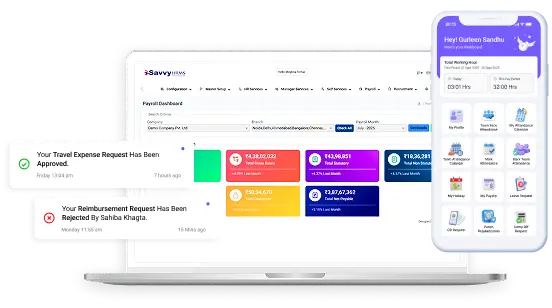
Savvy HRMS also connects Core HR with attendance, leave, payroll, performance, travel, expense management, and employee engagement, creating a more connected HR ecosystem. With employee and manager self-service, teams can handle routine requests and approvals more efficiently while reducing the administrative workload on HR.
Why consider Savvy HRMS for enterprise HR management?
- Centralized employee database
- Support for large workforce management
- Multiple company and organizational structures
- Configurable HR workflows and approvals
- Role-based access and data permissions
- Employee and manager self-service
- Integrated attendance, leave, payroll, and other HR processes
- HR dashboards and reporting
- Mobile accessibility
- Support for growing workforce requirements
Ultimately, the best Core HR software for 10,000+ employees is one that fits your current processes while remaining flexible enough to support future growth. Savvy HRMS can be a strong option for organizations looking for a connected and scalable HRMS platform rather than a standalone employee database.
Conclusion
Choosing Core HR software for 10,000+ employees requires looking beyond basic employee record management. The right solution should centralize workforce data, automate HR processes, support complex structures, protect sensitive information, connect with other business systems, and deliver useful insights.
Most importantly, choose a platform that can grow with your organization. A scalable Core HR solution should reduce administrative work today while giving HR the flexibility and visibility needed for tomorrow’s workforce.










Ready to simplify HR management for your large workforce?
Explore Savvy HRMS and book a free demo to see how it can support your organization's Core HR needs.
Frequently Asked Questions (FAQs)
1. What is Core HR software for 10,000+ employees?
Core HR software for 10,000+ employees is an enterprise HR platform that centralizes employee data, automates HR workflows, manages organizational structures, and connects processes such as attendance, leave, payroll, performance, and reporting.
2. What features should large enterprises look for in Core HR software?
Large enterprises should prioritize centralized employee data, bulk data management, workflow automation, role-based access, employee self-service, integrations, analytics, mobile access, security, and support for multiple companies, locations, and organizational structures.
3. How much does Core HR software cost for 10,000+ employees?
The cost varies depending on employee count, modules, integrations, customization, implementation, data migration, training, and support. Enterprises should evaluate the total cost of ownership rather than comparing software prices alone.
4. How long does it take to implement Core HR software for a large organization?
Implementation time depends on organizational complexity, data quality, integrations, customization, and the number of employees and locations involved. The process generally includes requirement analysis, configuration, data migration, testing, training, and go-live.
5. Is Savvy HRMS suitable for managing 10,000+ employees?
Savvy HRMS offers capabilities such as centralized employee database management, multiple company structures, configurable workflows, role-based access, employee self-service, attendance, leave, payroll, performance, travel and expense management, and reporting, making it an option to evaluate for large-scale HR management.