


How to Calculate ESI Contribution: Step-by-Step Guide


-
AuthorAnkit Singh
-
 Last Updated
July 29, 2026
Last Updated
July 29, 2026
-
 Reading Time
11 Mins
Reading Time
11 Mins
If you’ve ever stared at a payslip wondering why a small amount got deducted under “ESI,” or you’re the one running payroll and need to get the number right the first time, you’re in the right place. ESI contribution and calculation isn’t complicated once you know the formula – but it’s easy to get wrong if you don’t understand what counts as wages, who’s eligible, and how the contribution period actually works.
ESI applies for salary ≤ ₹21,000/month (₹25,000 for employees with disabilities)
Employee (0.75%)
₹0.00
Employer (3.25%)
₹0.00
Total ESI
₹0.00
Salary exceeds ₹21,000, so ESI does not apply (unless voluntarily opted by employer/employee).
(Calculate Your ESI Contribution for Free)
This guide walks through the exact calculation, current rates, real payroll examples, and the mistakes that trip up even experienced HR teams.
What Is ESI Contribution?
ESI contribution is the monthly statutory payment that employers and employees make toward the Employees’ State Insurance scheme, a social security programme run by the Employees’ State Insurance Corporation (ESIC) under the ESI Act, 1948. It funds medical care, sickness benefit, maternity benefit, disability compensation, and dependent benefits for workers in the organised sector.
In practical terms, it’s a payroll line item. Every month, a small percentage of an eligible employee’s wages is deducted, the employer adds its own share on top, and the combined amount goes to ESIC. The scheme exists so that lower and middle-income workers have access to medical treatment and income support without depending entirely on out-of-pocket expenses.
For payroll teams, ESI sits alongside PF, professional tax, and TDS as one of the recurring statutory calculations that has to be right every single cycle – because errors here don’t just affect one payslip, they trigger compliance notices.
ESI Contribution Percentage: Current Rates
The esi contribution percentage has been unchanged since 1 July 2019, when the total rate was reduced from 6.5% to 4%. That 4% is split between employer and employee as follows:
A few operational details matter here:
| Contributor | Rate | Applied On |
| Employer | 3.25% | Gross wages of covered employee |
| Employee | 0.75% | Gross wages of covered employee |
| Total | 4% | Gross wages of covered employee |
- The esi contribution by employer is not deducted from the employee’s salary – it’s a direct cost the company bears on top of what it pays the employee.
- The esi contribution by employee is deducted at source from the employee’s monthly wages.
- Employees whose average daily wage is ₹176 or less are exempt from paying their own share, but the employer must still contribute the full 3.25% for them.
- For establishments employing persons with disabilities, a concessional employer rate of 1% applies as a hiring incentive, for a specified period.
There’s no separate slab system – it’s a flat percentage applied to eligible wages, which is what makes the calculation itself fairly simple once eligibility is sorted out.
Who Is Eligible for ESI?
Coverage depends on two things: the establishment and the employee.
Establishment eligibility: Any non-seasonal factory or establishment employing 10 or more people (20 in some states) must register under the ESI Act, provided it falls within the categories notified by the respective state government – this typically includes factories, shops, hotels, restaurants, cinemas, and road transport establishments.
Employee eligibility: Once an establishment is covered, any employee earning gross wages up to the prescribed ceiling is automatically covered – there’s no opt-out for either party. This is a statutory requirement, not a benefit either side can waive.
ESI Contribution Salary Limit (Wage Ceiling)
The esi contribution salary limit is the maximum gross monthly wage at which an employee remains eligible for ESI coverage.
- Standard wage ceiling: ₹21,000 per month
- Persons with disabilities: ₹25,000 per month
Any employee earning above these thresholds falls outside the scheme entirely – no contribution is deducted, and the employer doesn’t contribute for them either. This ceiling has been in place since January 2017 and has not moved since, even though wage levels across many sectors have risen. It’s worth keeping an eye on, since a revision would affect a meaningful chunk of the workforce currently just above the line.
One nuance HR teams frequently miss: crossing the ceiling mid-month or mid-cycle doesn’t stop coverage immediately. That’s covered in the contribution period section below.
What Counts as “Wages” for ESI Calculation
This is where most calculation errors actually happen – not in the percentage math, but in deciding what the percentage should be applied to.
Included in ESI wages:
- Basic pay
- Dearness Allowance (DA)
- House Rent Allowance (HRA)
- City Compensatory Allowance (CCA)
- Attendance and incentive allowances
- Wages for overtime work (included for calculating the contribution, even though overtime itself isn’t counted toward the ₹21,000 eligibility ceiling)
- Wages/DA for unsubstituted holidays
Generally excluded from ESI wages:
- Annual bonus and gratuity
- Retrenchment compensation and encashment of leave
- Employer’s contribution to PF or pension
- Reimbursements like travel or medical expenses (in most cases)
- Tiffin/food allowance, under specified conditions
If your payroll structure leans heavily on allowances, there’s an additional rule to watch: where allowances such as HRA and conveyance together exceed 50% of an employee’s total remuneration, the excess portion gets added back into “wages” for the purpose of ESI calculation. This provision exists specifically to prevent companies from restructuring pay to artificially reduce ESI-eligible wages.
Step-by-Step ESI Calculation Formula
Here’s the actual process a payroll executive follows each cycle:
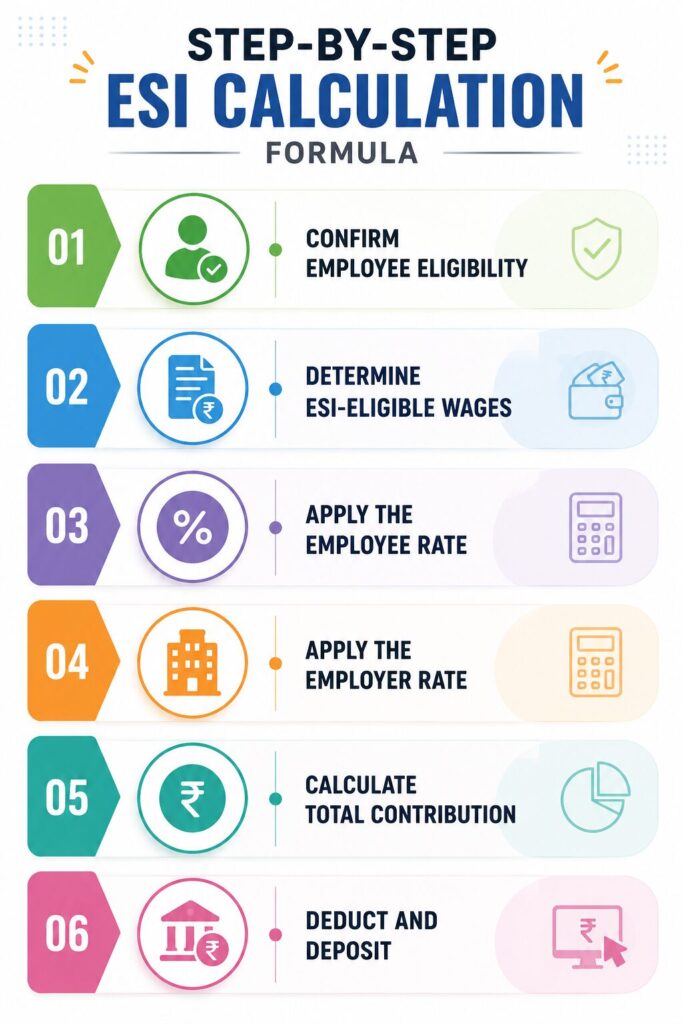
Step 1: Confirm employee eligibility. Check whether the employee’s gross monthly wage is at or below ₹21,000 (₹25,000 for PwD employees), and whether the employee is currently within a valid contribution period.
Step 2: Determine ESI-eligible wages. Add up basic pay, DA, HRA, and other includable components for the wage period – exclude bonus, gratuity, and other non-wage payments.
Step 3: Apply the employee rate. Employee Contribution = ESI Wages × 0.75%
Step 4: Apply the employer rate. Employer Contribution = ESI Wages × 3.25%
Step 5: Calculate total contribution. Total ESI Contribution = Employee Contribution + Employer Contribution
Step 6: Deduct and deposit. Deduct the employee’s share from their salary, add the employer’s share, and deposit the combined amount to ESIC – typically by the 15th of the following month.
That’s the full esi employee and employer contribution calculation, start to finish. The formula itself takes seconds; the eligibility and wage-definition checks are where the actual work is.
Worked Examples: ESI Employee and Employer Contribution Calculation
Numbers make this concrete. Here are two common payroll scenarios.
Example 1: Standard monthly wage
An employee’s gross monthly wage (ESI wages) is ₹15,000.
- Employee Contribution = ₹15,000 × 0.75% = ₹112.50
- Employer Contribution = ₹15,000 × 3.25% = ₹487.50
- Total Contribution = ₹600
The employer deducts ₹112.50 from the payslip, adds ₹487.50 from company funds, and deposits ₹600 to ESIC.
Example 2: Employee near the wage ceiling
An employee’s gross monthly wage is ₹20,500.
- Employee Contribution = ₹20,500 × 0.75% = ₹153.75
- Employer Contribution = ₹20,500 × 3.25% = ₹666.25
- Total Contribution = ₹820
Example 3: Mid-period salary hike
An employee earning ₹19,000 gets a raise to ₹22,000 in the third month of a six-month contribution period (say, in June, within the April–September cycle).
Because the wage now exceeds ₹21,000, it might seem like ESI should stop immediately – but it doesn’t. Coverage and contribution continue on the full revised wage until the end of that contribution period (30 September, in this case). Contributions only stop from the start of the next cycle. This is one of the most commonly mishandled scenarios in real payroll runs.
ESI Contribution and Benefit Period
The esi contribution and benefit period structure is what makes the mid-cycle salary crossing rule work, and it’s worth understanding on its own.
| Contribution Period | Corresponding Benefit Period |
| 1 April – 30 September | 1 January – 30 June (following year) |
| 1 October – 31 March | 1 July – 31 December (following year) |
Contributions made during a six-month contribution period fund the benefits an employee can claim during the corresponding six-month benefit period, which starts roughly three months after the contribution period ends. This lag is deliberate – it gives ESIC time to process contribution records before benefits become payable.
Two practical implications for HR teams:
- An employee who crosses the wage ceiling mid-period stays covered – and keeps contributing – until the contribution period closes.
- An employee who exits or becomes ineligible still retains benefit eligibility for the corresponding benefit period, provided they’ve met the minimum contribution days (commonly 78 days in a contribution period for cash benefits like sickness benefit).
Common Mistakes in ESI Calculation
A few recurring errors show up across payroll audits, regardless of company size:
- Applying the percentage to net salary instead of eligible gross wages. ESI is calculated on gross ESI-eligible wages, not take-home pay.
- Stopping deductions the moment salary crosses ₹21,000. As covered above, coverage continues till the end of the contribution period.
- Missing the allowance restructuring rule. Structuring HRA/conveyance to reduce reported wages below the ceiling doesn’t work if those allowances exceed 50% of total pay – the excess gets added back.
- Excluding overtime wages from the calculation. Overtime doesn’t count toward eligibility, but it is included once the employee is already covered.
- Late deposit. Missing the monthly deposit deadline attracts interest and penalties, and repeated delays invite closer ESIC scrutiny.
- Not updating wage records after mid-month joiners or exits, which distorts the ESI wage base for that cycle.
None of these are complicated in isolation, but they compound quickly across a workforce of even 50-100 employees, especially where salary structures vary by department or location.
How Payroll Software Simplifies ESI Compliance
Manually tracking eligibility, contribution periods, wage definitions, and deposit deadlines across dozens or hundreds of employees is where things go wrong – not because the formula is hard, but because the exceptions pile up. A payroll system that automatically flags ESI-eligible employees, applies the correct wage definition, and carries coverage through the contribution period removes most of the manual judgment calls that lead to errors.
If you’re managing this in spreadsheets today, it’s worth exploring how savvyhrms.com’s payroll and compliance module handles statutory calculations like ESI, PF, and professional tax automatically as part of the regular payroll run – including the contribution-period logic that’s easy to miss manually.
Conclusion
The math behind ESI contribution is genuinely simple – 3.25% from the employer, 0.75% from the employee, applied to eligible gross wages up to ₹21,000. What actually causes errors is everything around that formula: knowing what counts as wages, tracking contribution periods correctly, and catching mid-cycle salary changes before they throw off a payslip.
Get those fundamentals right once, build them into a repeatable process, and ESI stops being a monthly source of second-guessing. According to industry payroll benchmarks, this is exactly the kind of statutory calculation that benefits most from automation rather than manual tracking – the rules don’t change often, but the exceptions are where time and accuracy get lost.
If your team is still reconciling ESI manually each month, it may be worth seeing how much of this savvyhrms.com can take off your plate – from eligibility checks to deposit reminders – so payroll stays accurate without becoming a monthly fire drill.










Ready to eliminate ESI calculation errors?
Get started with Savvy HRMS today and simplify your entire payroll compliance!
FAQs
What is ESI contribution?
ESI contribution is the mandatory monthly payment made by employers and employees toward the Employees’ State Insurance scheme under the ESI Act, 1948. It totals 4% of gross wages – 3.25% from the employer and 0.75% from the employee – and funds medical, sickness, maternity, and disability benefits for covered workers.
How to calculate ESI contribution?
Multiply the employee’s ESI-eligible gross wages by 0.75% for the employee share and by 3.25% for the employer share, then add both. For example, on ₹15,000 in eligible wages, the employee pays ₹112.50 and the employer pays ₹487.50, totaling ₹600 per month.
How is ESI employer contribution calculated?
The employer’s share is calculated by applying 3.25% to the employee’s ESI-eligible gross wages. This amount is paid entirely by the employer and is not deducted from the employee’s salary, unlike the employee’s 0.75% share.
How is ESI salary calculated?
ESI salary (or ESI wages) includes basic pay, DA, HRA, CCA, and similar regular allowances, but generally excludes bonus, gratuity, and reimbursements. If allowances exceed 50% of total pay, the excess is added back into ESI wages before applying the contribution percentage.
What is the ESI contribution salary limit?
The ESI contribution salary limit is ₹21,000 per month in gross wages for most employees, and ₹25,000 per month for persons with disabilities. Employees earning above this ceiling are not covered under the scheme and don’t contribute.
What is the ESI contribution and benefit period?
ESI runs on two six-month contribution periods each year (April–September and October–March), each linked to a corresponding benefit period that starts three months later. Contributions made in a period fund benefit eligibility for the matching benefit period, and coverage continues through a full contribution period even if wages later cross the ceiling.