

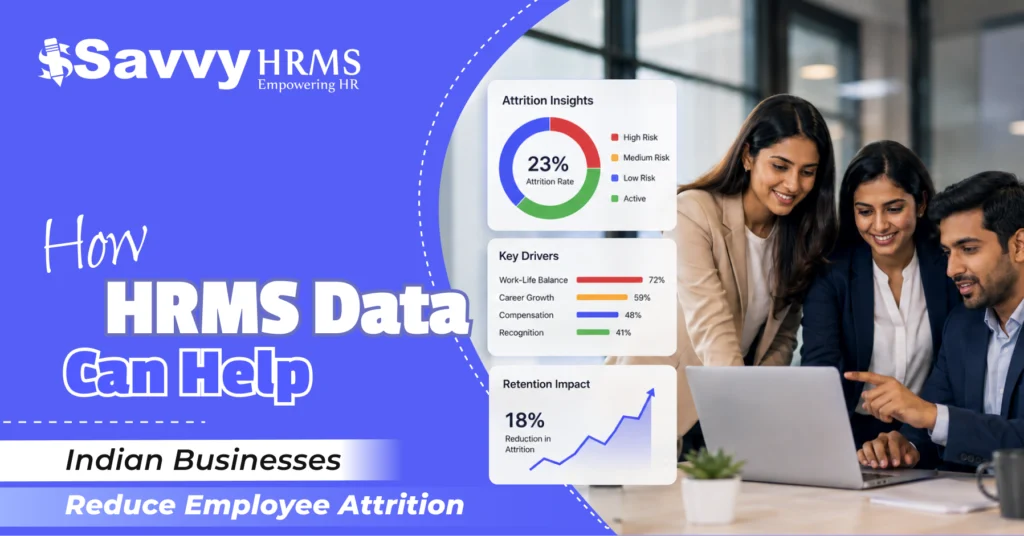
How HRMS Data Can Help Indian Businesses Reduce Employee Attrition


-
AuthorRuchika Rajput
-
 Last Updated
September 02, 2026
Last Updated
September 02, 2026
-
 Reading Time
17 Mins
Reading Time
17 Mins
Employee attrition can quietly become one of the biggest challenges for a growing business. When experienced employees leave, companies lose productivity, institutional knowledge, and recruitment investments. The good news is that HR teams no longer have to depend only on assumptions to understand why people leave.
HRMS data gives businesses a clearer picture of employee behaviour across attendance, leave, performance, compensation, tenure, engagement, promotions, and exits. When these data points are connected, HR teams can identify patterns that may indicate dissatisfaction or attrition risk before an employee submits a resignation.
For Indian businesses, this approach is becoming increasingly important. Aon reported overall employee attrition of 16.2% in India in 2025, down from 17.7% in 2024 and 18.7% in 2023. Deloitte, using a different methodology, reported 17.6% attrition in 2025, compared with 17.4% in 2024. The numbers differ by survey methodology, but both show why workforce retention remains an important business priority.
Why Is Employee Attrition a Growing Concern for Indian Businesses?
Employee attrition simply means employees leaving an organisation over a particular period. It can include voluntary attrition, when employees resign, and involuntary attrition, when the organisation ends employment.
The challenge is not merely the number of employees leaving. The bigger issue is who is leaving, why they are leaving, how frequently it is happening, and what the business is losing as a result.
Consider a company with 500 employees and a 16% annual attrition rate. That translates to roughly 80 employees leaving during the year. Even if the organisation successfully replaces them, recruitment and onboarding alone do not restore the experience, relationships, productivity, and organisational knowledge that may have been lost.
Recent Indian workforce data shows that attrition remains significant even though it has moderated from the unusually high levels seen after the pandemic. Aon reported that overall attrition fell from 21.4% in 2022 to 18.7% in 2023, 17.7% in 2024 and 16.2% in 2025.
Deloitte’s data tells a slightly different story, reporting 17.6% attrition in 2025, compared with 17.4% in 2024. The difference is a reminder that businesses should not blindly compare one benchmark with another. Instead, they should establish their own historical baseline and monitor trends within their organisation.
Attrition can become particularly expensive when it is concentrated among:
- High-performing employees
- Employees with critical skills
- Experienced managers
- Employees in revenue-generating roles
- Employees who have recently completed training
- Employees with strong institutional knowledge
- Employees in difficult-to-replace positions
There is another important dimension: employee engagement.
Gallup’s State of the Global Workplace 2026 reported that only 23% of Indian employees were engaged in 2025, while 59% were classified as not engaged and 18% as actively disengaged.
This does not mean every disengaged employee will resign. However, it highlights why organisations need to look beyond resignation numbers. An employee may remain on the payroll while becoming less productive, less committed, or more open to external opportunities.
That is where HR data and HRMS analytics become valuable.
What Role Does HRMS Data Play in Reducing Employee Attrition?
An HRMS brings employee information into a central system instead of leaving HR teams to analyse disconnected spreadsheets, emails, attendance records, payroll files, and performance documents.
The important point is that HRMS data does not reduce attrition by itself. Instead, it helps HR teams understand employee patterns and make better decisions.
For example, imagine HR notices that employees with:
- Low attendance,
- Increasing leave frequency,
- No promotion for several years,
- Below-average salary growth,
- Declining performance scores, and
- Low manager interaction
are leaving more frequently.
Without consolidated HR data, these patterns can be difficult to see.
With an HRMS, these data points can potentially be analysed together.
This changes the HR approach from:
“Employees are resigning. We need to hire replacements.”
to:
“Which employees are leaving, what patterns do they share, and what can we do before they decide to leave?”
That is the difference between reactive HR management and data-driven employee retention.
An HRMS can help businesses analyse the employee lifecycle from recruitment and onboarding through attendance, payroll, performance, learning, promotions, transfers, engagement and exit.
For example:
Employee Data → HR Analytics → Attrition Patterns → Risk Identification → HR Intervention → Retention → Measurement
The goal is not to predict every resignation perfectly. Instead, the goal is to give HR teams enough evidence to ask better questions and take timely action.
What Employee Data Should Businesses Track in an HRMS?
If a business wants to use HRMS data for employee retention, it first needs the right data.
Not every available data point is equally useful. HR teams should focus on information that can reveal changes in employee experience, performance, career progression, compensation, attendance, and engagement.
1. Employee Demographic Data
Basic employee information such as:
- Age group
- Location
- Department
- Job role
- Employment type
- Tenure
- Work location
- Reporting manager
can help HR identify whether attrition is concentrated in a particular employee segment.
For example, if employees in one location are leaving at twice the company average, HR may investigate workload, commuting challenges, local salary competitiveness, manager practices, or workplace conditions.
2. Tenure Data
Tenure is particularly useful because attrition often changes at different stages of the employee lifecycle.
HR can compare attrition among:
- Employees with less than 6 months of service
- 6-12 months
- 1-2 years
- 2-5 years
- 5+ years
If many employees resign between months 6 and 12, the issue may be related to onboarding, role expectations, manager relationships, career growth, or compensation.
3. Attendance and Leave Data
Attendance data can provide useful signals when interpreted carefully.
HR teams can monitor:
- Absenteeism
- Unplanned leave
- Late arrivals
- Early departures
- Overtime
- Leave utilisation
- Changes in attendance patterns
A sudden increase in absenteeism should not automatically be interpreted as an intention to resign. Employees may have personal, health, family, or workload-related reasons.
However, when attendance changes occur alongside other indicators, they can become worth investigating.
4. Compensation and Payroll Data
Salary remains an important part of employee retention, although it is rarely the only factor.
HRMS payroll data can help organisations analyse:
- Salary growth
- Increment history
- Variable pay
- Incentives
- Bonuses
- Pay position within a salary band
- Compensation differences across roles
- Payroll discrepancies
A useful question is:
Are employees who have received little or no salary growth leaving at higher rates?
That is much more actionable than simply assuming employees leave because of “salary dissatisfaction.”
5. Performance Data
Performance management data can reveal whether employees are:
- Consistently performing well
- Improving
- Stagnating
- Receiving regular feedback
- Being considered for promotion
- Meeting career expectations
High-performing employees who repeatedly receive strong evaluations but see no career progression may represent a retention risk.
6. Promotion and Internal Mobility Data
Career development is another important retention factor.
HRMS data can show:
- Time since last promotion
- Internal job applications
- Transfers
- Role changes
- Career progression
- Training completion
- Skill development
This helps HR identify employees who may have reached a career plateau.
How Can HRMS Data Help Identify the Reasons Behind Employee Attrition?
One of the biggest mistakes businesses make is treating all attrition as the same.
An employee leaving because of relocation is very different from an employee leaving because of poor management. Similarly, someone leaving for a 30% salary increase represents a different retention challenge from someone leaving because they see no career path.
HRMS analytics can help organisations segment attrition by reason and employee group.
1. Analyse Attrition by Department
Suppose a company has a 15% overall attrition rate.
That number sounds manageable.
But what if the breakdown is:
| Department | Attrition Rate |
| Finance | 7% |
| HR | 6% |
| Operations | 12% |
| Sales | 21% |
| Technology | 18% |
The company-wide number hides the real problem.
The next question becomes: Why are Sales and Technology experiencing higher turnover?
HR can then compare compensation, workload, manager changes, performance, tenure, promotion history, and exit reasons within those departments.
2. Analyse Attrition by Tenure
Imagine the data shows:
- 0-6 months: 8%
- 6-12 months: 19%
- 1-3 years: 16%
- 3-5 years: 11%
- 5+ years: 7%
This suggests the company may have a problem somewhere around the first year of employment.
HR could then examine onboarding quality, manager support, job expectations, training, workload, and probation-related experiences.
3. Analyse Attrition by Manager
Manager-level analysis can also reveal patterns.
If one manager consistently has significantly higher voluntary attrition than other managers handling similar roles, HR should investigate.
This does not mean automatically blaming the manager.
Instead, HR can examine:
- Team workload
- Engagement scores
- Performance distribution
- Promotion frequency
- Absenteeism
- Employee feedback
- Exit interview comments
The objective is to identify the underlying issue, not create a blame-based culture.
4. Analyse Attrition by Location
For businesses operating across cities such as Delhi NCR, Bengaluru, Mumbai, Hyderabad, Pune, Chennai, Gurugram and Noida, location-based analysis can also be useful.
For example, if attrition is significantly higher in one location, HR can explore whether the reason is related to:
- Local competition
- Salary expectations
- Commute
- Work model
- Cost of living
- Talent availability
- Local management practices
This makes HRMS data particularly useful for geographically distributed Indian businesses.
Which HR Metrics Can Help Predict Employee Attrition?
There is no single HR metric that can predict whether an employee will resign.
Instead, businesses should monitor a combination of employee attrition metrics and workforce indicators.
1. Employee Attrition Rate
A basic formula is:
| Employee Attrition Rate = Number of Employees Who Left ÷ Average Number of Employees × 100 |
For example, if 50 employees leave during a year and the average workforce is 500:
50 ÷ 500 × 100 = 10% attrition
Tracking this monthly, quarterly, and annually helps establish a trend.
2. Voluntary Attrition Rate
This focuses specifically on employees who choose to leave.
Voluntary Attrition Rate = Voluntary Exits ÷ Average Headcount × 100
This is especially useful for employee retention strategies because businesses have a greater opportunity to address the underlying causes.
3. Regrettable Attrition
Not every resignation has the same business impact.
A company can separately track the percentage of high-performing or critical employees who leave.
For example:
Regrettable Attrition Rate = Regrettable Employee Exits ÷ Average Headcount × 100
This helps leadership focus retention investments where they matter most.
4. Early Attrition Rate
This measures employees who leave shortly after joining.
For example, a business might track employees leaving within:
- 90 days
- 6 months
- 12 months
A high early attrition rate may indicate issues with recruitment quality, onboarding, job expectations, training, or manager support.
5. Absenteeism Rate
Changes in attendance patterns can provide useful context when combined with other HR data.
6. Internal Mobility Rate
If employees rarely move internally despite having suitable opportunities, HR may need to examine whether employees understand or trust the internal career path.
7. Promotion Rate
Tracking promotions by department, tenure, and performance can help identify career-development gaps.
8. Employee Engagement Score
Engagement surveys can provide another layer of information that payroll and attendance data cannot capture.
Gallup’s latest India data, for example, highlights the scale of the engagement challenge, with only 23% of Indian employees classified as engaged in 2025.
9. Time Since Last Increment
HR can compare salary progression with attrition patterns to identify potential compensation-related risks.
10. Time Since Last Promotion
A long period without career progression may be important, particularly among high-performing employees.
The real power comes from combining metrics, rather than looking at each one independently.
How Can HRMS Data Help Identify Employees at Risk of Leaving?
This is where HRMS analytics becomes particularly interesting.
Instead of waiting for an employee to resign, HR teams can monitor combinations of changes that may justify a conversation.
For example, consider an employee who:
- Has worked for the company for 4 years
- Has not received a promotion in 3 years
- Has received minimal salary growth
- Has recently shown declining engagement
- Has increased unplanned leave
- Has applied for an internal position
- Has recently experienced a manager change
None of these factors individually proves that the employee intends to leave.
But together, they may indicate that HR should check in with the employee.
This is where predictive HR analytics can support decision-making.
A business can create a risk model using historical workforce data and identify patterns associated with previous voluntary exits.
For example:
High Attrition Risk Signals
- Long time since promotion
- Low salary growth
- Declining engagement
- Increased absenteeism
- Low manager interaction
- Limited learning activity
- Repeated unsuccessful internal applications
- High workload
- Long tenure without career movement
However, HR should use such models responsibly.
An HRMS should support human decision-making, not automatically label employees as “likely to resign.”
The better approach is:
Data identifies a potential signal → HR reviews the context → Manager or HR has a meaningful conversation → Appropriate action is taken.
This approach is more ethical and more practical.
How Can HRMS Data Improve Employee Engagement and Retention?
Employee retention is not simply about convincing people to stay.
It is about creating an environment where employees can see a reason to stay.
HRMS data can help HR teams understand where the employee experience needs improvement.
1. Improve Career Development
If data shows that employees with limited career progression leave more frequently, businesses can introduce:
- Career pathways
- Internal mobility programs
- Mentoring
- Skill development
- Leadership programs
- Succession planning
2. Improve Manager Effectiveness
Managers have a major influence on employee experience.
HR can compare team-level data such as engagement, absenteeism, performance, and attrition to identify teams that may require management support.
Gallup’s 2026 global workplace report also highlights declining manager engagement, making manager effectiveness an increasingly important workforce issue.
3. Identify Workload Problems
If employees working excessive overtime or carrying unusually high workloads have higher attrition, HR can use workforce data to investigate workload distribution.
The objective is not simply to reduce working hours. It is to determine whether workload, staffing, or role design is contributing to employee dissatisfaction.
4. Strengthen Recognition
HRMS and performance systems can help businesses monitor whether employees are receiving:
- Recognition
- Performance feedback
- Incentives
- Rewards
- Development opportunities
Recognition becomes more meaningful when it is connected to actual performance data.
5. Improve Compensation Decisions
Businesses can compare attrition trends with salary bands, increments, and market movements.
For instance, if a specific skill group has significantly higher attrition and salaries have remained below the company’s target range, leadership has a clearer reason to review compensation.
How Can Exit Data Help Businesses Prevent Future Attrition?
Every resignation creates a new source of information.
Unfortunately, many organisations collect exit interview data but do not analyse it systematically.
An HRMS can help businesses organise exit information such as:
- Primary reason for leaving
- Secondary reason
- Department
- Job role
- Tenure
- Manager
- Location
- Compensation
- New opportunity
- Career growth
- Work-life balance
- Management concerns
Over time, this creates an employee attrition database.
Imagine that 100 employees leave over two years and the exit data shows:
- 30% cited career growth
- 24% cited compensation
- 18% cited management
- 12% cited workload
- 9% cited relocation
- 7% cited other reasons
Now HR has a much clearer starting point.
The next step is to compare exit reasons with other HRMS data.
For example:
Career growth → Promotion history → Internal mobility → Training data
Compensation → Salary history → Salary band → Increment data
Management → Manager → Team engagement → Team attrition
Workload → Attendance → Overtime → Leave → Staffing
This is where HRMS data becomes much more powerful than a standalone exit interview.
Do Not Ignore Stay Interviews
Businesses should not wait until employees resign to ask questions.
A stay interview is a structured conversation with existing employees to understand what keeps them engaged and what might encourage them to leave.
HRMS data can help HR decide which employee groups should receive more frequent stay interviews.
For example, if experienced employees in a particular department show low engagement and limited promotion activity, HR could proactively conduct conversations with that group.
How Can Businesses Turn HRMS Insights Into Retention Strategies?
Collecting data is only the first step.
The real value comes when HR turns insights into actions.
A simple framework is:
Step 1: Identify the Attrition Pattern
Start with the basic question:
Who is leaving?
Break attrition down by:
- Department
- Role
- Location
- Tenure
- Manager
- Age group
- Performance
- Employment type
Step 2: Understand the Cause
Next ask:
Why are they leaving?
Compare exit interview data with compensation, performance, attendance, engagement, promotion, and career data.
Step 3: Identify High-Impact Groups
Not every attrition problem requires the same response.
Prioritise groups where:
- Attrition is significantly above average
- Critical skills are involved
- High performers are leaving
- Replacement costs are high
- Business continuity is affected
Step 4: Create Targeted Interventions
Avoid using one retention strategy for everyone.
For example:
| Attrition Pattern | Possible HR Response |
| High early attrition | Improve onboarding |
| High attrition among high performers | Career progression and recognition |
| High salary-related exits | Compensation review |
| High manager-level attrition | Manager coaching |
| High attrition among critical skills | Skill-based retention plans |
| High workload-related exits | Workforce planning |
| Low internal mobility | Internal career marketplace |
| Low engagement | Employee listening and action plans |
Step 5: Measure the Outcome
After implementing a retention initiative, HR should ask:
Did the data actually improve?
Track:
- Attrition rate
- Voluntary attrition
- Regrettable attrition
- Engagement
- Absenteeism
- Internal mobility
- Promotion rate
- Retention of critical employees
This creates a continuous cycle:
Measure → Analyse → Act → Monitor → Improve
That is the foundation of data-driven employee retention.
Why HRMS Is Better Than Disconnected Spreadsheets
Spreadsheets can work for small datasets, but they become increasingly difficult to manage as organisations grow.
An HRMS can provide a central source of workforce information, making it easier to connect employee records, attendance, payroll, leave, performance and other HR processes.
For Indian organisations managing multiple locations, departments and employee categories, this centralisation can make HR reporting more consistent and accessible.
The goal is not to collect more data simply because technology makes it possible.
The goal is to collect useful data, interpret it correctly, and use it to improve employee experience.
Build a Retention Dashboard
A practical employee retention dashboard can include:
- Current headcount
- Monthly attrition
- Annualised attrition
- Voluntary attrition
- Involuntary attrition
- Regrettable attrition
- Department-wise attrition
- Location-wise attrition
- Tenure-wise attrition
- Early attrition
- Exit reasons
- Absenteeism
- Engagement score
- Promotion rate
- Internal mobility
- Average time since promotion
- Average time since last increment
The dashboard should make it easy for HR leaders to answer questions such as:
- Which teams are losing the most employees?
- Which employee groups have the highest attrition?
- What are the most common reasons for leaving?
- Is attrition increasing or decreasing?
- Are high performers leaving?
- Are employees leaving shortly after joining?
- Which retention initiatives are actually working?
These are the kinds of questions that turn HR reporting into workforce intelligence.
Conclusion
Employee attrition cannot always be eliminated, and not every resignation is preventable. However, Indian businesses can become much better at understanding why employees leave. HRMS data connects attendance, payroll, performance, engagement, career growth, and exit information to reveal meaningful workforce patterns.
The key is to move beyond simply measuring attrition. Businesses should identify high-risk patterns, understand their causes, take targeted action, and continuously measure results. With the right HRMS and analytics approach, employee data can become a practical tool for improving engagement, retention, and workforce stability.

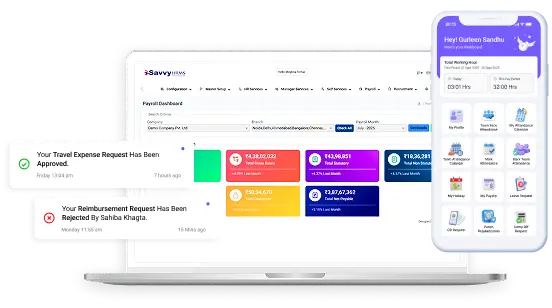









Ready to turn employee data into smarter retention decisions?
Explore how Savvy HRMS can help your business manage, analyse, and improve the complete employee lifecycle.
Frequently Asked Questions (FAQs)
1. How can HRMS data help reduce employee attrition?
HRMS data helps businesses identify patterns in employee turnover by analysing factors such as attendance, leave, salary, performance, tenure, promotions, engagement, and exit reasons. HR teams can use these insights to identify potential retention issues and take timely action.
2. What HRMS data is most useful for predicting employee attrition?
Important data points include employee tenure, salary growth, promotion history, performance, absenteeism, leave patterns, engagement scores, overtime, internal mobility, and exit reasons. Analysing these factors together can help identify patterns associated with employee attrition.
3. Can HRMS analytics identify employees who are likely to leave?
Yes, HRMS analytics can identify potential attrition risk patterns by analysing multiple workforce indicators. However, these insights should be treated as signals rather than definite predictions. HR teams should review the context and have meaningful conversations with employees before taking action.
4. Which HR metrics should Indian businesses track to reduce employee attrition?
Businesses should monitor overall attrition rate, voluntary attrition rate, regrettable attrition, early attrition, absenteeism rate, employee engagement, promotion rate, internal mobility, time since last increment, and time since last promotion.
5. How can businesses use exit data to improve employee retention?
Businesses can analyse exit reasons by department, role, location, tenure, manager, and employee category. Combining exit interview data with HRMS information such as salary, performance, attendance, and promotion history can help identify recurring causes of employee turnover and develop targeted retention strategies.