

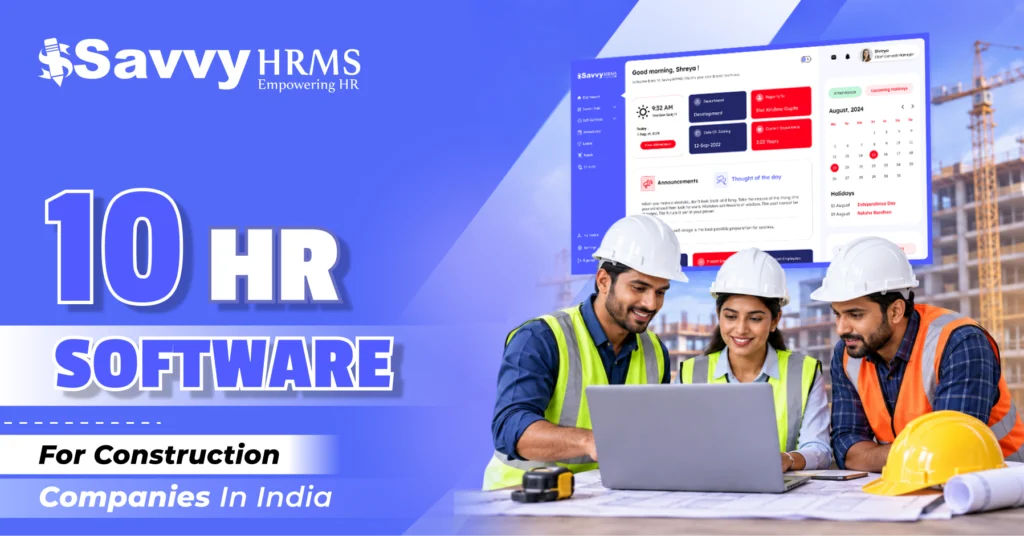
10 Best HR Software for Construction Companies in India in 2026


-
AuthorS.K. Gupta
-
 Last Updated
September 08, 2026
Last Updated
September 08, 2026
-
 Reading Time
21 Mins
Reading Time
21 Mins
Best HR software for construction companies should help businesses manage more than employee records and payroll. Construction organizations need to handle site-based attendance, multiple locations, shifts, leave, payroll, compliance, contractors, and employees working across different projects.
Unlike traditional office-based businesses, construction companies often have employees distributed across project sites, offices, and temporary work locations. Managing attendance, overtime, leave, payroll, and employee information manually can create errors, delays, and unnecessary administrative work.
The right HR software for construction companies in India can bring these processes together in one platform. In this blog, we compare 10 HR software solutions based on workforce management, attendance, payroll, compliance, scalability, employee experience, and suitability for construction businesses.
How Did We Rank These HR Software for Construction Companies?
To identify the best HR software for construction companies, we evaluated each platform against factors that matter specifically to construction and infrastructure businesses.
| Evaluation Criteria | Weightage |
| Attendance & Location-Based Workforce Management | 20% |
| Payroll & Statutory Compliance | 20% |
| Multi-Site Workforce Management | 15% |
| Core HR & Employee Self-Service | 10% |
| Leave, Shift & Overtime Management | 10% |
| Recruitment & Employee Lifecycle Management | 8% |
| Reporting & HR Analytics | 7% |
| Mobile Accessibility & Ease of Use | 5% |
| Integrations & Scalability | 5% |
| Total | 100% |
What did we evaluate?
We considered the following factors while ranking these HR software platforms:
- Construction workforce suitability: How effectively the software supports site-based and distributed employees.
- Attendance management: Availability of mobile, GPS, biometric, geo-fencing, and other attendance options.
- Payroll management: Ability to connect attendance, leave, shifts, and payroll.
- Compliance: Suitability for Indian payroll and statutory requirements.
- Multi-location management: Ability to manage employees across projects, sites, branches, and offices.
- Employee self-service: Availability of employee-facing HR features.
- Scalability: Ability to support growing construction companies.
- Reporting: Workforce, attendance, payroll, and HR analytics capabilities.
- Ease of use: How easily employees, supervisors, and HR teams can use the platform.
Note: The rankings are based on our assessment of each platform against the criteria above. “Overall fit” indicates suitability for construction businesses and is not an official ranking published by the software providers.
At a Glance
| Rank | HR Software | Best For | Overall Fit |
| 1 | Savvy HRMS | Indian construction companies needing integrated HR and payroll | Excellent |
| 2 | Darwinbox | Large construction and infrastructure enterprises | Excellent |
| 3 | Qandle | Construction companies needing mobile workforce management | Very Good |
| 4 | greytHR | Payroll-focused construction businesses | Very Good |
| 5 | Sage HR | Small and medium construction companies | Good |
| 6 | PeopleHR | SMBs needing HR and time management | Good |
| 7 | PeopleStrong | Large, multi-location construction organizations | Excellent |
| 8 | BambooHR | Businesses prioritizing employee experience | Good |
| 9 | uKnowva HRMS | Companies needing customizable HR automation | Very Good |
| 10 | HR Mantra | Businesses seeking broad HR and payroll functionality | Good |
10 Best HR Software for Construction Companies
1. Savvy HRMS
Overview
Savvy HRMS is an integrated HR and payroll platform designed to help businesses manage employee information, attendance, leave, payroll, compliance, expenses, and other HR processes. Its combination of attendance-to-payroll automation and employee management makes it a strong option for Indian construction companies.
Why Choose Savvy HRMS?
- Built to support Indian HR, payroll, attendance, and compliance requirements.
- Connects attendance and leave information with payroll for accurate salary processing.
- Helps manage employees working across multiple construction projects and locations.
- Provides employee self-service for everyday HR activities and requests.
- Supports statutory payroll processes including important deductions and compliance requirements.
- Helps reduce spreadsheets, manual calculations, and repetitive HR administration.
- Provides centralized employee information for HR teams and managers.
- Supports multiple HR processes through a single integrated platform.
- Helps construction businesses improve workforce visibility and administrative efficiency.
Who Should Choose Savvy HRMS?
Savvy HRMS is suitable for Indian construction and infrastructure companies managing office employees, engineers, supervisors, site teams, and other workforce groups. It is especially useful for businesses looking to connect attendance, payroll, leave, compliance, employee self-service, and workforce administration.
Who Might Not Need Savvy HRMS?
Very small construction businesses with only a few employees and straightforward salary processing may not require a complete HRMS. Organizations already using a highly integrated enterprise HCM system may also prefer expanding their existing software instead of implementing another HR platform.
Best For
Indian construction companies looking for integrated HR, attendance, payroll, compliance, leave, employee self-service, and workforce management.
2. Darwinbox
Overview
Darwinbox is an enterprise HCM platform offering core HR, recruitment, attendance, payroll, expenses, talent management, employee engagement, and workforce management. Its mobile-first approach and location-based attendance capabilities make it suitable for large construction organizations.
Why Choose Darwinbox?
- Offers comprehensive HCM capabilities for large and complex organizations.
- Supports location-based attendance for distributed construction workforces.
- Mobile functionality helps employees and managers operate from different locations.
- Supports customized shifts and workforce scheduling requirements.
- Connects attendance information with broader HR and payroll processes.
- Provides recruitment, onboarding, talent, payroll, and employee engagement capabilities.
Who Should Choose Darwinbox?
Darwinbox is suitable for large construction, infrastructure, engineering, and project-based organizations managing complex employee structures. It can be particularly useful for businesses with multiple locations, large workforces, and sophisticated HR workflows.
Who Might Not Need Darwinbox?
Small construction companies with simple attendance and payroll requirements may find an enterprise HCM platform more extensive than necessary. Businesses primarily looking for basic HR administration may prefer a simpler and more focused HRMS.
Best For
Large construction and infrastructure enterprises requiring comprehensive HCM and distributed workforce management.
3. Qandle
Overview
Qandle is a cloud-based HR platform covering employee management, attendance, leave, payroll, recruitment, performance, and employee self-service. Its mobile and location-based attendance capabilities make it a relevant option for construction companies managing employees across different project sites.
Why Choose Qandle?
- Supports GPS and biometric attendance for distributed workforces.
- Geofencing can help manage attendance at approved locations.
- Face recognition provides an additional attendance authentication option.
- Mobile access supports employees and managers working across locations.
- Connects attendance and leave information with payroll processes.
- Provides employee self-service for everyday HR requirements.
Who Should Choose Qandle?
Qandle can suit construction businesses that need mobile-first HR management and want employees to access attendance, leave, payroll, and HR services while managers maintain workforce visibility across multiple project locations.
Who Might Not Need Qandle?
Very small construction companies with straightforward employee administration may not need its broader feature set. Businesses looking for specialized construction project management rather than HR management would also need additional project-focused software.
Best For
Construction companies requiring GPS, biometric, geo-fencing, mobile attendance, payroll, and employee self-service.
4. greytHR
Overview
greytHR is an HR and payroll platform focused on employee management, attendance, leave, payroll, compliance, employee self-service, and HR workflows. Its combination of payroll and attendance functionality makes it a useful option for construction companies.
Why Choose greytHR?
- Strong payroll capabilities for Indian businesses and salary structures.
- Connects attendance information with payroll processing.
- Supports multiple attendance methods for different workforce requirements.
- Provides employee self-service through digital HR processes.
- Supports leave, attendance regularization, expenses, and approvals.
- Provides payroll reports and statutory compliance-related functionality.
Who Should Choose greytHR?
greytHR is suitable for construction businesses that prioritize payroll accuracy, attendance management, statutory processing, employee self-service, and structured HR workflows without necessarily requiring a large enterprise HCM platform.
Who Might Not Need greytHR?
Construction enterprises seeking highly complex enterprise-level HCM capabilities may require a more extensive platform. Companies looking for specialized project management, construction planning, or site execution tools would also need complementary software.
Best For
Construction businesses prioritizing Indian payroll, attendance, compliance, and employee self-service.
5. Sage HR
Overview
Sage HR is a cloud-based HR platform designed primarily for small and medium-sized businesses. It offers core HR, leave management, shift scheduling, timesheets, expenses, recruitment, performance management, and employee self-service.
Why Choose Sage HR?
- Designed for small and medium-sized businesses.
- Provides mobile access for employees working away from offices.
- Supports shift scheduling and timesheet management.
- Helps automate leave requests and approval workflows.
- Provides employee self-service for routine HR activities.
- Supports performance, recruitment, and expense management processes.
Who Should Choose Sage HR?
Sage HR can suit small and medium construction companies looking for straightforward employee management, leave, timesheets, shift scheduling, expenses, and performance functionality without adopting a highly complex enterprise HCM platform.
Who Might Not Need Sage HR?
Large construction organizations with extensive distributed workforces may need more advanced workforce management capabilities. Businesses that require highly specialized Indian payroll and statutory compliance features should also carefully evaluate whether the platform meets their specific requirements.
Best For
Small and medium construction companies looking for straightforward HR, leave, timesheet, and shift management.
6. PeopleHR
Overview
PeopleHR is a cloud-based HR platform offering employee records, time and attendance, absence management, recruitment, performance management, reporting, and employee self-service. Its time-management capabilities can be useful for construction businesses managing employees across different work locations.
Why Choose PeopleHR?
- Centralizes employee records for easier HR administration.
- Supports time and attendance tracking across different work patterns.
- Provides location-based attendance capabilities for distributed teams.
- Allows employees to record working time through mobile devices.
- Supports project and task-related time tracking.
- Provides HR reporting and employee self-service capabilities.
Who Should Choose PeopleHR?
PeopleHR can suit small and medium construction businesses looking for centralized employee records, attendance, timesheets, absence management, reporting, and mobile HR functionality for employees working across multiple projects.
Who Might Not Need PeopleHR?
Construction companies with highly complex Indian payroll and statutory requirements should verify whether the available payroll setup meets their needs. Large enterprises may also require broader HCM functionality and deeper organizational customization.
Best For
SMB construction companies needing employee records, attendance, timesheets, absence management, and mobile HR.
7. PeopleStrong
Overview
PeopleStrong is an enterprise HCM platform covering recruitment, onboarding, core HR, payroll, attendance, leave, performance, learning, expenses, and workforce management for larger organizations.
Why Choose PeopleStrong?
- Designed to support large organizations and complex workforce structures.
- Supports location-based attendance and workforce tracking.
- Provides attendance, shift, rostering, and workforce management capabilities.
- Connects attendance and leave data with payroll processing.
- Offers recruitment, onboarding, performance, and talent management.
- Provides comprehensive payroll workflows and employee self-service.
Who Should Choose PeopleStrong?
PeopleStrong is suitable for large construction and infrastructure organizations managing extensive employee populations, multiple locations, complex HR processes, payroll operations, workforce scheduling, and broader talent-management requirements.
Who Might Not Need PeopleStrong?
Small construction companies with basic attendance, payroll, and employee-management needs may not require an enterprise HCM platform. Businesses looking for lightweight HR software with simpler implementation may prefer a more focused solution.
Best For
Large construction and infrastructure organizations requiring scalable HCM, payroll, attendance, and workforce management.
8. BambooHR
Overview
BambooHR is a people-management platform covering employee records, hiring, onboarding, payroll, benefits, time and attendance, performance, compensation, compliance, and reporting. It is particularly suitable for organizations prioritizing employee experience and connected HR processes.
Why Choose BambooHR?
- Provides a centralized employee database for HR teams.
- Offers time and attendance management within its HR platform.
- Provides mobile access for employee HR activities.
- Supports employee self-service and digital HR workflows.
- Connects HR data across multiple employee lifecycle processes.
- Provides integration capabilities with other business applications.
Who Should Choose BambooHR?
BambooHR may suit construction businesses that prioritize employee experience, centralized HR records, onboarding, performance, time tracking, and connected employee lifecycle processes, particularly where broader international HR requirements are relevant.
Who Might Not Need BambooHR?
Indian construction companies primarily looking for India-specific payroll and statutory compliance may prefer a more locally focused HRMS. Businesses with highly complex site-level workforce management requirements should carefully assess the platform before selecting it.
Best For
Construction businesses prioritizing employee experience, centralized HR, time tracking, onboarding, performance, and integrations.
9. uKnowva HRMS
Overview
uKnowva HRMS is an HR platform covering core HR, payroll, attendance, onboarding, performance, expenses, documents, workflows, and employee management. Its customization and automation capabilities can support construction organizations with varied HR requirements.
Why Choose uKnowva HRMS?
- Supports employee lifecycle management from onboarding to offboarding.
- Provides configurable workflows for different HR processes.
- Includes attendance, leave, payroll, expenses, and employee management.
- Provides project-related functionality alongside HR processes.
- Offers workforce dashboards and reporting capabilities.
- Supports mobile access for employees and managers.
Who Should Choose uKnowva HRMS?
uKnowva can suit construction organizations seeking customizable HR workflows alongside employee management, attendance, payroll, expenses, documents, reporting, and project-related processes.
Who Might Not Need uKnowva HRMS?
Smaller construction companies with basic HR requirements may not need a highly customizable HR platform. Businesses looking only for simple payroll or attendance management may find a broader HRMS more extensive than necessary.
Best For
Construction businesses needing customizable HR automation, employee lifecycle management, attendance, payroll, and workforce workflows.
10. HR Mantra
Overview
HR Mantra is an HRMS solution offering capabilities across employee administration, attendance, payroll, leave, recruitment, performance, and other workforce processes. Its broad HR functionality makes it a potential option for construction businesses.
Why Choose HR Mantra?
- Provides broad functionality across different HR processes.
- Helps centralize employee information and HR administration.
- Supports attendance and payroll management requirements.
- Reduces dependency on manual HR processes and spreadsheets.
- Provides functionality across multiple stages of employee management.
- Can support businesses seeking an integrated HR environment.
Who Should Choose HR Mantra?
HR Mantra may suit construction companies looking for broad HR and payroll functionality and willing to configure their HR processes according to workforce structure, attendance requirements, employee size, and project-location requirements.
Who Might Not Need HR Mantra?
Organizations requiring highly specialized enterprise HCM functionality may prefer platforms built for complex and large-scale workforce environments. Very small construction businesses may also find a broad HRMS unnecessary for their current requirements.
Best For
Construction businesses looking for broad HR, attendance, payroll, and employee management functionality.
| HR Software | Best For | Biggest Advantage | Potential Integration | Ideal Employee Size |
| Savvy HRMS | Indian construction & infrastructure companies | Integrated HR, payroll, attendance & compliance | Attendance, leave, payroll, employee data | 50 – 10,000+ |
| Darwinbox | Large construction enterprises | Enterprise HCM and workforce management | Biometrics, payroll, enterprise systems | 200+ |
| Qandle | Mobile construction workforce | GPS, geo-fencing and mobile attendance | Biometric, GPS, payroll | 50 – 1,000+ |
| greytHR | Payroll-focused construction businesses | Payroll and attendance capabilities | Biometric, GPS, payroll | 50 – 1,000+ |
| Sage HR | Small and medium businesses | Simple HR and workforce administration | Timesheets, expenses, payroll ecosystem | 10 – 500 |
| PeopleHR | SMB construction companies | Time, attendance and HR management | Time tracking, payroll ecosystem | 10 – 500 |
| PeopleStrong | Large infrastructure organizations | Enterprise HCM scalability | Attendance, payroll, HR ecosystem | 500+ |
| BambooHR | Employee-centric organizations | User-friendly HR experience | HR and business applications | 50 – 1,000+ |
| uKnowva HRMS | Custom HR automation | Configurable workflows | APIs, payroll, HR systems | 100 – 1,000+ |
| HR Mantra | Broad HR administration | Wide HRMS functionality | Attendance, payroll, HR processes | 100 – 1,000+ |
Employee-size ranges are indicative best-fit ranges for this comparison and should not be interpreted as mandatory product limits.
How Does HR Software Improve Construction Workforce Management?
HR software can make construction workforce management more organized by connecting employees, project locations, attendance, leave, payroll, and HR processes within one system.
For example, instead of collecting attendance sheets from individual project sites and manually entering the information into payroll records, HR teams can use digital attendance systems to capture workforce data and process it more efficiently.
A construction HRMS can also help managers understand workforce availability, monitor attendance, approve leave requests, review employee information, and access reports without depending entirely on spreadsheets.
This creates a more connected workflow:
Employee → Project Site → Attendance → Leave/Shift → Payroll → HR Reports
For growing construction companies, this centralized approach can reduce administrative work while improving workforce visibility and data accuracy.
What Features Should Construction Companies Look for in HR Software?
Choosing HR software for construction companies requires looking beyond basic employee records and payroll. Construction businesses have unique workforce-management challenges because employees may work across multiple project sites, shifts, locations, and employment categories.
1. GPS and Location-Based Attendance
Construction employees may work at different project sites instead of a permanent office. GPS, geo-tagging, geo-fencing, and mobile attendance can help organizations monitor attendance based on approved work locations.
This can be particularly valuable when supervisors need visibility into attendance across several construction sites.
2. Multi-Site Workforce Management
Construction businesses may simultaneously manage employees across residential projects, commercial projects, infrastructure projects, roads, factories, and other locations.
The HRMS should allow employees to be organized according to:
- Project
- Site
- Department
- Location
- Shift
- Designation
- Supervisor
- Employee type
This gives HR teams a clearer view of where employees are assigned and how the workforce is distributed.
3. Attendance-to-Payroll Integration
Payroll becomes more complicated when salary calculations depend on attendance, leave, overtime, shifts, or other variable workforce inputs.
An integrated construction payroll software solution can reduce manual data transfer between attendance and payroll.
A general automated process can look like:
Attendance → Leave → Shift/Overtime → Payroll → Payslip
This helps reduce duplicate data entry and minimizes the possibility of manual calculation errors.
4. Payroll and Compliance
Construction companies should evaluate whether their HRMS can support the payroll and statutory requirements applicable to their workforce.
Depending on the business and employees, this can include:
- Provident Fund
- ESI
- TDS
- Professional Tax
- Wage-related requirements
- Labour-related records
- Applicable employee welfare requirements
Because construction companies often have large and distributed workforces, maintaining accurate employee and payroll records becomes particularly important.
5. Shift and Overtime Management
Construction projects may operate for extended hours or use different shifts depending on project requirements.
The HRMS should ideally support:
- Shift scheduling
- Multiple shifts
- Weekly offs
- Overtime
- Late arrivals
- Early departures
- Shift changes
- Attendance regularization
This allows HR teams to create workforce policies that reflect actual construction operations.
6. Employee Self-Service
Employees working at construction sites may not have regular access to the HR department.
Employee self-service allows employees to perform routine HR activities themselves, such as:
- Applying for leave
- Checking attendance
- Downloading payslips
- Viewing employee information
- Submitting expense claims
- Raising HR requests
- Accessing HR documents
This can significantly reduce repetitive HR queries.
7. Mobile HR Management
Mobile accessibility is particularly important for construction businesses because employees, supervisors, managers, and HR teams may work across different locations.
With mobile HR access, managers can potentially review attendance, approve leave, monitor requests, and complete HR activities without being physically present at the corporate office.
8. Workforce Reporting and Analytics
Construction companies need visibility into their workforce to make better operational decisions.
Useful reports can include:
- Site-wise attendance
- Employee attendance
- Absenteeism
- Overtime
- Leave
- Payroll
- Employee turnover
- Workforce distribution
- Department-wise employee data
- Location-wise workforce information
These reports can help HR teams and management identify workforce patterns and make more informed decisions.
How to Choose the Best HR Software for a Construction Company?
Choosing the best HR software for construction companies requires evaluating the software against the company’s actual workforce structure rather than selecting a platform based only on the number of features.
Before making a decision, construction businesses should consider:
1. Number of employees
Choose software that can support the current workforce while allowing the company to scale as new projects and locations are added.
2. Number of project sites
Companies managing several construction sites should prioritize location-based attendance, centralized workforce management, and site-wise reporting.
3. Attendance requirements
Evaluate whether the software supports the attendance methods your workforce actually uses, such as mobile attendance, GPS, geo-fencing, biometric devices, or other methods.
4. Payroll complexity
Check whether the platform can handle your salary structures, attendance inputs, leave, deductions, overtime, and applicable payroll requirements.
5. Workforce categories
Consider whether you need to manage office employees, site employees, supervisors, engineers, project teams, and other workforce categories.
6. Mobile accessibility
Mobile access can be particularly important when employees and managers are working away from the corporate office.
7. Compliance requirements
Check whether the HRMS supports the applicable payroll and statutory processes required by your organization.
8. Reporting requirements
Make sure the platform provides the reports management and HR teams need for attendance, payroll, employee data, and workforce analysis.
How Can HR Software Help Manage Employees Across Multiple Construction Sites?
Managing employees across multiple construction sites can become difficult when attendance and employee information are maintained separately for every location.
HR software for construction companies can centralize workforce information and help HR teams organize employees based on project, location, department, designation, shift, or reporting manager.
For example, an organization managing five construction projects can create separate workforce structures for each project while maintaining employee information within the same HR platform.
This can help HR teams answer important questions such as:
- How many employees are assigned to each project?
- Who is present at a particular site?
- Which employees are absent?
- Which teams are working different shifts?
- What attendance information needs to be considered for payroll?
- Which employees have pending leave or HR requests?
This visibility can make workforce administration more structured as construction operations expand.
How Can HR Software Help Construction Companies?
The biggest advantage of implementing HR software for construction companies is bringing fragmented HR processes into one centralized system.
Instead of maintaining separate spreadsheets for different projects, HR teams can manage employee information, attendance, leave, payroll, and HR workflows through one platform.
Key benefits include:
1. Better Attendance Accuracy
Automated attendance reduces dependency on manually maintained attendance sheets and helps HR teams get more consistent workforce information.
2. Faster Payroll Processing
When attendance, leave, shifts, and payroll are connected, HR teams can reduce repetitive data entry and payroll preparation time.
3. Better Multi-Site Visibility
Management can gain a centralized view of employees working across different construction sites and locations.
4. Reduced Administrative Work
Automation reduces repetitive HR activities such as data entry, attendance consolidation, leave tracking, and payroll preparation.
5. Improved Employee Experience
Employees can access important HR information without depending entirely on HR teams.
6. Better Workforce Planning
Attendance and workforce reports can help managers understand workforce availability and identify staffing requirements.
7. Improved Compliance Management
Centralized employee and payroll records can make it easier for HR teams to organize and manage applicable statutory processes.
8. Greater Scalability
As construction companies acquire new projects or expand into additional locations, an HRMS can provide a centralized framework for managing the growing workforce.
What Types of Construction Companies Can Benefit From HR Software?
HR software can benefit construction organizations of different sizes and operating models. The exact requirements, however, may vary depending on workforce size and project complexity.
It can be useful for:
- Construction contractors managing employees across multiple projects.
- Infrastructure companies with geographically distributed teams.
- Real estate developers managing construction and corporate employees.
- Engineering and construction companies with technical and project teams.
- Road and highway contractors operating across multiple locations.
- Building contractors managing site workers and supervisors.
- Industrial construction companies with multiple shifts and workforce categories.
- Large EPC companies requiring centralized workforce and HR management.
The larger and more geographically distributed the workforce becomes, the more valuable centralized HR and workforce management can become.
What Are the Biggest HR Challenges Faced by Construction Companies?
Construction companies face several HR challenges because their workforce is distributed across multiple project locations and may operate under different working schedules.
Some of the most common challenges include:
- Managing site-based attendance: Employees may work at different project locations, making traditional attendance methods difficult to manage.
- Tracking multiple locations: HR teams need visibility into employees assigned to different construction sites.
- Managing shifts and overtime: Different projects may require different shifts, working hours, and overtime arrangements.
- Payroll accuracy: Attendance, leave, overtime, and other workforce inputs can directly affect salary calculations.
- Employee communication: Site employees may not have regular access to the HR department.
- Maintaining employee records: Managing workforce information through spreadsheets can become difficult as the company grows.
- Compliance management: Construction businesses need organized records and processes for applicable employment and payroll requirements.
- Workforce visibility: Management needs accurate information about employee availability and workforce distribution.
An effective construction workforce management software solution can help address many of these challenges by bringing workforce information and HR processes into a centralized platform.
Conclusion
Choosing the right HR software for construction companies can simplify workforce management, improve attendance accuracy, simplify payroll, and help HR teams manage employees across multiple project sites.
The best solution should support mobile access, site-based attendance, payroll integration, employee records, compliance, leave management, and reporting while remaining flexible enough for changing construction workforce requirements.
Before making a decision, compare features, scalability, ease of use, implementation, support, and overall suitability for your workforce to ensure the software delivers long-term value.

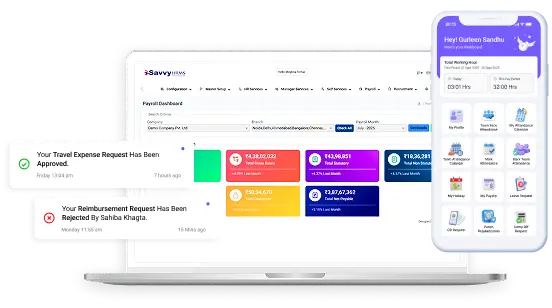









Ready to simplify workforce management across your construction sites?
Explore Savvy HRMS today and take your HR operations to the next level.
Frequently Asked Questions (FAQs)
1. What is the best HR software for construction companies in India?
The best HR software for construction companies should support attendance, payroll, employee management, leave, compliance, mobile access, and workforce management across multiple construction sites.
2. Why do construction companies need HR software?
Construction companies use HR software to manage distributed workforces, track attendance, automate payroll, maintain employee records, manage leave, and simplify HR processes across different project locations.
3. What features should HR software for construction companies have?
Important features include GPS-based attendance, mobile access, payroll management, leave management, employee self-service, statutory compliance, shift scheduling, workforce tracking, reporting, and multi-site employee management.
4. Can HR software manage employees across multiple construction sites?
Yes. HR software can help businesses manage employees across multiple sites by providing centralized employee records, location-based attendance, shift management, payroll integration, and real-time workforce information.
5. How does HR software improve construction payroll management?
HR software connects attendance, leave, overtime, shifts, and employee information with payroll processes, helping reduce manual calculations, improve payroll accuracy, and simplify salary processing.