

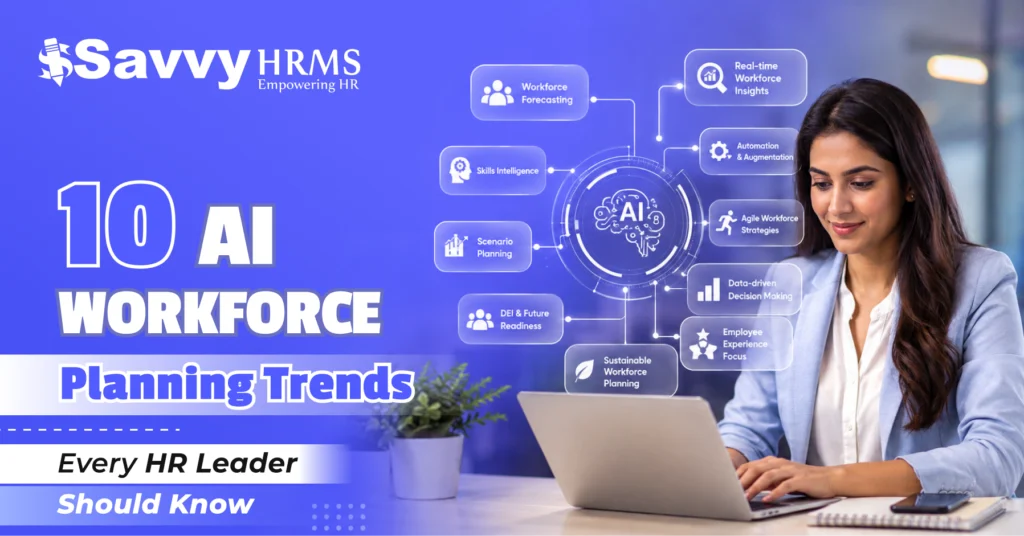
10 AI Workforce Planning Trends Every HR Leader Should Know in 2026


-
AuthorRaghvendra Bhardwaj
-
 Last Updated
September 04, 2026
Last Updated
September 04, 2026
-
 Reading Time
18 Mins
Reading Time
18 Mins
AI is changing how businesses decide who to hire, which skills to build, and where workforce capacity is needed. What does AI-powered workforce planning look like in 2026? HR leaders are moving beyond headcount forecasts toward continuous, data-driven workforce decisions.
Traditional workforce planning focused on job titles, historical headcount, and fixed annual budgets. AI is shifting the conversation toward skills, capabilities, scenarios, productivity, and business outcomes. The result is a dynamic approach that can respond faster to changing organizational needs.
In this blog, we explore 10 AI workforce planning trends shaping HR in 2026, from predictive analytics and skills intelligence to human-agent teams and responsible AI. You will also learn how HR teams can prepare their workforce strategy for a more AI-driven future.
What Is AI-Powered Workforce Planning and Why Does It Matter in 2026?
AI-powered workforce planning is the use of artificial intelligence, workforce data, predictive analytics, and automation to forecast talent requirements, identify skill gaps, optimize workforce capacity, and support better people decisions.
Traditional workforce planning usually asks questions such as:
- How many employees will we need next year?
- Which departments need more people?
- What will our hiring budget be?
- Which positions should we recruit for?
AI-powered workforce planning expands these questions.
HR leaders can now consider:
- Which skills will the business need?
- Which skills already exist internally?
- Where are the biggest capability gaps?
- Which roles could be redesigned or augmented by AI?
- Which employees could move into emerging roles?
- What happens if business demand increases or decreases?
- What workforce mix of people, automation, and AI agents is appropriate?
This shift is important because workforce planning is becoming less predictable. Technology, business models, employee expectations, and required skills can change faster than traditional annual planning cycles can accommodate.
Deloitte describes the future of workforce planning as a move away from simply forecasting headcount toward flexing human capacity and capabilities in real time.
Microsoft’s 2026 Work Trend Index similarly highlights a workplace where AI agents increasingly handle execution while humans have greater responsibility for directing work and owning outcomes.
For HR leaders, this means workforce planning is no longer only about how many people an organization needs. It is increasingly about what work needs to be done, what skills are required, and what combination of human and digital capacity can deliver it.
Why Is AI Changing Traditional Workforce Planning?
AI is changing workforce planning because organizations now have access to more workforce data and more powerful ways to analyze it.
An HR team can combine information such as:
- Employee skills
- Job roles
- Performance data
- Attendance patterns
- Attrition trends
- Compensation costs
- Recruitment data
- Learning records
- Workforce demographics
- Business forecasts
- Productivity indicators
AI can analyze these signals to identify patterns that may be difficult to detect manually.
For example, instead of simply noticing that turnover increased in a department, an AI-enabled workforce planning system could help HR investigate whether turnover is associated with workload, skills shortages, compensation, manager changes, career progression, or other workforce factors.
AI also makes scenario planning more practical.
An HR leader could compare scenarios such as:
Scenario A: Hire 100 additional employees.
Scenario B: Hire 50 employees and reskill 50 existing employees.
Scenario C: Redesign selected processes and combine employees with AI-enabled automation.
The goal is not to allow AI to make every workforce decision automatically. Instead, AI can provide faster analysis and evidence so HR leaders can make more informed decisions.
10 AI Workforce Planning Trends HR Leaders Should Know in 2026
1. Predictive Workforce Analytics for Smarter Headcount Planning
One of the biggest AI workforce planning trends in 2026 is the move from reactive headcount management to predictive workforce analytics.
Traditional headcount planning often depends heavily on historical numbers. If a business had 500 employees last year, leadership may estimate future requirements based on expected growth and previous staffing levels.
AI enables a more dynamic approach.
Predictive workforce analytics can analyze historical workforce information alongside business and operational data to identify potential future workforce requirements.
For example, AI can help HR analyze:
- Expected business growth
- Historical hiring patterns
- Attrition trends
- Workforce productivity
- Department-level capacity
- Seasonal demand
- Skills availability
- Recruitment timelines
This can help organizations identify potential staffing shortages before they become operational problems.
Why does predictive workforce planning matter?
Because hiring decisions often take time.
If a company waits until a department is already understaffed before starting recruitment, it may face productivity issues, overtime costs, employee burnout, and delayed business outcomes.
Predictive analytics allows HR to move from:
“We need employees now.”
to:
“Our workforce data indicates we may need these capabilities in the next few months.”
That difference can make workforce planning more proactive.
However, predictive analytics should be treated as decision support rather than a guarantee. AI forecasts are only as reliable as the data, assumptions, and business context behind them.
2. AI-Powered Skills Gap Analysis
Workforce planning is increasingly moving from jobs to skills.
A job title tells HR what position an employee occupies. A skills-based workforce view provides more detail about what the employee can actually do.
AI can help organizations create and analyze skills inventories by examining information from:
- Employee profiles
- Resumes
- Learning records
- Certifications
- Performance information
- Projects
- Job descriptions
- Self-assessments
- Manager assessments
The result can be a more detailed picture of the organization’s current capabilities.
For example, a company may discover that it has enough employees for its planned expansion but lacks specific skills in AI, cybersecurity, data analysis, cloud technology, or digital operations.
That changes the workforce planning question.
Instead of asking:
“How many people should we hire?”
HR can ask:
“Which capabilities are missing, and can we build or acquire them?”
This can support more strategic decisions around hiring, reskilling, upskilling, internal mobility, and learning.
Deloitte’s human capital research has highlighted the growing importance of addressing changing skills requirements and the experience gap as AI reshapes work.
3. Intelligent Demand and Workforce Forecasting
Business demand can change quickly, and workforce requirements often change with it.
AI can help HR connect workforce planning with business demand forecasting.
For example, an organization could analyze historical workforce requirements against:
- Sales volume
- Customer demand
- Production levels
- Store traffic
- Service requests
- Project pipelines
- Seasonal patterns
This can help HR understand how changes in business activity may affect workforce requirements.
Consider a retail organization preparing for a major seasonal period.
Instead of simply using last year’s staffing numbers, AI could help evaluate current demand patterns, employee availability, historical staffing requirements, and expected business activity.
The organization can then plan staffing levels more accurately.
This is particularly useful for businesses with:
- Seasonal workforces
- Multiple locations
- Shift-based employees
- Variable customer demand
- Project-based teams
- Rapidly growing operations
The key benefit is better alignment between business demand and workforce capacity.
4. AI-Driven Recruitment and Talent Allocation
AI is also changing how organizations acquire and allocate talent.
Recruitment is traditionally viewed as a separate process from workforce planning. In an AI-enabled organization, the two functions can become more closely connected.
If workforce planning identifies a future capability gap, recruitment technology can help HR determine:
- Which roles need to be filled
- Which skills should be prioritized
- Which candidates match those skills
- Which roles could potentially be filled internally
- Which capabilities may require external hiring
AI-powered recruitment can assist with activities such as candidate matching, sourcing, screening, job description creation, and talent recommendations.
The more important workforce planning shift is that recruitment can become capability-driven rather than simply vacancy-driven.
Instead of recruiting because a position became vacant, organizations can recruit because a particular business capability is required.
This can make workforce planning more strategic.
5. Personalized Employee Career and Skills Planning
AI workforce planning is not only about external hiring.
Organizations can increasingly use workforce intelligence to identify opportunities for employees to develop new skills and move into different roles.
For example, AI could compare:
Current employee skills → Required future skills → Recommended development path
An employee working in an operational role may already have several skills required for a future analytical or supervisory position.
Rather than immediately recruiting externally, HR could identify:
- Existing transferable skills
- Skills gaps
- Recommended learning
- Potential career paths
- Internal job opportunities
This supports a more flexible workforce strategy.
It can also strengthen employee development because career planning becomes more connected to actual organizational capability requirements.
Microsoft’s 2026 Work Trend Index describes organizations increasingly operating as learning systems, with AI and agents changing how people develop capabilities and contribute to work.
The broader trend is clear: workforce planning is becoming more closely connected to learning, career development, and internal mobility.
6. Real-Time Workforce Planning and Scenario Modeling
Annual workforce planning is becoming less sufficient for organizations operating in rapidly changing environments.
AI enables HR teams to move toward more continuous workforce planning.
Instead of creating one workforce plan and reviewing it once or twice a year, HR can continuously monitor workforce indicators and evaluate different scenarios.
For example:
What if revenue grows by 20%?
What if employee attrition increases?
What if a new technology automates part of a process?
What if the organization opens five new locations?
What if certain skills become difficult to hire externally?
Scenario modeling allows HR and business leaders to understand the potential workforce implications of different decisions before committing resources.
This supports a more agile approach to workforce planning.
The practical lesson is simple:
Don’t create one workforce plan for one future. Build the ability to respond to multiple possible futures.
7. AI-Powered Internal Mobility and Talent Matching
Another major trend is using AI to find talent that already exists inside the organization.
Internal mobility can be challenging because HR teams may not have complete visibility into employee skills, interests, experience, and potential.
AI can help connect employees with:
- Open positions
- Projects
- Short-term assignments
- Mentoring opportunities
- Learning programs
- Leadership pathways
- Cross-functional opportunities
This creates an internal talent marketplace.
For example, an employee may not have the exact job title required for an emerging position but could possess many of the necessary skills.
An AI-powered system can potentially identify that connection and recommend the employee for consideration.
This changes workforce planning from:
“Which external candidates should we hire?”
to:
“Where is the talent we already have, and how can we deploy it better?”
Internal mobility can also help organizations reduce unnecessary hiring, preserve institutional knowledge, and create stronger career pathways.
However, recommendations should always be reviewed carefully. AI matching should support human decision-making rather than automatically determine who receives an opportunity.
8. Automation of Workforce Planning and HR Decisions
AI is also reducing the amount of manual work involved in workforce planning.
HR teams traditionally spend significant time collecting, cleaning, comparing, and reporting workforce information.
AI-enabled HR technology can automate parts of this process.
Potential applications include:
- Workforce dashboards
- Automated reporting
- Headcount monitoring
- Attrition alerts
- Skills analysis
- Workforce forecasts
- Data summarization
- Scenario comparisons
- Workforce recommendations
The bigger shift is from reporting what happened to helping HR understand what could happen next.
For example:
Traditional HR reporting:
“The organization lost 8% of employees last year.”
AI-enabled workforce intelligence:
“Attrition increased in these teams, certain skills are becoming harder to retain, and projected workforce capacity may fall below expected demand.”
The second type of insight is more actionable for workforce planning.
Microsoft’s research also points toward a workplace where AI agents increasingly handle execution, and humans focus more on directing work, making decisions, and owning outcomes.
This means HR professionals may spend less time preparing workforce information and more time interpreting it.
9. AI-Driven Workforce Cost and Productivity Optimization
Workforce planning cannot be separated from cost management.
Organizations need to understand not only how many employees they require but also what workforce structure can deliver business outcomes efficiently.
AI can help HR and finance teams analyze relationships between:
- Headcount
- Compensation
- Workforce capacity
- Productivity
- Overtime
- Attrition
- Hiring costs
- Training investments
- Workforce utilization
This can support better workforce cost planning.
For example, instead of simply asking whether a company can afford 100 additional employees, leadership can evaluate different workforce models.
Option 1: Hire 100 employees.
Option 2: Hire 60 employees and reskill 40 existing employees.
Option 3: Hire 50 employees while redesigning selected workflows using automation.
Option 4: Build human-AI teams for specific processes.
The objective should not simply be reducing headcount.
A better objective is:
Optimize workforce capacity while protecting productivity, employee experience, skills, and business outcomes.
This distinction matters because excessive cost-cutting can create capability gaps and operational risks.
10. Responsible and Explainable AI in Workforce Planning
The final trend may be the most important one: responsible AI.
As AI becomes involved in workforce decisions, HR leaders must consider questions around:
- Bias
- Fairness
- Privacy
- Transparency
- Data quality
- Explainability
- Human oversight
- Employee trust
- Regulatory compliance
An AI system may identify a workforce pattern, but HR needs to understand how that conclusion was reached and whether the underlying data is reliable.
This is particularly important when AI is used in decisions involving recruitment, promotion, performance, compensation, workforce reduction, or employee opportunities.
Responsible AI does not mean avoiding AI.
It means establishing clear controls around how AI is used.
HR teams should consider implementing:
- Human review for high-impact decisions.
- Regular checks for potential bias.
- Clear data governance policies.
- Appropriate access controls.
- Transparent communication about AI use.
- Periodic validation of AI outputs.
- Clear accountability for final decisions.
The principle should be:
AI can recommend. Humans remain accountable.
How Is AI Improving Workforce Planning for Growing Businesses?
For growing businesses, AI can make workforce planning more scalable.
As employee numbers increase, workforce data becomes harder to manage manually. Businesses may have multiple departments, locations, shifts, job levels, skill sets, and recruitment pipelines.
AI can help bring these data points together.
Key advantages include:
- Faster workforce analysis
- Better headcount forecasting
- Early identification of skills gaps
- Improved workforce utilization
- More informed hiring
- Stronger internal mobility
- Better workforce cost visibility
- Faster scenario planning
- More personalized employee development
For example, a business expanding into multiple cities may need to determine where it should hire, which skills are available locally, which positions can be filled internally, and where workforce shortages could emerge.
AI can help analyze these factors faster than manual spreadsheets and disconnected HR systems.
This is particularly valuable for organizations experiencing rapid growth because workforce decisions increasingly need to happen alongside business decisions.
What Are the Key Benefits of Using AI in Workforce Planning?
The biggest benefit of AI workforce planning is not simply automation. It is better decision-making based on more connected workforce intelligence.
1. Better Forecasting
AI analyzes historical workforce data, business trends, and employee patterns to help HR teams anticipate future staffing needs and make more accurate workforce planning decisions.
2. Faster Decision-Making
AI quickly processes large amounts of workforce data, helping HR leaders access relevant insights faster and make informed decisions without spending excessive time preparing reports.
3. Improved Skills Visibility
AI helps organizations map existing employee skills, identify capability gaps, and understand which skills may be required to support future business growth and changing roles.
4. Smarter Hiring
AI connects workforce requirements with recruitment needs, helping HR teams identify critical roles, prioritize required skills, and align hiring decisions with broader business objectives.
5. Better Internal Mobility
AI can identify employees whose existing skills, experience, and potential align with available opportunities, supporting internal career movement, reskilling, and more effective talent utilization.
6. Workforce Cost Optimization
AI helps organizations compare workforce scenarios, analyze staffing costs, and identify opportunities to balance employee capacity, productivity, hiring, and operational expenses more effectively.
7. Greater Agility
Continuous AI-driven workforce insights help HR teams respond quickly to changing business demands, talent shortages, skill requirements, organizational changes, and unexpected workforce challenges.
8. Stronger Strategic HR
By automating data analysis and routine workforce reporting, AI allows HR professionals to spend more time on strategic workforce planning, talent development, and business priorities.
What Challenges Should HR Leaders Consider Before Adopting AI?
AI workforce planning has significant potential, but implementation is not simply a matter of buying an AI tool.
The quality of workforce planning depends heavily on the quality of workforce data.
Common challenges include:
1. Poor Data Quality
If employee records, job information, skills data, or organizational structures are incomplete, AI outputs may be unreliable.
2. Fragmented HR Systems
Data spread across disconnected HR, payroll, attendance, recruitment, and performance systems can make workforce analysis difficult.
3. Lack of AI Skills
HR professionals need enough AI literacy to understand what AI can and cannot reliably do.
4. Employee Trust
Employees may be concerned about how their data is being analyzed and how AI recommendations could affect their careers.
5. Algorithmic Bias
Historical data can contain existing organizational biases. AI may reproduce or amplify them if appropriate safeguards are missing.
6. Overdependence on Automation
AI should not replace human judgment in sensitive workforce decisions.
7. Implementation Complexity
Organizations need appropriate processes, governance, data structures, and technology infrastructure before advanced workforce planning can deliver meaningful results.
Therefore, the best approach is not AI first.
It is business problem first, data second, AI third.
Start by identifying the workforce decisions that are difficult, repetitive, slow, or highly dependent on fragmented data. Then determine where AI can genuinely improve the process.
How Can HR Teams Prepare for AI-Driven Workforce Planning?
HR leaders can begin with a practical five-step approach.
Step 1: Build a Reliable Workforce Data Foundation
Ensure employee, role, department, skills, compensation, attendance, recruitment, and performance information is accurate and accessible.
Step 2: Move From Job-Based to Skills-Based Thinking
Start documenting the capabilities required for important roles instead of spending only on job titles.
Step 3: Identify High-Value AI Use Cases
Don’t attempt to automate everything.
Start with areas such as:
- Workforce forecasting
- Skills gap analysis
- Internal talent matching
- Attrition analysis
- Workforce reporting
- Recruitment planning
Step 4: Establish AI Governance
Define who can use AI, what data can be processed, how recommendations are reviewed, and who is accountable for decisions.
Step 5: Keep Humans in the Loop
AI should provide analysis, predictions, recommendations, and scenarios. HR and business leaders should retain responsibility for important decisions.
This human-AI balance is becoming increasingly important as organizations move toward human-agent teams. Microsoft describes this shift as a new model in which organizations determine the appropriate mix of humans and AI agents for different types of work.
How Can HRMS Software Support AI-Powered Workforce Planning?
A modern HRMS (Human Resource Management System) can provide the data foundation required for effective workforce planning.
Workforce planning becomes difficult when employee information is scattered across spreadsheets and disconnected applications.
An integrated HRMS can bring together information such as:
- Employee records
- Attendance
- Leave
- Payroll
- Recruitment
- Performance
- Employee skills
- Training
- Organizational structures
- Workforce reports
This creates a more connected view of the workforce.
For example, HR leaders can use workforce data to understand current headcount, analyze employee movement, identify workforce trends, and support future planning.
An HRMS can therefore serve as the operational foundation, while AI and analytics can provide additional intelligence on top of that foundation.
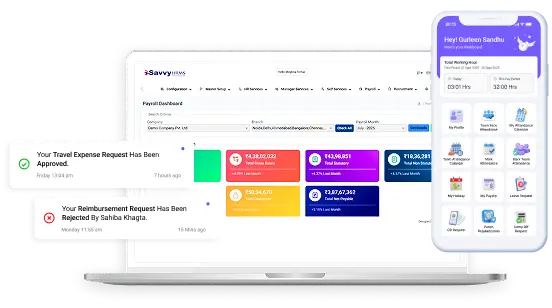
For businesses looking to modernize workforce management, platforms such as Savvy HRMS can help bring multiple HR processes and employee information into a centralized system. The broader objective is to give HR teams cleaner workforce data, stronger visibility, and a more connected basis for workforce decisions.
The important point is that AI workforce planning should not exist separately from everyday HR operations.
The more connected the workforce data, the more useful workforce intelligence can become.
Conclusion
AI is not simply adding another tool to the HR technology stack. It is changing how organizations think about workforce capacity, skills, jobs, productivity, and talent strategy.
The 10 AI workforce planning trends discussed in this guide show a clear direction: workforce planning is moving from static headcount forecasting toward dynamic capability planning.
Predictive analytics can help HR anticipate workforce requirements. Skills intelligence can reveal capability gaps. Scenario modeling can prepare organizations for multiple futures. Internal mobility can help unlock existing talent. AI-driven recruitment can connect hiring with strategic workforce needs.
At the same time, the rise of human-agent teams means workforce planning will increasingly need to consider not only employees but also the technology and AI systems that support them.
However, AI should not become a replacement for HR judgment.
The strongest workforce strategies will combine AI-driven intelligence with human experience, ethical governance, business context, and employee-centric decision-making.
For HR leaders, the goal is not to predict the future perfectly. It is to build a workforce that can adapt when the future changes.









Ready to make workforce planning smarter, more agile, and data-driven?
Explore how Savvy HRMS can help you centralize workforce data and build a stronger foundation for modern HR management.
Frequently Asked Questions (FAQs)
1. What is AI workforce planning?
AI workforce planning uses artificial intelligence, workforce data, and predictive analytics to forecast staffing needs, identify skill gaps, optimize workforce capacity, and support informed talent decisions.
2. How does AI improve workforce planning?
AI analyzes workforce and business data to identify trends, forecast future requirements, detect skill gaps, evaluate scenarios, and help HR leaders make faster, data-driven workforce decisions.
3. Can AI replace workforce planning professionals?
No. AI supports workforce planners by automating analysis and forecasting, while HR professionals provide business context, human judgment, ethical oversight, and strategic decision-making.
4. What are the key benefits of AI workforce planning?
Key benefits include better forecasting, faster decisions, improved skills visibility, smarter hiring, stronger internal mobility, optimized workforce costs, greater agility, and more strategic HR planning.
5. How can businesses prepare for AI-powered workforce planning?
Businesses should improve workforce data quality, adopt skills-based planning, identify suitable AI use cases, establish responsible AI policies, and maintain human oversight for important decisions.