How AI-Powered Attendance Systems Improve Payroll Accuracy in Manufacturing Plants


-
AuthorRaghvendra Bhardwaj
-
 Last Updated
October 26, 2026
-
 Reading Time
19 Mins
How AI-Powered Attendance Systems Improve Payroll Accuracy in Manufacturing Plants
Summary: An AI-powered attendance management system helps manufacturing plants improve payroll accuracy by tracking employee working hours, managing rotating shifts, validating overtime, and identifying attendance discrepancies. When integrated with payroll software, it reduces manual data entry and helps HR teams process salaries more consistently. This guide explains the key features, benefits, implementation checks, and metrics manufacturers can use to evaluate improvements in payroll accuracy.
TL: DR
An AI-powered attendance management system helps manufacturing plants improve payroll accuracy by tracking working hours, managing rotating shifts, validating overtime, and identifying attendance discrepancies.
Here are the key ways these systems help manufacturers improve attendance records and streamline payroll processing:
- Biometric verification helps reduce buddy punching and unauthorized attendance entries.
- Shift management helps track overnight schedules, working hours, leave, and overtime more consistently.
- AI-based anomaly detection can flag unusual attendance patterns for HR teams to review.
- Integrating attendance management software with payroll software reduces manual data entry and helps streamline salary processing.
- Reviewing missing punches, shift mismatches, and overtime approvals before payroll cut-off helps prevent incorrect salary calculations.
- Tracking payroll corrections, attendance discrepancies, and reconciliation time helps manufacturers measure improvements across payroll cycles.
Payroll accuracy in manufacturing starts with reliable attendance records. HR teams need to track employee working hours, shift schedules, overtime, approved leave, and absences to ensure salaries are calculated correctly. When factories operate multiple shifts, production lines, and locations, managing these records manually can lead to errors and payroll discrepancies.
An AI-powered attendance management system can help manufacturers identify unusual attendance patterns, validate working hours against shift rules, and transfer approved records to payroll software.
In this guide, we explain how AI-enabled attendance systems improve payroll accuracy, which features manufacturers should look for, and how to measure results.
What Is an AI-Powered Attendance Management System?
An AI-powered attendance management system uses attendance-capture technology, configured workforce rules, and, where supported, AI-based analysis to help businesses record and review employee working hours.
Depending on the system, employees may register attendance through biometric devices, facial recognition, mobile applications, web check-ins, or other connected devices. The system can then compare recorded activity with expected schedules and flag discrepancies for review.
For example, if a worker’s recorded hours differ significantly from the assigned shift, the system may flag the entry for verification before payroll processing.
Typical capabilities include:
- Biometric attendance: Fingerprint or facial-recognition devices help verify employee identity.
- Real-time attendance records: Attendance information becomes available to authorized supervisors and HR teams.
- Shift and roster management: Records are checked against configured work schedules.
- Anomaly detection: AI-based features may identify unusual patterns, repeated exceptions, or records that need investigation.
- Attendance and payroll integration: Validated records can be transferred to connected payroll software for salary calculations.
- Reports and audit trails: HR teams can review corrections, approvals, and changes to attendance records.
It is important to distinguish AI from ordinary automation. A biometric device captures an attendance event, and a rules-based system applies configured shift or overtime policies. AI may add capabilities such as pattern detection or anomaly identification. Not every biometric attendance system is AI-powered, and an AI system cannot determine whether every flagged record is fraudulent without further evidence.
Why Is Payroll Accuracy a Challenge in Manufacturing Plants?
Manufacturing payroll is complicated because employees may work different shifts, follow rotating schedules, earn overtime, or work across multiple production locations. If attendance records do not accurately reflect these activities, payroll calculations can be affected.
Common challenges include:
- Rotating shifts: Employees may move between morning, evening, night, and weekly rotating shifts, making it important to apply the correct working hours and shift rules.
- Overtime and holiday work: Extra hours, rest-day work, and applicable premiums must be recorded and approved according to company policies and relevant laws.
- Missed punches: Employees may forget to clock in or out, leaving incomplete records that require verification.
- Buddy punching: One employee may attempt to record attendance on behalf of another, resulting in inaccurate attendance data.
- Contract and temporary workers: Different wage arrangements, work orders, contractors, and attendance policies can complicate payroll reconciliation.
- Multiple factory locations: Differences in shift schedules, local policies, and reporting processes can make consolidated attendance management difficult.
- Leave and absence adjustments: Unapproved leave, incorrect absence records, or delayed attendance corrections can lead to incorrect payable days or deductions.
These issues can affect both employee payments and labour-cost reporting.
How Does an AI-Powered Attendance System Improve Payroll Accuracy?
An AI-powered attendance system helps manufacturing plants maintain accurate attendance records before they are used for payroll calculations. It can help identify unusual attendance patterns, reduce manual data entry, and connect approved working hours with payroll software. This makes it easier for HR teams to manage shifts, overtime, leave, and contract workers.
1. Prevent Buddy Punching With Biometric Verification
Buddy punching happens when one employee marks attendance on behalf of another. This can make an absent employee appear present and lead to incorrect attendance records.
That’s why many organizations use biometric attendance systems that verify employees through fingerprints or facial recognition, making it harder for someone to mark attendance on a colleague’s behalf.
For example, if a worker is absent but another employee tries to mark attendance using that worker’s identity, the system may prevent the entry through identity verification. However, biometric systems are not perfect because sometimes device problems or failed identity matches may still require manual verification.
2. Improve Working-Hour Calculations Across Shifts
Manufacturing plants often run morning, evening, and night shifts. Employees may also move between shifts depending on production needs. If attendance records are matched with the wrong shift, working hours may be calculated incorrectly.
Manufacturing attendance software compares clock-in and clock-out records with assigned shifts and work schedules.
For example, an employee may start a night shift at 10 p.m. and finish at 6 a.m. the next day. The system should recognize these hours according to the assigned shift rather than treating midnight as the end of the work period. Accurate shift records help payroll teams calculate working hours and payable time more consistently.
3. Reduce Overtime and Night-Shift Payroll Errors
Employees in manufacturing plants may work beyond their scheduled hours to meet production targets or handle urgent orders. If these extra hours are missed or recorded incorrectly, their overtime payments may also be wrong.
With an attendance system, businesses can compare recorded hours with shift schedules and flag entries that need checking. Once a supervisor approves eligible overtime, the information can be sent to payroll software.
For example, if a worker stays two hours beyond the scheduled shift, the system can flag the additional hours for review before they are included in payroll. Recording extra hours does not automatically make them eligible for overtime pay. The applicable rules, rates, and approvals must follow company policy and relevant labour laws.
4. Improve Leave and Absence Calculations
Attendance records help determine whether an employee was present, absent, or on approved leave. If these records are incorrect, an employee may receive the wrong payable-day calculation or an incorrect loss-of-pay deduction.
An integrated attendance management software can match attendance records with approved leave requests.
For example, if an employee has approved leave but is mistakenly marked absent, HR can correct the record before payroll is processed. This helps reduce avoidable salary corrections. HR teams should still review pending leave requests, missing punches, and other unresolved attendance issues before finalising payroll.
5. Simplify Attendance Tracking for Contract Workers
Many manufacturing plants employ contract workers and temporary staff alongside permanent employees. Managing attendance for different contractors can become difficult when records are kept in separate registers or spreadsheets.
Workforce management software can organize attendance records by worker, contractor, department, or factory location, depending on its features.
For example, a plant can compare the attendance of workers supplied by a contractor with the contractor’s submitted work records before approving the relevant payment or billing details. This makes attendance records easier to review. However, contractor billing and employee wage calculations may follow different processes and should be checked separately where required.
6. Identify Attendance Issues Before Payroll Processing
Attendance records may contain errors such as missing punches, duplicate entries, unusually long working hours, or mismatches with assigned shifts.
Where AI-based anomaly detection is available, the system can identify unusual patterns and flag them for review. Basic rules-based checks can also identify common problems, such as a missing clock-out.
For example, if an employee’s recorded hours repeatedly exceed the normal shift duration, the system can alert HR or the supervisor to check the records.
An alert does not necessarily mean an employee has done something wrong. The employee may have worked approved overtime or changed shifts. The records should be checked before any corrections or payroll decisions are made.
7. Reduce Manual Work Through Attendance and Payroll Integration
When attendance and payroll systems operate separately, HR teams may need to download spreadsheets, check working hours, update leave records, and enter information manually. Each additional step creates another opportunity for errors.
Integrated attendance management and payroll software can transfer approved attendance data directly into the payroll process.
For example, after attendance and overtime are checked, the system can send the relevant working hours, payable days, and approved overtime details to payroll software. The software then uses this information along with the employee’s salary structure and applicable deductions to calculate pay.
This reduces repetitive data entry and helps keep attendance and payroll records consistent. However, incorrect salary details or incomplete attendance records can still affect the final calculation.
How Does Attendance Data Flow From the Factory Floor to Payroll Software?
Attendance and payroll integration works best when attendance records are checked before salary calculations begin. In manufacturing plants, this process connects employee attendance, shift schedules, leave records, overtime approvals, and payroll data to reduce errors at each stage.
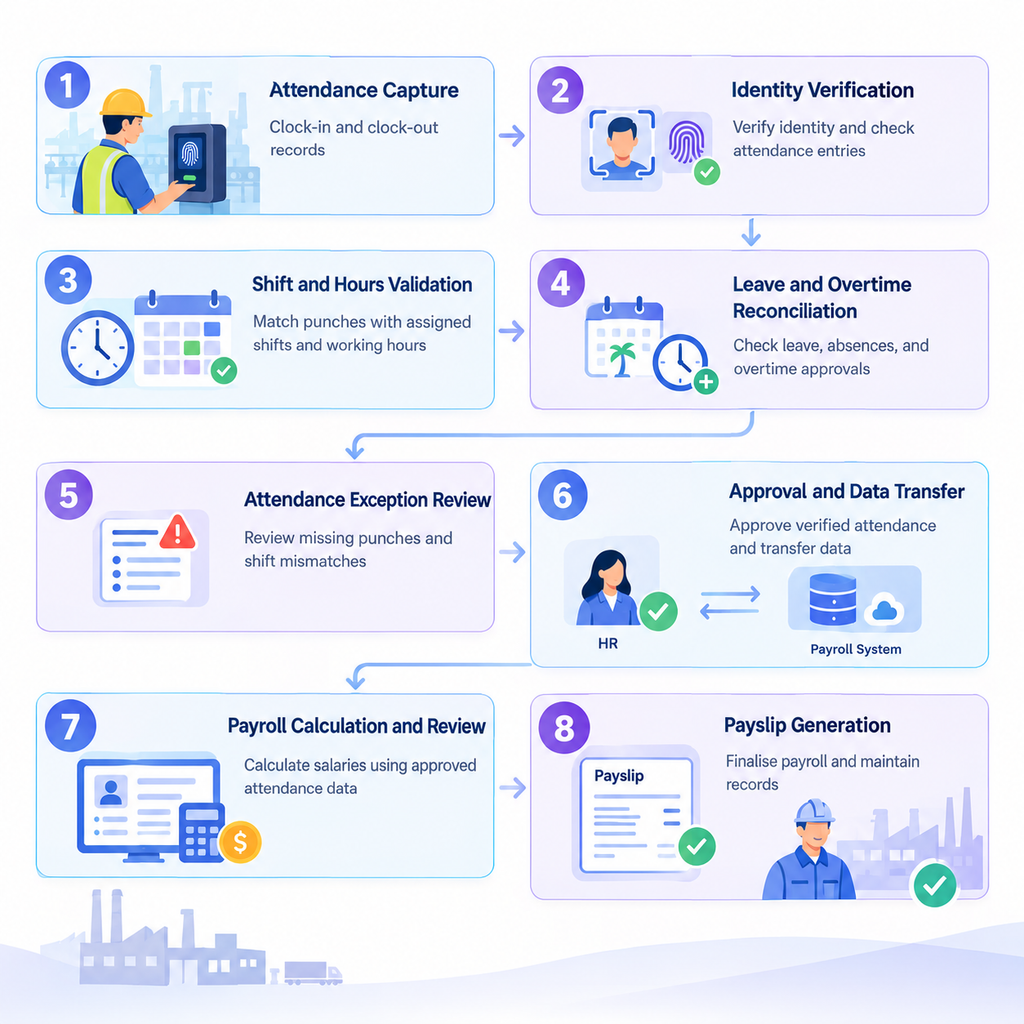
1. Attendance Capture
Workers clock in and out using biometric devices, facial recognition systems, mobile applications, or other configured attendance tools. These records create the initial record of employee working hours.
2. Identity and Record Verification
The system verifies employee identity where supported and checks for incomplete or duplicate attendance entries. This helps HR teams identify questionable records before they affect working-hour calculations.
3. Shift and Working-Hour Validation
The system compares recorded attendance with assigned shifts, rosters, and working-hour rules. This is particularly important for factories with rotating shifts and overnight schedules, where incorrect shift mapping can lead to discrepancies in payable hours.
4. Leave and Overtime Reconciliation
Attendance records are compared with different types of leave, such as approved leave, absence records, and overtime entries. Supervisors or HR teams verify additional working hours and ensure that applicable overtime rules and approval requirements are followed.
5. Attendance Exception Review
Before payroll processing, HR teams review missing punches, unusual attendance patterns, unapproved overtime, and shift mismatches. These exceptions are investigated and corrected through the appropriate approval process rather than being passed directly into payroll.
6. Attendance Approval and Data Transfer
Once attendance records are validated, authorized personnel approve them for payroll processing. The system then transfers the relevant information to connected payroll software, reducing manual data entry and the risk of inconsistent records.
7. Payroll Calculation and Review
Payroll software uses the approved attendance data alongside employee salary structures, applicable deductions, and other payroll inputs to calculate salaries. The payroll team reviews the calculations and investigates discrepancies before finalising payroll.
8. Payslip Generation and Final Reconciliation
After payroll is reviewed and finalized, payslips are generated and payroll records are maintained for future reference. HR teams can use these records to investigate employee queries about working hours, payable days, or overtime payments.
How Should Manufacturers Validate Attendance Before Payroll Cut-Off?
Payroll cut-off is the point at which attendance and related inputs are finalized for a particular payroll cycle. If incomplete or incorrect records remain unresolved at this stage, payroll teams may need to make manual adjustments or process corrections later.
Manufacturers can use the following checklist before closing attendance for payroll:
- Review missing punches: Identify employees with missing clock-in or clock-out records and obtain the required confirmation.
- Check shift mismatches: Confirm that employees who changed shifts or worked overnight are assigned the correct schedules.
- Verify overtime approvals: Ensure additional hours have been reviewed and approved under the applicable policy.
- Reconcile leave and absence: Compare attendance exceptions with approved leave and other authorized absence records.
- Check worker status: Confirm joining dates, exit dates, transfers, and contractor assignments are up to date.
- Investigate unusual records: Review duplicate entries, unexpected working hours, and other flagged anomalies rather than automatically changing them.
- Confirm payroll transfer: Check that approved records have been transferred successfully and that failed or incomplete records are resolved.
A simple exception report can help HR teams prioritize unresolved issues. It should show the employee or worker identifier, date, exception type, responsible reviewer, status, and resolution.
What Features Should Manufacturing Attendance Software Include?
The right manufacturing attendance system should match the plant’s shift patterns, workforce structure, attendance policies, and payroll process. Here are the key features manufacturers should look for.
1. Biometric and Identity Verification
Fingerprint scanners and facial recognition help to verify employee identity during clock-in and clock-out. These features can reduce buddy punching and unauthorized attendance entries.
2. AI-Based Attendance Anomaly Detection
Where available, AI-based anomaly detection can flag unusual attendance patterns, repeated missed punches, or unexpected clock-in times, which help HR teams to review these alerts and find potential issues before payroll processing.
3. Real-Time Attendance Tracking
Real-time attendance visibility helps authorized HR teams and supervisors monitor employee attendance, late arrivals, absences, and missed punches. This is particularly useful for factories operating across multiple shifts.
4. Overtime Tracking and Approvals
The system should record additional working hours and support overtime approval workflows. This helps HR teams to verify overtime entries against company policies before transferring approved hours to payroll.
5. Leave and Absence Integration
Attendance software should connect daily attendance records with approved leave and absence information. This helps prevent employees from being incorrectly marked absent and reduces errors in payable days and salary deductions.
6. Contract Labour Management
Factories often employ contract labour from multiple contractors. Software should help organize attendance records by worker, contractor, department, and work location to support workforce reconciliation and related wage calculations.
7. Payroll Software Integration
Attendance software should transfer verified and approved attendance data to connected payroll software, which helps reduce manual data entry and helps ensure that working hours, payable days, and approved overtime are considered during salary calculations.
8. Exception Reports and Audit Trails
Exception reports help identify missing punches, shift mismatches, and attendance discrepancies. Audit trails record changes, corrections, and approvals, making it easier to investigate payroll queries and maintain accountability.
9. Rotating Shift and Roster Management
Manufacturing attendance software should support rotating shifts, overnight schedules, shift changes, and weekly rosters. It should match employee punches with assigned shifts so that working hours and overtime are calculated using the correct rules.
10. Multi-Plant Reporting
Manufacturers operating multiple plants need attendance reports that can be reviewed by location, department, production unit, or shift. As centralized reporting helps HR teams identify missing punches, frequent attendance discrepancies, and unusual overtime patterns across facilities.
What Is the Difference Between Traditional and AI-Powered Attendance Systems?
Traditional attendance systems generally rely on manual records, basic time-tracking devices, or configured rules. AI-powered systems may add pattern analysis and anomaly detection to help teams identify records that need attention.
However, the distinction depends on the product’s actual capabilities. Many conventional systems already automate shift calculations and payroll transfers without using AI.
| Comparison | Traditional or rules-based system | AI-powered attendance system |
| Attendance capture | Manual registers, cards, biometric devices, or applications | May use the same capture methods |
| Working-hour calculations | Applies configured schedules and rules | May combine rules with additional AI-based analysis |
| Error identification | Detects predefined errors, such as missing punches | May flag less obvious patterns, depending on its capabilities |
| Exception handling | HR or supervisors investigate flagged records | AI-based alerts may help prioritize records for investigation |
| Payroll integration | Available when supported by the software | Also depends on the integration and product configuration |
| Human review | Needed for exceptions and approvals | Still needed to verify alerts and approve sensitive changes |
The main difference is not simply automation versus no automation. It is whether the system adds useful AI-based analysis beyond the standard attendance rules and workflows already available.
How Can Manufacturers Measure Improvements in Payroll Accuracy?
Manufacturers can measure payroll accuracy by tracking attendance discrepancies, payroll corrections, and reconciliation time before and after implementing an AI-powered attendance management software.
The process starts with understanding existing errors, then monitoring how attendance data is validated and used for payroll calculations across multiple payroll cycles.
1. Establish a Baseline of Existing Payroll Errors
Before implementing new attendance technology, HR and payroll teams should review previous payroll cycles to understand the frequency of attendance-related errors.
They can record missing punches, incorrect shift records, overtime discrepancies, payroll corrections, and the time spent reconciling attendance. This baseline provides a reference point for evaluating whether the new system improves payroll accuracy.
2. Validate Attendance Records Before Payroll Processing
Once the baseline is established, manufacturers should monitor how accurately employee attendance is captured and validated. HR teams can check clock-in and clock-out records against shift schedules, approved leave, and overtime approvals.
An AI-powered attendance management system may flag unusual patterns or incomplete records for review, so resolving these discrepancies before payroll processing helps prevent incorrect attendance data from affecting salary calculations.
3. Track Attendance-Related Payroll Corrections
After attendance records are validated, payroll teams should record how many salary entries require correction because of attendance-related issues. These may include incorrect payable days, missing working hours, shift mismatches, or differences between approved and paid overtime.
Comparing these figures with the baseline helps manufacturers determine whether fewer attendance errors are reaching payroll.
4. Measure Attendance Reconciliation Time
Manufacturers should also measure how much time HR and payroll teams spend resolving attendance exceptions and preparing payroll inputs. They can track the hours required to investigate missing punches, obtain overtime approvals, correct records, and reconcile attendance across shifts or plants.
A reduction in reconciliation time may indicate that automated checks and integrated records are reducing manual work. However, faster processing alone does not prove that payroll is more accurate.
5. Compare Results Across Payroll Cycles
After collecting the data, manufacturers should compare results across several payroll cycles using consistent definitions and comparable workforce groups. Useful metrics include:
- Payroll correction rate: The proportion of payroll records requiring attendance-related correction.
- Missing-punch frequency: The number of incomplete clock-in or clock-out records.
- Overtime discrepancies: Differences between recorded, approved, and paid overtime.
- Manual payroll adjustments: The number of salary adjustments caused by attendance-related errors.
- Attendance reconciliation time: The time spent resolving attendance issues before payroll cut-off.
- Payroll-related employee queries: The number of queries about attendance, payable days, and overtime.
Tracking these metrics together gives manufacturers a clearer picture of whether attendance data quality and payroll processing are improving.
Example: Measuring Payroll Accuracy in a Manufacturing Plant
Consider a manufacturing plant with 500 employees working across three shifts. Before implementing an improved attendance system, the HR team spends considerable time correcting attendance records and reconciling overtime entries. After implementation, the team reviews fewer discrepancies and completes reconciliation more quickly.
The following example illustrates how a manufacturer could measure these changes over a monthly payroll cycle. These figures are hypothetical and are not actual customer results.
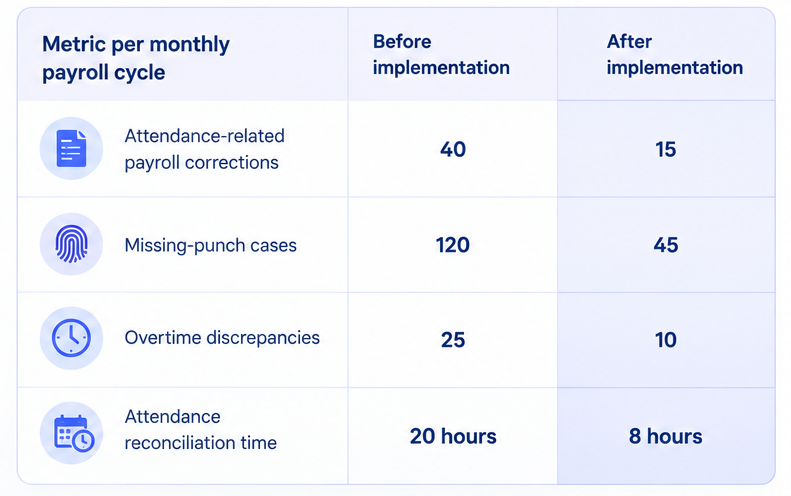
As you can see in the example image, the plant reduces attendance-related corrections and reconciliation time after improving its attendance process. Manufacturers should track the same metrics over several payroll cycles to determine whether the changes lead to sustained improvements.
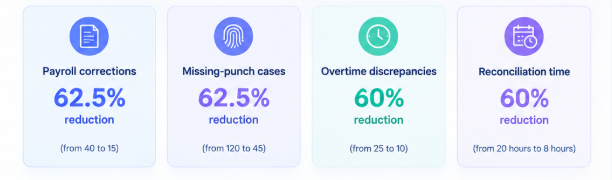
In this example, attendance-related payroll corrections decrease from 40 to 15 per cycle, a 62.5% reduction. Missing-punch cases fall by 62.5%, while overtime discrepancies decrease by 60%. Attendance reconciliation time drops from 20 hours to 8 hours, a 60% reduction.
The HR team should then verify that the improvements reflect fewer errors in final payroll records, not merely faster processing or fewer reported issues. It should also investigate any remaining discrepancies and check whether changes in staffing, policies, or reporting practices influenced the results.
By following this process, manufacturers can assess whether their attendance management system is improving data quality, reducing payroll corrections, and making payroll preparation more efficient.
Conclusion
Payroll accuracy in manufacturing begins with reliable attendance records. When workers work across rotating shifts, production locations, and different employment arrangements, even small attendance discrepancies can create extra work for HR and payroll teams.
An AI-powered attendance management system can help manufacturers identify unusual patterns, validate working hours, and reduce manual data entry. Integrated payroll software then uses approved attendance information to support salary calculations, overtime processing, and payroll reconciliation.
The best results come from combining appropriate technology with clear attendance policies, accurate employee data, reliable integrations, and timely exception reviews. Manufacturers should measure actual changes in payroll corrections, reconciliation time, and attendance discrepancies rather than assuming that automation automatically guarantees accuracy.



Ready to Simplify Attendance Management in Your Factory?
Explore how Savvy HRMS can help your team manage attendance records and streamline payroll processes.
Frequently Asked Questions
How does an AI-powered attendance management system improve payroll accuracy?
An AI-powered attendance management system helps identify unusual records, validate attendance against configured schedules, and reduce manual data entry. When integrated with payroll software, it helps ensure that approved working hours, leave, and overtime information are available for salary calculations.
Can a biometric attendance system calculate overtime?
A biometric device primarily records or verifies attendance. Overtime calculations generally require attendance data to be processed against configured shift rules, overtime policies, and approval workflows in the attendance or payroll software.
How does manufacturing attendance software manage rotating shifts?
A manufacturing attendance system assigns workers to configured rosters and compares recorded working hours with their schedules. It can help identify shift mismatches and overnight work, provided the shift rules and employee assignments are configured correctly.
Can attendance management software integrate with payroll software?
Yes, many attendance management systems can integrate with payroll software directly or through an API, file transfer, or HRMS platform. The integration should transfer validated attendance data accurately and handle failed transfers, employee mapping, and exceptions.
How can factories track contract workers?
Factories can use workforce management software to organize attendance by worker, contractor, plant, department, or work order where supported. Attendance should be reconciled with relevant work records and approvals before it is used for contractor billing or other payroll-related processes.
Does AI eliminate payroll errors?
No. AI can help identify attendance anomalies and reduce some manual errors, but payroll accuracy also depends on correct employee data, salary structures, policies, integrations, and approvals. Human review remains important for exceptions and disputed records.