

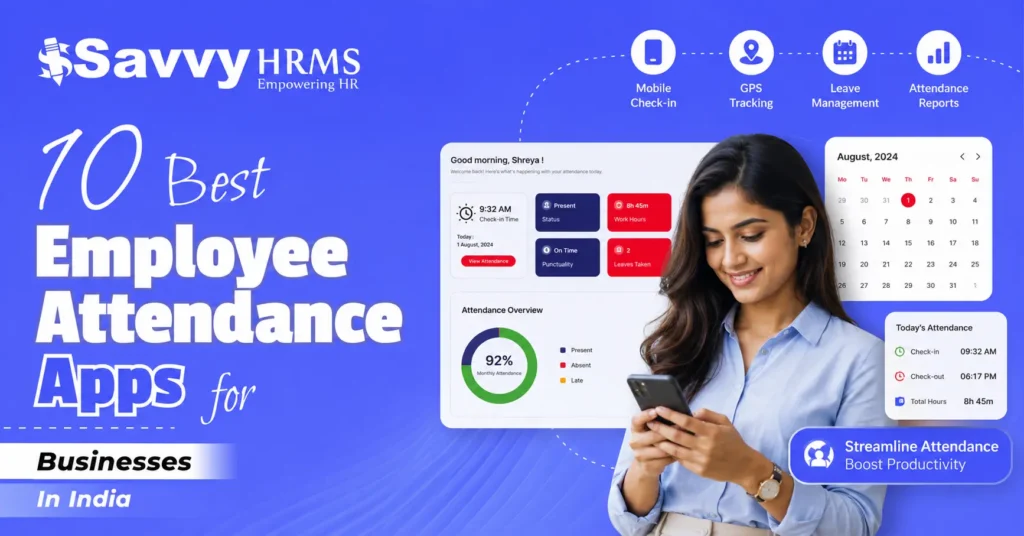
10 Best Employee Attendance Apps for Businesses in 2026


-
AuthorSalilendra Kumar
-
 Last Updated
September 12, 2026
Last Updated
September 12, 2026
-
 Reading Time
24 Mins
Reading Time
24 Mins
The best employee attendance apps are replacing outdated, error-prone manual registers across fast-moving workplaces everywhere. Businesses in 2026 need smarter systems that track time, automate payroll, and reduce compliance risks instantly. This guide breaks down the top platforms built to simplify workforce management for every team size.
From five-person startups to thousand-employee enterprises, attendance tracking directly shapes productivity, payroll accuracy, and employee trust across departments. Picking the right tool means fewer manual errors, stronger compliance, and happier, more engaged teams throughout the year. This list makes that decision easier and faster.
Every business, whether a restaurant chain, IT company, or retail brand, faces unique attendance challenges like shift scheduling and remote check-ins. That’s why we researched and ranked the best employee attendance app of 2026 based on features, pricing, and real usability across industries and business sizes.
Before comparing tools, let’s begin by understanding what employee attendance apps actually are and why they’ve become important for modern businesses.
What Is an Employee Attendance App?
An employee attendance app is a digital tool that records when employees clock in, clock out, and take breaks, replacing manual registers and biometric machines with cloud-based tracking. These apps generally use mobile GPS, geofencing, biometric authentication, or QR codes to verify presence in real time.
Beyond simple clock-ins, modern attendance apps calculate work hours, flag late arrivals, manage leave requests, and sync directly with payroll systems. Managers get live dashboards showing who is present, absent, or on leave, while employees get self-service portals to apply for leave or check their attendance history without HR intervention.
For businesses with remote, hybrid, or multi-location teams, attendance apps also support geofenced check-ins and selfie-based verification, making it nearly impossible for employees to mark attendance from unauthorized locations. This shift from paper registers to intelligent software is what defines workforce management in 2026.
Why Do Businesses Need Employee Attendance Apps in 2026?
Let’s be honest, nobody’s excited about chasing down attendance registers or fixing payroll mistakes at 11 PM before salary day. That’s exactly why businesses in 2026 are ditching manual tracking for good. Hybrid work, gig hiring, and multi-location teams have basically broken the old system, and attendance apps are stepping in to fix it.
Here’s what’s really pushing businesses to make the switch:
- Manual tracking just can’t keep up: Excel sheets and paper registers weren’t built for remote check-ins or last-minute shift changes.
- Buddy punching is a real problem: someone clocking in for a friend costs more than people realize, and apps shut that down with GPS and biometric checks.
- Payroll errors are expensive: even small miscalculations in hours or overtime add up fast across a growing team.
- Compliance rules have gotten stricter: Indian labor laws now demand accurate records of working hours, overtime, and leave, and audits don’t wait for excuses.
- HR teams are stretched thin: automating attendance frees up hours that used to go into manual calculations and chasing approvals.
And it’s not just about saving HR’s sanity. Employees genuinely want transparency too. When they can check their own attendance and leave balance without emailing HR five times a week, trust goes up and friction goes down.
So really, it comes down to this: businesses that still depend on manual attendance in 2026 aren’t just working harder than they need to; they are also taking on unnecessary payroll and compliance risk. Attendance apps simply remove that risk while giving both employees and managers a much clearer picture of what’s actually happening day to day.
How Did We Rank These Employee Attendance Apps?
We evaluated each employee attendance app using a consistent set of criteria focused on accuracy, ease of use, automation, payroll integration, scalability, and real-world business requirements. The ranking considers how effectively each platform helps businesses manage employee attendance while reducing manual work and improving workforce visibility.
Our Ranking Criteria Included:
- Attendance Accuracy: We assessed the reliability of attendance tracking through GPS, geofencing, biometrics, facial recognition, and other verification methods.
- Ease of Use: We considered how simple the app is for HR teams, managers, and employees to use for daily attendance, leave, and approvals.
- Payroll Integration: We evaluated how effectively attendance, leave, overtime, and working-hour data can be connected with payroll processing.
- Features and Functionality: We looked at essential features such as shift scheduling, leave management, overtime tracking, employee self-service, and attendance analytics.
- Pricing and Scalability: We considered affordability for small businesses as well as the ability to support growing teams, multiple locations, and larger workforces.
- Compliance Support: We assessed features that help businesses maintain accurate attendance records and support statutory and labor-law compliance requirements.
- Mobile Experience: We evaluated the quality and usability of mobile attendance features, especially for remote, field, hybrid, and multi-location employees.
- Customization: We considered flexibility in configuring attendance policies, shifts, leave rules, approval workflows, and location-based requirements.
- Reporting and Analytics: We assessed the availability of real-time dashboards, attendance reports, absenteeism insights, and workforce analytics.
- Industry and Business Fit: We considered how well each app serves different business environments, including IT, retail, restaurants, manufacturing, startups, remote teams, and large enterprises.
- Customer Support: We considered the availability, responsiveness, and overall quality of vendor support during implementation and ongoing usage.
Based on these criteria, we ranked the apps according to their overall functionality, business suitability, usability, and value for different types and sizes of organizations.
At a Glance
Here’s a quick summary of the top 10 employee attendance apps for businesses in 2026, ranked by overall fit, features, and value for money.
| Rank | Employee Attendance Apps | Best For | Overall Fit |
| 1 | Savvy HRMS | All-in-one attendance and payroll automation | Best overall |
| 2 | Keka | Growing mid-sized businesses | Excellent |
| 3 | ZingHR | Enterprises with complex workforce needs | Very good |
| 4 | Kredily | Small businesses and startups | Great for budget |
| 5 | Qandle | Customizable HR workflows | Very good |
| 6 | greytHR | Compliance-heavy small and mid businesses | Excellent |
| 7 | Darwinbox | Large enterprises | Very good |
| 8 | Deel | Global and remote-first teams | Excellent for global |
| 9 | Sage HR | Simple attendance and leave tracking | Good |
| 10 | PeopleStrong | Large-scale enterprise HR | Very good |
1. Savvy HRMS – Best Overall Employee Attendance App for Indian Businesses
Overview
Savvy HRMS is a comprehensive attendance and payroll platform built for Indian businesses looking for accuracy, automation, and compliance. It combines biometric, GPS, and geofenced attendance tracking with real-time payroll syncing, making it a strong all-in-one HR solution for growing teams.
Key Features of Savvy HRMS include:
- Geofenced and GPS-based mobile attendance tracking for accurate, location-verified employee check-ins from anywhere
- Biometric integration for offices and factories to eliminate buddy punching and time theft
- Real-time payroll sync with attendance data for faster, error-free monthly salary processing
- Automated leave and overtime calculations based on configurable company policies and shift rules
- Shift scheduling for multi-location businesses managing rotating staff across different branches
- Employee self-service portal for leave requests, attendance history, and approval tracking
- Statutory compliance reports generated automatically to stay audit-ready at all times
- Customizable attendance policies per department, role, or location for maximum flexibility
- Detailed analytics dashboard giving HR managers real-time visibility into workforce attendance trends
Who should choose Savvy HRMS
Businesses wanting one platform for attendance, payroll, and compliance without juggling multiple tools should choose Savvy HRMS. It suits restaurants, retail chains, manufacturing units, and multi-location companies needing accurate real-time tracking with minimal manual HR intervention.
Who might not need Savvy HRMS?
Very small teams under ten employees with simple attendance needs and no payroll complexity might not need Savvy HRMS. Freelance-only businesses or companies already locked into another payroll ecosystem may also find it unnecessary for their scale.
Best For
Savvy HRMS is best for small, medium, and large Indian businesses, restaurants, retail chains, and multi-location companies wanting one unified platform for accurate attendance tracking, automated payroll processing, and hassle-free statutory compliance management, all without juggling multiple disconnected HR tools.
2. Keka – Employee-Friendly HR & Payroll for Growing Teams
Overview
Keka is a popular HR and payroll platform known for its intuitive interface and strong attendance module, designed for mid-sized companies wanting employee-friendly software.
Key Features:
- Mobile app with selfie-based attendance verification
- Shift and roster management for multiple teams
- Automated leave balance calculations
- Payroll processing integrated with attendance data
- Performance management module included
Who should choose Keka
Mid-sized businesses wanting a modern, employee-friendly interface alongside strong payroll and performance tools should choose Keka. It works well for IT companies and service businesses prioritizing employee experience alongside accurate attendance tracking.
Who might not need Keka?
Very small businesses with tight budgets or highly complex, industry-specific compliance needs might find Keka’s pricing and feature depth more than necessary for their current operational stage.
Best For
Keka is best for mid-sized businesses, especially IT and service companies, wanting an intuitive, employee-friendly platform combining accurate attendance tracking, smooth payroll processing, and built-in performance management tools together.
3. ZingHR – AI-Powered Attendance for Complex Enterprises
Overview
ZingHR is an enterprise-grade HR suite offering AI-powered attendance tracking, facial recognition, and workforce analytics for large, complex organizations across industries.
Key Features:
- Facial recognition-based attendance verification
- AI-driven workforce analytics and insights
- Multi-location and multi-shift management
- Deep payroll and compliance integrations
- Mobile-first design for field employees
Who should choose ZingHR
Large enterprises with complex workforce structures, multiple locations, and advanced compliance requirements should choose ZingHR. It suits organizations needing AI-driven insights and facial recognition for accurate, fraud-resistant attendance tracking.
Who might not need ZingHR?
Small businesses or startups with simple attendance needs might find ZingHR’s enterprise pricing and feature complexity unnecessary, especially if they lack dedicated HR teams to manage advanced configurations.
Best For
ZingHR is best for large enterprises with complex, multi-location workforces needing AI-driven analytics, facial recognition-based attendance verification, and deep payroll and compliance integrations across diverse teams and departments.
4. Kredily – Free Attendance & Payroll for Startups
Overview
Kredily is a free-to-use HR and payroll platform popular among startups and small businesses needing basic attendance tracking without upfront software costs.
Key Features:
- Free attendance and leave management module
- Biometric device integration support
- Basic payroll processing capabilities
- Employee self-service mobile app
- Simple, no-cost onboarding process
Who should choose Kredily
Startups and small businesses with limited budgets wanting essential attendance and payroll features without licensing costs should choose Kredily. It’s ideal for companies just beginning to digitize their HR processes.
Who might not need Kredily?
Larger businesses needing advanced analytics, deep customization, or dedicated customer support might find Kredily’s free-tier limitations restrictive as their workforce and HR complexity grows over time.
Best For
Kredily is best for budget-conscious startups and small businesses wanting essential attendance tracking, leave management, and basic payroll processing without upfront licensing costs while digitizing their core HR operations.
5. Qandle – Customizable HR Workflows for Flexible Businesses
Overview
Qandle offers a highly customizable HR platform with modular attendance, payroll, and performance tools suited to businesses wanting flexible, configurable workflows.
Key Features:
- Customizable attendance rules and shift patterns
- Modular pricing based on required features
- Biometric and mobile attendance options
- Automated compliance and statutory reporting
- Integration with third-party payroll tools
Who should choose Qandle
Businesses wanting flexibility to pick only the HR modules they need, without paying for unused features, should choose Qandle. It suits companies with unique workflows requiring extensive customization capabilities.
Who might not need Qandle?
Businesses looking for an immediate, out-of-the-box solution without configuration time might find Qandle’s modular setup process slower compared to more plug-and-play attendance platforms available today.
Best For
Qandle is best for businesses wanting flexible, modular HR workflows, letting them pick specific attendance, payroll, and compliance features that match their unique operational needs without paying for unused extras.
6. greytHR – Compliance-First Attendance for Indian SMBs
Overview
greytHR is a trusted, compliance-focused HR platform widely used by small and mid-sized Indian businesses for reliable attendance, leave, and payroll management.
Key Features:
- Strong statutory and labor law compliance tools
- Biometric device and mobile attendance support
- Automated payroll processing and payslips
- Leave and attendance policy configuration
- Reliable customer support and documentation
Who should choose greytHR
Small and mid-sized businesses prioritizing labor law compliance and reliable statutory reporting should choose greytHR. It’s particularly strong for companies operating under strict Indian regulatory requirements and audits.
Who might not need greytHR
Global or remote-first companies needing multi-country payroll support might not need greytHR, since its strength lies primarily in Indian compliance rather than international workforce management.
Best For
greytHR is best for small and mid-sized Indian businesses prioritizing strong statutory compliance, reliable attendance tracking, and automated payroll processing while operating under strict regulatory and labor law requirements.
7. Darwinbox – Enterprise-Scale HR for Global Organizations
Overview
Darwinbox is a cloud-based enterprise HR platform offering end-to-end attendance, payroll, and talent management for large, fast-growing organizations across multiple countries.
Key Features:
- Enterprise-scale attendance and workforce management
- AI-powered analytics and predictive insights
- Multi-country payroll and compliance support
- Extensive third-party integration ecosystem
- Configurable workflows for large teams
Who should choose Darwinbox
Large enterprises and fast-scaling companies needing end-to-end HR management across multiple countries should choose Darwinbox. It suits organizations requiring deep analytics and enterprise-grade scalability for growing workforces.
Who might not need Darwinbox?
Small businesses or startups with limited HR budgets and simple attendance needs might find Darwinbox overly complex and expensive relative to their actual operational requirements.
Best For
Darwinbox is best for large, fast-growing enterprises operating across multiple countries, needing end-to-end attendance tracking, AI-powered analytics, and scalable payroll and compliance management for expanding global workforces.
8. Deel – Global Payroll & Attendance for Remote Teams
Overview
Deel is a global HR and payroll platform built specifically for remote-first and distributed teams, combining attendance tracking with international compliance and payments.
Key Features:
- Global payroll and compliance across countries
- Time tracking for remote and contract workers
- Automated international payment processing
- Contractor and full-time employee management
- Built-in compliance for multiple jurisdictions
Who should choose Deel
Companies hiring globally distributed teams, remote employees, or international contractors should choose Deel. It’s ideal for businesses needing simplified cross-border payroll alongside reliable time and attendance tracking.
Who might not need Deel?
Businesses operating entirely within one country with a local workforce might not need Deel’s global infrastructure, since its core value lies in international hiring and compliance capabilities.
Best For
Deel is best for companies hiring globally distributed teams, remote employees, and international contractors, needing simplified cross-border payroll, compliance, and reliable time and attendance tracking across multiple countries.
9. Sage HR – Simple Attendance & Leave Tracking Made Easy
Overview
Sage HR is a straightforward, easy-to-use HR platform offering essential attendance, leave, and performance tracking for small and mid-sized businesses globally.
Key Features:
- Simple leave and attendance management
- Shift scheduling and rota planning tools
- Employee self-service mobile application
- Basic performance review functionality
- Clean, intuitive user interface
Who should choose Sage HR
Small and mid-sized businesses wanting simple, no-frills attendance and leave management without complex configuration should choose Sage HR. It suits teams prioritizing ease of use over advanced customization.
Who might not need Sage HR?
Larger enterprises needing deep compliance automation, advanced analytics, or multi-country payroll support might find Sage HR’s simpler feature set insufficient for their operational scale.
Best For
Sage HR is best for small and mid-sized businesses wanting simple, easy-to-use attendance and leave management without complex setup, ideal for teams prioritizing usability over advanced customization features.
10. PeopleStrong – Unified HR Technology for Large Enterprises
Overview
PeopleStrong is an enterprise HR technology platform offering AI-driven attendance, payroll, and talent management solutions built for large-scale Indian and global organizations.
Key Features:
- AI-powered attendance and workforce analytics
- Enterprise payroll and compliance automation
- Talent management and performance integration
- Multi-location and multi-shift support
- Scalable architecture for large workforces
Who should choose PeopleStrong
Large enterprises needing a unified platform for attendance, payroll, and talent management at scale should choose PeopleStrong. It suits organizations with thousands of employees across multiple locations and functions.
Who might not need PeopleStrong?
Small businesses or startups with fewer than fifty employees might find PeopleStrong’s enterprise pricing and feature depth unnecessary for their current, simpler attendance tracking needs.
Best For
PeopleStrong is best for large-scale enterprises needing a unified platform combining AI-powered attendance tracking, payroll automation, and talent management across thousands of employees spanning multiple locations and functions.
| Employee Attendance Apps | Best For | Biggest Advantage | Potential Integration | Ideal Employee Size |
| Savvy HRMS | All-in-one attendance and payroll | Real-time payroll sync | Biometric devices, payroll tools | 10 – 50,000+ |
| Keka | Employee-friendly mid-sized teams | Intuitive user experience | Payroll, performance tools | 50 – 5000+ |
| ZingHR | Enterprise AI-powered tracking | Facial recognition accuracy | ERP, payroll systems | 500+ |
| Kredily | Budget startups | Free core features | Biometric devices | 10 – 5000+ |
| Qandle | Customizable workflows | Modular flexibility | Third-party payroll apps | 20 – 10,000+ |
| greytHR | Compliance-focused SMBs | Strong statutory compliance | Biometric, banking systems | 10 – 5000+ |
| Darwinbox | Large multi-country enterprises | Deep analytics and scale | ERP, finance systems | 500+ |
| Deel | Global remote teams | Cross-border compliance | Payment gateways | 1 – 1000+ |
| Sage HR | Simple SMB tracking | Ease of use | Basic payroll tools | 10 – 200+ |
| PeopleStrong | Large-scale enterprises | Unified talent and attendance | ERP, HRMS ecosystems | 500+ |
What Features Should You Look for in an Employee Attendance App?
Choosing the right attendance app means looking beyond basic clock-ins. Focus on accuracy, automation, and scalability so the tool grows with your business instead of becoming another operational bottleneck.
1. GPS and Geofencing
Location-based tracking ensures employees can only mark attendance within approved zones, preventing fraudulent check-ins from unauthorized locations. This feature is essential for field staff, retail teams, and multi-location businesses managing remote workers.
2. Biometric and Facial Recognition
Biometric verification eliminates buddy punching by confirming the actual employee is present during check-in. Facial recognition adds an extra security layer, making attendance records tamper-proof and significantly more reliable for audits.
3. Payroll Integration
Smooth payroll syncing automatically pulls verified attendance data into salary calculations, removing manual reconciliation. This reduces errors, speeds up monthly payroll cycles, and ensures employees are paid accurately for actual hours worked.
4. Leave and Overtime Automation
Automated leave balance tracking and overtime calculations prevent disputes and manual miscalculations. Employees can apply for leave digitally, while managers approve requests instantly without lengthy back-and-forth communication or paperwork delays.
5. Shift Scheduling
Flexible shift management allows businesses to handle rotating schedules, multiple locations, and varying employee availability. This is especially valuable for restaurants, retail chains, and manufacturing units with non-standard working hours.
6. Compliance and Statutory Reporting
Automated compliance reports keep businesses audit-ready by tracking working hours, overtime, and leave according to labor law requirements. This reduces legal risk and simplifies documentation during inspections or regulatory reviews.
7. Mobile Accessibility
A strong mobile app lets employees clock in, apply for leave, and check attendance history on the go. This is important for remote, hybrid, and field-based teams working outside traditional office setups.
8. Analytics Dashboard
Real-time dashboards give HR managers visibility into attendance trends, absenteeism patterns, and department-wise performance. This data-driven insight helps businesses make proactive staffing and policy decisions instead of reacting after problems arise.
What Are the Benefits of Using an Employee Attendance App?
Employee attendance apps replace error-prone manual processes with automated, accurate tracking that saves time for HR teams while giving employees transparency into their own working hours, leave balances, and attendance history.
Beyond convenience, these apps directly protect business revenue by eliminating time theft, buddy punching, and payroll miscalculations, while also strengthening compliance with labor laws through automated, audit-ready statutory reporting and documentation.
Key benefits include:
- Reduces manual errors and eliminates paper-based tracking
- Saves HR time through automated calculations and reporting
- Improves payroll accuracy with real-time attendance syncing
- Prevents buddy punching and time theft effectively
- Builds employee trust through self-service transparency
- Strengthens compliance with automated statutory reports
- Provides real-time visibility into workforce attendance patterns
Ultimately, attendance apps turn a tedious administrative task into a simplified, transparent process that benefits HR teams, managers, and employees equally across the organization.
How Do Attendance Apps Improve Employee Time Tracking?
Time tracking used to mean someone scrawling entry and exit times on a register, then someone else blinking at that handwriting weeks later trying to make sense of it. Not exactly a system built for accuracy.
Attendance apps flip that whole process on its head. Instead of depending on memory or paperwork, everything gets captured the moment it happens and flows automatically from there. Here’s roughly what that looks like in practice:
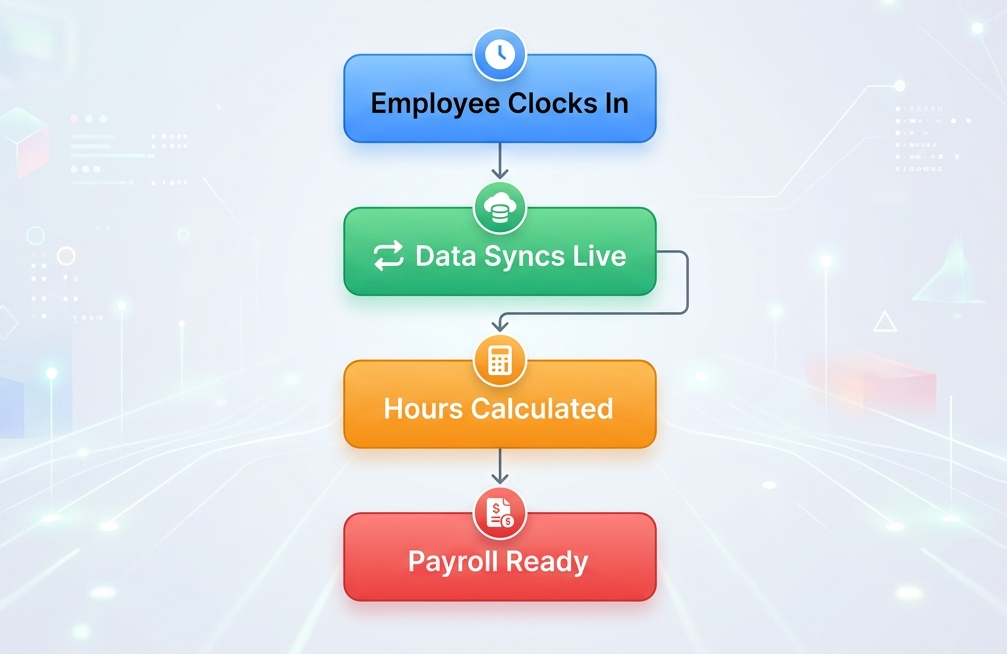
The nice part about this whole chain is that it doesn’t wait for anyone to run a report. The moment someone clocks in, that data is already live, no compiling registers at the end of the month, no chasing down who forgot to log their hours.
That quickness is really what changes the game. Managers can spot a pattern of late arrivals or unusual absences the same week it happens instead of discovering it in a quarterly review. And since overtime and breaks get calculated automatically, nobody’s left arguing over whether an extra 45 minutes actually counted or not; the system already worked it out, consistently, every single time.
How Do Employee Attendance Apps Integrate With Payroll?
Here’s the thing about payroll: it’s usually the most stressful few days of the month for any HR team, mostly because of one boring but painful task: matching attendance records with salary sheets. Attendance apps basically make that entire headache disappear.
Instead of someone manually cross-checking who worked how many hours, who took leave, and who clocked overtime, the app does all of that in the background the moment attendance is marked. By the time payroll day rolls around, the numbers are already sitting there, verified and ready to go.
Think of it like this: every clock-in and clock-out feeds directly into a live record. No spreadsheets, no re-typing numbers from one system into another, no “wait, did we count his half-day correctly” conversations three days before salaries go out.
Here’s what actually happens behind the scenes:
- The app tracks total hours worked, including late clock-ins and early exits
- Leave taken (paid, unpaid, sick) gets automatically deducted from the payable days
- Overtime is calculated based on whatever policy the company has set
- All of this data pushes directly into the payroll software, with no manual copy-pasting
- Payroll then applies salary structure, deductions, and taxes on top of accurate attendance numbers
So really, the app isn’t just recording attendance; it’s quietly doing half of payroll’s job before payroll even starts. That’s the real reason businesses see faster processing times and fewer “why is my salary wrong” complaints once they switch to an integrated system.
How Much Does an Employee Attendance App Cost in India?
Let’s talk numbers, because this is usually the first question business owners actually want answered. The good news? Attendance apps in India are far more affordable than most people expect, and there’s genuinely something for every budget.
Pricing generally ranges from free basic plans for small teams to ₹50 – ₹150 per employee per month for mid-tier features like payroll sync and biometric support, with custom pricing for large enterprises needing advanced compliance and scale.
- Free to low-cost: basic attendance and leave tracking, ideal for startups
- ₹50 – ₹150 per employee/month: includes payroll sync, biometric support, and analytics
- Custom enterprise pricing: for large-scale, multi-location, or global workforce needs
At the end of the day, the real cost isn’t the subscription; it’s what manual errors, payroll disputes, and compliance penalties end up costing when you don’t have one.
How to Choose the Right Employee Attendance App for Your Business?
Choosing the right employee attendance app comes down to matching the tool to your actual business needs, not just picking the one with the most features. Here’s a step-by-step approach to help you decide.
1. Identify Your Business Size and Structure
A five-person startup and a 500-employee, multi-location company have vastly different needs. Understanding your team size, locations, and operational complexity upfront helps you avoid overpaying for unnecessary features or underestimating future scalability requirements.
2. List Your Must-Have Features
Before comparing tools, decide whether you need GPS tracking, biometric verification, shift scheduling, or payroll integration. Having a clear feature checklist prevents decision fatigue and ensures you evaluate apps against your actual requirements.
3. Check Compliance Requirements
Make sure the app generates statutory reports aligned with Indian labor laws, especially if you operate in a regulated industry. Compliance-ready reporting reduces legal risk and keeps your business audit-prepared throughout the year.
4. Evaluate Payroll Integration
Confirm the app syncs smoothly with your existing payroll system or offers built-in payroll processing. Smooth integration eliminates manual reconciliation, reduces errors, and significantly speeds up your monthly salary processing cycle.
5. Test the Mobile Experience
Since most employees will use the app on their phones, usability and performance matter as much as backend features. A clunky mobile experience leads to poor adoption and frequent employee complaints.
6. Compare Pricing Against Scalability
Choose a plan that fits your current budget but can scale as your team grows, instead of switching tools later. Scalable pricing prevents costly migrations and disruptions as your workforce expands over time.
7. Request a Demo or Free Trial
Hands-on testing reveals usability issues and workflow gaps that feature lists often don’t show. A trial period lets your team experience the app firsthand before committing to a long-term contract.
8. Check Support and Onboarding
Reliable customer support and easy onboarding save significant time during implementation and early adoption. Responsive vendor support becomes especially valuable when resolving technical issues or configuring complex attendance policies.
Employee Attendance Apps vs. Traditional Attendance Systems: What’s Better?
| Factor | Traditional Attendance Systems | Employee Attendance Apps |
| Data accuracy | Prone to manual errors and manipulation | Real-time, verified through GPS or biometrics |
| Speed | Slow, manual compilation required | Instant syncing and automated calculations |
| Payroll integration | Requires manual reconciliation | Seamlessly integrates with payroll systems |
| Compliance | Difficult to maintain audit-ready records | Automated statutory reports generated instantly |
| Remote/multi-location support | Limited or non-existent | Fully supports remote and multi-location teams |
| Cost over time | Low upfront, high hidden labor cost | Subscription-based, saves significant HR time |
| Employee transparency | Minimal self-service access | Self-service portals for leave and attendance |
For most growing businesses, employee attendance apps are clearly better, offering real-time accuracy, smooth payroll integration, and compliance support that traditional systems simply cannot match, though very small, single-location teams may still manage with basic manual tracking.
Which Employee Attendance App Is Best for Different Types of Businesses?
Different business types have different attendance challenges, so the “best” app really depends on your industry, team size, and operational structure. Here’s a quick breakdown by business type.
1. Best for Restaurants and Retail Chains
Savvy HRMS and Keka work best here, offering geofenced check-ins and flexible shift scheduling that suit high staff turnover, rotating shifts, and multi-location operations common across restaurant and retail businesses.
2. Best for IT and Service Companies
Keka and Qandle are strong choices, providing employee-friendly interfaces, customizable workflows, and performance tracking that align well with tech and service teams prioritizing usability and flexibility.
3. Best for Startups and Small Businesses
Kredily is ideal here, offering free core attendance and payroll features that let budget-conscious startups digitize HR processes without upfront costs while they scale their operations.
4. Best for Manufacturing and Factory Units
Savvy HRMS and greytHR suit manufacturing well, combining biometric integration, compliance-ready reporting, and shift management to handle large workforces and strict labor law requirements effectively.
5. Best for Global and Remote-First Teams
Deel is the clear choice, offering cross-border payroll, compliance, and time tracking built specifically for distributed teams hiring employees and contractors across multiple countries.
6. Best for Large Enterprises
Darwinbox and Savvy HRMS fit best, delivering enterprise-scale attendance tracking, AI-powered analytics, and unified HR management for organizations managing thousands of employees across multiple locations.
Conclusion
Choosing among the best employee attendance apps depends on your business size, industry, and compliance requirements. Whether you need all-in-one automation or simple leave tracking, the right platform saves time and reduces costly errors.
From Savvy HRMS to Deel, each tool on this list serves a distinct business need in 2026. Evaluate your priorities, test a few options, and invest in software that grows alongside your team.

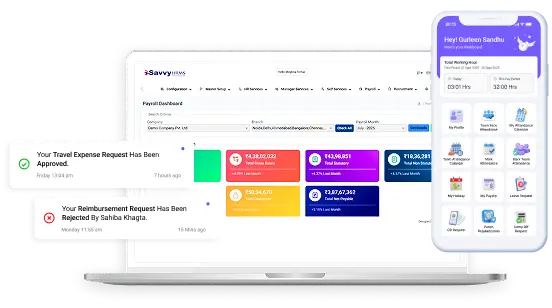









Ready to simplify attendance and payroll management?
Explore Savvy HRMS today and see how automated attendance tracking can transform your workforce operations.
Frequently Asked Questions (FAQs)
1. What is the best employee attendance app for small businesses in India?
Kredily and Sage HR are among the best options for small businesses, offering simple, budget-friendly attendance tracking with essential leave management and easy setup, ideal for teams just starting to digitize HR.
2. Can employee attendance apps work for remote and hybrid teams?
Yes, most modern attendance apps support remote and hybrid teams through GPS tracking, geofencing, and mobile check-ins, allowing employees to mark attendance accurately from home, client sites, or any approved location.
3. Do employee attendance apps integrate with existing payroll software?
Most attendance apps offer either built-in payroll processing or smooth integration with third-party payroll systems, automatically syncing verified hours, leave, and overtime data to eliminate manual reconciliation errors.
4. Are employee attendance apps compliant with Indian labor laws?
Yes, reputable attendance apps like greytHR and Savvy HRMS generate statutory compliance reports automatically, helping businesses stay audit-ready and meet Indian labor law requirements around working hours and leave records.
5. How much does an employee attendance app cost for a growing business?
Pricing generally ranges from free basic plans to ₹50 – ₹150 per employee per month for mid-tier features like payroll sync and biometric support, with custom pricing for larger, enterprise-scale requirements.