What Is the Definition of HRM and Its Role in Business?


-
AuthorRaghvendra Bhardwaj
-
 Last Updated
October 23, 2026
-
 Reading Time
12 Mins
TL;DR
The definition of HRM (Human Resource Management) refers to the process of managing employees, developing their skills, and aligning workforce activities with business goals. It helps organizations manage the employee lifecycle, from recruitment and onboarding to performance management and exit.
Key takeaways:
- HRM helps in managing, developing, and retaining employees to achieve organizational goals.
- Its main objectives are to attract suitable employees, improve performance, support employee well-being, and use workforce resources effectively.
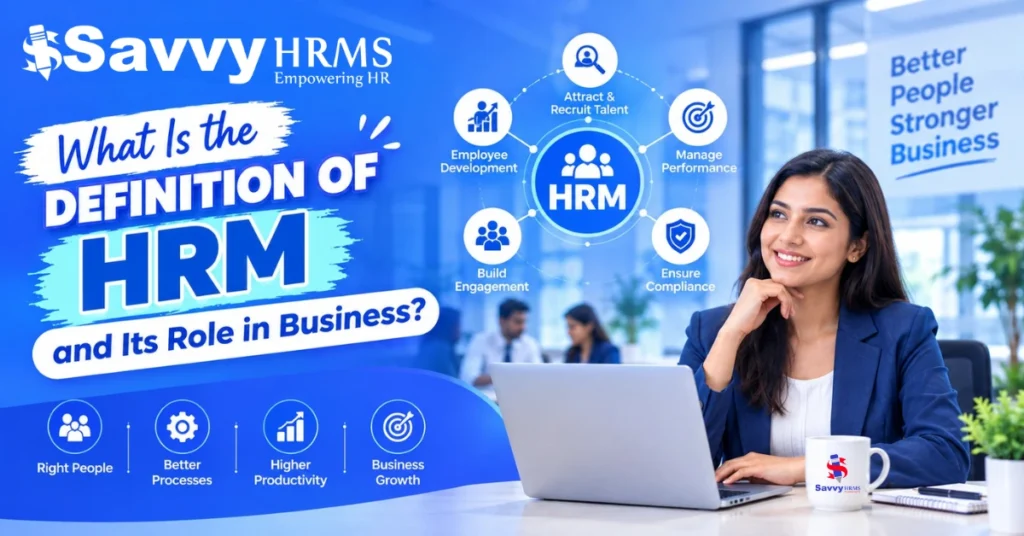
- Key functions are recruitment, onboarding, training, payroll, attendance and leave management, performance management, and compliance.
- Help businesses to Improve workforce productivity, support employee retention, manage staffing costs, and address workplace responsibilities.
Human Resource Management (HRM) plays an important role in helping businesses hire the right people, develop employee skills, manage workplace responsibilities, and achieve organizational goals. It covers the employee journey from recruitment and onboarding to performance management, compensation, and exit.
The definition of HRM goes beyond managing employee records or processing salaries. It refers to the policies, practices, and processes an organization uses to manage its workforce effectively. When HRM aligns employee needs with business objectives, it can help create a productive, well-organized, and supportive workplace.
In this guide, we explain the meaning of HRM, definitions by management authors, its objectives and functions, and how it supports business growth.
What Is the Definition of HRM?
Human Resource Management (HRM) is the process of planning, recruiting, developing, managing, and retaining employees to support organizational goals while addressing employee needs and workplace responsibilities.
In simple terms, HRM is how a business manages its people throughout their employment. It includes finding suitable candidates, helping new employees settle into their roles, managing compensation, supporting performance, and maintaining a healthy working environment.
For example, when a company plans to open a new office, its HR team may estimate staffing needs, recruit employees, organize onboarding, establish attendance policies, coordinate payroll, and arrange training. These activities help the company build the workforce it needs to operate effectively.
HRM generally covers three connected areas:
- People management: Hiring employees, supporting their development, managing performance, and addressing workplace concerns.
- HR operations: Coordinating employee records, attendance, leave, payroll administration, benefits, and employment processes.
- Strategic workforce management: Planning future staffing needs, identifying skill gaps, supporting organizational change, and aligning people-related decisions with business goals.
Human Resource Management therefore combines administrative responsibilities with long-term workforce planning. Its exact scope depends on the size, structure, industry, and needs of the organization.
What Is Human Resource Planning?
Human resource planning is the process of estimating an organization’s future workforce needs and ensuring it has the right number of employees with the skills needed to achieve its goals. It helps businesses prepare for growth, employee turnover, and changing workloads.
For example, if a company plans to open two new branches, HR may estimate how many managers, sales employees, and support staff it needs. This allows the company to plan recruitment and training before the new branches open.
Human resource planning is an important part of HRM because it connects workforce decisions with business plans and helps reduce staffing gaps.
What Are the Definitions of HRM by Authors?
Several management authors explain Human Resource Management (HRM) from different perspectives. Their definitions highlight how organizations manage employees, develop their skills, and connect workforce activities with business objectives.
The following table summarizes the approaches of three established HRM authors in simple words. These are paraphrased explanations, not direct quotations.
| Author | Explanation of the HRM concept |
| Michael Armstrong | Presents HRM as an integrated approach to managing people’s employment, development, and well-being within organizations. |
| Edwin B. Flippo | Describes HRM through management activities such as planning, organizing, directing, and controlling the acquisition, development, compensation, integration, maintenance, and separation of employees. |
| Gary Dessler | Focuses on the policies and practices managers use to handle the people-related aspects of their responsibilities, including recruitment, training, compensation, and performance appraisal. |
What Do These Definitions Have in Common?
Although the wording differs, these approaches share three central ideas:
- HRM involves organized activities for managing employees.
- It covers several stages of employment, including recruitment, development, compensation, and employee relations.
- It connects the management of people with the wider needs and goals of an organization.
Together, these ideas show why HRM is not limited to an HR department. Managers across departments also play a role in setting expectations, supporting employee performance, and creating effective working relationships.
What Are the Main Objectives of HRM?
The main objectives of Human Resource Management (HRM) are to help businesses achieve their goals while managing and developing their workforce effectively. These objectives include attracting suitable employees, improving performance, supporting employee well-being, using workforce resources efficiently, and meeting workplace responsibilities.
The five main objectives of HRM are explained below.
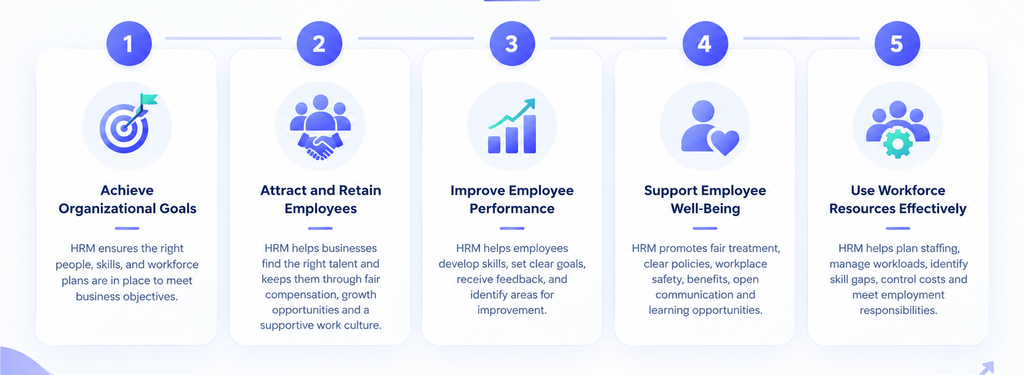
1. Achieve Organizational Goals
HRM ensures that businesses have the right people, skills, and workforce plans to meet their objectives. Recruitment, training, and performance management are aligned with business priorities.
For example, a company expanding its customer support team may need to hire more representatives and train them to handle customer queries effectively.
2. Attract and Retain Suitable Employees
HRM helps businesses recruit candidates whose skills and experience match job requirements because effective onboarding, fair compensation, career development, and a supportive work environment can encourage employees to remain with the organization.
3. Improve Employee Performance
HRM helps employees understand their responsibilities, develop relevant skills, and work toward clear business goals. However, regular feedback, performance reviews, and training programs help managers identify strengths and address skill gaps.
4. Support Employee Satisfaction and Well-Being
HRM helps create a positive work environment by supporting employee well-being, encouraging open communication, and addressing workplace concerns. When employees feel heard and supported, they may be more motivated and engaged at work.
5. Use Workforce Resources Effectively and Meet Workplace Responsibilities
HRM helps businesses plan staffing, manage workloads, identify skill gaps, and control workforce costs. It also helps maintain employee records, follow workplace policies, and meet employment requirements.
These objectives work together to support business growth. For example, proper onboarding helps employees understand their roles, while regular training and feedback help them improve their performance.
What Are the Key Functions of HRM?
The key functions of HRM include workforce planning, recruitment, onboarding, training, payroll, attendance and leave management, performance management, employee relations, and compliance. The key functions of HRM include the following.
1. Workforce Planning and Recruitment
Workforce planning helps businesses identify staffing needs, while recruitment helps them find and hire suitable candidates with relevant skills and experience.
For example, a company launching a new product may hire software developers, sales staff, or customer support employees.
2. Employee Onboarding and Management
Onboarding introduces new employees to their roles, company policies, workplace rules, and responsibilities, helping them settle into their jobs.
HR teams coordinate documentation, training, and team introductions to help new employees understand how the organization works.
3. Training and Development
Training helps employees learn job-related skills, while development programs prepare them for new responsibilities and future career opportunities.
HR teams organize technical courses, leadership programs, workplace training, and skill assessments to support employee growth.
4. Payroll, Compensation, and Benefits
This function covers employee salaries, incentives, benefits, deductions, and payslips to ensure accurate salary calculations and timely payments.
Clear payroll records help employees understand their earnings, deductions, and benefits while supporting organized financial administration.
5. Attendance and Leave Management
HR teams track working hours, shifts, absences, overtime, and leave balances to maintain accurate attendance records.
These records help managers plan work schedules and provide reliable attendance information for payroll processing.
6. Performance Management
Performance management helps employees understand their goals, review progress, receive feedback, and identify areas where improvement may be needed.
For example, a sales manager may recommend additional training to help an employee achieve their targets.
7. Employee Relations and Engagement
HRM helps address employee concerns, resolve workplace conflicts, manage complaints, and improve communication between employees and managers.
Engagement activities help businesses understand employee experiences and build positive workplace relationships through fair policies and open communication.
8. Compliance and Employee Records
HR teams maintain employee records, manage required documents, and help businesses follow applicable employment laws and workplace policies.
Responsibilities may include salary-related compliance, social security contributions, workplace safety, and employment documentation, depending on applicable legal requirements.
What Is the Role of HRM in Business?
HRM connects workforce decisions with business goals by helping organizations hire skilled employees, improve productivity, manage costs, meet workplace responsibilities, and plan for future staffing needs.
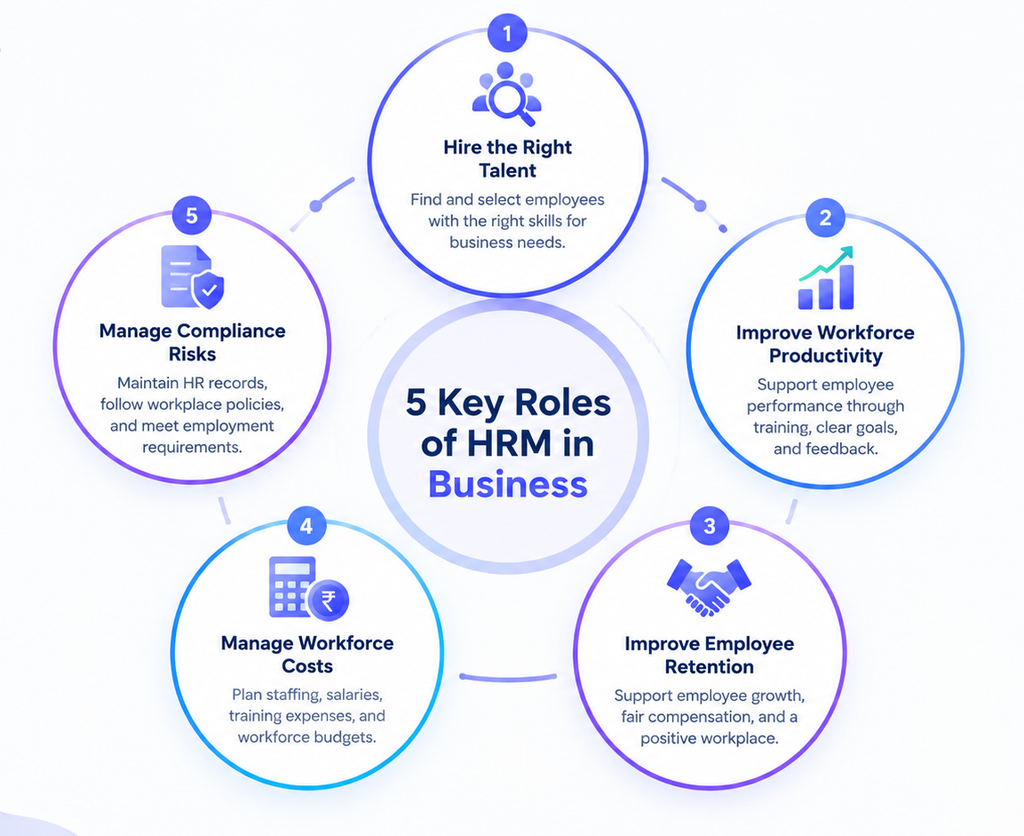
1. Helps Businesses Hire the Right Talent
HRM identifies staffing needs, manages recruitment, and selects candidates with skills suited to business requirements.
2. Supports Workforce Productivity
Training, clear responsibilities, suitable tools, and regular feedback help employees perform their roles effectively.
3. Helps Improve Employee Retention
HRM addresses employee feedback, development opportunities, compensation, and workplace concerns to support retention.
4. Supports Workforce Cost Management
HRM helps managers plan staffing levels, compensation, training expenses, and workforce budgets without compromising employee capabilities.
5. Helps Manage Compliance Risks
Organized HR records, consistent policies, and compliance processes help businesses meet applicable employment requirements.
What Is the Difference Between HRM and HR Administration?
HR administration focuses mainly on routine employee records and employment processes, while HRM covers these activities along with workforce planning, employee development, performance management, and broader business goals.
| Comparison factor | HR administration | Human Resource Management |
| Main focus | Routine employee processes and documentation | Overall management and development of the workforce |
| Typical activities | Records, attendance documentation, letters, and employment paperwork | Recruitment, training, performance, retention, and workforce planning |
| Time horizon | Often focused on current operational requirements | Includes current needs and longer-term workforce priorities |
| Business contribution | Supports consistency and accurate administration | Supports workforce capability, employee experience, and business objectives |
| Relationship | A component of broader HR work | A wider function that includes administrative responsibilities |
The distinction is not absolute as in smaller organizations, one HR professional may handle administrative work and strategic responsibilities while in larger businesses, these activities may be distributed across specialized teams.
How Does HRM Contribute to Business Growth? An Example
Let’s understand with the help of examples of human resource management. So, consider a growing company that plans to increase its workforce from 100 to 250 employees over the next year. Without coordinated HR processes, the company may face delayed recruitment, inconsistent onboarding, incomplete employee records, and difficulties managing attendance and payroll inputs.
HRM can help address these challenges through coordinated workforce planning and employee management.
| Business challenge | HRM response | Potential business benefit |
| New roles are difficult to fill | Create a plan for hiring requirements and improve recruitment coordination | Better preparation for staffing needs |
| New employees take time to settle in | Introduce structured onboarding and role-specific training | Clearer responsibilities and smoother transitions |
| Attendance records are inconsistent | Establish standard attendance and leave management | More reliable workforce records |
| Managers lack visibility into employee performance | Define goals and introduce regular feedback | Better identification of development needs |
| Employee exits disrupt operations | Review turnover patterns and plan handovers | Improved workforce continuity |
The example shows how HRM can help a company prepare for growth by organizing the people-related work behind its operations, while actual results depend on how well the company implements these practices and responds to the information it collects.
How Does HR Software Support HRM Functions?
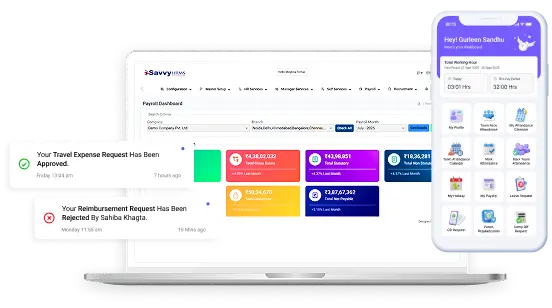
As organizations grow, managing employee information across spreadsheets, email threads, and separate systems can become difficult. Human Resource Management Systems (HRMS) help businesses organize and coordinate selected HR processes through a centralized digital platform.
Depending on the product and configuration, HR software may support:
- Employee management: Maintain employee profiles, employment information, and relevant documents.
- Attendance and leave: Record attendance, shifts, and leave requests while supporting approval workflows.
- Payroll processing: Organize salary-related inputs, deductions, and payslip generation.
- Recruitment and onboarding: Track candidates and coordinate joining formalities.
- Performance management: Record goals, assessments, and feedback.
- Reporting: Provide workforce information that helps HR teams and managers review operations.
Software can make information easier to access and routine processes easier to coordinate, but it does not replace sound HR policies, managerial judgment, or the need to verify compliance requirements.
Conclusion
The definition of HRM goes beyond hiring and managing employees; it also includes developing talent, supporting employee performance, and aligning workforce decisions with business goals.
Effective HRM helps businesses organize these activities, develop employee capabilities, and prepare their workforce for changing needs. As organizations grow, clearly defined processes and suitable HR technology can help make employee management more consistent and easier to coordinate.
The key is to treat HRM as more than an administrative responsibility. When people management is aligned with business priorities, it can support a stronger workforce and a more organized working environment.\



Want to Manage Your HR Operations More Efficiently?
test
Frequently Asked Questions About HRM
1. What Is the Simple Definition of HRM?
HRM is the process of managing employees through recruitment, training, compensation, performance management, and retention to achieve business goals.
2. What Is the Full Form of HRM?
HRM stands for Human Resource Management, which refers to the practices and processes organizations use to manage their workforce.
3. What Are the Main Functions of HRM?
The main functions of Human Resource Management (HRM) include:
• Workforce planning and recruitment
• Employee onboarding and management
• Training and development
• Payroll, compensation, and benefits
• Attendance and leave management
• Performance management
• Employee relations and engagement
• Compliance and employee records
Together, these functions help businesses manage the employee lifecycle, maintain workplace processes, and align workforce activities with organizational goals.
4. What Are the Main Objectives of HRM?
The main objectives of HRM are to achieve organizational goals, retain suitable employees, improve performance, support employee well-being, and manage workforce resources effectively.
5. What Is the Difference Between HR and HRM?
HR can refer to an organization’s employees or HR department, while HRM refers to the practices used to manage employees throughout their employment.
6. Why Is HRM Important for Small Businesses?
HRM helps small businesses organize recruitment, onboarding, payroll, employee records, and workplace policies as their teams grow.