



When a company grows across locations, payroll can quickly become more complicated than simply calculating salaries. With 4,000+ employees across 12+ locations, Liberty Shoes needed reliable payroll software for multiple locations that could keep calculations consistent, handle different salary structures, and maintain accuracy at scale.
The challenge became even bigger because payroll data was maintained in SAP and required considerable manual effort to process. Liberty Shoes also had multiple formula-based salary structures that had to be maintained according to its company policies, making payroll processing more complex and time-consuming.
To simplify this process, Savvy HRMS enabled Liberty Shoes to process payroll directly from SAP while supporting its policy-based and formula-driven salary structures. The result was a more consistent and accurate payroll process with less need for constant HR intervention.
TL;DR
- 4,000+ employees supported across the organization.
- Payroll operations covered 12+ locations.
- SAP data previously required significant manual processing.
- Multiple formula-based salary structures made payroll maintenance challenging.
- Savvy HRMS enabled direct payroll processing through SAP information.
- Salary structures were configured according to Liberty Shoes’ policies.
- The solution helped improve payroll consistency and accuracy.
- HR teams no longer needed to manage payroll-related issues constantly.
- Payroll changes and refinements could be handled more seamlessly.
- The implementation provided a scalable payroll solution for a large, multi-location manufacturing organization.
Liberty Shoes Payroll at a Glance
| Metric | Liberty Shoes |
| Employees | 4,000+ |
| Locations | 12+ |
| Industry | Manufacturing |
| Geography | Pan India |
| Core challenge | SAP-to-payroll processing |
| Salary structures | Multiple formula-based structures |
| Solution | Savvy HRMS |
| Integration | SAP-integrated payroll |
Source: Liberty Shoes case study published by Savvy HRMS.
How Liberty Shoes Managed Payroll Across 12+ Locations Before Savvy HRMS
Before implementing Savvy HRMS, Liberty Shoes had a payroll process that involved considerable manual effort. The organization already used SAP, but converting the information stored in SAP into payroll required additional processing.
For an organization with 4,000+ employees across 12+ locations, this created a significant operational challenge. Payroll teams had to work with data, salary calculations, policies, and location-level requirements while ensuring employees were paid correctly.
The problem was not simply the number of employees. It was the combination of scale + multiple locations + SAP data + complex salary formulas + changing payroll requirements.
When payroll depends heavily on manual intervention, every additional calculation or data-handling step creates another opportunity for inconsistency.
The challenge can be visualized like this:
SAP Data → Manual Processing → Salary Formula Calculations → Validation → Payroll
The more manual steps involved, the more effort HR teams need to spend validating information before payroll can be finalized.
For Liberty Shoes, the goal was therefore not just to “automate payroll.” It was to create a payroll process that could work with its existing SAP environment and company-specific salary policies.
What Payroll Challenges Was Liberty Shoes Facing?
Liberty Shoes faced several interconnected payroll challenges.
1. SAP data required time-consuming manual processing
The organization already had payroll-related information stored in SAP, but using that information for payroll involved significant manual effort. This created additional processing work for HR and payroll teams.
2. Complex salary formulas were difficult to maintain
Different employee salary structures required different formulas. Maintaining these formulas manually could become confusing and contributed to payroll calculation errors.
3. Payroll changes required frequent HR involvement
Payroll policies and salary requirements can change with a particular period of time. Liberty Shoes needed proper software or a system that could include changes and improvements without requiring HR teams to repeatedly manage the underlying payroll process manually or on spreadsheets.
4. Maintaining consistency across locations was difficult
With payroll operations managing 12+ locations, maintaining uniformity became more challenging when different processes involved manual intervention.
5. SAP and payroll were not sufficiently connected
The disconnect between SAP information and the payroll system made the overall payroll process less efficient. Directly using SAP information for payroll became an important requirement.
Liberty Shoes’ Payroll Challenge
| Challenge | Operational Impact |
| Manual SAP data processing | More payroll effort |
| Complex formulas | Difficult maintenance |
| Multiple salary structures | Higher calculation complexity |
| 12+ locations | Consistency challenges |
| Frequent policy changes | More HR intervention |
| SAP-payroll disconnect | Less efficient processing |
This is an important lesson for other large organizations: payroll complexity is usually created by several factors working together, not by employee headcount alone.
Why Is Payroll Accuracy Difficult for Businesses Operating Across Multiple Locations?
Payroll accuracy becomes more difficult as organizations grow because payroll is connected to many moving parts.
A company operating from one location with a relatively standardized workforce may have fewer variations to manage. A business operating across multiple locations can have different employees, departments, policies, salary structures, attendance inputs, and operational requirements.
For example, consider a business with:
4,000 employees ÷ 12 locations ≈ 333 employees per location
This is only a simple average, not Liberty Shoes’ actual location-wise employee distribution, but it illustrates the scale of the payroll operation.
Now imagine maintaining salary calculations for thousands of employees while ensuring that company policies are consistently applied.
Why manual payroll becomes harder at scale
More employees → More payroll records
More locations → More operational variations
More salary structures → More formulas
More formulas → More validation
More manual processing → More opportunities for inconsistency
That is why enterprise payroll software needs to do more than calculate salaries. It needs to provide a centralized, configurable, and integrated payroll environment.
What multi-location businesses need
A scalable payroll system should ideally provide:
- Centralized payroll processing
- Configurable salary structures
- Formula-based calculations
- ERP/SAP integration
- Consistent policy application
- Easy payroll configuration changes
- Reduced manual data entry
- Better visibility into payroll information
- Standardized processing across locations
This is exactly the type of challenge demonstrated by the Liberty Shoes case.
How Did Savvy HRMS Integrate with SAP for Liberty Shoes?
Savvy HRMS addressed one of Liberty Shoes’ biggest challenges by enabling direct payroll processing through SAP information.
Instead of requiring HR teams to manually move and process SAP information before payroll, the solution was configured to use SAP data directly for payroll processing.
In simple terms, the approach can be represented as:
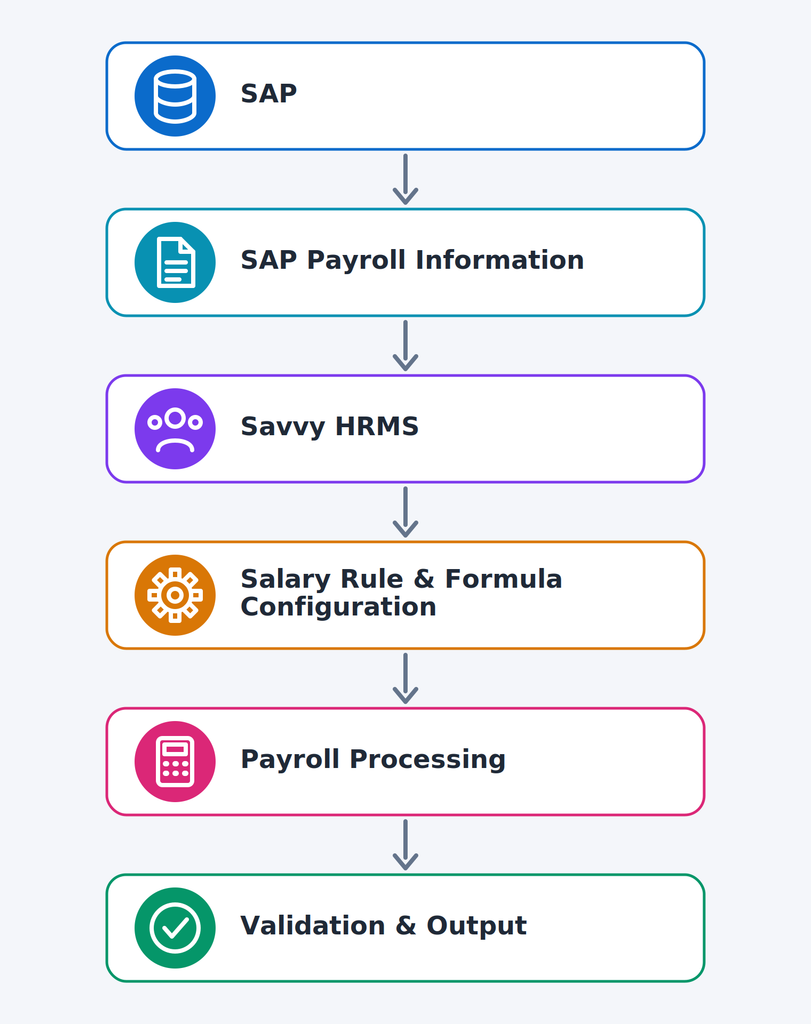
This integration reduced the dependence on manual data entry and helped create a more connected payroll workflow.
Why SAP integration matters for payroll
For organizations already using SAP, introducing a payroll platform that cannot communicate effectively with SAP can create another data silo.
A connected payroll system can help organizations:
- Reduce duplicate data entry
- Minimize manual data transfer
- Improve data consistency
- Simplify payroll processing
- Reduce repetitive HR work
- Create a more standardized workflow
In Liberty Shoes’ case, direct processing from SAP information was one of the core elements of the solution.
How Does Savvy HRMS Handle Complex Salary Structures and Payroll Formulas?
One of the key requirements for Liberty Shoes was the ability to handle multiple formula-based salary structures according to company policies.
Instead of forcing the organization into one standardized salary model, Savvy HRMS configured payroll around Liberty Shoes’ specific requirements.
This is important because enterprise payroll rarely follows a single formula.
Different employees may have different:
- Salary components
- Allowances
- Deductions
- Policy rules
- Calculation methods
- Employee categories
- Compensation structures
A payroll system therefore needs to be configurable enough to represent these rules accurately.
A simplified formula-driven payroll workflow
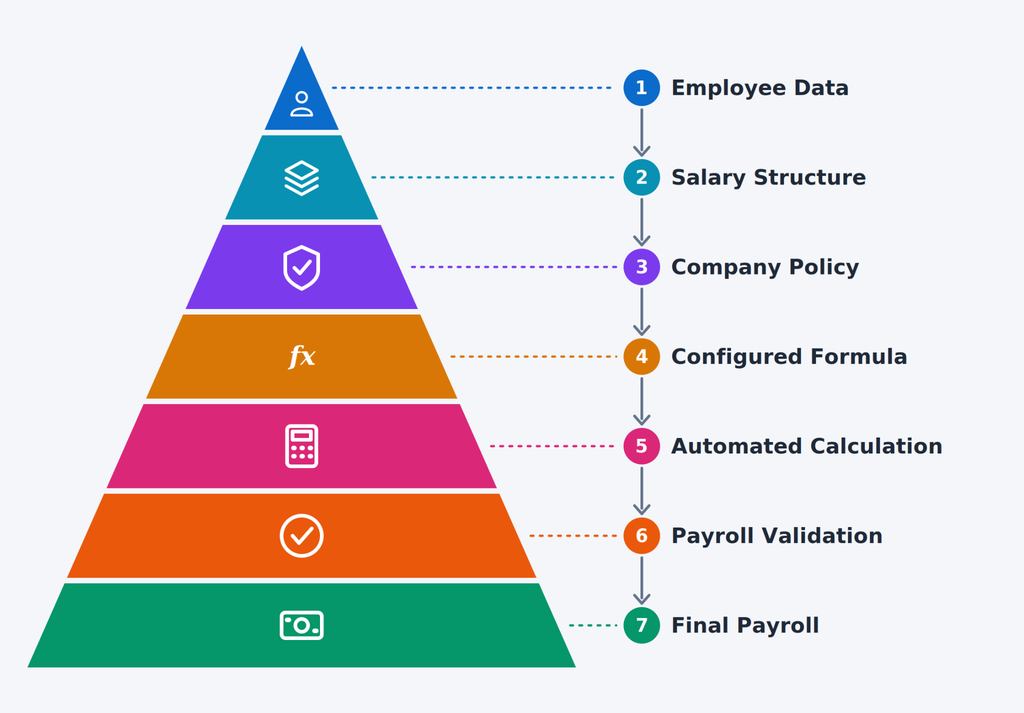
The benefit is not simply automation. It is repeatability.
Once the required salary structures and formulas are configured correctly, the organization does not need to recreate the same calculations manually every payroll cycle.
For Liberty Shoes, this configuration capability helped create greater consistency and accuracy without constant HR intervention.
How Did Savvy HRMS Improve Payroll Accuracy for Liberty Shoes?
Savvy HRMS improved payroll accuracy by addressing the underlying causes of inconsistency rather than simply adding another payroll calculation tool.
The solution brought together three important elements:
1. SAP integration
Payroll could be processed directly using SAP information, reducing manual data handling.
2. Configurable salary structures
Multiple policy-based and formula-driven salary structures could be configured according to Liberty Shoes’ requirements.
3. Reduced daily HR intervention
The case study states that the solution helped Liberty Shoes maintain payroll consistency and accuracy without constant intervention from HR.
Before vs. After
| Payroll Area | Earlier Process | With Savvy HRMS |
| SAP data | Significant manual processing | Direct payroll processing from SAP information |
| Salary formulas | Difficult to maintain | Configured within payroll |
| Salary structures | Multiple and complex | Policy-based and formula-driven |
| HR involvement | Frequent intervention | Reduced constant intervention |
| Multi-location consistency | Difficult to maintain | More standardized |
| Changes/refinements | Required additional effort | More smooth |
| Payroll approach | Manual-intensive | Integrated and scalable |
How Did Liberty Shoes Manage Payroll for 4,000+ Employees?
Managing payroll for 4,000+ employees requires a system that can handle scale without making every payroll change a manual exercise.
Liberty Shoes’ implementation focused on creating a payroll environment where employee salary structures could be configured according to company policies and payroll could be processed directly from SAP information.
The scale can be represented simply:
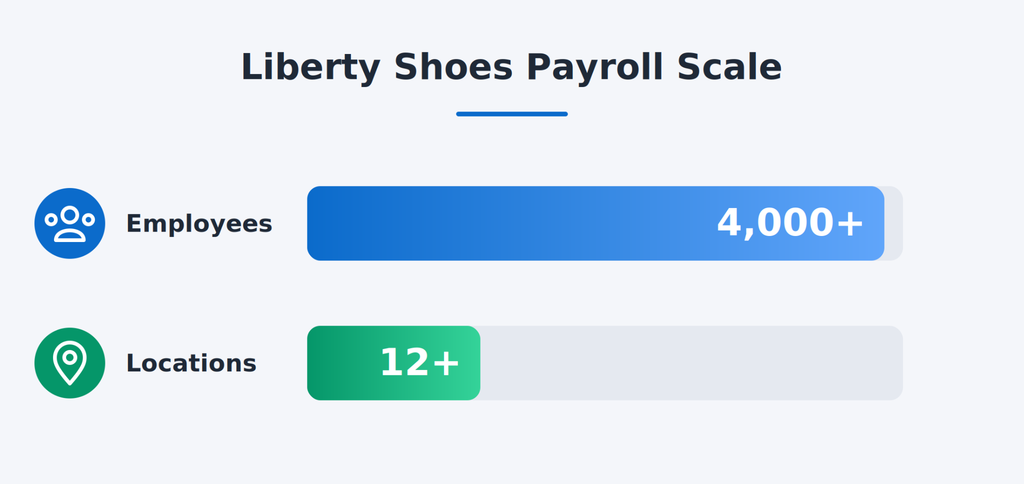
The bars above are illustrative rather than proportional to employee/location figures.
Another useful way to understand the case is through the relationship between workforce size and locations:
| Scale Indicator | Liberty Shoes |
| Total employees | 4,000+ |
| Locations | 12+ |
| Approx. average employees/location* | 333+ |
*Calculated as 4,000 ÷ 12 for illustration only. The case study does not provide location-wise employee distribution.
The important point is that Liberty Shoes needed payroll technology capable of supporting enterprise-level workforce management, rather than a system designed only for simple salary calculations.
How Can HRMS Software Simplify Multi-Location Payroll Processing?
HRMS software can simplify multi-location payroll by creating a centralized environment for employee information, payroll policies, salary structures, calculations, and reporting.
Instead of every location depending on separate manual processes, an HRMS can standardize how payroll rules are configured and applied.
A centralized payroll model
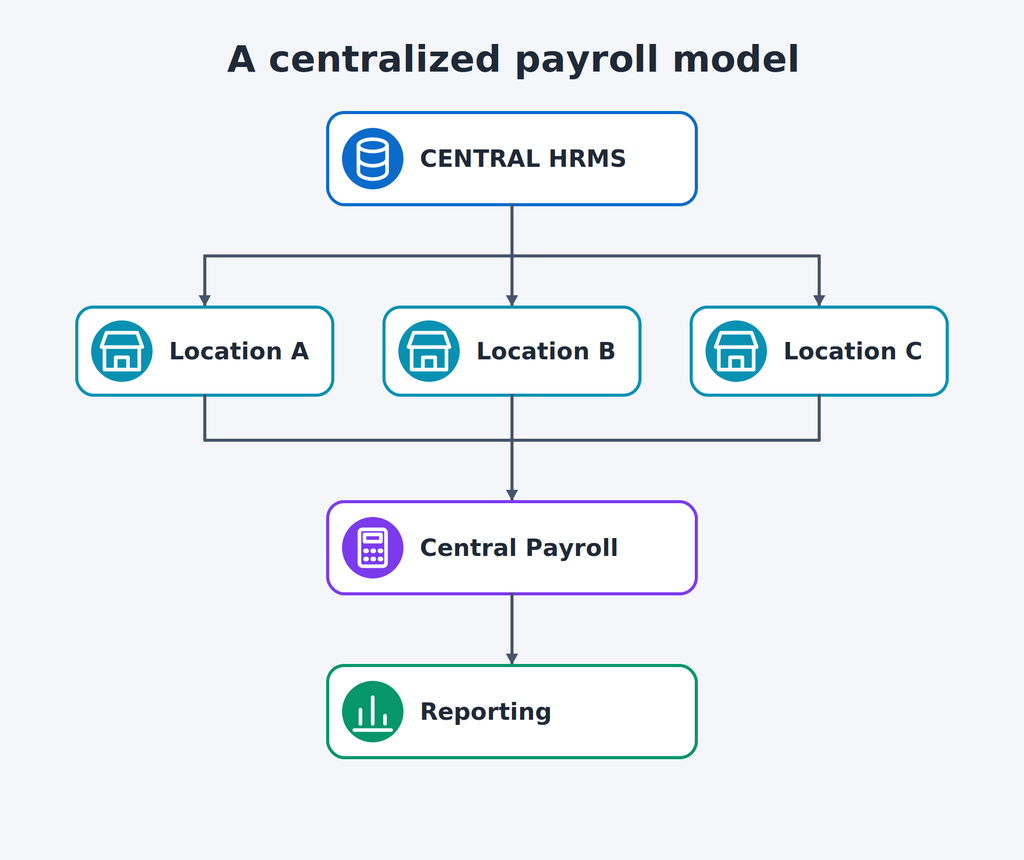
This model makes it easier for HR teams to establish common payroll rules while still supporting organization-specific salary structures.
Key benefits include:
- Centralized employee data
- Standardized payroll rules
- Configurable salary structures
- Automated calculations
- Reduced duplicate data entry
- Better payroll visibility
- Easier policy updates
- More consistent processing
For organizations similar to Liberty Shoes, the objective is not merely to automate one payroll calculation. The objective is to build a repeatable payroll process that can operate consistently across locations.
What Are the Benefits of SAP-Integrated Payroll Software for Large Businesses?
SAP-integrated payroll software can be particularly useful for organizations that already depend on SAP for core business or employee-related data.
The biggest advantage is connectivity.
Instead of creating a separate process where HR teams repeatedly export, modify, validate, and import information, payroll can be designed to work directly with SAP information.
Key benefits of SAP-integrated payroll
1. Reduced manual data handling
Direct integration can reduce the need for repetitive data transfer between systems.
2. Improved data consistency
Using connected data sources can help reduce discrepancies caused by duplicate manual entries.
3. Faster payroll workflows
When data does not need to be repeatedly moved between disconnected systems, payroll processing can become simpler.
4. Better scalability
An integrated payroll environment can be easier to scale as employee numbers and payroll requirements increase.
5. Simpler policy management
Configurable salary structures allow organizations to represent their payroll policies more systematically.
6. Reduced HR dependency
Automation can reduce the amount of repetitive payroll administration HR teams need to perform.
In Liberty Shoes’ case, SAP integration was specifically identified as an important part of solving its payroll challenge.
How Does Automated Payroll Reduce Manual Errors?
Automated payroll reduces manual errors primarily by reducing the number of repetitive calculations and data-entry activities performed by people.
Consider a simplified manual process:
Collect Data → Enter Data → Apply Formula → Calculate → Check → Correct → Recalculate
Every manual step can potentially introduce an error.
An automated process can instead follow:
Integrated Data → Configured Rules → Automated Calculation → Validation → Payroll
The difference becomes more significant when an organization has thousands of employees.
Manual vs. Automated Payroll
| Process | Manual Payroll | Automated Payroll |
| Data entry | Repetitive | Reduced |
| Formula calculation | Manual/configuration dependent | System-driven |
| Policy application | HR dependent | Configured |
| Repetitive calculations | High effort | Automated |
| Changes | More manual work | Configuration-based |
| Consistency | Harder at scale | Easier to standardize |
Automation does not eliminate the need for HR oversight. Instead, it allows HR professionals to spend less time repeatedly performing calculations and more time reviewing exceptions, policies, and workforce-related decisions.
That distinction is important.
Good payroll automation does not remove HR from payroll; it removes unnecessary repetitive work from HR.
What Results Can Businesses Expect from a Centralized Payroll System?
The results of a centralized payroll system depend on the organization’s existing processes, configuration, workforce size, and level of automation.
However, a well-designed centralized payroll environment can support several operational improvements.
1. Greater consistency
Payroll rules can be configured centrally rather than being recreated manually at individual locations.
2. Better accuracy
Standardized formulas and automated calculations can reduce opportunities for manual calculation errors.
3. Reduced HR intervention
Routine payroll processing can require less manual involvement once the appropriate rules and structures are configured.
4. Easier changes
Payroll systems can be configured to accommodate changes and refinements more systematically.
5. Better scalability
A centralized system can support larger workforces and multiple locations without requiring the same increase in manual payroll administration.
For Liberty Shoes, the documented result was greater consistency and accuracy in payroll without constant HR intervention, alongside the ability to make changes and refinements more smoothly.
Liberty Shoes: Problem → Solution → Outcome
| Business Problem | Savvy HRMS Approach | Outcome |
| Manual SAP payroll processing | Direct processing from SAP information | Less manual data handling |
| Complex salary formulas | Formula-based salary configuration | Easier payroll management |
| Multiple locations | Centralized payroll approach | Greater consistency |
| Frequent HR intervention | Automated/configured processes | Less constant intervention |
| Payroll changes | Configurable system | More smooth refinements |
| Enterprise workforce | Scalable payroll solution | Supports 4,000+ employees |
Why Should Multi-Location Businesses Choose an Integrated HRMS for Payroll?
For a business operating across multiple locations, payroll software should do more than calculate salaries.
It should connect employee data, payroll rules, salary structures, organizational policies, and existing business systems.
That is especially important for manufacturing and other enterprise organizations where payroll structures can be complex, and employee populations can be large.
A multi-location business should look for:
1. Integration capability
Can the HRMS integrate with existing ERP or SAP systems?
2. Payroll configurability
Can the system support different salary structures and formulas?
3. Scalability
Can it support thousands of employees and multiple locations?
4. Policy flexibility
Can payroll rules be configured according to organizational policies?
5. Automation
Can repetitive payroll processes be automated?
6. Consistency
Can the same payroll standards be maintained across locations?
7. Support
Is there an experienced team available when payroll requirements change?
These were also important reasons Liberty Shoes selected Savvy HRMS, including its SAP integration capabilities, experience with high-complexity formula-based salary structures, policy-based payroll configuration, payroll expertise, and scalability for larger multi-location organizations.
What Can Businesses Learn from the Liberty Shoes Payroll Transformation?
The Liberty Shoes case provides a useful lesson for any organization struggling with complex payroll.
The first lesson is that integration matters.
If an organization already has SAP or another enterprise system, payroll software should ideally work with that existing environment rather than create another disconnected data source.
The second lesson is that configurability matters.
Large organizations rarely have one simple salary formula for every employee. Payroll software needs to accommodate multiple structures and company-specific policies.
The third lesson is that automation should focus on removing repetitive work.
HR teams should not have to spend every payroll cycle manually repeating calculations that can be configured and automated.
Finally, scalability matters.
A payroll process that works for a small organization may not work efficiently for thousands of employees across multiple locations.
Liberty Shoes had more than 4,000 employees across 12+ locations, making scalability and consistency central to the payroll requirement.
Conclusion
Liberty Shoes’ payroll journey shows that accuracy becomes easier when SAP data, salary formulas, company policies, and payroll processing work together. Savvy HRMS helped create a consistent process across 12+ locations, reducing manual intervention and supporting reliable, accurate payroll operations.
For businesses managing thousands of employees across multiple locations, the lesson is clear: payroll software should connect with existing systems, adapt to policies, and reduce repetitive work. Savvy HRMS brings these capabilities together in a scalable HR and payroll platform.
Ready to Simplify Your Payroll Like Liberty Shoes?
If your organization manages multiple locations, complex salary structures, or thousands of employees, Savvy HRMS can help you move from manual payroll processes to a more integrated, automated, accurate, and scalable payroll system.