



TL;DR
- Q2 TDS Return Filing for July–September 2026 is due by October 31, 2026.
- From Tax Year 2026-27, salary TDS statements use Form 138, replacing the earlier Form 24Q terminology.
- Verify employee PAN, salary, taxable income, tax regime, deductions, and TDS before filing.
- Review new joiners, exits, salary revisions, bonuses, incentives, arrears, and manual adjustments.
- Reconcile payroll TDS → challans → quarterly TDS statement and investigate every unexplained difference.
- Track monthly TDS deposits separately from the quarterly return filing deadline.
- Use a pre-filing checklist to validate employee master data, payroll records, TDS details, challans, and filing information.
- Payroll software can centralize employee data, automate calculations, support reconciliation, and provide audit trails.
- Complete verification before the final filing week instead of waiting until October 31.
For HR and payroll teams, the end of September is more than just the close of another quarter. It is also the point at which salary, tax deduction, employee, and challan records need to be brought together for Q2 TDS return filing. A small data mismatch can create unnecessary corrections later.
For Tax Year 2026-27, the July-September quarter is Q2, and the quarterly salary TDS statement is due by October 31. For periods from Tax Year 2026-27 onward, the salary TDS statement is referred to as Form 138, replacing the earlier Form 24Q terminology.
This guide explains what employers should check before filing: employee PAN details, salary and taxable income, deductions, TDS deducted, challans, new joiners, exits, salary revisions, and other payroll changes. It also covers reconciliation, common errors, a practical checklist, and how payroll software can simplify the entire process.
What Is Q2 TDS Return Filing and Why Is October 31 Important?
TDS, or Tax Deducted at Source, is a method through which tax is collected at the time specified payments are made or credited. In the case of salary, employers calculate and deduct the applicable TDS from employees’ salaries and report the deduction through the prescribed quarterly statement.
For Q2 of Tax Year 2026-27, the reporting period is July to September 2026.
| Quarter | Period | Salary TDS Statement Due Date |
| Q1 | April-June 2026 | July 31, 2026 |
| Q2 | July-September 2026 | October 31, 2026 |
| Q3 | October-December 2026 | January 31, 2027 |
| Q4 | January-March 2027 | May 31, 2027 |
So, October 31, 2026 is the important deadline for employers to complete their Q2 salary TDS return filing.
A terminology change HR teams should know
There is an important change that payroll professionals should be aware of in 2026.
For periods up to FY 2025-26, employers commonly referred to the salary TDS quarterly statement as Form 24Q. From Tax Year 2026-27, the new framework uses Form 138 for salary TDS statements.
This means HR and payroll teams updating their compliance calendars, payroll software, and internal documentation should make sure they are working with the correct form and reporting framework for the applicable tax year.
Why should HR care about October 31?
Because quarterly filing is not simply about submitting a form.
Think about everything that may have happened between July and September:
- Employees joined or left.
- Salaries were revised.
- Bonuses or incentives were paid.
- Tax declarations were updated.
- PAN details were corrected.
- TDS calculations were adjusted.
- Arrears were processed.
- Monthly TDS challans were deposited.
- Payroll corrections were made.
All of these changes can affect the information ultimately reported in the quarterly TDS statement.
A useful rule: Don’t treat October 31 as the day to start checking payroll data. Treat it as the final filing deadline after your reconciliation is already complete.
Which Employers Need to File the Q2 TDS Return?
Employers who deduct TDS from salary payments have quarterly reporting responsibilities.
This can include companies, organizations, government organizations, and other employers that deduct tax from employees’ salary payments, depending on the applicable provisions.
For a general organization, the HR and payroll team should begin with a few basic questions:
- Did the organisation pay salaries during July-September?
- Was TDS required to be deducted from any employee’s salary?
- Was TDS deducted during the quarter?
- Does the organization have the required TAN and payroll tax setup?
- Were the relevant TDS amounts deposited?
If applicable, the payroll team should prepare the quarterly statement rather than waiting until the final days of October.
Don’t confuse salary TDS with other TDS
A business may have several types of TDS obligations.
For example, TDS may also apply to certain:
- Professional payments
- Commission payments
- Rent payments
- Contractual payments
- Other specified non-salary payments
Salary TDS reporting and non-salary TDS reporting should therefore be treated as separate compliance activities.
This distinction is particularly useful for organizations where the HR, payroll, and finance teams manage different categories of payments.
Key Payroll Data HR Teams Should Verify Before TDS Filing
This is where most of the practical work begins.
Before the payroll data is converted into the quarterly TDS statement, HR and payroll teams should perform an employee-level review.
1. Employee PAN details
Start with the basics.
Check:
- PAN availability
- PAN accuracy
- Employee name
- PAN-to-employee mapping
- Duplicate employee records
- Recently corrected PAN details
- Missing PAN information
A wrong PAN can create problems later when the employee checks their tax credit information.
2. Salary actually paid
Don’t depend only on annual CTC.
TDS reporting should be connected with actual salary payments and applicable tax calculations.
Review:
- Basic salary
- HRA
- Special allowances
- Bonuses
- Incentives
- Arrears
- Perquisites
- Taxable reimbursements
- Leave encashment, where applicable
- Other taxable salary components
The payroll register and TDS working should tell the same story.
3. Taxable salary
Gross salary and taxable salary are not necessarily the same.
Payroll teams should verify how taxable income was calculated after considering applicable exemptions, deductions, perquisites, and other tax-related adjustments.
A useful internal calculation is:
Gross Salary → Exempt/Non-Taxable Components → Applicable Deductions → Taxable Income → Tax Liability → TDS Deduction
4. Tax regime and employee declarations
For Tax Year 2026-27, payroll teams should ensure their calculations are aligned with the applicable provisions under the new income-tax framework.
The employee’s selected tax regime and applicable declarations should therefore be reviewed before the quarterly filing.
5. Employee investment and deduction information
Where applicable, review the information used by payroll to calculate TDS.
Depending on the employee’s circumstances, this may include information relating to:
- HRA
- Home-loan interest
- Eligible investments
- Other applicable deductions
- Taxable or exempt allowances
Don’t simply check whether a declaration exists. Check whether the payroll calculation actually reflects the relevant information.
6. New joiners
For employees who joined between July and September, check:
- Date of joining
- Previous-employer information, where applicable
- PAN
- Tax regime
- Salary structure
- TDS calculation
- Previous employment income considered for tax calculation
A new employee’s payroll record may look correct by itself but still produce an incorrect annual tax projection if relevant previous employment income isn’t considered.
7. Full & final settlements
Employees who left during Q2 should receive a separate review.
Check:
- Last working date
- Salary paid
- Leave encashment
- Bonus/incentive settlement
- Recoveries
- Taxable components
- TDS deducted
- Final payroll adjustments
8. Salary revisions and arrears
Promotions and increments are common sources of payroll changes.
If an employee’s salary increased in August, for example, payroll should confirm that:
Revised Salary → Revised Projected Income → Revised TDS Calculation → Correct Monthly Deduction → Correct Quarterly Reporting
remain aligned.
How to Reconcile Payroll Records With TDS Challans
A payroll report showing a particular TDS amount does not automatically mean that the same amount was correctly deposited and reported.
That’s why reconciliation should happen before the return is submitted.
The three-way reconciliation
HR and finance teams can use this simple model:
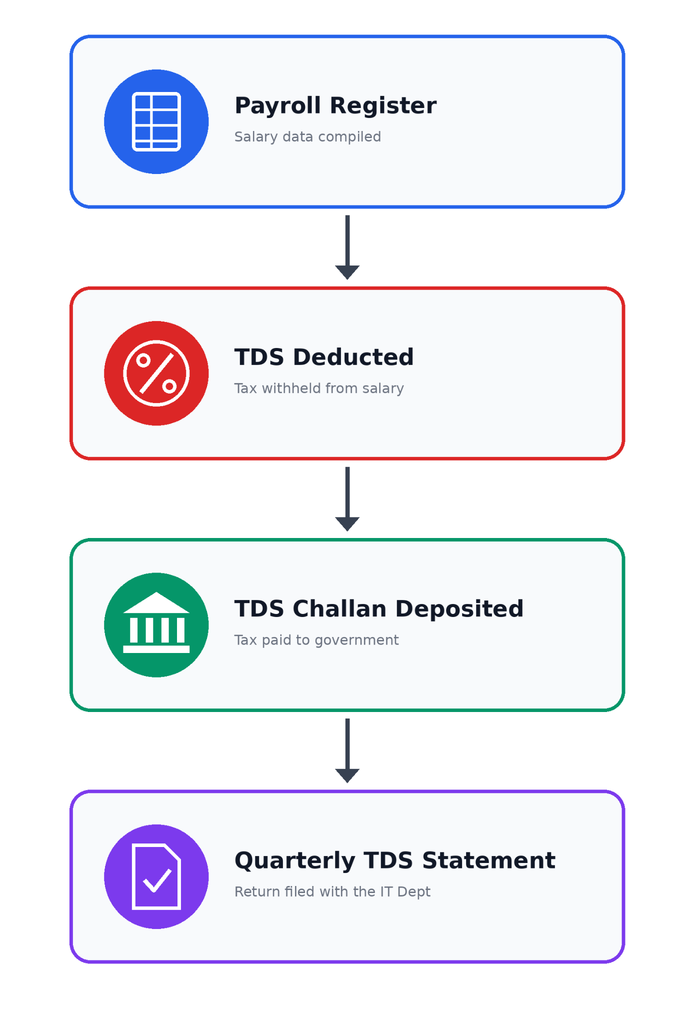
The figures should be explainable at every stage.
Example
Suppose an organization has the following Q2 payroll figures:
| Month | TDS Deducted |
| July | ₹4,80,000 |
| August | ₹5,10,000 |
| September | ₹5,40,000 |
| Q2 Total | ₹15,30,000 |
The team should reconcile the ₹15.30 lakh against the relevant TDS deposits and the amount being reported in the quarterly statement.
If the numbers don’t match, don’t simply adjust the return to make the totals agree.
Find the reason.
Possible explanations may include:
- Incorrect deduction month
- Challan mapped incorrectly
- Previous-period adjustment
- Employee-level correction
- Payroll reversal
- Duplicate entry
- Interest or fee component
- Data-entry error
A practical reconciliation formula
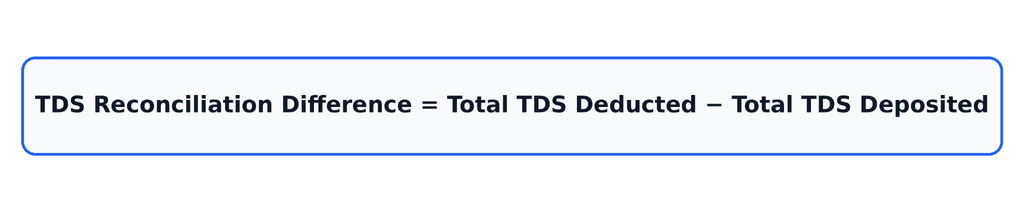
For a clean quarter, the unexplained difference should ideally be ₹0.
The objective isn’t merely to make two reports show the same number. Every difference should have a documented explanation.
Common TDS Data Errors HR Teams Should Check Before Filing
TDS problems are often caused by incorrect or incomplete data rather than complicated calculations.
Here are some common areas to review.
Error 1: Incorrect PAN
An employee’s PAN is entered incorrectly or mapped to another employee.
Impact: The employee may later experience a tax-credit mismatch.
Error 2: Salary register and TDS report don’t match
The payroll register shows one taxable salary figure while the TDS data contains another.
What to do: Trace the calculation at the employee level rather than correcting only the final total.
Error 3: Wrong challan details
Check:
- Challan number
- Date
- Amount
- Relevant tax period
- TAN
- Other applicable details
A challan with incorrect information can create reconciliation problems.
Error 4: New employee omitted
Employees joining during Q2 can easily be missed when HR and payroll master data are maintained separately.
Error 5: Exited employee remains active
This can result in incorrect salary or TDS reporting.
Error 6: Bonus or incentive not considered
A bonus paid during Q2 can change taxable salary and the applicable TDS calculation.
Error 7: Incorrect tax regime configuration
A payroll system may contain outdated tax settings.
For Tax Year 2026-27, payroll teams should ensure their systems and calculations reflect the applicable new tax framework.
Error 8: Manual adjustments without documentation
A ₹25,000 payroll adjustment may be obvious to the person who entered it, but another payroll executive may have no idea why it exists.
Every manual TDS adjustment should ideally have:
- Reason
- Employee ID
- Month
- Amount
- Approval
- Supporting document
Error 9: Assuming tax-credit records will automatically correct errors
They won’t.
If incorrect information is reported by the employer, the employer may need to take corrective action to resolve the mismatch.
Important takeaway: Reconciliation should happen before filing, not after employees start reporting missing tax credits.
How Salary Changes and New Employees Affect Q2 TDS Reporting
Payroll is dynamic.
An employee’s salary at the beginning of April can look very different by September.
Consider a simple example.
An employee begins the year with projected annual taxable income of ₹9,00,000.
In August, the employee receives a salary revision that changes the projected annual taxable income to ₹10,20,000.
Payroll should not simply continue using the original projection without reviewing the tax calculation.
Salary revision flow
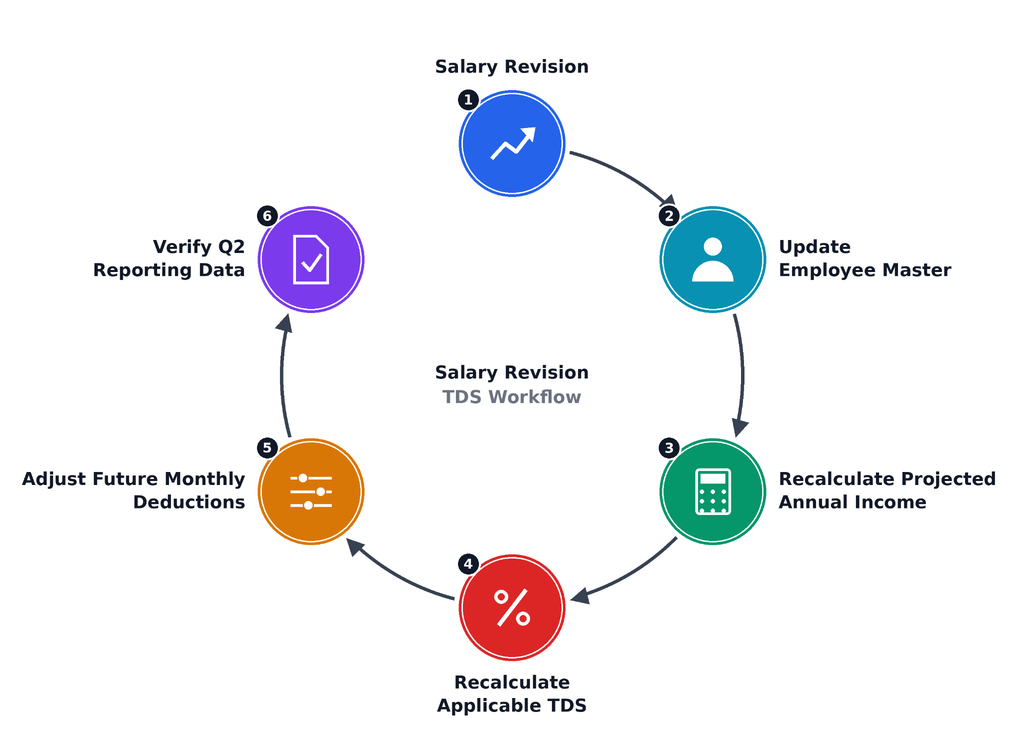
The same principle applies to:
- Promotions
- Variable pay
- Joining bonuses
- Retention bonuses
- Arrears
- Revised allowances
- Tax declarations
What about new employees?
Suppose an employee joins in August.
Payroll should establish whether relevant previous-employer salary information is available and ensure the current employer’s tax calculation uses the appropriate information.
The biggest mistake is treating a new joiner as a completely blank tax record.
From an HR perspective, the employee is new.
From a tax-calculation perspective, that may not be the complete picture.
What Happens If TDS Is Deducted or Reported Incorrectly?
An incorrect TDS filing can create issues for both the employer and employee.
For employees, one of the most visible consequences can be a tax-credit mismatch.
For example:
TDS actually deducted: ₹42,000
TDS correctly reported: ₹42,000
→ No unexplained difference.
But if the employer reports ₹35,000 while ₹42,000 was actually deducted, the employee may later see a mismatch.
Where TDS information is incorrect, the employer/deductor may need to submit a correction so that the reported information accurately reflects the underlying transaction.
What if TDS wasn’t deposited on time?
The monthly TDS deposit obligation is separate from the quarterly return filing deadline.
For general non-government deductors, TDS deducted during a month is generally required to be deposited by the 7th of the following month, while tax deducted during March generally has a later deadline of April 30.
Therefore, payroll teams shouldn’t think:
“The quarterly return is due on October 31, so we can sort out all the monthly TDS payments before then.”
Monthly TDS deposits and quarterly TDS return filing are separate compliance activities.
Incorrect filing doesn’t always mean starting from zero
If an error is identified, the appropriate correction depends on the nature of the error.
The important HR lesson is:
Detect → Document → Reconcile → Correct → Recheck
Don’t hide a mismatch inside the next payroll cycle.
Q2 TDS Return Filing Checklist for HR and Payroll Teams
Use this checklist during your September payroll closing process.
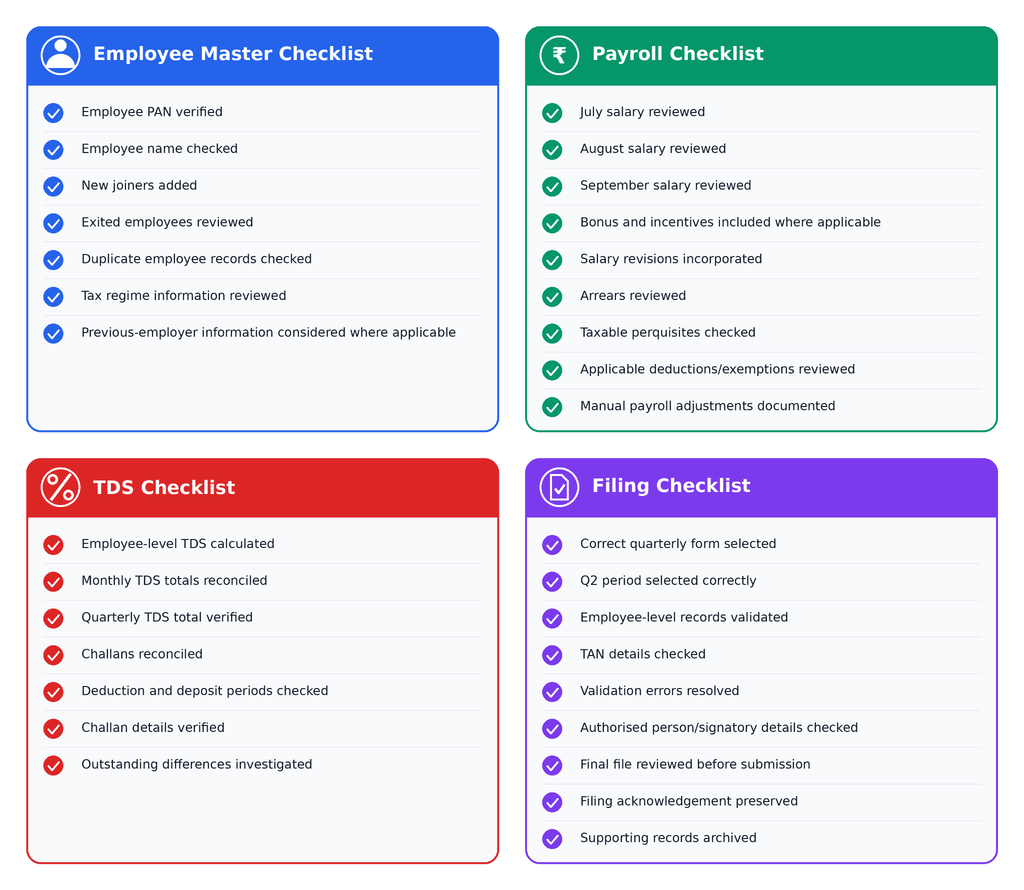
Employee Master Checklist
- Employee PAN verified
- Employee name checked
- New joiners added
- Exited employees reviewed
- Duplicate employee records checked
- Tax regime information reviewed
- Previous-employer information considered where applicable
Payroll Checklist
- July salary reviewed
- August salary reviewed
- September salary reviewed
- Bonus and incentives included where applicable
- Salary revisions incorporated
- Arrears reviewed
- Taxable perquisites checked
- Applicable deductions/exemptions reviewed
- Manual payroll adjustments documented
TDS Checklist
- Employee-level TDS calculated
- Monthly TDS totals reconciled
- Quarterly TDS total verified
- Challans reconciled
- Deduction and deposit periods checked
- Challan details verified
- Outstanding differences investigated
Filing Checklist
- Correct quarterly form selected
- Q2 period selected correctly
- Employee-level records validated
- TAN details checked
- Validation errors resolved
- Authorized person/signatory details checked
- Final file reviewed before submission
- Filing acknowledgement preserved
- Supporting records archived
A better internal deadline
Don’t make October 31 your internal deadline.
A better workflow is:
| Activity | Suggested Internal Target |
| September payroll closure | Early October |
| Employee master review | First half of October |
| TDS reconciliation | Mid-October |
| Challan verification | Mid-October |
| Error correction | Before final filing week |
| Final validation | Several working days before October 31 |
| Q2 TDS filing | On or before October 31 |
The exact internal dates can vary by organization, but the principle remains the same: complete the data work before the deadline week.
How Payroll Software Can Simplify TDS Data Verification and Filing
Here’s where technology can make the process significantly easier.
The objective isn’t simply to “automate TDS.”
The bigger objective is to create a connected data trail:
Employee Master → Salary Processing → Tax Calculation → TDS Deduction → Challan → Reconciliation → Quarterly Statement → Reports
When these stages live in disconnected spreadsheets, HR teams spend considerable time comparing files manually.
1. Centralised employee data
A payroll system can maintain employee information in one place.
This reduces repetitive data entry for:
- PAN
- Joining date
- Exit date
- Salary structure
- Tax details
- Department
- Location
- Employment status
2. Automated salary calculations
When salary components change, payroll calculations can be updated systematically instead of being recalculated manually across multiple spreadsheets.
3. Better employee-level TDS visibility
Payroll teams can review TDS employee by employee rather than looking only at a quarterly grand total.
That’s important because:
₹15 lakh total TDS
doesn’t tell you whether one employee’s ₹20,000 deduction was calculated incorrectly.
Employee-level visibility does.
4. Payroll-to-challan reconciliation
A connected payroll process makes it easier to compare:
TDS Deducted → TDS Payable → TDS Deposited → TDS Reported
Instead of manually comparing multiple Excel files, payroll teams can use reports and exception lists to identify differences.
5. Exception-based checking
Imagine a payroll report that flags:
- PAN missing: 3 employees
- TDS mismatch: 2 employees
- Unreconciled challan: ₹18,500
- Salary revision pending tax recalculation: 4 employees
That is much more actionable than a 5,000-row spreadsheet.
6. Audit trail
For compliance teams, knowing what changed, when it changed, and who changed it is valuable.
Payroll software with appropriate audit trails can make investigation easier when someone asks:
“Why did this employee’s TDS change between August and September?”
7. Reports for HR and finance
Different teams need different views.
HR: Employee changes and master data
Payroll: Salary and TDS calculations
Finance: Challans and payment reconciliation
Management: Compliance status and exceptions
A structured payroll platform can bring these views together without requiring everyone to manipulate the same spreadsheet.
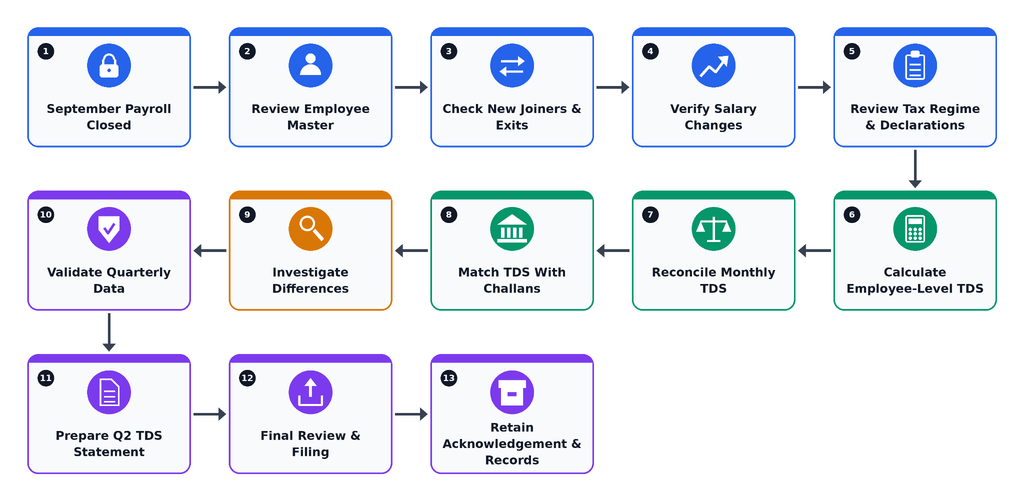
Q2 TDS Verification Flowchart
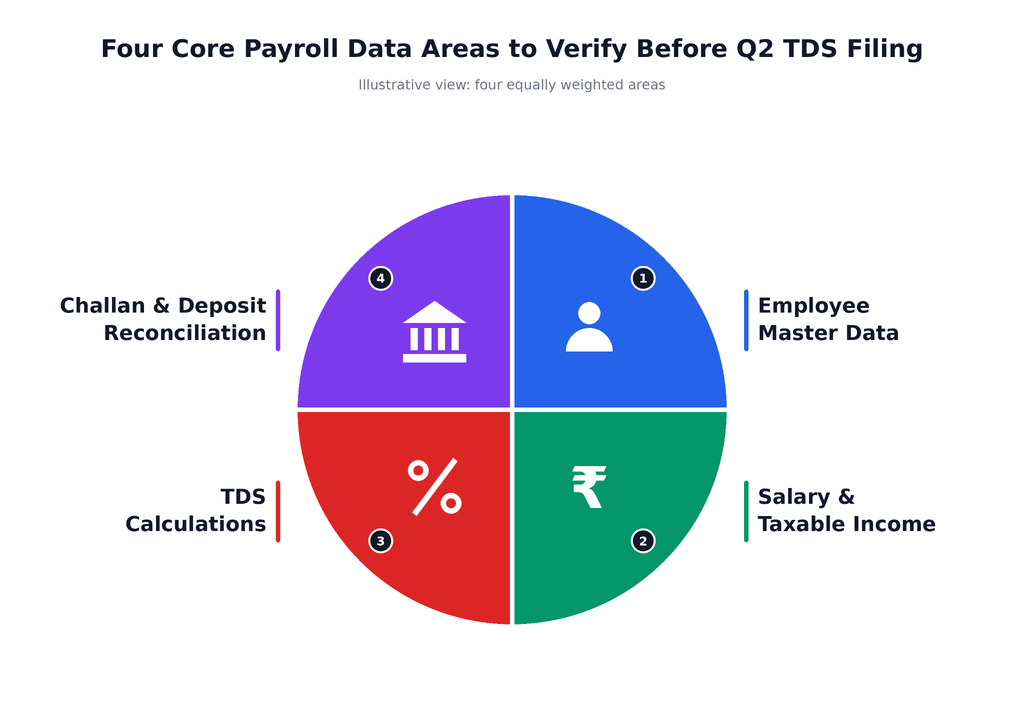
Q2 TDS Data: Four Areas HR Teams Should Prioritise
A practical way to structure your review is to divide payroll data into four major areas:
| Data Area | What to Check | Why It Matters |
| Employee Master | PAN, name, joining/exit status | Correct employee identification |
| Payroll | Salary, bonus, arrears, revisions | Correct taxable income |
| TDS | Deduction and calculation | Correct tax reporting |
| Challans | Amount, period, and mapping | Correct deposit reconciliation |
A Practical Example: Finding a Q2 TDS Mismatch
Let’s say a company has 250 employees.
During its Q2 review, payroll reports:
Total TDS deducted: ₹18,75,000
Finance’s challan reconciliation shows:
TDS deposited: ₹18,60,000
Difference:
₹15,000
The wrong approach is to change the return total simply because the challan figure is lower.
The right approach is to investigate the ₹15,000.
The difference might relate to:
- Incorrect payroll entry
- Deduction adjustment
- Challan mapping issue
- Timing difference
- Reversal
- Missed deposit
- Another documented accounting or compliance item
Example reconciliation dashboard
| Metric | Amount |
| TDS according to payroll | ₹18,75,000 |
| TDS according to challans | ₹18,60,000 |
| Difference | ₹15,000 |
| Difference investigated | ₹15,000 |
| Unexplained difference | ₹0 |
That final line is the important one.
The objective isn’t simply to make two reports display the same number. It is to ensure that every difference has a documented explanation.
Important Q2 TDS Dates for Your Payroll Calendar
For Tax Year 2026-27, the following dates are important for quarterly salary TDS reporting:
- July 31, 2026: Q1 quarterly TDS statement deadline.
- July-September 2026: Q2 reporting period.
- October 31, 2026: Q2 quarterly TDS statement deadline.
- January 31, 2027: Q3 quarterly TDS statement deadline.
- May 31, 2027: Q4 quarterly TDS statement deadline.
For monthly TDS deposits, the applicable payment deadlines should be tracked separately rather than waiting for the quarterly filing date.
Frequently Overlooked Checks Before October 31
Even experienced payroll teams can miss small changes.
Before final submission, ask:
1. Did anyone join during Q2?
If yes, verify their complete payroll and tax information.
2. Did anyone leave during Q2?
Check full-and-final settlement and TDS treatment.
3. Did anyone receive a promotion or salary revision?
Make sure the tax projection and deductions reflect the change.
4. Were bonuses or incentives paid?
Check whether they changed taxable income and TDS.
5. Were any manual adjustments made?
Every adjustment should have supporting documentation.
6. Do payroll and finance agree?
If not, stop and reconcile.
7. Are there unresolved employee-level exceptions?
Don’t let a quarterly deadline turn an unresolved exception into a filing problem.
Why Data Quality Matters More Than Last-Minute Filing
A quarterly TDS statement isn’t just another compliance form.
It is effectively a summary of several months of payroll activity.
If the employee master is wrong, the TDS record can be wrong.
If the salary data is wrong, taxable income can be wrong.
If taxable income is wrong, TDS can be wrong.
If challan information is wrong, tax-credit reconciliation can become difficult.
That’s why the real Q2 process looks like this:
Accurate Employee Data → Accurate Payroll → Accurate TDS → Accurate Challans → Accurate Quarterly Statement
A filing system cannot compensate for poor source data.
Conclusion
Q2 TDS return filing becomes much easier when October 31 is treated as the final checkpoint rather than the starting point. For HR teams, the real work is checking employee details, salary changes, tax calculations, new joiners, exits, challans, and every adjustment made during July-September.
With the transition to the new income-tax framework and the use of Form 138 for salary TDS statements from Tax Year 2026-27, payroll teams should also review their existing processes, payroll configurations, and compliance calendars.
The simplest approach is to keep payroll, TDS, and finance data connected throughout the quarter. When those three records reconcile cleanly, the October filing doesn’t have to become an October crisis. It becomes the final step in a process your HR team has already completed properly.
Make Q2 TDS Compliance Easier with Savvy HRMS
Stop juggling spreadsheets and manual payroll checks. Savvy HRMS brings payroll, employee data, attendance, tax calculations, and compliance processes together in one platform, helping HR and payroll teams reduce errors and stay prepared for every TDS filing deadline.










Ready to simplify your payroll and compliance workflow?
Explore Savvy HRMS today.
Frequently Asked Questions (FAQ)
1. What is the TDS return filing date?
For employers, the Q2 TDS return filing date is October 31, 2026, covering salary payments and TDS deductions made from July through September 2026. HR and payroll teams should complete data verification and challan reconciliation before submitting the quarterly statement.
2. How do I file my TDS return?
Employers can file their TDS return by preparing the applicable quarterly statement, validating employee and deduction details, reconciling TDS with challans, and submitting the statement through the prescribed income-tax filing process using the organisation’s valid TAN and authorised credentials.
3. Is TDS return filing mandatory?
Yes, TDS return filing is mandatory for employers and other deductors who are required to deduct TDS under applicable tax provisions. Employers must report relevant deductions through the prescribed quarterly statement and maintain accurate payroll, employee, deduction, and challan records.
4. What are the new TDS rules for 2026?
From April 1, 2026, TDS provisions operate under the Income Tax Act, 2025. Employers should update payroll systems for revised section references, terminology, and applicable reporting requirements while ensuring salary TDS calculations continue to reflect current tax provisions.
5. What is the Q2 TDS return deadline for employers in 2026?
The Q2 TDS return deadline for employers is October 31, 2026, covering the July to September 2026 quarter. Payroll teams should ideally complete employee-data verification, salary reconciliation, TDS calculations, and challan matching several days before the deadline.
6. What payroll data should employers check before filing a TDS return?
Before filing, HR teams should verify employee PAN, salary, taxable income, tax regime, deductions, bonuses, arrears, new joiners, exited employees, TDS deducted, and challan details. Payroll and finance records should also be reconciled to identify and resolve unexplained differences.