


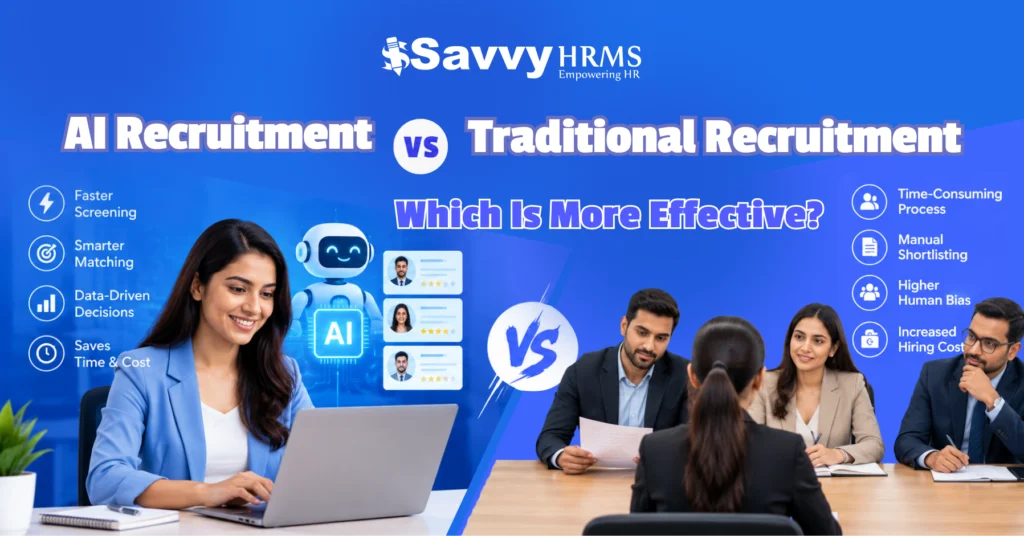

Recruitment is changing rapidly as companies adopt artificial intelligence to source candidates, screen resumes, match skills, automate communication, and schedule interviews. At the same time, traditional recruitment still depends heavily on recruiter expertise, personal interaction, referrals, interviews, and human decision-making.
The debate around AI recruitment vs traditional recruitment is therefore not simply about technology versus people. It is about which approach can deliver better hiring speed, cost efficiency, candidate matching, hiring quality, fairness, and candidate experience for a particular organization.
In this blog, we compare AI recruitment and traditional recruitment across the complete hiring process. We will examine how both approaches work, their differences, advantages and limitations, speed, cost, candidate matching, hiring bias, and the situations where each method works best.
What Is AI Recruitment?
AI recruitment is the use of artificial intelligence, machine learning, natural language processing, generative AI, and automation technologies to support or perform recruitment activities.
Instead of requiring recruiters to manually complete every stage of hiring, AI recruitment software can automate repetitive tasks and analyze large amounts of candidate information. Depending on the platform, AI can help with candidate sourcing, resume screening, job-description creation, candidate matching, interview scheduling, candidate communication, assessments, and recruitment analytics.
AI recruitment does not necessarily mean that an AI system makes the final hiring decision. In many organizations, AI acts as a support layer that helps recruiters process information faster and identify potentially suitable candidates.
According to SHRM’s (Society for Human Resource Management ) 2025 Talent Trends research, 51% of organizations reported using AI to support recruiting, making recruitment the HR area in which AI was used most frequently. Among organizations using AI for recruiting, 89% reported that it saves time or increases efficiency, while 36% reported reduced recruitment, interviewing, or hiring costs.
Common AI recruitment applications include:
- AI-powered resume screening
- Candidate sourcing and search
- Resume parsing
- Candidate-job matching
- Automated interview scheduling
- Recruitment chatbots
- Job-description generation
- Candidate communication
- Skills identification
- Recruitment analytics
- Interview assistance
- Candidate ranking and prioritization
The primary objective is not simply to replace recruiters. Instead, AI recruitment aims to reduce manual workload and help recruiters spend more time on activities requiring human judgment, such as interviewing, relationship building, stakeholder communication, and final candidate evaluation.
What Is Traditional Recruitment?
Traditional recruitment is a human-led hiring approach in which recruiters or HR professionals manage most recruitment activities manually.
The process generally begins with identifying a vacancy, creating a job description, advertising the position, sourcing candidates, reviewing applications, conducting preliminary screening, coordinating interviews, evaluating candidates, and making a hiring recommendation.
Traditional recruitment can involve:
- Job boards and career websites
- Employee referrals
- Recruitment agencies
- Campus recruitment
- Networking
- Manual resume screening
- Phone or video screening
- Structured and unstructured interviews
- Reference checks
- Recruiter-led candidate evaluation
- Hiring-manager discussions
Traditional recruitment has an important advantage: human judgment.
Recruiters can consider context that may not be obvious from a resume, such as communication style, motivation, career goals, cultural alignment, transferable experience, and the candidate’s response to unexpected interview questions.
However, traditional recruitment can become difficult to scale when application volumes increase. Manual resume screening, candidate communication, scheduling, and data entry can consume significant recruiter time.
SHRM reported that the average time to fill open roles fell from 48 days in 2023 to 41 days in 2024, highlighting the broader push toward faster and more efficient recruitment processes. Automation and technologies such as conversational AI and interview scheduling tools can contribute to shorter hiring timelines.
How Do AI and Traditional Recruitment Work?
Although both approaches aim to identify and hire suitable employees, they distribute recruitment work differently.
How AI Recruitment Works
A general AI-supported recruitment process may follow these steps:
1. Job requirement analysis
AI tools can analyze job descriptions and identify relevant skills, qualifications, experience levels, and keywords.
2. Candidate sourcing
AI can search candidate databases, professional networks, recruitment platforms, and existing talent pools for profiles that match the defined requirements.
3. Resume screening
AI-powered recruitment software can parse resumes and identify relevant qualifications, experience, skills, certifications, and other information.
4. Candidate matching
Machine-learning algorithms can compare candidate profiles with job requirements and prioritize candidates based on predefined criteria.
5. Candidate communication
Recruitment chatbots and automated communication tools can answer common questions, send updates, and maintain communication with candidates.
6. Interview scheduling
AI-enabled systems can coordinate availability and automate interview scheduling.
7. Recruiter review
Recruiters review shortlisted candidates, conduct interviews, assess suitability, and make or recommend the final hiring decision.
This approach is particularly useful for organizations handling large applicant volumes.
How Traditional Recruitment Works
Traditional recruitment generally follows a more human-led process:
1. Identify the vacancy
The hiring manager and HR team define the role and requirements.
2. Create the job description
The recruiter prepares the job posting based on the requirements.
3. Source candidates
Candidates are found through job portals, referrals, agencies, professional networks, campus hiring, or direct applications.
4. Manually screen applications
Recruiters review resumes and select candidates for the next stage.
5. Conduct interviews
Recruiters and hiring managers evaluate candidates through phone, video, or in-person interviews.
6. Compare candidates
The recruitment team assesses qualifications, experience, skills, interview performance, and overall suitability.
7. Select and offer
The preferred candidate receives an offer after the required approvals and checks.
The main difference is therefore where automation ends and human effort begins.
What Is the Difference Between AI Recruitment and Traditional Recruitment?
The biggest difference between AI recruitment vs traditional recruitment is the role of technology in processing information and performing repetitive hiring activities.
| Recruitment Factor | AI Recruitment | Traditional Recruitment |
| Candidate sourcing | Automated or AI-assisted | Primarily manual |
| Resume screening | AI-assisted screening and ranking | Recruiter manually reviews resumes |
| Candidate matching | Algorithm-based matching | Recruiter judgment and keyword review |
| Job descriptions | Can be generated or optimized using AI | Usually written manually |
| Interview scheduling | Can be automated | Often coordinated manually |
| Candidate communication | Chatbots and automated workflows | Recruiter-led communication |
| Data processing | Fast and scalable | Time-consuming at high volumes |
| Hiring decisions | Usually supported by AI, with human oversight | Primarily human-led |
| Personal interaction | Limited in early stages | Strong throughout the process |
| Scalability | High | Limited by recruiter capacity |
| Speed | Generally faster for repetitive tasks | Can be slower for high-volume hiring |
| Cost | Can reduce manual recruitment workload | Higher dependence on recruiter hours |
| Candidate experience | Fast responses and availability can improve experience | More personalized human interaction |
| Bias | Can reduce some human biases but may introduce algorithmic bias | Vulnerable to human bias |
| Complex judgment | Limited compared with experienced recruiters | Strong human judgment |
| Best suited for | High-volume and repetitive recruitment | Relationship-driven and specialized hiring |
The table shows why there is no universal winner in AI recruitment vs traditional recruitment. AI has clear advantages in speed, scale, automation, and data processing, while traditional recruitment remains valuable for human judgment, relationship building, and complex candidate evaluation.
AI Recruitment vs Traditional Recruitment: Key Differences
1. Speed
AI recruitment can process large volumes of applications much faster than manual screening.
A recruiter may need to review hundreds or thousands of resumes manually, whereas an AI system can process candidate data rapidly and identify profiles matching predefined requirements.
LinkedIn’s 2025 Future of Recruiting research found that 37% of organizations were actively integrating or experimenting with generative AI in recruiting, up from 27% a year earlier. Recruiting professionals using or experimenting with generative AI reported saving an average of 20% of their workweek, equivalent to approximately one working day.
2. Scalability
Traditional recruitment becomes increasingly difficult as application volumes rise.
For example, screening 100 applications manually may be manageable. Screening 10,000 applications requires substantially more recruiter time.
AI recruitment tools can help organizations scale initial screening and sourcing without increasing manual effort at the same rate.
3. Candidate Matching
Traditional recruitment often depends on resumes, keywords, recruiter experience, and interviews.
AI recruitment can analyze multiple data points, including skills, experience, qualifications, job requirements, and potentially transferable skills.
SHRM notes that AI-enabled sourcing can help identify adjacent skills that candidates may not explicitly describe and match those skills with suitable roles.
4. Human Judgment
Traditional recruitment has an advantage when hiring decisions require complex judgment.
A recruiter can ask follow-up questions, interpret ambiguous answers, understand career motivations, and evaluate interpersonal factors.
AI can provide recommendations, but it should not automatically be treated as the final authority.
5. Candidate Experience
AI can provide faster responses, automated scheduling, and round-the-clock assistance.
Traditional recruitment can provide more personalized communication because candidates interact directly with recruiters.
The best experience often comes from combining the two: automation for routine interactions and human communication for important recruitment stages.
6. Recruitment Costs
AI recruitment can reduce the amount of recruiter time spent on repetitive tasks.
SHRM’s 2025 data found that 36% of organizations using AI for recruiting reported reduced recruitment, interviewing, and hiring costs.
However, AI also introduces technology costs such as software subscriptions, implementation, integration, training, monitoring, and governance.
Therefore, organizations should compare total recruitment cost, not simply software cost.
AI Recruitment vs Traditional Recruitment: Pros and Cons
Advantages of AI Recruitment
- Faster candidate screening: AI can process large volumes of applications quickly.
- Higher scalability: Organizations can manage larger candidate pools without increasing manual work proportionally.
- Automation: Routine tasks such as scheduling, candidate communication, sourcing, and resume screening can be automated.
- Data-driven recruitment: AI can identify patterns and compare candidates against defined requirements.
- Recruiter productivity: Recruiters can spend less time on administrative work and more time on strategic activities.
- Consistent processing: AI can apply the same predefined criteria across large candidate pools.
Limitations of AI Recruitment
- Algorithmic bias: AI can reproduce or amplify biases present in training data or recruitment criteria.
- Lack of context: Algorithms may not fully understand career changes, unconventional experience, or complex candidate circumstances.
- Technology dependency: Poor-quality data or poorly configured systems can produce poor recommendations.
- Candidate concerns: Some candidates may be uncomfortable with automated assessment or communication.
- Human oversight is required: AI recommendations should be reviewed rather than blindly accepted.
Advantages of Traditional Recruitment
- Human judgment: Recruiters can evaluate candidates beyond structured data.
- Personal relationships: Direct recruiter interaction can build trust and engagement.
- Contextual evaluation: Humans can understand unconventional career paths and transferable experiences.
- Flexibility: Recruiters can adapt questions and evaluation criteria during interviews.
- Better suited to complex roles: Specialized executive, leadership, or relationship-heavy positions may require deeper human assessment.
Limitations of Traditional Recruitment
- Time-consuming: Manual screening and coordination can take substantial time.
- Difficult to scale: Recruiter capacity limits the number of candidates that can be processed.
- Potential human bias: Recruiters may unintentionally be influenced by subjective preferences.
- Administrative workload: Scheduling, follow-ups, data entry, and communication can consume recruiter time.
- Inconsistent evaluation: Different recruiters may evaluate candidates differently without standardized processes.
Which Is Faster and More Cost-Effective?
AI recruitment is generally faster for repetitive, high-volume recruitment activities, while traditional recruitment can be more effective when roles require extensive human evaluation.
Speed is one of the strongest arguments for AI recruitment.
AI can automate resume screening, candidate searches, interview scheduling, and routine communication. This allows recruiters to move qualified candidates through the recruitment funnel faster.
LinkedIn reports that recruiting professionals who are experimenting with or integrating generative AI save an average of 20% of their workweek.
Cost effectiveness is more complex.
AI can lower the amount of recruiter time required for repetitive tasks. SHRM found that 36% of organizations using AI in recruiting reported cost reductions.
However, organizations need to consider:
- AI software costs
- Implementation expenses
- Integration costs
- Training
- Data quality
- Human oversight
- Compliance and governance
- Maintenance
Traditional recruitment may have fewer technology expenses but can require significantly more employee hours.
Therefore, AI recruitment is generally more cost-effective for organizations with high hiring volumes, while traditional recruitment may remain appropriate for organizations hiring a small number of highly specialized candidates.
Which Provides Better Candidate Matching and Hiring Quality?
There is no simple answer because candidate matching and hiring quality depend on how the recruitment process is designed.
AI can be highly effective at identifying candidates based on skills, experience, qualifications, and job requirements.
LinkedIn’s 2025 Future of Recruiting research found that 93% of talent acquisition professionals believe accurately assessing candidate skills is important for improving quality of hire. It also found that companies with the most skills-based searches were 12% more likely to make a quality hire.
AI can support this shift toward skills-based hiring by analyzing candidate capabilities rather than depending only on job titles or educational background.
At the same time, hiring quality cannot be measured only through resume matching.
A high-quality hire may depend on:
- Technical capability
- Problem-solving ability
- Communication
- Motivation
- Role expectations
- Team dynamics
- Leadership capability
- Cultural contribution
- Career goals
- Long-term potential
These factors require human assessment.
Therefore, AI is highly effective for candidate discovery and initial matching, while human recruiters remain important for evaluating overall suitability and making informed hiring decisions.
Does AI Recruitment Reduce Bias in Hiring?
AI recruitment can reduce certain forms of human bias, but it does not automatically make recruitment bias-free.
Traditional recruitment can be affected by unconscious bias. Recruiters may unintentionally make decisions based on names, educational backgrounds, previous employers, communication styles, or other factors that are not directly related to job performance.
AI can standardize parts of the screening process by applying predefined criteria consistently.
However, AI systems can also introduce algorithmic bias.
If an AI system is trained on historical hiring data that contains bias, the system may learn and reproduce those patterns. Poorly designed screening criteria can also disadvantage qualified candidates.
SHRM has highlighted concerns around AI transparency and bias. In one study, only 40% of employers said their technology vendor was very transparent about the steps used to protect against bias, while more than half of respondents using automation or AI reported challenges, including difficulties auditing algorithms and cases where algorithms could overlook qualified applicants.
For this reason, responsible AI recruitment should include:
- Human oversight
- Regular bias testing
- Transparent criteria
- Validated assessment methods
- Data-quality checks
- Monitoring of selection outcomes
- Clear accountability
- Periodic review of AI recommendations
The goal should not be “AI instead of humans.”
The goal should be “AI with responsible human oversight.”
When Is AI Recruitment Better Than Traditional Recruitment?
AI recruitment is generally better suited to organizations that manage high recruitment volumes, repetitive hiring processes, large candidate pools, or geographically distributed hiring.
AI can be particularly useful when organizations need to:
1. Handle High Application Volumes
Companies receiving hundreds or thousands of applications for a single position can use AI to support initial screening and prioritization.
2. Hire at Scale
Organizations conducting seasonal, frontline, sales, customer support, retail, logistics, or other high-volume recruitment can benefit from automation.
3. Reduce Administrative Work
AI can automate scheduling, candidate communication, sourcing, resume parsing, and other repetitive activities.
4. Improve Recruitment Speed
Organizations with urgent hiring requirements can use automation to reduce delays between application, screening, and interview stages.
5. Support Skills-Based Hiring
AI can help identify relevant skills and transferable capabilities across candidate profiles.
6. Improve Recruiter Productivity
By reducing administrative work, AI allows recruiters to focus on candidate relationships, interviews, hiring-manager collaboration, and strategic workforce planning.
SHRM’s 2025 research shows why this is becoming important: 51% of organizations reported using AI for recruiting, and 89% of those using AI for recruitment said it saves time or increases efficiency.
Can AI and Human Recruiters Work Together?
Yes. In many cases, the most effective recruitment strategy is a combination of AI automation and human expertise.
AI is particularly strong at processing large amounts of structured information and automating repetitive activities.
Recruiters are stronger at understanding context, building relationships, assessing interpersonal factors, conducting complex interviews, and making complex decisions.
A hybrid recruitment model can therefore divide responsibilities according to each capability.
| Recruitment Activity | AI’s Role | Recruiter’s Role |
| Job description | Draft and optimize | Review and finalize |
| Candidate sourcing | Identify potential candidates | Validate relevance |
| Resume screening | Parse and prioritize | Review shortlisted profiles |
| Candidate communication | Handle routine queries | Handle important conversations |
| Interview scheduling | Automate coordination | Conduct interviews |
| Candidate assessment | Analyze defined criteria | Apply contextual judgment |
| Bias monitoring | Detect patterns | Investigate and correct issues |
| Final selection | Provide insights | Make or recommend decision |
| Offer stage | Automate workflows | Negotiate and communicate |
| Candidate relationship | Support communication | Build genuine relationships |
LinkedIn’s 2025 research reinforces this human-AI partnership. Among recruiting professionals using or experimenting with generative AI, the average reported time saving was around 20% of the workweek, while LinkedIn also found that relationship development was becoming increasingly important as AI took over routine work.
The future of recruitment is therefore unlikely to be completely human or completely automated.
Instead, recruitment is moving toward increased hiring, where AI handles repetitive processes and recruiters focus on higher-value decisions.
AI Recruitment vs Traditional Recruitment: Which Is More Effective?
AI recruitment is more effective for speed, scalability, automation, candidate sourcing, resume screening, and high-volume hiring. Traditional recruitment is more effective when human judgment, relationship building, contextual evaluation, and complex decision-making are central to the hiring process.
So, which one should organizations choose?
The answer depends on the recruitment requirement.
| Business Requirement | More Suitable Approach |
| High-volume hiring | AI recruitment |
| Large applicant pools | AI recruitment |
| Automated resume screening | AI recruitment |
| Candidate sourcing at scale | AI recruitment |
| Faster scheduling | AI recruitment |
| Routine candidate communication | AI recruitment |
| Executive hiring | Human-led recruitment |
| Highly specialized positions | Hybrid approach |
| Relationship-driven hiring | Traditional/hybrid |
| Complex candidate evaluation | Hybrid approach |
| Bias monitoring | AI + human oversight |
| Strategic hiring | Hybrid approach |
| End-to-end scalable recruitment | AI + human recruiters |
For most modern organizations, the question should not be “AI recruitment or traditional recruitment?”
It should be:
“Which parts of recruitment should be automated, and where should human expertise remain in control?”
AI is already becoming a significant part of recruitment. SHRM’s 2025 data shows that 51% of organizations use AI to support recruiting, while LinkedIn reports that 37% of organizations are actively integrating or experimenting with generative AI in recruitment.
The evidence suggests that AI can make recruitment faster and more scalable, but technology alone does not guarantee better hiring.
The strongest recruitment model is one where AI handles repetitive and data-intensive tasks while recruiters remain responsible for judgment, candidate relationships, interviews, fairness, and final hiring decisions.
Conclusion
AI recruitment is more effective than traditional recruitment for high-volume hiring, automation, speed, and scalable candidate screening. Traditional recruitment remains valuable for human judgment and complex hiring. For most organizations, combining AI recruitment technology with recruiter expertise can deliver the strongest balance of efficiency and hiring quality.
The future of recruitment is therefore not about replacing recruiters with AI. It is about enabling recruiters to work smarter. By automating repetitive recruitment tasks while retaining human oversight, organizations can improve hiring speed, candidate matching, recruiter productivity, and overall talent acquisition outcomes.










Ready to make your recruitment process faster, smarter, and more efficient?
Explore how an integrated HRMS can help streamline recruitment and manage the employee lifecycle from hiring to onboarding and beyond.
Frequently Asked Questions (FAQs)
1. Is AI recruitment better than traditional recruitment?
AI recruitment is generally better for high-volume, repetitive, and data-intensive hiring tasks, while traditional recruitment can be stronger for relationship-driven and complex hiring. A hybrid approach often provides the best balance.
2. Does AI recruitment replace recruiters?
No. AI can automate tasks such as resume screening, sourcing, scheduling, and candidate communication, but recruiters remain important for interviews, relationship building, contextual evaluation, and final hiring decisions.
3. Is AI recruitment faster than traditional recruitment?
Yes. AI can quickly screen applications, identify potential candidates, automate scheduling, and support candidate communication, making the recruitment process faster and more efficient.
4. Can AI reduce recruitment costs?
Yes. AI can reduce recruitment costs by automating repetitive tasks and reducing the manual effort required for sourcing, screening, interviewing, and hiring.
5. Can AI recruitment eliminate hiring bias?
No. AI can help standardize certain recruitment processes, but it can also reproduce biases present in historical data or poorly designed criteria. Regular audits, transparent processes, and human oversight are essential.
6. What is the future of recruitment?
The future of recruitment is likely to involve greater collaboration between AI and human recruiters. AI will handle repetitive and data-intensive tasks, while recruiters focus on strategic hiring, candidate relationships, assessment, and decision-making.