



Growing a startup means managing more employees, payroll processes, attendance records, leave requests, compliance requirements, and performance data. As these responsibilities increase, spreadsheets and disconnected tools can quickly become difficult to maintain, making HR software increasingly important.
The best HR software for growing startups brings core HR, payroll, attendance, recruitment, employee self-service, performance, and compliance processes into one centralized platform. This helps startups reduce manual work, improve accuracy, and give employees easier access to everyday HR services.
But which HR software for startups is actually suitable for a growing business in India? To help you compare the options, this guide evaluates 7 popular platforms based on features, scalability, payroll capabilities, usability, integrations, and overall suitability for growing startup teams in 2026.
What Is HR Software and Why Do Growing Startups Need It?
HR software is a digital platform that helps businesses manage employee information and automate human resource processes such as recruitment, onboarding, attendance, leave, payroll, performance management, employee records, and compliance.
For startups, HR software becomes particularly valuable as the workforce grows. What can be handled manually with 10 or 20 employees can become time-consuming and error-prone when the company reaches 50, 100, or several hundred employees.
A suitable HR software for startups can help businesses:
- Centralize employee information in one system.
- Automate repetitive HR administration.
- Reduce manual payroll and attendance calculations.
- Give employees self-service access to HR information.
- Improve visibility into workforce data.
- Standardize HR workflows across teams.
- Support statutory payroll and compliance processes.
- Scale HR operations without increasing administrative workload at the same pace.
The right platform can therefore become more than an employee database. It can act as the operational foundation for managing the employee lifecycle as a startup grows.
What Should Startups Look for in HR Software in 2026?
Startups should not select HR software simply because it has the largest number of features. The better approach is to evaluate whether the platform solves current HR problems while remaining flexible enough to support future growth.
Key factors to consider include
1. Core HR management
The software should maintain employee profiles, documents, organizational structures, roles, and important employee information centrally.
2. Payroll and compliance
For Indian startups, payroll should support salary calculations, deductions, tax-related processes, and applicable statutory requirements.
3. Attendance and leave management
The platform should automate attendance tracking, leave requests, approvals, holidays, shifts, and related records.
4. Recruitment and onboarding
Growing startups need tools that can help manage candidates, hiring workflows, document collection, onboarding tasks, and employee joining processes.
5. Employee self-service
Employees should be able to access payslips, apply for leave, update information, submit requests, and access HR documents without depending on HR for every task.
6. Scalability
The platform should remain useful as employee numbers, departments, locations, and HR processes increase.
7. Integrations
Integration with accounting, finance, attendance devices, communication tools, identity systems, or other business applications can reduce duplicate data entry.
8. Analytics and reporting
HR teams should be able to understand headcount, attendance, payroll, attrition, performance, and other workforce trends.
9. Usability and support
A startup usually has limited HR resources, so an intuitive interface, onboarding assistance, training, and responsive support can make a significant difference.
How Do We Rank These HR Software for Growing Startups?
To make this list more useful, we evaluated the 7 HR software platforms using a practical startup-focused framework rather than ranking them solely by the number of features.
| Evaluation Criteria | Weight | What We Evaluate |
| Core HR capabilities | 15% | Employee records, workflows, documents, organizational management |
| Payroll & Indian compliance | 20% | Payroll automation, statutory processes, tax and compliance support |
| Attendance & leave | 10% | Attendance tracking, shifts, leave policies and approvals |
| Recruitment & onboarding | 10% | Hiring workflows, onboarding and employee lifecycle support |
| Performance & talent management | 10% | Goals, reviews, performance and employee development |
| Scalability | 15% | Suitability as employee count, teams and processes grow |
| Employee experience | 5% | ESS, mobile access, self-service and usability |
| Integrations & ecosystem | 5% | Ability to connect with other business systems |
| Reporting & analytics | 5% | Dashboards, reports and workforce insights |
| Overall startup fit | 5% | Value, flexibility and suitability for growing Indian startups |
Our ranking therefore considers the overall balance of functionality, scalability, Indian HR requirements, employee experience, and startup suitability. Pricing and features can change over time, so startups should verify current plans and included capabilities before making a purchase decision.
At a Glance: 7 Best HR Software for Growing Startups in India
| Rank | HR Software | Best For | Overall Fit |
| 1 | Savvy HRMS | Growing startups seeking broad HR, payroll, and workforce management | Excellent |
| 2 | Darwinbox | Startups with ambitious growth and broader enterprise HR requirements | Excellent |
| 3 | Keka | Startups prioritizing payroll, HR operations and employee experience | Excellent |
| 4 | Zoho People | Startups already using or considering the wider Zoho ecosystem | Very Good |
| 5 | greytHR | Startups focused on payroll, HR administration and compliance | Very Good |
| 6 | Zimyo | Growing businesses wanting configurable HR and payroll capabilities | Very Good |
| 7 | Qandle | Startups looking for customizable, broad HR workflows | Very Good |
Overall fit is an editorial assessment based on the criteria above and may vary depending on business size, industry, budget, and HR requirements.
1. Savvy HRMS
Overview
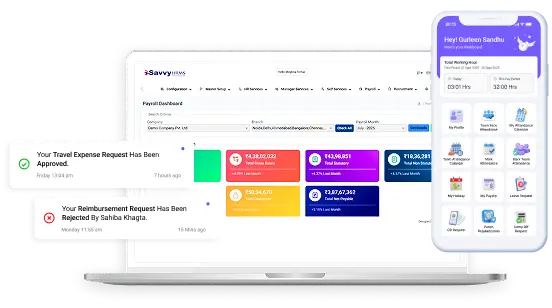
Savvy HRMS is a comprehensive HR and payroll platform designed to bring core HR, recruitment, attendance, leave, payroll, statutory compliance, performance, learning, expenses, helpdesk, and other workforce processes together. Its broad module coverage makes it suitable for startups looking to consolidate HR operations as they grow.
Key Features
- Core HR: Centralizes employee records, HR information, workflows, and essential workforce processes.
- Payroll Management: Helps automate salary processing and recurring payroll administration.
- Attendance Management: Tracks employee attendance and supports workforce time-management requirements.
- Leave Management: Digitizes leave applications, approvals, balances, and related workflows.
- Recruitment Management: Helps organize hiring activities and recruitment processes from one platform.
- Performance Management: Supports structured performance processes and employee objective management.
- Learning & Development: Helps organizations manage employee learning and development activities.
- Travel & Expense: Provides tools for managing business travel, expenses, and reimbursements.
- Employee Self-Service: Gives employees access to relevant HR services and information through digital channels.
Who Should Choose Savvy HRMS?
Savvy HRMS is a strong choice for growing startups that want to consolidate HR, payroll, attendance, recruitment, performance, employee self-service, and workforce processes into one scalable platform instead of managing multiple disconnected HR tools.
Who Might Not Need Savvy HRMS?
Very small startups with only a handful of employees and extremely basic HR requirements may not immediately need a broad HRMS. Businesses that require only simple attendance or payroll functionality could prefer a more narrowly focused solution.
Best For
Growing Indian startups that want broad HR, payroll, attendance, recruitment, performance, compliance, and employee-management capabilities within one platform.
2. Darwinbox
Overview
Darwinbox is a broad human capital management platform designed for organizations managing complex employee lifecycle, workforce, payroll, talent, and HR requirements across growing teams and larger organizational structures.
Key Features
- Core HR: Centralizes employee information and HR processes across organizational structures.
- Payroll: Supports Indian payroll processes and automated payroll inputs.
- Talent Management: Helps manage performance, development, and broader employee lifecycle activities.
- Recruitment: Supports structured hiring and candidate management workflows.
- Employee Experience: Provides digital employee services and engagement-oriented capabilities.
- Analytics: Helps HR and business leaders access workforce insights and reporting.
Who Should Choose Darwinbox?
Darwinbox can suit startups that are already scaling rapidly and expect increasingly sophisticated HR requirements. It is particularly relevant for businesses that want a broad HCM platform capable of supporting more complex organizational structures over time.
Who Might Not Need Darwinbox?
A very early-stage startup with a small employee base and straightforward HR processes may find a broad HCM platform more extensive than necessary. Such businesses may prefer a simpler solution focused on essential HR and payroll workflows.
Best For
High-growth startups and businesses preparing for larger-scale workforce management and increasingly sophisticated HR operations.
3. Keka
Overview
Keka combines HR, payroll, workforce management, talent management, hiring, performance, employee engagement, and related capabilities in one platform, with a strong focus on Indian payroll and employee experience.
Key Features
- HRIS: Maintains employee information, documents, reporting structures, and HR records.
- Payroll: Automates payroll processing and salary-related workflows for Indian businesses.
- Attendance: Connects attendance, timesheets, time-off, and payroll processes.
- Hiring: Supports recruitment, screening, interviews, and onboarding workflows.
- Performance: Provides goals, reviews, feedback, and performance-related processes.
- Employee Helpdesk: Helps employees raise HR questions and access assistance.
Who Should Choose Keka?
Keka can be a strong fit for startups that want HR and payroll closely connected with attendance, employee workflows, hiring, performance, and employee-facing services. It can particularly suit growing teams where payroll accuracy and employee experience are priorities.
Who Might Not Need Keka?
Startups looking only for a basic employee database and simple leave tracking may not require Keka’s broader HR, payroll, and talent capabilities. Businesses with highly specialized requirements should also evaluate integrations and configuration options carefully.
Best For
Growing startups that want strong payroll, HR operations, workforce management, employee experience, and talent capabilities in one platform.
4. Zoho People
Overview
Zoho People is an HR management platform from the wider Zoho ecosystem, making it particularly relevant for startups already using Zoho applications for business operations, finance, sales, collaboration, or productivity.
Key Features
- Employee Database: Maintains centralized employee information and HR records.
- Leave Management: Automates leave requests, policies, approvals, and balances.
- Attendance: Supports employee attendance and workforce time management.
- Performance: Provides structured performance and employee development workflows.
- Onboarding: Helps organize employee joining and onboarding processes.
- HR Automation: Reduces repetitive HR administration through configurable workflows.
Who Should Choose Zoho People?
Zoho People can suit startups that already use several Zoho applications and want HR processes connected within the same broader business technology ecosystem. It can also appeal to startups looking for flexible digital HR administration.
Who Might Not Need Zoho People?
Startups that do not use the broader Zoho ecosystem may find ecosystem integration less compelling. Businesses requiring highly specialized Indian payroll capabilities should evaluate the exact payroll setup and required integrations before selecting a plan.
Best For
Startups seeking flexible HR management and businesses already invested in the wider Zoho ecosystem.
5. greytHR
Overview
greytHR is an established HR and payroll platform focused on employee administration, payroll, attendance, leave, workflows, employee services, reporting, and related HR processes for businesses in India.
Key Features
- Payroll Management: Supports payroll processing and salary administration workflows.
- Core HR: Centralizes employee information and HR administration.
- Leave Management: Automates leave policies, applications, and approvals.
- Attendance: Helps organizations manage employee attendance and time records.
- Employee Portal: Provides employees with digital access to HR services.
- Reporting: Provides HR reports and analytics for workforce administration.
Who Should Choose greytHR?
greytHR can be suitable for startups that prioritize dependable HR administration, payroll, attendance, and employee-management workflows. It can particularly appeal to businesses that want established HR and payroll functionality without necessarily requiring an extensive enterprise HCM ecosystem.
Who Might Not Need greytHR?
Startups primarily searching for highly advanced talent management, extensive employee experience capabilities, or specialized global workforce functionality may need to compare greytHR against broader HCM platforms before deciding.
Best For
Indian startups prioritizing payroll, attendance, HR administration, employee services, and structured workforce processes.
6. Zimyo
Overview
Zimyo is an HRMS platform offering employee management, payroll, attendance, leave, learning, helpdesk, engagement, performance, and other workforce capabilities through a modular approach.
Key Features
- Employee Management: Centralizes employee profiles, organizational structures, and workforce information.
- Payroll: Supports configurable salary rules, payroll processes and compliance workflows.
- Attendance: Provides attendance, shift, roster, and workforce time-management capabilities.
- Leave Management: Allows organizations to configure and automate leave policies.
- Learning: Supports employee training, learning programs and development activities.
- Helpdesk: Helps employees raise HR queries and track support requests.
Who Should Choose Zimyo?
Zimyo can suit growing startups looking for modular HR functionality and configurable workflows. It may be particularly useful for businesses that want to gradually expand from core HR and payroll into performance, engagement, learning, helpdesk, and other HR capabilities.
Who Might Not Need Zimyo?
A startup with highly straightforward HR needs may not need a modular HRMS with a wider collection of workforce capabilities. Businesses with very specific integration or enterprise requirements should validate those requirements before purchasing.
Best For
Growing startups seeking configurable HR, payroll, attendance, employee engagement and workforce management capabilities.
7. Qandle
Overview
Qandle is an HR platform offering capabilities across recruitment, attendance, payroll, employee records, performance, engagement, helpdesk, analytics, and other employee lifecycle processes.
Key Features
- Recruitment: Helps businesses manage candidate screening and hiring workflows.
- Attendance: Supports employee attendance and workforce time management.
- Payroll: Provides digital payroll and employee salary-related services.
- Employee Records: Centralizes important employee information and HR documentation.
- Analytics: Provides dashboards and workforce insights for HR decision-making.
- Employee Helpdesk: Helps manage employee questions, requests, and HR support.
Who Should Choose Qandle?
Qandle can work well for startups that value configurable HR workflows and want a broad HR platform covering recruitment, payroll, attendance, employee services, analytics, and engagement from a centralized environment.
Who Might Not Need Qandle?
Startups that need only basic payroll, leave, and attendance functionality may find a broader HR platform unnecessary. Businesses with complex global payroll or highly specialized enterprise requirements should also assess whether Qandle’s current capabilities match their needs.
Best For
Growing startups looking for customizable HR workflows and broad employee lifecycle management capabilities.
| HR Software | Best For | Biggest Advantage | Potential Integration | Ideal Employee Size |
| Savvy HRMS | Growing Indian startups and large enterprises looking for broad HR automation | Broad HR, payroll, and workforce module coverage | Accounting, finance, attendance and business systems | 50 – 1,000+ |
| Darwinbox | High-growth businesses with sophisticated HR needs | Broad HCM and enterprise-oriented capabilities | ERP, payroll, identity and business applications | 500+ and scaling organizations |
| Keka | Startups prioritizing payroll and employee experience | Strong payroll, HR and talent combination | Accounting, finance and workplace applications | 50 – 1,000+ |
| Zoho People | Zoho ecosystem users | Wider Zoho ecosystem alignment | Zoho and third-party business applications | 20 – 500+ |
| greytHR | Payroll and HR administration | Established Indian HR and payroll focus | Finance, attendance and business tools | 50 – 1,000+ |
| Zimyo | Modular HR management | Configurable HR and workforce modules | Payroll, attendance and business systems | 50 – 1,000+ |
| Qandle | Customizable HR workflows | Broad HR functionality and configurability | Finance, payroll and workplace applications | 50 – 1,000+ |
Employee-size ranges are practical editorial guidance rather than fixed vendor limitations. Actual suitability depends on the organization’s complexity, locations, workflows, and implementation requirements.
How Much Does HR Software Cost for a Startup in India?
The cost of HR software for startups in India depends on employee count, selected modules, payroll requirements, implementation, integrations, and whether the vendor uses per-employee, per-module, or customized pricing.
Some providers publish plan-level pricing, while others primarily provide customized quotations. For example, Zimyo currently publishes Basic, Standard, and Enterprise plans with different per-user pricing and a minimum billing requirement, while greytHR publishes plan information with different feature levels and additional-employee pricing.
Savvy HRMS also provides multiple plans with different levels of functionality, ranging from core HR, attendance, leave, payroll, and statutory compliance to additional talent, expense, helpdesk, and other modules.
Instead of comparing HR software only on monthly subscription price, startups should calculate the total cost of ownership.
Consider:
- Monthly or annual subscription.
- Number of employees covered.
- Payroll module costs.
- Recruitment or performance module costs.
- Implementation charges.
- Data migration charges.
- Integration costs.
- Support and training.
- Additional hardware requirements for attendance.
- Costs of maintaining multiple separate HR tools.
A slightly higher subscription can sometimes deliver better value if it replaces several disconnected systems and reduces manual HR administration.
What Are the Benefits of Using HR Software as a Startup Grows?
The biggest benefit of HR software for startups is that it allows HR processes to scale without requiring the same level of manual administration.
1. Reduces Manual HR Work
Automated workflows can reduce repetitive activities such as leave approvals, employee data updates, attendance processing, onboarding tasks, and payroll preparation.
2. Improves Payroll Accuracy
Connecting employee information, attendance, leave, and payroll can reduce duplicate data entry and manual calculations.
3. Creates a Central Employee Database
Instead of maintaining employee information across spreadsheets, emails, and individual systems, HR teams can maintain a centralized source of workforce information.
4. Improves Employee Self-Service
Employees can access payslips, leave balances, HR documents, attendance information, and requests through self-service tools, reducing routine queries to HR.
5. Supports Compliance
Indian startups must manage applicable payroll and employment-related requirements as their workforce grows. HR and payroll software can help standardize processes and maintain relevant records.
6. Makes Scaling Easier
A startup may move from 30 employees to 100, then 300 or more. A scalable HRMS can support increasing employee records, departments, managers, workflows, and locations without rebuilding HR processes from scratch.
7. Improves Workforce Visibility
Dashboards and reports can help founders and HR leaders understand headcount, attendance, payroll, workforce trends, and other people-related metrics.
8. Standardizes HR Processes
Growing startups often develop different processes across teams. HR software can establish consistent workflows for onboarding, approvals, leave, attendance, performance, and employee exits.
9. Supports Better Employee Experience
A modern HR platform gives employees a centralized place to complete common HR activities rather than depending on HR teams for every request.
How Can Startups Choose the Right HR Software for Their Business?
Choosing the best HR software for startups should begin with the company’s current HR problems and expected growth rather than a generic feature checklist.
Step 1: Identify Your Current HR Challenges
List the processes currently handled through spreadsheets, emails, or separate applications. These could include payroll, attendance, leave, recruitment, onboarding, employee records, or performance reviews.
Step 2: Estimate Your Growth
Consider where your employee count could be over the next two to three years. The best HR software for a 30-person startup may not be the best option when the organization reaches 300 employees.
Step 3: Prioritize Essential Modules
Do not pay for functionality you will never use. Identify your immediate priorities, such as:
- Core HR
- Payroll
- Attendance
- Leave
- Recruitment
- Onboarding
- Performance
- Employee self-service
- Expenses
- Compliance
- Analytics
Step 4: Check Indian Payroll and Compliance Requirements
If the startup operates in India, verify that the platform supports the payroll calculations, statutory processes, reports, and state-specific requirements relevant to the organization.
Step 5: Evaluate Integrations
Check whether the HRMS can connect with the tools your business already uses, such as accounting systems, attendance devices, identity platforms, finance software, or other business applications.
Step 6: Test Employee Experience
Do not evaluate the software only from the HR administrator’s perspective. Ask employees and managers to test leave requests, attendance, payslips, approvals, document access, and mobile functionality.
Step 7: Evaluate Scalability
Ask the vendor how the platform handles additional employees, departments, locations, approval levels, entities, and workflows.
Step 8: Compare Total Cost
Compare subscription fees, implementation, integrations, support, modules, additional users, and other costs before making the final decision.
Step 9: Request a Demo
A product demo can help identify whether the platform actually matches your workflows. Prepare specific questions and use your own HR scenarios instead of depending only on a generic vendor presentation.
Step 10: Choose for Both Today and Tomorrow
The ideal HR software for a growing startup should solve today’s administrative problems while providing enough flexibility to support tomorrow’s workforce.
Conclusion
The best HR software for growing startups in India depends on workforce size, HR complexity, payroll requirements, budget, integrations, and growth plans. Savvy HRMS, Darwinbox, Keka, Zoho People, greytHR, Zimyo and Qandle each offer different combinations of HR, payroll, workforce and employee-management capabilities.
For startups, the most important consideration is not simply choosing the platform with the longest feature list. The right HR software should simplify daily HR operations, support Indian payroll requirements, improve employee experience, provide useful workforce insights, and continue delivering value as the organization scales.










Ready to simplify HR as your startup grows?
Explore Savvy HRMS and see how one platform can bring your core HR, payroll, attendance, recruitment, performance, and workforce processes together.
Frequently Asked Questions (FAQs)
1. What is the best HR software for growing startups in India?
The best HR software depends on a startup’s employee size, HR requirements, payroll needs, budget, and growth plans. Savvy HRMS, Darwinbox, Keka, Zoho People, greytHR, Zimyo, and Qandle are options worth evaluating.
2. What features should startups look for in HR software?
Startups should prioritize core HR, payroll, attendance, leave management, recruitment, onboarding, employee self-service, performance management, reporting, compliance support, integrations, and scalability.
3. How much does HR software cost for startups in India?
HR software pricing varies based on employee count, modules, implementation, integrations, and support. Startups should compare the total cost of ownership and included features instead of looking only at the monthly subscription.
4. Can HR software help startups manage payroll and compliance?
Yes. HR and payroll software can automate salary processing and help manage applicable statutory processes, records, and reports. Startups should verify whether the selected platform supports their specific Indian payroll and compliance requirements.
5. Can HR software scale with a growing startup?
Yes. Scalable HR software can support increasing employees, departments, locations, workflows, and HR processes. Startups should select a platform that can accommodate their expected growth without requiring an immediate system replacement.