


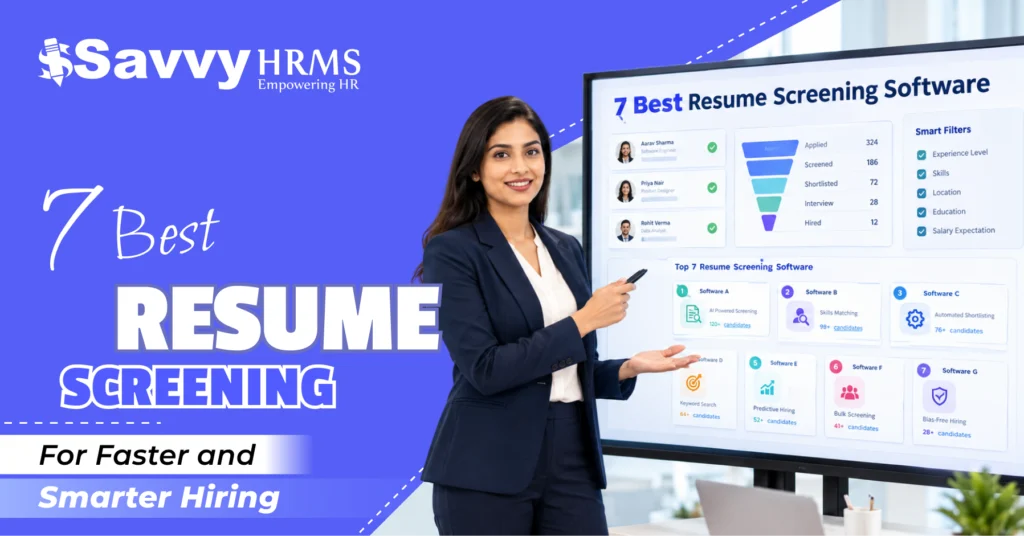

Best resume screening software helps recruiters automatically review applications, identify relevant candidates, compare skills with job requirements, and create focused shortlists without manually checking every resume. It can make recruitment faster, more consistent, and easier to manage.
As businesses receive more applications across multiple hiring channels, manual resume screening can become time-consuming and difficult to scale. AI-powered resume screening software can analyze candidate profiles, identify relevant qualifications, and help recruiters prioritize the most suitable applicants.
In this blog, we compare 7 leading resume screening software platforms in 2026 based on AI capabilities, resume parsing, candidate matching, recruitment automation, applicant tracking, integrations, scalability, and overall suitability for modern HR and recruitment teams.
What Is Resume Screening Software and How Does It Work?
Resume screening software is a recruitment technology that helps recruiters automatically review and evaluate resumes against predefined job requirements. It identifies relevant skills, experience, education, qualifications, and other candidate information to help recruiters shortlist suitable applicants.
Modern resume screening tools generally use resume parsing, keyword matching, skills-based matching, AI-powered candidate scoring, candidate ranking, and automated filtering.
A general resume screening process works in the following steps:
1. Resume Collection
Candidate resumes enter the recruitment system through career pages, job portals, employee referrals, recruitment campaigns, or other application channels.
2. Resume Parsing
The software extracts important information from resumes, including candidate details, skills, work experience, education, certifications, and previous positions.
3. Job Requirement Matching
The candidate’s profile is compared with the requirements defined for a particular job opening.
4. Candidate Scoring
The software can assign a score, match percentage, or ranking based on relevant qualifications and job-specific criteria.
5. Candidate Filtering
Recruiters can filter candidates based on skills, experience, location, education, certifications, or other predefined requirements.
6. Shortlisting
The most relevant candidates are prioritized for further evaluation, interviews, assessments, or communication.
AI-powered resume screening can go beyond simple keyword matching by analyzing the context and relevance of skills and experience. However, recruiters should still review automated recommendations before making final hiring decisions.
Why Is Resume Screening Important for Faster Hiring?
Resume screening is important because recruiters often receive hundreds of applications for a single position. Reviewing every application manually can consume significant time and delay the hiring process.
Resume screening software helps automate repetitive candidate evaluation and allows recruiters to focus on the applicants most closely aligned with the role.
The major benefits include:
- Faster candidate shortlisting: Recruiters can identify relevant applicants more quickly.
- Reduced manual screening: Automated tools handle repetitive resume evaluation.
- Consistent screening: Candidates can be evaluated against predefined job requirements.
- Improved recruiter productivity: HR teams can spend more time on interviews and candidate engagement.
- High-volume recruitment: Screening tools can help manage large application volumes.
- Better candidate matching: AI can identify relevant skills and experience across different resume formats.
- Centralized candidate management: Screening can connect with applicant tracking and recruitment workflows.
- Reduced hiring delays: Faster shortlisting can help organizations move suitable candidates through the recruitment funnel sooner.
For organizations hiring frequently, the difference between manually reviewing hundreds of resumes and using automated candidate screening can significantly affect recruiter productivity and time-to-hire.
How We Ranked This Resume Screening Software
We evaluated these resume screening platforms using criteria that reflect the needs of modern HR and recruitment teams.
| Criteria | What We Evaluated |
| Resume Screening | Resume parsing, filtering, matching, scoring, and candidate ranking capabilities |
| AI Capabilities | AI matching, recommendations, summaries, scoring, and recruitment automation |
| Candidate Matching | Ability to identify candidates based on skills, experience, and job requirements |
| Recruitment Automation | Automated workflows, communication, interview scheduling, and candidate movement |
| Applicant Tracking | Candidate pipeline, application management, and recruitment-stage tracking |
| Integrations | Job boards, HRMS, calendars, communication tools, assessments, and APIs |
| Scalability | Suitability for growing organizations and increasing hiring volumes |
| Ease of Use | Recruiter-friendly workflows, dashboards, search, and collaboration |
| Overall Fit | Combination of screening capabilities, recruitment features, scalability, and usability |
Note: Rankings are based on overall fit for resume screening and modern recruitment requirements. The right software can vary depending on organization size, hiring volume, recruitment complexity, existing HR technology, and budget.
At a Glance: 7 Best Resume Screening Software in 2026
| Rank | Resume Screening Software | Best For | Overall Fit |
| 1 | Savvy HRMS | Integrated HRMS and recruitment screening | Excellent |
| 2 | Keka | AI-powered screening and recruitment automation | Excellent |
| 3 | Qandle | AI resume matching and flexible recruitment workflows | Excellent |
| 4 | PeopleStrong | Enterprise recruitment and high-volume hiring | Excellent |
| 5 | ZingHR | AI-driven recruitment and talent acquisition | Very Good |
| 6 | Darwinbox | Enterprise AI-powered recruitment and HCM | Very Good |
| 7 | Deel | Global hiring and international recruitment | Very Good |
1. Savvy HRMS
Overview
Savvy HRMS combines recruitment management, resume management, AI-powered resume search, intelligent screening, applicant tracking, interview management, and broader HRMS capabilities. It helps businesses manage recruitment from job creation and candidate screening to interviews and employee onboarding within one platform.
Key Features
- AI-powered job description creation helps recruiters define relevant hiring requirements.
- Resume parsing automatically extracts candidate information into structured recruitment profiles.
- AI deep search finds relevant candidates beyond basic keyword matching.
- Intelligent screening helps recruiters identify potentially suitable candidates faster.
- Applicant tracking provides visibility across recruitment stages and candidate progress.
- Internal job posting supports employee referrals and internal recruitment opportunities.
- Job distribution helps publish openings across multiple recruitment channels efficiently.
- Interview scheduling simplifies coordination between recruiters, candidates, and hiring managers.
- Recruitment dashboards provide centralized visibility into hiring activities and performance.
Why Should You Choose Savvy HRMS?
Savvy HRMS is a strong choice for businesses that want resume screening combined with complete recruitment and HR management. Instead of using separate tools for screening, applicant tracking, interviews, onboarding, and employee management, businesses can manage connected HR processes through a unified HRMS environment.
Who Might Not Need Savvy HRMS?
Businesses looking only for a lightweight standalone resume screening tool may not need a broader HRMS platform. Organizations already using a mature ATS and separate HR systems may also prefer specialized software rather than consolidating recruitment and HR operations.
Best For
Savvy HRMS is best for large businesses looking for AI-powered resume screening, applicant tracking, recruitment automation, and broader HR management capabilities within one integrated platform.
2. Keka
Overview
Keka provides recruitment capabilities with AI-powered resume screening, candidate scoring, smart filtering, applicant tracking, assessments, interviews, and recruitment workflows designed to simplify candidate evaluation and hiring.
Key Features
- AI resume scoring evaluates candidate profiles against job requirements.
- AI-powered screening helps automate initial candidate evaluation processes.
- Smart filters help recruiters quickly narrow down suitable applicants.
- Ranked candidate profiles make promising applicants easier to prioritize.
- Integrated assessments provide additional information about candidate capabilities.
- Interview scorecards help hiring teams standardize candidate feedback.
Who Should Choose Keka?
Keka is suitable for businesses seeking an integrated HR platform with strong recruitment automation and AI-assisted screening capabilities. It can be particularly useful for growing organizations that want to simplify candidate evaluation, interviews, feedback, and hiring processes without depending on disconnected recruitment tools.
Who Might Not Need Keka?
Organizations with very low hiring volumes may not require advanced recruitment automation and AI screening capabilities. Companies needing only basic resume filtering may prefer a simpler ATS, while highly specialized global enterprises may require platforms designed specifically for complex international recruitment.
Best For
Keka is best for growing organizations looking for AI-assisted resume screening, candidate scoring, recruitment automation, structured interviews, and integrated HR management.
3. Qandle
Overview
Qandle offers recruitment management with AI-based resume matching, candidate filtering, profile scoring, applicant tracking, and recruitment workflow capabilities designed to help recruiters identify suitable candidates efficiently.
Key Features
- AI-based resume matching identifies candidates relevant to specific job requirements.
- Keyword search helps recruiters find relevant candidate profiles quickly.
- Skills filters narrow candidate pools using role-specific requirements.
- Experience filters help identify candidates meeting required experience levels.
- Profile scoring helps recruiters prioritize potentially suitable applicants.
- Automated workflows simplify candidate movement through recruitment stages.
Who Should Choose Qandle?
Qandle is a good option for organizations wanting AI-assisted resume matching alongside broader recruitment and HR capabilities. It can suit businesses that want recruiters to search, filter, score, shortlist, and manage candidates through a centralized recruitment workflow.
Who Might Not Need Qandle?
Companies with very straightforward hiring processes may not need advanced resume matching and recruitment workflow capabilities. Organizations already committed to another comprehensive ATS and HRMS may also find switching platforms unnecessary unless Qandle provides significant workflow or integration benefits.
Best For
Qandle is best for businesses wanting AI-based resume matching, candidate filtering, profile scoring, applicant tracking, and flexible recruitment management.
4. PeopleStrong
Overview
PeopleStrong provides enterprise recruitment technology with AI-powered resume parsing, candidate-job matching, skill recommendations, assessments, recruitment automation, and applicant tracking capabilities for organizations managing larger hiring operations.
Key Features
- AI-powered resume parsing converts candidate information into structured profiles.
- Candidate-job matching identifies applicants aligned with specific positions.
- Skill recommendations help recruiters discover relevant candidate capabilities.
- Assessments provide additional evaluation beyond resume information.
- Recruitment automation reduces repetitive candidate management activities.
- Applicant tracking provides visibility across the recruitment pipeline.
Who Should Choose PeopleStrong?
PeopleStrong is suitable for larger organizations with complex recruitment requirements and higher hiring volumes. Businesses looking for enterprise-grade HR technology can benefit from connecting recruitment with broader workforce management, talent management, employee lifecycle, and HR processes.
Who Might Not Need PeopleStrong?
Small organizations with occasional hiring requirements may not need an enterprise-oriented HR technology platform. Businesses searching only for basic resume screening or simple candidate filtering may prefer a smaller recruitment solution with fewer implementation and management requirements.
Best For
PeopleStrong is best for enterprises and larger organizations seeking AI-driven recruitment, candidate matching, skills-based screening, assessments, and integrated workforce management.
5. ZingHR
Overview
ZingHR provides AI-enabled recruitment and talent acquisition capabilities that help organizations automate candidate screening, shortlist applicants, manage recruitment workflows, schedule interviews, and support broader hire-to-rehire processes.
Key Features
- AI-ranked shortlists help recruiters prioritize relevant candidate profiles.
- Candidate screening automates initial evaluation against recruitment requirements.
- Automated workflows simplify repetitive recruitment and approval processes.
- Interview scheduling helps coordinate candidates and hiring teams efficiently.
- Assessments provide additional insights into candidate suitability.
- Talent acquisition workflows connect multiple stages of recruitment.
Who Should Choose ZingHR?
ZingHR is suitable for organizations looking to combine AI-driven recruitment with broader HR technology. It can be valuable for businesses that want automated screening, candidate shortlisting, interview management, and connected talent acquisition processes within a centralized platform.
Who Might Not Need ZingHR?
Companies with limited recruitment activity may not require a comprehensive talent acquisition platform. Businesses wanting only a basic resume scanner or standalone candidate filter may find ZingHR’s wider recruitment and HR functionality more extensive than necessary.
Best For
ZingHR is best for organizations seeking AI-enabled candidate screening, recruitment automation, talent acquisition workflows, assessments, and broader HR management.
6. Darwinbox
Overview
Darwinbox offers enterprise recruitment capabilities with AI-powered screening, skills intelligence, candidate recommendations, resume parsing, applicant tracking, and recruitment analytics for organizations managing complex hiring environments.
Key Features
- AI-powered resume screening evaluates applicants against role requirements.
- Resume parsing extracts candidate information into structured profiles.
- Candidate recommendations help recruiters identify relevant talent pools.
- Skills intelligence supports skills-based candidate evaluation and matching.
- Applicant tracking provides visibility throughout the recruitment process.
- Recruitment analytics help teams monitor hiring performance and activity.
Who Should Choose Darwinbox?
Darwinbox is suitable for larger organizations seeking AI-powered recruitment connected with a broader HCM ecosystem. It can benefit businesses managing multiple departments, locations, recruitment teams, and higher hiring volumes while requiring centralized workforce and talent management capabilities.
Who Might Not Need Darwinbox?
Small businesses with simple recruitment requirements may not need a comprehensive enterprise HCM platform. Companies looking only for resume screening, basic applicant tracking, or straightforward candidate filtering may prefer a more focused recruitment solution.
Best For
Darwinbox is best for enterprises seeking AI-powered recruitment, skills-based candidate matching, talent acquisition, applicant tracking, and integrated HCM capabilities.
7. Deel
Overview
Deel provides an ATS with AI-assisted candidate sourcing, screening, scoring, matching, and recruitment workflows. Its platform is particularly relevant for businesses hiring internationally and connecting recruitment with global onboarding, HR, and payroll processes.
Key Features
- AI-assisted screening helps recruiters evaluate candidate suitability.
- Candidate scoring helps prioritize applicants based on defined requirements.
- Criteria-based matching identifies candidates aligned with role expectations.
- AI sourcing helps recruiters discover potential candidates efficiently.
- Interview intelligence supports better candidate evaluation and interview workflows.
- Global hiring workflows connect recruitment with international employment processes.
Who Should Choose Deel?
Deel is suitable for businesses hiring internationally or managing distributed teams across multiple countries. Organizations looking to connect recruitment with global onboarding, employment, HR administration, and payroll can benefit from its broader international workforce management capabilities.
Who Might Not Need Deel?
Businesses hiring only within one local market may not need Deel’s international employment capabilities. Organizations primarily looking for an India-focused HRMS with payroll, attendance, and domestic workforce management may find other platforms more aligned with their requirements.
Best For
Deel is best for globally distributed businesses seeking AI-assisted recruitment, candidate screening, international hiring, onboarding, and global workforce management.
| Resume Screening Software | Best For | Biggest Advantage | Potential Integration | Ideal Employee Size |
| Savvy HRMS | All Indian Businesses | Integrated recruitment and HRMS | Job boards, career pages, HR workflows | 50 – 10,000+ |
| Keka | Growing Indian businesses | AI-assisted screening and recruitment | HR, recruitment, assessments, calendars | 100 – 1,000+ |
| Qandle | Mid-sized businesses | AI resume matching and candidate scoring | Recruitment, HR, communication tools | 100 – 1,000+ |
| PeopleStrong | Enterprises | Enterprise recruitment and skills matching | HCM, assessments, job boards, HR systems | 1,000+ |
| ZingHR | Growing and large organizations | AI-driven recruitment workflows | Recruitment, assessments, HR systems | 500+ |
| Darwinbox | Enterprises | AI recruitment within HCM | HCM, ATS, talent and HR systems | 1,000+ |
| Deel | Global companies | International hiring and workforce management | Global HR, onboarding, payroll, recruitment | 100+ |
Employee-size ranges are indicative recommendations rather than strict vendor limits. Actual suitability depends on hiring volume, organizational complexity, budget, and technology requirements.
What Are the Key Benefits of Using Resume Screening Software?
Resume screening software can improve recruitment efficiency by automating repetitive application review and helping recruiters focus on candidates who appear most relevant to a particular role.
1. Faster Candidate Shortlisting
Automated resume screening can process large candidate pools much faster than manual resume-by-resume review.
2. Reduced Recruiter Workload
Recruiters can spend less time performing repetitive screening and more time interviewing, engaging, and evaluating candidates.
3. Consistent Screening
Using predefined criteria can make the initial candidate screening process more standardized across roles and recruiters.
4. Better Candidate Matching
AI-powered tools can analyze skills, experience, and other candidate information to identify profiles relevant to job requirements.
5. High-Volume Hiring Support
Businesses conducting mass recruitment, campus hiring, seasonal hiring, or expansion hiring can manage larger application volumes more efficiently.
6. Improved Recruiter Productivity
Automation allows recruitment teams to redirect time toward activities requiring communication, relationship building, and human judgment.
7. Centralized Candidate Management
When resume screening is connected to an ATS, recruiters can manage candidate information and recruitment stages from one system.
8. Better Hiring Visibility
Recruitment dashboards and analytics can help HR teams understand application volumes, screening activity, candidate pipelines, and hiring performance.
What Features Should You Look for in Resume Screening Software?
The best resume screening software should provide more than simple resume scanning. Businesses should evaluate whether the platform can support their complete recruitment workflow.
Essential features include:
- Resume Parsing: Automatically extracts candidate information from resumes and creates structured profiles.
- AI Candidate Matching: Compares candidate qualifications with job requirements.
- Skills-Based Screening: Identifies relevant technical, functional, and transferable skills.
- Candidate Scoring: Helps recruiters prioritize applicants using defined criteria.
- Applicant Tracking: Tracks candidates across application, screening, interview, selection, and hiring stages.
- Candidate Search: Enables recruiters to search existing talent pools using skills, experience, keywords, or other filters.
- Automated Workflows: Reduces repetitive recruitment administration.
- Interview Scheduling: Helps recruiters coordinate interviews with candidates and hiring managers.
- Assessments: Provides additional evaluation beyond information available in a resume.
- Recruitment Analytics: Tracks recruitment metrics and hiring pipeline performance.
- Job Distribution: Helps publish vacancies across relevant recruitment channels.
- Integrations: Connects recruitment software with HRMS, calendars, job boards, communication tools, and other business systems.
- Security and Privacy: Protects sensitive candidate information and controls access to recruitment data.
- Human Review: Allows recruiters to review AI recommendations before making important hiring decisions.
Businesses should avoid selecting software simply because it claims to be “AI-powered.” Instead, evaluate what information the AI analyzes, how candidate matches are generated, whether recommendations are explainable, and how recruiters remain involved in final decisions.
How Does AI Improve Resume Screening and Candidate Shortlisting?
AI improves resume screening by helping recruiters analyze candidate information against job requirements more quickly and at greater scale.
Traditional screening can depend heavily on exact keywords. For example, a candidate may have relevant project management experience but use different terminology from the job description.
AI-powered resume screening can use contextual and semantic analysis to identify relationships between skills, experience, qualifications, and job requirements.
A typical AI-powered workflow can look like this:
Resume Parsing → Skill Extraction → Experience Analysis → Job Matching → Candidate Scoring → Ranking → Human Review
AI can also help recruiters generate candidate summaries, identify matching skills, highlight potential gaps, recommend relevant applicants, and prioritize candidates.
However, AI should support recruitment decisions rather than independently make them. Recruiters should review shortlisted candidates and consider information that may not be fully represented in resumes, including communication, motivation, potential, and role-specific suitability.
The best approach is therefore AI-assisted, human-led recruitment.
How Can Resume Screening Software Reduce Recruitment Time and Cost?
Resume screening software reduces recruitment time by automating repetitive candidate evaluation. Instead of manually opening, reading, comparing, and filtering every resume, recruiters can use software to prioritize potentially relevant applicants.
A traditional screening process may look like:
Applications → Resume Review → Qualification Check → Filtering → Shortlisting → Recruiter Review
An automated process can simplify the early stages:
Applications → Resume Parsing → AI Matching → Candidate Ranking → Recruiter Review
This can reduce the amount of manual work involved in initial screening.
The productivity benefits can become more noticeable when businesses receive large numbers of applications. Recruiters can spend more time on interviews and candidate engagement rather than repetitive resume review.
Organizations can measure the impact using recruitment metrics such as:
- Time to shortlist
- Time to hire
- Cost per hire
- Applications screened per recruiter
- Shortlist-to-interview ratio
- Interview-to-offer ratio
- Offer acceptance rate
- Candidate drop-off rate
- Quality of hire
Resume screening software does not automatically guarantee lower hiring costs. The real value depends on whether automation improves recruiter productivity, reduces delays, and contributes to better recruitment outcomes.
What Are the Challenges of Using Automated Resume Screening Software?
Automated resume screening offers significant efficiency benefits, but HR teams should understand its limitations before implementing it.
1. Algorithmic Bias
AI systems can potentially reproduce biases present in their training data or screening criteria. Organizations should monitor outcomes and maintain appropriate human oversight.
2. Poor Resume Quality
Incomplete, outdated, poorly formatted, or inconsistent resumes can affect parsing and candidate matching.
3. Over-Reliance on Keywords
Basic systems may overlook qualified candidates who use different terminology. Modern AI can reduce this problem, but recruiters should still review recommendations.
4. Incorrect Screening Criteria
Poorly defined job requirements can lead to poor candidate recommendations. Screening criteria should be relevant, realistic, and job-related.
5. Limited Human Context
Resumes do not always capture communication skills, motivation, adaptability, potential, or other qualities important to hiring decisions.
6. Data Privacy
Resumes contain personal information. Organizations should establish appropriate access controls, security measures, data retention practices, and privacy processes.
7. Candidate Experience
Excessive automation can make recruitment feel impersonal if candidates receive limited human interaction.
8. Explainability
Recruiters should understand why an applicant has been recommended, ranked, or filtered whenever AI significantly influences the screening process.
For these reasons, automated resume screening should be used as a decision-support tool rather than an unquestionable hiring authority.
How to Choose the Right Resume Screening Software for Your Business?
Selecting the right resume screening software requires looking beyond features. The platform should fit your hiring volume, recruitment process, organization size, technology environment, and long-term HR strategy.
1. Assess Your Hiring Volume
Determine how many applications recruiters generally receive each month. High-volume hiring usually creates a stronger business case for automated screening.
2. Define Your Screening Criteria
Identify the skills, experience, qualifications, certifications, location requirements, and other job-specific factors recruiters need to evaluate.
3. Choose the Right Software Type
Decide whether you need a dedicated recruitment platform or an integrated HRMS.
A dedicated ATS may be suitable when recruitment is your primary requirement. An integrated HRMS can be more valuable when you also want recruitment connected with onboarding, employee management, payroll, attendance, and other HR processes.
4. Evaluate AI Screening Capabilities
Check whether the platform provides:
- Resume parsing
- Semantic matching
- Skills extraction
- Candidate scoring
- Candidate ranking
- AI-generated summaries
- Candidate recommendations
- Explainable screening
- Human review controls
5. Check Recruitment Automation
Look for automated workflows covering job posting, candidate communication, interview scheduling, assessments, approvals, and hiring.
6. Review Integrations
Your resume screening software should work with your existing technology stack. Evaluate integrations with job boards, career pages, calendars, communication tools, assessments, HRMS platforms, and other systems.
7. Consider Scalability
Choose software that can accommodate increasing candidate volumes, recruiters, departments, locations, and future hiring requirements.
8. Evaluate User Experience
Recruiters should be able to search candidates, review recommendations, filter profiles, collaborate with hiring managers, and move candidates through recruitment stages easily.
9. Review Security and Privacy
Ask how candidate information is stored, protected, accessed, and retained. Understand the platform’s data security and privacy controls before implementation.
10. Calculate Total Cost
Consider more than subscription fees. Include implementation, integrations, training, support, additional modules, and potential productivity gains.
11. Run a Practical Test
Before selecting a platform, test it with representative job descriptions and resumes. Compare automated recommendations with recruiter evaluations to understand how well the software fits your actual hiring requirements.
The best resume screening software is ultimately the platform that matches your recruitment needs, reduces repetitive work, improves candidate discovery, integrates with your HR ecosystem, and keeps recruiters involved in important hiring decisions.
Conclusion
Resume screening software has become an important recruitment technology for businesses dealing with increasing application volumes. By automating resume parsing, candidate matching, filtering, and shortlisting, these tools can help recruiters save time, improve productivity, and create more efficient hiring workflows.
The right solution depends on your organization size, hiring volume, recruitment complexity, HR technology, and business goals. Whether you choose Savvy HRMS, Keka, Qandle, PeopleStrong, ZingHR, Darwinbox, or Deel, prioritize useful AI, reliable screening, scalability, integrations, data protection, and human-led hiring decisions.









Ready to make your hiring process faster and smarter?
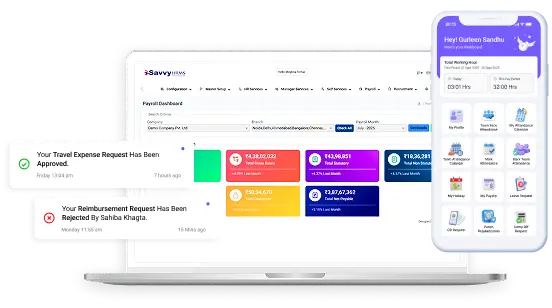
Explore Savvy HRMS to simplify resume screening, candidate management, recruitment automation, and your complete HR workflow in one platform.
Frequently Asked Questions (FAQs)
1. What are the main benefits of resume screening software?
Resume screening software helps recruiters reduce manual resume review, shortlist candidates faster, improve screening consistency, manage high application volumes, and spend more time on interviews and candidate engagement.
2. Which businesses should use resume screening software?
Resume screening software is useful for businesses that receive large numbers of applications, hire frequently, operate multiple recruitment teams, or want to automate candidate screening and shortlisting as part of their recruitment process.
3. Can resume screening software screen candidates based on skills?
Yes. Modern resume screening software can identify and compare skills, experience, qualifications, and other job-related criteria. AI-powered platforms can also use contextual matching to identify relevant candidates beyond exact keyword matches.
4. How does resume screening software improve the candidate shortlisting process?
Resume screening software automatically analyzes candidate profiles against job requirements, filters unsuitable applications, ranks potentially relevant candidates, and creates a focused shortlist for recruiters to review before proceeding with interviews.
5. What is the difference between AI resume screening and traditional resume screening?
Traditional resume screening often relies on manual review or basic keyword filtering, while AI resume screening can analyze skills, experience, context, and job relevance to help recruiters identify and prioritize suitable candidates more efficiently.