

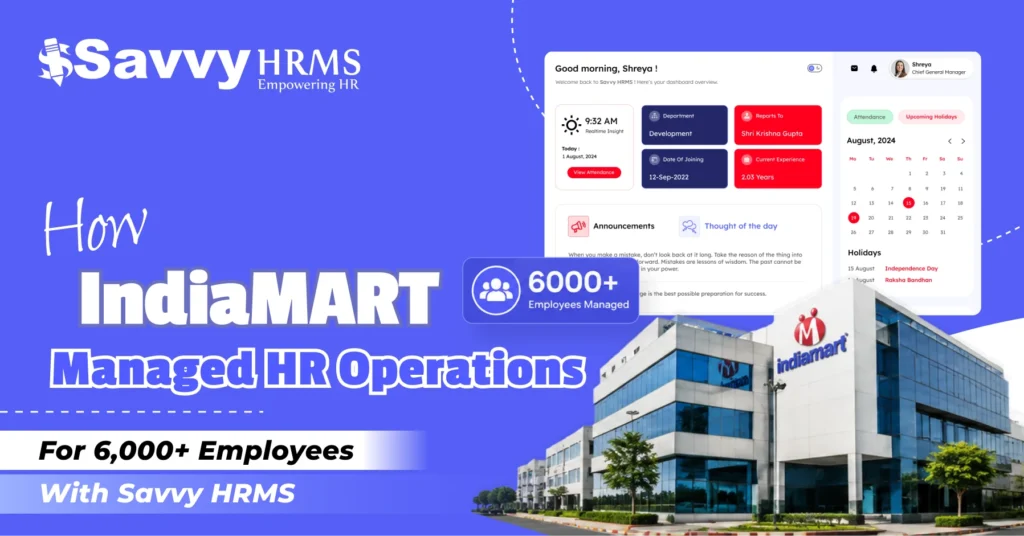
How IndiaMART Managed HR Operations for 6,000+ Employees with Savvy HRMS


-
AuthorS.K. Gupta
-
 Last Updated
September 03, 2026
Last Updated
September 03, 2026
-
 Reading Time
17 Mins
Reading Time
17 Mins
How can a company manage HR operations efficiently when its workforce crosses 6,000 employees? As employee numbers grow, HR teams face increasing complexity around attendance, employee data, policies, integrations, and everyday workforce processes that demand a reliable, scalable HRMS solution.
IndiaMART needed HR software that could support its large, distributed workforce while adapting to changing policies and business requirements. The IndiaMART HRMS implementation with Savvy HRMS addressed key HR challenges, including field attendance, ERP integration, historical data migration, and simplified workforce operations.
How Does Managing HR Operations Become Challenging at 6,000+ Employees?
Managing HR operations becomes increasingly complex as an organization grows. When thousands of employees are working across different locations and roles, HR teams have to manage large volumes of employee information, attendance records, policies, approvals, and workforce-related processes.
At this scale, even a small gap in an HR process can affect multiple employees and departments. Using disconnected systems or manual processes can make it harder to maintain accurate employee information, monitor attendance, implement policy changes, and coordinate HR activities.
For an organization with 6,000+ employees, HR software needs to do more than simply store employee records. It should provide a centralized environment where HR teams can manage workforce-related processes efficiently and adapt the system to changing organizational requirements.
1. Managing Employee Data at Scale
Employee data is one of the most important parts of HR operations. As the workforce grows, the volume of information that HR teams need to maintain also increases.
This can include employee profiles, organizational information, attendance records, leave details, historical information, and other workforce-related data.
A centralized HRMS can help organizations bring this information together and reduce dependency on disconnected spreadsheets or multiple applications.
2. Managing Employees Across Different Locations
Large organizations often have employees working across different offices, cities, and field locations.
This can make workforce management more complicated because HR teams need visibility into employee activities while ensuring that HR processes remain consistent across the organization.
IndiaMART highlights its Pan-India operations and workforce of around 6,000-7,000 employees. This scale naturally creates a need for structured and scalable HR management.
3. Keeping HR Policies Updated
HR policies can change as business requirements evolve.
An organization may introduce new policies, modify existing rules, or change internal processes from time to time. If an HR system is too rigid, implementing these changes can become difficult.
IndiaMART specifically required an HR solution that could adapt to yearly policy changes. This made flexibility an important consideration when selecting its HR software.
4. Managing Field Employee Attendance
Attendance management can become particularly challenging when employees work outside a traditional office environment.
Field employees may work across different locations and may not follow the same attendance pattern as office-based employees. HR teams therefore need reliable ways to capture and manage attendance information.
For IndiaMART, accurately managing field employee attendance was one of the important requirements of its HRMS implementation.
5. Connecting HR With Existing Business Systems
Large organizations often already have ERP platforms, internal applications, and other business systems in place.
When HR software operates separately from these systems, employees may have to enter or transfer information multiple times. This can increase administrative work and create opportunities for data inconsistencies.
This is why HRMS and ERP integration becomes an important consideration for organizations managing large workforces.
What HR Challenges Was IndiaMART Facing Before Savvy HRMS?
IndiaMART was looking for a one-stop HR solution that could help manage its HR functions more efficiently while fitting into its existing technology environment.
Its requirements included flexibility to accommodate yearly policy changes, customized HR software, accurate attendance management for field employees, and integration with its larger ERP and home-grown systems.
These requirements show that IndiaMART was not simply looking for basic HR software. It needed an HRMS that could adapt to its existing processes and support its large employee base.
1. Need for Flexible HR Management
One of the major requirements was flexibility.
Every organization has its own HR policies, workflows, approval processes, and workforce structure. A rigid HR system may not be able to accommodate these differences effectively.
IndiaMART needed HR software that could support its specific HR requirements and adapt as those requirements changed.
2. Need for Customized HR Software
IndiaMART also required customized HR software.
Instead of completely changing its existing HR processes to fit a predefined system, the organization needed a solution that could be configured according to its business requirements.
This is particularly important for large organizations because their HR processes can be more complex than standard workflows.
3. Field Employee Attendance
Managing attendance for field employees was another important challenge.
Traditional office-based attendance processes may not work equally well for employees who regularly work outside the office.
IndiaMART therefore needed an attendance management solution that could support its field workforce while providing HR teams with better visibility.
4. ERP and Internal System Integration
IndiaMART also needed its HRMS to integrate with its existing ERP and home-grown systems.
For a large organization, this type of integration can be essential because HR data often needs to work alongside information maintained by other business systems.
Why Did IndiaMART Choose Savvy HRMS for Its HR Operations?
IndiaMART chose Savvy HRMS because it could address the combination of flexibility, customization, attendance management, integration, and employee data requirements involved in its HR operations.
Savvy HRMS provided a flexible configuration architecture designed to accommodate changing policies. It also supported integration with IndiaMART’s larger ERP and home-grown systems and provided customized HR software according to the organization’s requirements.
In simple terms, IndiaMART needed an HRMS that could adapt to the organization rather than forcing the organization to completely change its existing HR processes.
1. Flexible Configuration
HR requirements can change over time. A flexible HRMS allows organizations to adjust workflows and processes according to evolving business requirements.
For IndiaMART, the ability to accommodate yearly policy changes was particularly important.
Savvy HRMS addressed this requirement through a flexible configuration approach that allowed the HR system to adapt to changing policies.
2. Customized HR Processes
Different businesses manage HR differently.
The approval structure, attendance rules, employee categories, and internal workflows can vary from one organization to another.
Savvy HRMS provided customized HR software to IndiaMART, helping align the HRMS with the organization’s specific requirements.
3. Integration Capabilities
IndiaMART also needed its HRMS to work alongside its existing technology infrastructure.
Savvy HRMS was integrated with the organization’s larger ERP and home-grown systems, helping connect HR operations with its existing business environment.
4. Ability to Support a Large Workforce
Scale was another important consideration.
Savvy HRMS was deployed for more than 6,000 employees across the group and locations.
This makes the IndiaMART implementation a useful example for organizations looking for HR software that can support a large workforce.
How Did Savvy HRMS Help IndiaMART Manage a 6,000+ Employee Workforce?
Savvy HRMS helped IndiaMART create a more centralized and customized environment for managing its HR operations.
The implementation addressed several requirements rather than focusing on only one HR process. These included employee data management, attendance, policy configuration, system integration, customized HR workflows, and historical data transfer.
1. Centralizing HR Operations
One of the key advantages of HRMS software is the ability to bring different HR processes into one platform.
Instead of depending on disconnected systems for employee information, attendance, leave, payroll, and other processes, organizations can manage multiple HR activities through a centralized HR environment.
Savvy HRMS provides a wide range of HR capabilities, including core HR, attendance, leave, payroll, recruitment, performance management, learning and development, travel and expense, employee helpdesk, employee assets, surveys, visitor management, and other workforce management functions.
This connected approach can make it easier for HR teams to manage employee-related processes.
2. Supporting Workforce Management
Managing thousands of employees requires consistent and structured HR processes.
An HRMS can provide HR teams, managers, and employees with access to relevant workforce information while helping standardize routine HR activities.
For a large organization, this can reduce administrative complexity and create greater visibility into HR operations.
3. Providing a Scalable HR Foundation
Scalability is not simply about the number of employees a system can handle.
A scalable HRMS should also support organizational growth, policy changes, additional locations, new processes, and integrations.
The IndiaMART implementation demonstrates how Savvy HRMS was deployed across a workforce of more than 6,000 employees and locations.
How Did Savvy HRMS Handle IndiaMART’s 12 Years of Employee Data?
One of the most notable aspects of the IndiaMART HRMS implementation was the handling of historical employee data.
Savvy HRMS was integrated with IndiaMART’s ERP along with employee data from the previous 12 years.
This is significant because historical data migration can be one of the most complicated stages when replacing a legacy HR system.
Why Historical Employee Data Matters
Employee records can contain years of information that organizations may need for operational, administrative, and reporting purposes.
When an organization moves from one HRMS to another, simply starting with new employee records may not be practical.
Historical employee information may need to be retained and transferred into the new system.
Replacing a Legacy HR System
Savvy HRMS replaced IndiaMART’s existing legacy system.
A transition like this requires careful planning because the organization needs to move to a new HR platform while continuing its regular HR operations.
The objective is not simply to install new software. It is to move the organization’s HR environment from the old system to the new one without creating unnecessary disruption.
Integrating Historical Data With the ERP
Highlights the integration of 12 years of employee data with IndiaMART’s ERP.
This demonstrates the importance of considering data migration and integration when selecting new HR software.
For businesses replacing legacy HR systems, questions around historical data should be addressed early in the implementation process.
How Did IndiaMART Manage Employee Attendance With Savvy HRMS?
Attendance can become difficult to track when employees are spread across different locations, especially when a business has a large field workforce. For IndiaMART, having a reliable way to track field employee attendance was an important part of its HR management requirements.
Savvy HRMS helped address this requirement by bringing attendance management into a centralized HRMS environment. Instead of treating attendance as a separate administrative activity, it became part of the broader employee management process.
With Savvy HRMS, IndiaMART could:
- Manage employee attendance through a centralized system.
- Support attendance tracking for field employees.
- Use biometric attendance capabilities as part of its HR processes.
- Reduce dependence on disconnected attendance records.
- Maintain more organized employee attendance information.
The bigger advantage was having attendance connected with the overall HR system. For an organization with 6,000+ employees, this kind of centralized approach can make everyday HR operations more organized and easier to manage.
IndiaMART’s experience also highlights an important point for other large organizations: attendance software should be flexible enough to support different types of employees and working environments, rather than being designed only for employees working from a fixed office location.
How Did Savvy HRMS Support IndiaMART’s Changing HR Policies?
HR policies rarely stay the same for years. As business needs change, organizations may need to update rules, workflows, and processes. For IndiaMART, supporting yearly policy changes was an important requirement while choosing the right HRMS.
Savvy HRMS addressed this need through a flexible configuration architecture that could be adapted to IndiaMART’s changing HR requirements. Instead of depending on a rigid HR software structure, the system could be configured to support evolving policies and processes.
This flexibility helped IndiaMART:
- Adapt HR processes according to changing policies.
- Configure workflows around specific business requirements.
- Reduce the need for workarounds when HR rules changed.
- Keep HR operations aligned with evolving organizational needs.
- Manage changing requirements within a centralized HRMS.
For a workforce of thousands of employees, even a small policy change can affect multiple teams and processes. Having flexible HR software therefore becomes important for keeping everyday HR operations consistent while allowing the organization to evolve.
IndiaMART’s experience shows why businesses should look beyond basic HRMS features and consider flexibility and customization when choosing HR management software. An HRMS should be able to grow and adapt with the organization rather than becoming a limitation as requirements change.
How Was Savvy HRMS Integrated With IndiaMART’s Existing ERP System?
ERP integration was an important component of IndiaMART’s HRMS implementation.
Savvy HRMS was integrated with IndiaMART’s larger ERP and home-grown system. The implementation also included employee data from the previous 12 years.
Why HRMS and ERP Integration Matters
Large organizations generally use several technology platforms.
An ERP may manage business operations, while an HRMS focuses on workforce and employee management.
If these platforms are completely disconnected, HR teams may have to transfer information manually between systems.
This can increase administrative work and create the possibility of data errors.
Reducing Duplicate Data Entry
Integrated systems can help reduce unnecessary duplication of information.
When relevant data can move between connected systems, HR teams may spend less time repeatedly entering or transferring the same information.
In IndiaMART’s case, the implementation focused on smooth data transfer and integration.
Creating a Connected HR Environment
The purpose of HRMS integration is not just technical connectivity.
The larger goal is to create a connected technology environment where HR operations can work alongside existing business systems.
For organizations with thousands of employees, this can make HR administration more structured and manageable.
What Improvements Did IndiaMART Achieve After Implementing Savvy HRMS?
IndiaMART’s HRMS implementation resulted in several documented improvements.
Savvy HRMS replaced the organization’s legacy system and was deployed for more than 6,000 employees across the group and locations.
The implementation also integrated the organization’s historical employee data with its ERP.
Most importantly, it highlights smooth data transfer, increased efficiency, and reduced data errors.
1. Successful Legacy System Replacement
Replacing an existing HR system is a significant technology change.
IndiaMART successfully transformed from its legacy HR system to Savvy HRMS, creating a new platform for managing its HR operations.
2. Deployment for 6,000+ Employees
The implementation was carried out for more than 6,000 employees across the group and locations.
This demonstrates the scale at which the HRMS was implemented.
3. Smoother Data Transfer
Smooth data transfer is one of the benefits of the implementation.
This is especially important when an organization has years of historical employee information that needs to be moved into a new HR environment.
4. Reduced Data Errors
IndiaMART also highlights reduced data errors following the improved data transfer process.
For a large workforce, data accuracy is particularly important because even small errors can become more significant when repeated across thousands of employee records.
5. Increased HR Efficiency
The implementation also helped improve efficiency and order in everyday HR activities.
This demonstrates that the value of an HRMS is not only about digitizing HR processes. The bigger benefit is creating a more organized and efficient way of managing workforce operations.
What Can Large Organizations Learn From IndiaMART HRMS Transformation?
IndiaMART’s experience provides several useful lessons for organizations considering an HRMS for a large workforce.
1. Choose HR Software That Can Scale
A large organization needs HR software that can support its existing workforce and continue to remain useful as the business evolves.
IndiaMART’s implementation involved more than 6,000 employees across the group and locations.
This makes scalability an important consideration when evaluating HR management software.
2. Look Beyond Basic HR Features
Large organizations often need more than employee records and leave management.
They may require attendance management, customized workflows, ERP integration, historical data migration, and flexible policy configuration.
Therefore, businesses should evaluate an HRMS based on their complete HR requirements rather than focusing only on individual features.
3. Plan Data Migration Carefully
Historical employee data should be considered from the beginning of an HRMS implementation.
IndiaMART’s implementation included 12 years of employee data.
Organizations replacing legacy HR systems should therefore ask how historical records will be migrated, validated, preserved, and integrated with the new system.
4. Prioritize System Integration
HR software should ideally work with the existing technology environment.
IndiaMART’s implementation shows the importance of integrating HRMS with ERP and internal systems.
Before selecting HR software, businesses should understand how the new system will communicate with their existing technology infrastructure.
5. Look for Policy Flexibility
HR policies can change.
A flexible HRMS can make it easier to adjust HR workflows when organizational requirements evolve.
For large organizations, this flexibility can be particularly valuable because even a small policy change may affect thousands of employees.
6. Consider Field Workforce Requirements
Businesses with field employees should also evaluate their attendance and workforce management requirements carefully.
IndiaMART’s need to manage field employee attendance demonstrates why attendance capabilities should be evaluated according to the organization’s actual workforce structure.
7. Think of HRMS as a Long-Term HR Platform
An HRMS should not be viewed only as software for automating administrative tasks.
For a large organization, it can become a central technology platform supporting employee management, attendance, HR workflows, data management, and integration with other business systems.
Why Is Savvy HRMS Suitable for Managing HR at Scale?
Savvy HRMS is designed to bring multiple HR functions together through a centralized HR management platform.
Its capabilities include core HR, recruitment, attendance, leave, payroll, statutory compliance, performance management, learning and development, travel and expense, employee helpdesk, employee assets, surveys, visitor management, biometric attendance, mobile HR, and other workforce management functions.
For large organizations, this broader approach can help connect different HR activities instead of managing every process through separate applications.
1. Centralized HR Management
A centralized HRMS gives HR teams a common environment for managing employee-related information and processes.
This can help improve visibility and make everyday HR operations more structured.
2. Flexible HR Configuration
IndiaMART demonstrates why flexibility matters.
Savvy HRMS provided a flexible configuration architecture that could accommodate yearly policy changes and customized requirements.
This can be particularly useful for organizations where HR policies and workflows evolve over time.
3. Attendance and Workforce Management
Attendance is a fundamental part of workforce management.
Savvy HRMS provides attendance management and biometric attendance capabilities, supporting organizations that need structured and digital attendance processes.
For businesses with field employees, attendance management becomes even more important because employees may not always work from a fixed location.
4. ERP Integration
Integration is another important capability for large businesses.
Savvy HRMS’s implementation for IndiaMART included integration with its ERP and home-grown system.
This helps demonstrate how HR software can operate as part of a broader business technology environment rather than as a standalone application.
5. Support for Large Employee Populations
The IndiaMART implementation is a practical example of Savvy HRMS being deployed for more than 6,000 employees across group and location-level operations.
For organizations evaluating HRMS software for large businesses, this type of real-world implementation can provide useful context when comparing HR software solutions.
Conclusion
IndiaMART’s experience shows that managing HR for 6,000+ employees requires more than basic HR software. Organizations need flexibility, attendance management, customized workflows, reliable data migration, ERP integration, and scalable workforce management capabilities.
With Savvy HRMS, IndiaMART replaced its legacy system, deployed HRMS for 6,000+ employees, integrated 12 years of employee data, and improved data transfer, efficiency, and everyday HR operations. The case demonstrates the value of flexible HR technology.









Have a growing workforce to manage?
See how Savvy HRMS can make your HR operations simpler, smarter, and more organized.
Frequently Asked Questions (FAQs)
1. Why did IndiaMART choose Savvy HRMS?
IndiaMART chose Savvy HRMS to manage its large workforce and address specific HR requirements, including changing policies, field employee attendance, customized HR processes, ERP integration, and historical employee data management.
2. How many employees did IndiaMART manage with Savvy HRMS?
Savvy HRMS was deployed for more than 6,000 employees across the IndiaMART group and its locations, providing a centralized platform for managing its HR operations at scale.
3. How did Savvy HRMS help IndiaMART manage employee attendance?
Savvy HRMS helped address IndiaMART’s requirement for accurate field employee attendance through centralized attendance management and biometric attendance capabilities, making workforce attendance processes more organized.
4. How did IndiaMART migrate its historical employee data?
As part of the implementation, Savvy HRMS integrated employee data from the previous 12 years with IndiaMART’s ERP, helping support the transition from its legacy HR system.
5. What improvements did IndiaMART achieve after implementing Savvy HRMS?
IndiaMART successfully replaced its legacy HR system and achieved smoother data transfer, increased efficiency, and reduced data errors while managing HR operations for more than 6,000 employees.