

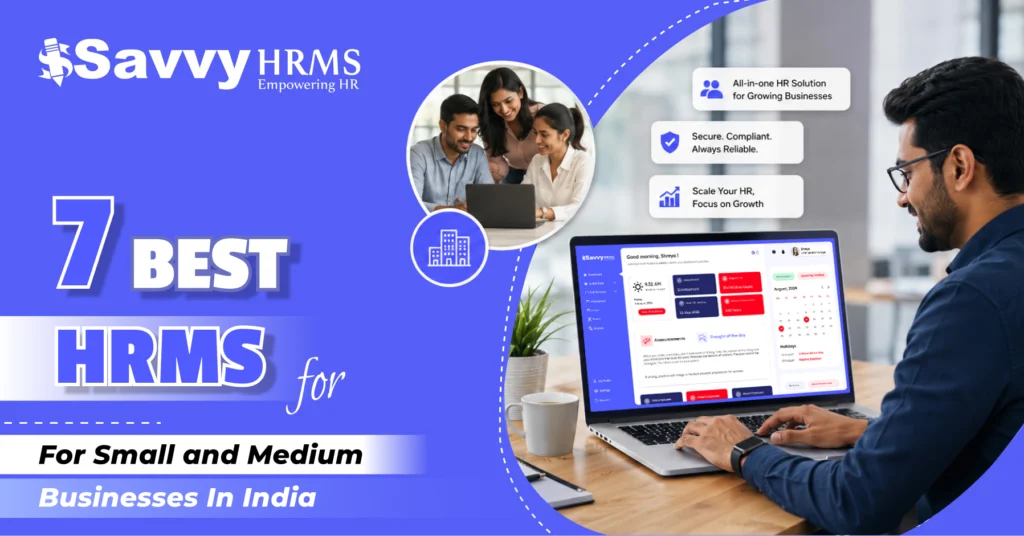
7 Best HRMS for Small and Medium Businesses in India 2026


-
AuthorAvkash Maurya
-
 Last Updated
September 30, 2026
Last Updated
September 30, 2026
-
 Reading Time
19 Mins
Reading Time
19 Mins
Best HRMS for small and medium businesses can make a noticeable difference when HR teams are still managing attendance, leave, payroll, employee records, and compliance through spreadsheets or disconnected tools. For growing Indian businesses, the right HRMS can bring these processes together.
The best HRMS for small and medium businesses should not simply have the largest feature list. It should be easy to implement, affordable to operate, scalable as the workforce grows, and capable of handling Indian payroll and statutory requirements without creating additional administrative work.
Best HRMS for small and medium businesses in India is becoming increasingly relevant as HR technology adoption expands. The India HRMS market was valued at about USD 1.3 billion in 2025 and is projected to reach USD 4.6 billion by 2034, showing how quickly businesses are moving toward digital workforce management.
What Is the Best HRMS for Small and Medium Businesses in India in 2026?
The best HRMS for small and medium businesses in India in 2026 is one that balances functionality, affordability, ease of use, scalability, payroll automation, compliance, and employee experience. There is no single platform that is perfect for every SMB because business requirements differ by workforce size, industry, HR complexity, and budget.
For a growing business, an HRMS should solve today’s HR problems without becoming a limitation tomorrow. A company with 50 employees may primarily need payroll, attendance, leave, and employee records, while a company approaching 500 employees may need recruitment, performance management, analytics, workflows, expenses, and stronger integrations.
This is also why the HRMS market is becoming increasingly important for smaller organizations. One 2025 market assessment found that organizations with fewer than 1,000 employees represented 41% of India’s HR technology market, indicating strong demand from the small and mid-sized segment.
For this comparison, the most important factors are:
- HR and employee management
- Payroll and statutory compliance
- Attendance and leave management
- Recruitment and onboarding
- Performance management
- Employee self-service
- HR analytics and reporting
- Integrations
- Mobile accessibility
- Ease of implementation
- Scalability
- Overall value for money
The objective is not simply to identify software with the most modules. It is to identify the platforms that can realistically support a small or medium-sized Indian business as it grows.
What Are the 7 Best HRMS for Small and Medium Businesses in India in 2026?
The 7 HRMS platforms worth considering are Savvy HRMS, ZFour HRMS, greytHR, ZingHR, Darwinbox, Zoho People, and Zimyo. Each has a different strength, so the right choice depends on what your organization needs most.
1. Savvy HRMS
Founded in 2015, Savvy HRMS was built with a simple vision: to empower HR teams and make everyday work stress-free. What started as an idea shaped by three experienced minds from the IT field has grown into a unified People Management Ecosystem trusted across industries. Backed by Orasis Infotech, a strong technical foundation established in 2005, Savvy HRMS has evolved into a hassle-free HR and Payroll software designed around real business challenges.
Today, with 11+ years of Savvy HRMS, the platform continues to develop as a cloud-ready HRMS that helps businesses simplify HR processes, strengthen compliance, and improve productivity. With capabilities covering different stages of the employee lifecycle, Savvy HRMS enables small and medium businesses to manage essential HR operations through a connected platform rather than depending on multiple disconnected systems.
Key strengths:
- Core HR: Centralize employee records, organizational structures, documents, and essential workforce information.
- Payroll Management: Automate salary processing, deductions, payslips, reimbursements, and payroll-related calculations efficiently.
- Attendance and Leave: Manage attendance, shifts, holidays, overtime, and leave requests from one platform.
- Recruitment: Simplify hiring workflows, candidate management, interview processes, and employee onboarding activities.
- Performance Management: Set goals, track performance, conduct appraisals, and improve employee productivity.
- Statutory Compliance: Simplify payroll compliance processes and maintain accurate statutory records and reports.
- Learning and Development: Manage employee training, learning programs, skill development, and growth opportunities.
- Travel and Expense: Streamline travel requests, expense claims, approvals, reimbursements, and expense tracking.
- Employee Self-Service & Mobile: Enable employees to access HR services, requests, attendance, and payslips anytime.
- HR and Workforce Management: Connect HR processes, workforce data, workflows, and employee lifecycle management seamlessly.
- Savvy AI: Use AI-powered capabilities to simplify HR tasks, insights, automation, and decision-making.
Best suited for: Businesses that want a broad HRMS ecosystem with a strong India-focused HR and payroll orientation.
2. ZFour HRMS
ZFour HRMS is a cloud-based HR and payroll platform built specifically for Indian SMEs. Trusted by 500+ businesses, it brings hiring, onboarding, attendance, leave, payroll, performance, and statutory compliance together in one integrated system.
Its payroll engine automates gross-to-net salary processing, PF, ESI, Professional Tax, and TDS deductions, Form 16 generation, and bank transfers, helping HR teams close payroll faster with fewer manual adjustments.
For SMBs, ZFour stands out for its affordability and quick implementation. Pricing starts at ₹50 per employee per month, and businesses can be up and running in about 7 days.
Its attendance system supports biometric devices, GPS, geofencing, and mobile check-ins, while integrations with Tally, SAP, Zoho, and QuickBooks make it easier to connect HR data with existing accounting systems. This makes it a practical choice of HRMS software in India for growing businesses that want strong compliance without enterprise-level costs.
Key strengths:
- Payroll automation
- Statutory compliance (PF, ESI, PT, TDS)
- Attendance and geofencing
- Leave management
- Shift management
- Recruitment and onboarding
- Performance management
- Employee self-service and mobile app
- Asset management
- Accounting integrations
Best suited for: Startups and small to mid-sized Indian businesses looking for an affordable, compliance-first HRMS with fast implementation.
3. greytHR
greytHR is an established HRMS platform in India, currently stating that it serves 34,000+ companies and 3.5 million+ employees across 30+ countries. Its platform covers key HR functions including recruitment, onboarding, payroll, attendance, performance management, expenses, employee exits, and employee self-service. It also supports payroll calculations for PF, ESI, Professional Tax, LWF, and TDS across Indian states.
For SMBs, greytHR can be particularly attractive because of its transparent entry-level pricing. Its Essential plan is listed at ₹2,495 per month for up to 50 employees, while the Growth plan is listed at ₹4,495 per month for up to 50 employees, with additional charges for employees above the included limit. This gives smaller businesses a clearer starting point when evaluating HRMS costs.
Key strengths:
- Payroll
- Statutory compliance
- Leave management
- Attendance
- Employee self-service
- Core HR
- Recruitment
- Performance management
- HR reports
- Mobile access
Best suited for: SMBs that prioritize reliable payroll, compliance, attendance, and everyday HR operations.
4. ZingHR
ZingHR offers a broad HCM platform covering workforce management, payroll, performance, recruitment, compliance, learning, employee engagement, and employee lifecycle management. The platform states that it supports 1,200+ enterprises across 27 countries and 32 languages, with more than 2.8 million users. Its HRMS includes automated payroll, PF/ESI/TDS compliance, payroll analytics, full and final settlement, real-time payroll data, geofencing, shift rostering, employee self-service, and face recognition.
ZingHR also incorporates AI-powered capabilities across areas such as recruitment, payroll, compliance, performance, and learning. However, its enterprise-oriented approach is an important consideration for SMBs. ZingHR describes its platform as being built for 1,000+ employee organizations, making it particularly suitable for larger mid-market businesses or rapidly growing companies that expect significant workforce expansion.
Key strengths:
- Workforce management
- Payroll automation
- Statutory compliance
- Performance management
- AI capabilities
- Attendance and rostering
- Analytics
- Recruitment
- Employee lifecycle management
Best suited for: Larger mid-sized organizations or rapidly scaling businesses with advanced automation requirements.
5. Darwinbox
Darwinbox offers a comprehensive HR technology suite covering Core HR, workforce management, attendance, payroll, expenses, recruitment, and onboarding. Its platform supports organizations managing multiple locations, legal entities, geographies, and varying compliance requirements, making it suitable for businesses with more complex workforce structures.
For growing SMBs, Darwinbox can be useful when operations expand across multiple cities, states, or countries. Its payroll capabilities include salary structures, automated validation, full and final settlement, tax management, payslips, TDS, and PF ECR reports, while its mobile HRMS supports geofencing, geotagging, and AI-powered facial recognition for office, field, and remote employees.
Key strengths:
- Core HR
- Workforce management
- Payroll
- Attendance
- Recruitment
- Onboarding
- Employee engagement
- Travel and expense
- Analytics
- Global workforce management
Best suited for: Medium-sized organizations with complex HR requirements and ambitious growth plans.
6. Zoho People
Zoho People is a cloud-based HRMS covering employee records, onboarding, attendance, leave, performance management, learning, employee engagement, documents, helpdesk, and analytics. Its small-business offering also includes shift and overtime management, employee self-service, integrations, and performance tracking, making it suitable for growing SMBs.
A key advantage is its connection with the wider Zoho ecosystem, including Zoho Books, Zoho Expense, and Zoho Recruit. Its mobile app also supports attendance, leave, performance, tasks, learning, and approvals, helping employees and managers handle routine HR activities from anywhere.
Key strengths:
- Employee database
- Attendance
- Leave
- Performance
- Learning
- HR analytics
- Employee self-service
- Mobile HR
- Integrations
- Customization
Best suited for: Small and medium businesses that already use, or plan to use, the broader Zoho ecosystem.
7. Zimyo
Zimyo offers a unified HCM platform covering Core HR, recruitment and onboarding, payroll, expense management, and performance management. Its focus on automation helps businesses reduce repetitive HR tasks while creating a more simplified employee experience.
For SMBs, Zimyo can be a suitable option for businesses looking beyond basic payroll software. Its time and attendance features include shift configuration, leave, holidays, rosters, biometric integration, and employee calendars, making it useful for managing everyday workforce operations.
Key strengths:
- Core HR
- Recruitment
- Onboarding
- Payroll
- Expense management
- Performance management
- Attendance
- Leave
- Shift management
- Employee experience
Best suited for: Growing SMBs looking for an integrated HR and workforce management platform.
How Do the 7 Best HRMS Software Compare?
Choosing between HRMS platforms becomes easier when you stop looking at the number of features and start looking at business fit.
| HRMS | Best For | Major Strengths | SMB Fit |
| Savvy HRMS | Indian SMBs and large businesses | Payroll, HR, attendance, recruitment, performance, compliance | Strong |
| ZFour HRMS | Indian startups and SMEs | Payroll, compliance, attendance, leave, affordable pricing | Strong |
| greytHR | Payroll-focused SMBs | Payroll, compliance, attendance, ESS | Strong |
| ZingHR | Larger mid-market organizations | Automation, payroll, AI, workforce management | Moderate to Strong |
| Darwinbox | Complex and scaling organizations | HCM, payroll, workforce, global capabilities | Moderate to Strong |
| Zoho People | Small and medium businesses | HR, attendance, performance, integrations | Strong |
| Zimyo | Growing SMBs | Core HR, payroll, recruitment, performance | Strong |
The comparison also shows an important point: the best HRMS for small and medium businesses is not necessarily the platform with the most features.
For example, a 40-person company may not need the same complexity as a 700-person organization. At the same time, a 200-person business with employees across 5 states may need stronger attendance, payroll, and compliance capabilities than a 200-person company operating from one location.
That is why employee count should be considered alongside business complexity.
The wider market supports this trend. A recent industry assessment estimates that India’s HR technology market grew from INR 4.9 thousand crore in FY20 to INR 9.5 thousand crore in FY25, reflecting a 14.1% CAGR.
What Features Should Small and Medium Businesses Look for in HRMS Software?
Small and medium businesses should focus on features that reduce manual work and help HR teams manage employees more consistently.
1. Core HR
A centralized employee database should be the foundation. HR should be able to manage employee profiles, departments, designations, documents, employment information, and organizational structures without maintaining multiple spreadsheets.
2. Payroll Management
Payroll is one of the most important features for an Indian SMB HRMS. The system should support salary calculations, deductions, reimbursements, payslips, tax calculations, and payroll reports.
This matters because payroll errors are not simply administrative inconveniences. They can affect employee trust, compliance, and the HR team’s workload.
3. Attendance and Leave Management
The HRMS should connect attendance, shifts, overtime, holidays, and leave policies. Ideally, attendance data should flow directly into payroll rather than requiring HR teams to reconcile two separate spreadsheets.
Keka, for example, describes attendance as payroll-ready and designed to work across different teams and locations.
4. Recruitment and Onboarding
As SMBs grow, recruitment becomes a recurring process rather than an occasional activity. An HRMS with recruitment and onboarding capabilities can help organize candidate information, onboarding tasks, documents, and employee records.
5. Performance Management
Performance management should go beyond annual appraisals. Look for goal setting, KRAs, KPIs, feedback, reviews, and performance analytics.
6. Employee Self-Service
Employee self-service can reduce the number of routine HR queries. Employees should be able to check payslips, apply for leave, view attendance, update information, and submit requests themselves.
7. Analytics and Reporting
An HRMS should turn employee data into useful information. HR teams may need reports on headcount, absenteeism, turnover, payroll costs, attendance, performance, and workforce trends.
8. Mobile Access
For field employees, hybrid teams, and distributed workforces, mobile access is increasingly important. Mobile HRMS functionality can allow employees to mark attendance, apply for leave, access payslips, and complete HR tasks away from a desktop.
9. Integrations
The HRMS should connect with payroll, accounting, recruitment, biometric devices, communication tools, or other business applications where required.
10. Scalability
Finally, ask a simple question: Will this HRMS still work when we double our workforce?
A good HRMS for small and medium businesses should not force the company to migrate to a completely different platform every time employee count increases.
How Much Does HRMS Software Cost for SMBs in India?
HRMS pricing in India varies significantly depending on employee count, modules, implementation requirements, integrations, and whether payroll is included.
Common pricing models include:
- Per employee per month
- Per employee per year
- Fixed monthly plans
- Employee-band pricing
- Module-based pricing
- Custom enterprise pricing
For example, greytHR currently lists its Essential plan at ₹2,495 per month for up to 50 employees, while its Growth plan is listed at ₹4,495 per month for up to 50 employees. Additional employee charges apply above the included 50 employees.
Zoho People uses flexible per-user pricing, while its small-business offering emphasizes affordability and easy implementation.
However, price should not be the only deciding factor.
Imagine two HRMS platforms. One costs ₹30 per employee but requires HR to manually export attendance every month. Another costs ₹50 per employee but automatically connects attendance, leave, payroll, and reporting.
The second system may actually be cheaper when you calculate the total cost of HR administration.
There is also a broader reason to evaluate automation carefully. An ADP survey published in 2025 found that 75% of Indian businesses surveyed reported that payroll services were affected by a shortage of payroll professionals, while 93% said they were looking to expand their payroll teams. The survey covered senior payroll leaders at multinational companies with more than 1,000 employees, so these figures should not be treated as a direct SMB benchmark, but they do illustrate how payroll talent constraints can increase the value of automation.
Before buying an HRMS, calculate:
Total HRMS cost = subscription + implementation + integrations + support + training + internal administration
That gives you a much more realistic picture than looking only at the monthly license price.
What Are the Benefits of HRMS Software for Small and Medium Businesses?
The biggest benefit of HRMS software for small and medium businesses is reducing repetitive HR work while giving employees and managers easier access to information.
1. Reduced manual work
Instead of entering the same employee information into multiple spreadsheets and systems, HR teams can maintain a centralized employee record.
2. Faster payroll processing
When attendance, leave, employee information, and salary structures are connected, payroll teams can spend less time collecting and reconciling data.
3. Fewer administrative errors
Automation can reduce errors caused by repetitive manual data entry. This is especially useful for payroll, attendance, leave balances, and statutory calculations.
4. Better employee experience
Employees can apply for leave, view attendance, download payslips, and submit requests without asking HR for every small update.
5. Improved workforce visibility
Managers can see information about attendance, leave, goals, performance, and workforce trends in a more structured way.
6. Easier business growth
An HR process that works for 50 employees may become difficult at 200 or 500 employees. HRMS software provides workflows and automation that can help businesses scale without increasing administrative work at the same rate.
7. Better HR decision-making
HR analytics can turn employee data into actionable insights. Instead of asking, “How many employees were absent last month?”, HR can analyze absenteeism patterns, department trends, turnover, and workforce costs.
The market itself reflects this movement toward automation. One 2026 estimate puts India’s HR technology market at approximately USD 1.21 billion in 2025, with a projected CAGR of 7.56% through 2034.
In other words, HRMS is moving from being a “nice-to-have” HR tool toward becoming part of the operating infrastructure of many businesses.
How Does HRMS Help SMBs Manage Payroll and HR Compliance in India?
For Indian SMBs, payroll and compliance can be among the strongest reasons to adopt HRMS software.
A modern HRMS can help centralize employee information, salary structures, attendance, leave, deductions, taxes, and statutory information. Depending on the software and plan, it may support areas such as PF, ESI, Professional Tax, TDS, Labour Welfare Fund, payroll reports, and statutory filings.
For example, greytHR states that its payroll platform supports PF, ESI, Professional Tax, LWF, and TDS across Indian states. ZingHR similarly lists PF, ESI, TDS, and other statutory compliance capabilities as part of its payroll offering.
Darwinbox’s payroll platform also lists statutory reports including TDS and PF ECR, along with monthly, quarterly, half-yearly, and annual returns.
The important point is that HRMS does not eliminate the employer’s legal responsibility. Businesses still need to configure policies correctly, maintain accurate employee information, review statutory updates, and ensure that filings and payments are completed appropriately.
For an SMB operating across multiple states, this becomes even more important because payroll rules and state-level requirements can vary.
A good HRMS should therefore help answer questions such as:
- Are PF deductions calculated correctly?
- Are ESI-eligible employees identified?
- Is Professional Tax handled according to the applicable state?
- Are TDS calculations updated?
- Are payroll records easy to audit?
- Can HR generate statutory reports?
- Can attendance and leave data flow into payroll?
- Can the system accommodate different salary structures?
The benefit is not simply compliance automation. It is better control over the entire payroll process.
How Should an SMB Choose the Right HRMS Software?
Choosing the right HRMS for small and medium businesses becomes much easier when you follow a step-by-step approach.
Step 1: Define your current employee count
Start with your actual workforce size and expected growth over the next three to five years.
A 30-employee company and a 500-employee company should not necessarily choose the same HRMS.
Step 2: Identify your biggest HR problems
- Are you struggling with payroll?
- Attendance?
- Recruitment?
- Leave approvals?
- Employee records?
- Performance reviews?
- Compliance?
Start with the problems that consume the most HR time.
Step 3: Separate essential and optional features
Create two lists.
Essential: Payroll, attendance, leave, Core HR, employee self-service.
Optional: Recruitment, LMS, travel expenses, engagement surveys, advanced analytics, AI features, and other specialized modules.
This prevents you from paying for features your business will never use.
Step 4: Evaluate Indian payroll and compliance capabilities
If your company operates in India, verify the platform’s support for relevant payroll and statutory requirements.
Do not depend only on the phrase “compliance-ready.” Ask exactly which statutory processes are supported and how updates are handled.
Step 5: Check implementation time
A technically powerful HRMS is not useful if your HR team cannot implement it successfully.
Ask about:
- Data migration
- Training
- Support
- Configuration
- Integrations
- Go-live process
Step 6: Test employee experience
Don’t let only the HR administrator evaluate the software.
Ask employees to test:
- Leave application
- Attendance
- Payslip access
- Profile updates
- Expense claims
- Mobile application
An HRMS is successful only when employees actually use it.
Step 7: Compare the total cost
Look beyond the advertised subscription.
Check implementation charges, additional modules, integrations, support, employee limits, and additional-user pricing.
Step 8: Think about scalability
Finally, imagine your business grows from 50 to 100 employees, then 250, then 500.
Can the same HRMS support that growth?
This is particularly important because organizations with fewer than 1,000 employees already represent a significant portion of India’s HR technology demand, according to recent market analysis.
Conclusion
The best HRMS for small and medium businesses in India in 2026 is not simply the software with the longest feature list. It is the platform that gives your business the right combination of HR automation, payroll accuracy, compliance support, employee self-service, ease of use, scalability, and value for money.
Savvy HRMS, greytHR, ZingHR, Darwinbox, Zoho People, and Zimyo each bring different strengths to the table. Savvy HRMS offers a broad set of HR and workforce modules; focuses strongly on modern HR, payroll, performance, and employee experience; greytHR has a strong payroll and compliance orientation; ZingHR brings extensive workforce automation and AI capabilities; Darwinbox offers a comprehensive HCM approach for complex organizations; Zoho People is particularly attractive for businesses wanting flexible HR software and integrations; and Zimyo provides an integrated HR and workforce management platform.
The right decision ultimately depends on your employee count, HR challenges, payroll complexity, required modules, budget, and future growth plans.
If your business is still managing HR through spreadsheets or disconnected tools, 2026 is a good time to evaluate how much time and effort automation could save. The growing Indian HR technology market, increasing demand for cloud HR solutions, and continued focus on payroll and compliance all point toward HRMS becoming an increasingly important part of SMB operations.







Ready to simplify HR, payroll, attendance, and employee management?
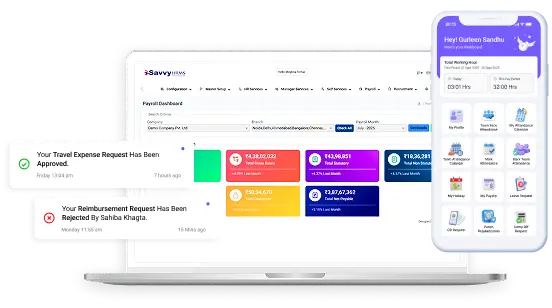
Explore Savvy HRMS and book a free demo to see how it can support your growing business.
Frequently Asked Questions (FAQs)
1. What is the best HRMS for small and medium businesses in India in 2026?
The best HRMS depends on business size, HR requirements, payroll needs, budget, and scalability. Savvy HRMS, ZFour HRMS, Keka, greytHR, ZingHR, Darwinbox, Zoho People, and Zimyo are notable options for Indian SMBs.
2. How much does HRMS software cost for SMBs in India?
HRMS pricing varies by employee count, modules, features, implementation, and support. Some platforms offer per-employee pricing, while others provide fixed plans or customized pricing for different business requirements.
3. Which HRMS features are most important for small businesses?
Small businesses should prioritize Core HR, payroll, attendance, leave management, employee self-service, compliance, recruitment, and reporting. As the business grows, performance management, analytics, expenses, and automation can become increasingly valuable.
4. Can HRMS software manage payroll and statutory compliance in India?
Yes. Many HRMS platforms support Indian payroll processes and statutory requirements such as PF, ESI, TDS, Professional Tax, and LWF. However, businesses should verify the specific compliance features and coverage offered by their chosen HRMS.
5. How should an SMB choose the right HRMS software?
An SMB should compare HRMS platforms based on employee size, required features, payroll and compliance capabilities, ease of implementation, integrations, mobile access, pricing, customer support, and scalability. A free demo or trial can also help evaluate whether the platform fits everyday HR workflows.