


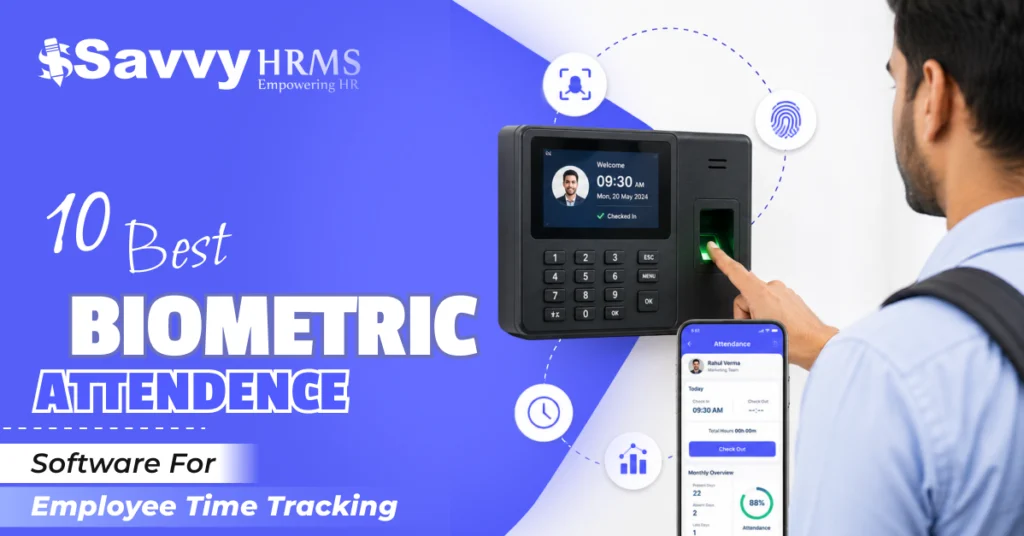

When attendance depends on spreadsheets, manual registers, or disconnected biometric devices, even a small error can affect time tracking and payroll. These 10 best biometric attendance software solutions can help businesses automate attendance, reduce proxy punching, simplify approvals, and create a reliable source of employee time data.
Modern attendance platforms go beyond fingerprint machines. They can combine biometrics, face recognition, geofencing, GPS, mobile attendance, shift management, leave tracking, and payroll integration. The right solution can therefore make employee time tracking more accurate while reducing repetitive work for HR and payroll teams.
To help you find the right solution for your workforce, we’ve evaluated 10 of the best biometric attendance software based on features, time tracking capabilities, integrations, ease of use, and overall value.
Our Evaluation Methodology
We evaluated the shortlisted biometric attendance software based on practical factors that matter to HR teams:
- Attendance accuracy: Ability to capture reliable employee in/out timings.
- Biometric capabilities: Support for fingerprint, facial recognition, or biometric devices.
- Time tracking: Flexibility in tracking working hours, overtime, shifts, and breaks.
- Location controls: Availability of GPS, geofencing, or geo-tagging.
- Payroll integration: Ability to move attendance data into payroll workflows.
- HRMS capabilities: Integration with leave, employee records, ESS, and other HR processes.
- Ease of implementation: Configuration effort, device integration, and employee adoption.
- Support: Availability of onboarding, troubleshooting, and ongoing customer assistance.
- Scalability: Suitability for growing teams and distributed workforces.
- Compliance readiness: Ability to support attendance-driven payroll and statutory processes.
What Is Biometric Attendance Software?
Biometric attendance software is a digital system that records employee attendance using unique identity markers such as fingerprints, facial recognition, iris scans, or connected biometric devices. Instead of depending on manual attendance sheets, it verifies the employee and records their exact check-in and check-out time.
The software can then use this data for time tracking, shift management, overtime calculation, leave processing, payroll integration, and workforce reporting.
For businesses with large teams, multiple shifts, factories, field employees, or distributed locations, biometric attendance software can provide much better control over attendance than traditional manual methods.
What Are the Benefits of Biometric Attendance Software?
1. Reduces Proxy Attendance
Biometric verification uses unique employee identifiers, making it difficult for employees to mark attendance for colleagues and helping organizations maintain more reliable attendance records.
2. Improves Attendance Accuracy
Automated attendance capture reduces errors caused by manual registers, spreadsheets, forgotten entries, and incorrect time calculations, giving HR teams more dependable employee time data.
3. Simplifies Employee Time Tracking
Biometric attendance software automatically records check-in and check-out times, helping HR monitor working hours, late arrivals, early departures, breaks, overtime, and attendance exceptions.
4. Enables Payroll Integration
Attendance data can be connected with payroll to simplify salary calculations, overtime, loss of pay, and deductions while reducing repetitive data entry and reconciliation.
5. Supports Location-Based Attendance
Features such as GPS and geofencing allow businesses to verify employee locations during attendance marking, making them particularly useful for field, remote, and multi-location teams.
6. Supports Mobile and Remote Workforces
Mobile attendance allows employees to record their working hours from approved locations, making time tracking easier for hybrid teams, field employees, and distributed workforces.
7. Saves HR Time
Automated attendance calculations, approval workflows, regularization requests, and reporting reduce repetitive administrative tasks, allowing HR teams to focus more on strategic workforce activities.
8. Improves Workforce Visibility
Real-time dashboards give managers a clearer view of employee attendance, absences, late arrivals, working hours, shifts, and overtime across different teams and locations.
What Are the Key Features of Biometric Attendance Software?
The exact feature set differs between platforms, but these are the capabilities worth looking for:
1. Biometric Device Integration
Connect fingerprint, facial, RFID, and other compatible attendance devices to automatically capture employee check-ins and check-outs while maintaining accurate attendance records across different workplace locations.
2. Face Recognition
Face recognition verifies employee identity using facial features, providing a contactless attendance option that can reduce proxy punching and make employee time tracking more convenient.
3. Geofencing
Geofencing allows organizations to define approved attendance locations and restrict mobile check-ins outside designated areas, helping businesses maintain better control over employee attendance across multiple workplaces.
4. Geo-Tagging
Geo-tagging records the employee’s location when attendance is marked, providing HR and managers with additional visibility into where employees are checking in from.
5. Mobile Attendance
Mobile attendance allows employees to check in and check out using smartphones, making time tracking convenient for remote employees, field teams, and hybrid workforces.
6. Shift Management
Shift management helps HR configure regular, rotating, night, and flexible shifts while managing weekly offs, schedules, working hours, and attendance rules for different employee groups.
7. Overtime Management
Overtime management tracks additional working hours based on configured organizational policies, helping HR calculate overtime accurately and incorporate relevant information into payroll processing.
8. Leave Integration
Leave integration connects attendance records with employee leave balances and approved absences, helping HR identify attendance gaps and maintain accurate working-day and leave records.
9. Payroll Integration
Payroll integration transfers relevant attendance, overtime, leave, and loss-of-pay information into payroll workflows, reducing manual calculations and helping improve salary processing accuracy.
10. Attendance Regularization
Attendance regularization allows employees to request corrections for missed punches, incorrect timings, or attendance exceptions while enabling managers and HR teams to review and approve requests.
11. Real-Time Dashboards
Real-time dashboards provide managers with an overview of employee presence, absences, late arrivals, working hours, shifts, and attendance exceptions from a centralized interface.
12. Reports and Analytics
Reports and analytics help HR analyze attendance trends, absenteeism, overtime, working hours, late arrivals, and other workforce patterns to support better attendance and staffing decisions.
10 Best Biometric Attendance Software for Employee Time Tracking
Choosing the best biometric attendance software depends on your workforce size, attendance methods, HR processes, and payroll requirements. Here are 10 platforms worth considering:
- Savvy HRMS: Best for complete biometric attendance and HRMS management.
- Zoho People: Best for flexible attendance and employee management.
- Kredily: Best for biometric attendance and payroll management.
- Keka: Best for advanced attendance and shift management.
- greytHR: Best for integrated attendance and payroll.
- Darwinbox: Best for enterprise workforce and attendance management.
- ZingHR: Best for distributed workforce attendance tracking.
- Qandle: Best for flexible mobile and biometric attendance.
- factoHR: Best for touchless and location-based attendance.
- Pocket HRMS: Best for integrated HR and attendance management.
| Software | Biometric Attendance | Face Recognition | Geofencing | Payroll Integration | Mobile Attendance | Best For |
| Savvy HRMS | Yes | Yes | Yes | Yes | Yes | Complete HR, attendance & payroll |
| Zoho People | Yes | Yes | Yes | Yes | Yes | Flexible HR management |
| Kredily | Yes | Yes | Yes | Yes | Yes | Cost-conscious HR teams |
| Keka | Yes | Yes | Yes | Yes | Yes | Growing businesses |
| greytHR | Yes | Yes | Yes | Yes | Yes | HR & payroll management |
| Darwinbox | Yes | Yes | Yes | Yes | Yes | Enterprise workforce management |
| ZingHR | Yes | Yes | Yes | Yes | Yes | Distributed workforces |
| Qandle | Yes | Yes | Yes | Yes | Yes | Mobile-first HR operations |
| factoHR | Yes | Yes | Yes | Yes | Yes | Touchless attendance |
| Pocket HRMS | Yes | Varies by setup | Varies | Yes | Yes | Integrated HRMS |
Feature availability can vary by plan, configuration, device, region, and integration setup. Confirm the exact functionality with the vendor before purchase.
1. Savvy HRMS: Best for Complete Attendance, Payroll & HRMS Management
Overview
Savvy HRMS brings attendance, time tracking, payroll, leave, employee management, and statutory compliance into one connected HRMS. It supports biometric and face recognition attendance, geofencing, geo-tagging, mobile attendance, and payroll workflows, making it particularly useful for businesses wanting fewer disconnected HR systems.
Key Features
- Biometric attendance: Capture employee attendance through connected biometric attendance devices.
- AI face recognition: Verify employee identity using facial recognition and anti-spoofing technology.
- Geofencing: Restrict mobile attendance punches to approved workplace locations.
- Geo-tagging: Capture employee location information along with attendance records.
- Mobile attendance: Employees can punch attendance, request regularization, and manage attendance remotely.
- Offline clocking: Capture attendance without internet and synchronize data when connectivity returns.
- Kiosk mode: Enable shared-device attendance using facial recognition for on-site employees.
- Payroll synchronization: Connect attendance information with payroll, leave, and employee records.
Implementation and Support Reality
- Suitable for organizations wanting attendance and payroll in one HRMS environment.
- Device and attendance-policy configuration should be completed before employee rollout.
- Biometric devices, mobile attendance, and facial recognition can support different workforce groups.
- HR teams should test shifts, overtime, leave, and attendance rules before going live.
- Mobile attendance can support field and distributed employees where configured.
- Dedicated onboarding and configuration support can help organizations move from manual processes.
Best For
Best for businesses seeking a connected HRMS that combines biometric attendance, mobile time tracking, payroll integration, compliance, and workforce management.
2. Zoho People: Flexible HR & Attendance Management
Overview
Zoho People provides attendance, timesheets, biometric integrations, facial recognition, IP restrictions, location-based attendance, and geofencing within its HR platform.
Key Features
- Biometric integrations support real-time attendance capture.
- Facial recognition verifies employees through web and mobile.
- IP and location restrictions control attendance access.
- Geofencing supports location-based employee attendance.
- Timesheets help track project and employee work time.
- Roster management supports shifts and working schedules.
Implementation and Support Reality
- Works well for organizations already using other Zoho products.
- Attendance policies need proper configuration before employee rollout.
- Biometric integrations may require device-specific setup.
- Mobile and web attendance provide flexible capture options.
- Teams should test location restrictions across actual work sites.
Best For
Best for businesses wanting flexible attendance management within a broader cloud-based HR ecosystem.
3. Kredily: Flexible Attendance & Payroll for Growing Teams
Overview
Kredily combines payroll and HRMS capabilities with several attendance methods, including biometric devices, facial recognition, selfie attendance, geofencing, geo-tagging, and geo-tracking.
Key Features
- Biometric devices can transmit attendance data into Kredily.
- Facial recognition supports identity-based attendance verification.
- Selfie attendance enables mobile employee check-ins.
- Geofencing restricts attendance to designated locations.
- Geo-tagging records location during attendance marking.
- Payroll workflows can use attendance and LOP information.
Implementation and Support Reality
- Biometric integration requires device installation and configuration.
- Attendance rules need to be configured for each workforce group.
- Organizations should test synchronization before payroll processing.
- Mobile attendance provides an alternative to physical devices.
- HR teams should define geofencing boundaries carefully.
Best For
Best for growing teams looking for multiple attendance methods alongside HRMS and payroll functionality.
4. Keka: Best for Multi-Device Attendance Management
Overview
Keka combines attendance management with biometric, facial recognition, geofencing, mobile attendance, shifts, overtime, leave, and payroll-related workflows. Its platform supports integration with a broad range of attendance devices.
Key Features
- Supports real-time integration with biometric attendance devices.
- Facial recognition enables mobile-based attendance verification.
- Geofencing supports attendance from approved locations.
- Shift management handles rotations and complex schedules.
- Overtime and attendance rules support payroll calculations.
- Mobile access supports employees and managers.
Implementation and Support Reality
- Device compatibility should be checked before deployment.
- Complex shifts require careful policy configuration.
- Organizations should test biometric synchronization during implementation.
- Mobile and GPS-based attendance can complement physical devices.
- Payroll rules should be validated using actual attendance scenarios.
Best For
Best for growing organizations managing multiple attendance devices, shifts, locations, and payroll-linked attendance processes.
5. greytHR: Best for Integrated HR & Payroll
Overview
greytHR connects attendance with leave and payroll while supporting biometric, GPS, geofencing, and face recognition-based attendance. Its attendance data can flow into the payroll engine, reducing separate reconciliation work.
Key Features
- Biometric attendance connects physical device data with HR workflows.
- Face recognition supports selfie-based attendance verification.
- Geofencing helps validate employee work locations.
- GPS and geo-tracking support mobile attendance.
- Attendance data feeds connected payroll processes.
- Leave and attendance management work within one platform.
Implementation and Support Reality
- New attendance capture methods may require feature activation.
- Attendance schemes need configuration by administrators.
- GPS accuracy can vary depending on device and environment.
- Biometric failures may require alternate attendance methods.
- Payroll teams should validate attendance-to-payroll calculations.
Best For
Best for organizations looking for established HR, attendance, and payroll workflows in a unified platform.
6. Darwinbox: Enterprise Workforce Time Management
Overview
Darwinbox focuses strongly on enterprise workforce management, combining facial recognition, geofenced attendance, biometric options, rostering, timesheets, and broader HR processes.
Key Features
- AI-powered facial recognition supports contactless attendance.
- Geofenced check-ins verify employee locations.
- Biometric attendance supports physical workplace environments.
- Rostering helps manage complex shift structures.
- Timesheets connect employee time with projects.
- Attendance workflows support large distributed workforces.
Implementation and Support Reality
- Enterprise deployments generally require structured implementation.
- Complex organizational policies need detailed configuration.
- Multi-location environments should be mapped before rollout.
- Employee adoption should be managed through training.
- Integration testing is important before organization-wide deployment.
Best For
Best for larger organizations with complex locations, shifts, workforce structures, and enterprise HR transformation requirements.
7. ZingHR: Workforce-Focused Attendance & Payroll
Overview
ZingHR provides multiple attendance capture options, including biometrics, AI face recognition, geo-fenced mobile punches, IP login, and supervisor marking, with attendance connected to payroll workflows.
Key Features
- Biometric attendance captures employee time through devices.
- AI face recognition supports identity verification.
- Geo-fenced mobile punches validate employee locations.
- IP-based attendance provides another capture method.
- Shift rostering supports workforce scheduling.
- Attendance data can feed payroll calculations.
Implementation and Support Reality
- Suitable for organizations with varied workforce types.
- Multiple attendance modes require clear policy configuration.
- Geofence boundaries should match actual work locations.
- Payroll workflows should be tested with overtime scenarios.
- Distributed teams may benefit from mobile attendance options.
Best For
Best for organizations managing field, distributed, blue-collar, or large workforce populations with multiple attendance requirements.
8. Qandle: Mobile-First Attendance Management
Overview
Qandle provides biometric, GPS, Wi-Fi, face recognition, and geofencing-based attendance alongside leave, payroll access, employee self-service, and other HR functions.
Key Features
- Biometric check-ins support traditional workplace attendance.
- GPS attendance supports location-aware time tracking.
- Wi-Fi check-ins provide another workplace verification method.
- AI face recognition helps prevent proxy punching.
- Geofencing restricts attendance to approved areas.
- Mobile access supports employee self-service.
Implementation and Support Reality
- Mobile attendance requires appropriate employee device permissions.
- Location-based rules should be tested at each worksite.
- Biometric deployment depends on compatible hardware.
- HR teams should configure attendance policies before rollout.
- Employees need clear guidance on mobile attendance usage.
Best For
Best for businesses wanting flexible, mobile-friendly attendance with multiple locations and verification options.
9. factoHR: Touchless & Location-Based Attendance
Overview
factoHR combines attendance automation with selfie punching, geo-tagging, geofencing, AI-powered face verification, and payroll and leave integration. It is particularly relevant for hybrid and mobile workforces.
Key Features
- AI face verification supports secure attendance marking.
- Selfie punching provides touchless mobile attendance.
- Geofencing restricts punches to approved workplace boundaries.
- Geo-tagging records location during employee check-ins.
- Attendance data integrates with payroll and leave.
- Mobile access supports field and remote employees.
Implementation and Support Reality
- Mobile deployment can reduce dependency on physical devices.
- Geofence locations need accurate boundary configuration.
- Employee face registration should be completed before rollout.
- Payroll and leave rules should be tested together.
- Mobile connectivity should be considered for field teams.
Best For
Best for businesses looking for touchless attendance and location-based time tracking for office, hybrid, remote, and field employees.
10. Pocket HRMS: HRMS-Based Attendance Management
Overview
Pocket HRMS offers an integrated HRMS approach where attendance can be managed alongside employee records, leave, payroll, and other HR processes.
Key Features
- Attendance management connects with broader HR workflows.
- Mobile functionality supports employee self-service.
- Leave management can work alongside attendance records.
- Payroll integration helps reduce manual attendance processing.
- Employee records remain centralized within the HRMS.
- Reporting provides visibility into workforce attendance data.
Implementation and Support Reality
- Implementation depends on workforce size and HR requirements.
- Attendance policies should be configured before employee onboarding.
- Existing payroll processes may need mapping.
- Device integrations should be confirmed during product evaluation.
- Employees should receive basic training before rollout.
Best For
Best for organizations looking for an HRMS approach that combines attendance with payroll, employee management, and other HR processes.
How Did We Evaluate These 10 Best Biometric Attendance Software?
A good biometric attendance system is not simply the one with the most features. It needs to work reliably in the environment where your employees actually work.
For this comparison, we looked at several practical criteria.
1. First, attendance capture. We considered whether platforms support biometric devices, facial recognition, mobile attendance, or multiple methods.
2. Second, time tracking. A useful platform should go beyond simply recording an in and out punch. It should help HR understand working hours, shifts, overtime, late arrivals, and attendance exceptions.
3. Third, location controls. Geofencing and geo-tagging are increasingly important for field employees, hybrid teams, and multi-location businesses.
4. Fourth, payroll integration. Attendance becomes much more valuable when the data can move into payroll without repeated spreadsheet work.
5. Fifth, HRMS connectivity. We considered whether attendance works together with leave, employee records, approvals, ESS, and other HR processes.
6. Finally, implementation and scalability. A solution may look impressive on paper but still be difficult to deploy. We therefore considered configuration, device integration, employee adoption, and suitability for different workforce sizes.
How to Select the Best Biometric Attendance Software?
There is no single biometric attendance software that is perfect for every organization. The right choice depends on how your workforce operates.
1. Understand how employees work
Start by asking whether your employees work from offices, factories, client locations, homes, or multiple sites. A factory may prioritize biometric devices, while a field workforce may need geofencing and mobile attendance.
2. Check biometric options
If you already have fingerprint or other biometric machines, check whether the software supports those devices. If you want touchless attendance, look for face recognition or selfie-based verification.
3. Look at payroll integration
This is one of the most important factors. Attendance should ideally flow directly into payroll so working days, overtime, leave, and loss-of-pay calculations do not have to be entered manually.
4. Evaluate geofencing
For mobile employees, geofencing can ensure that employees can only mark attendance within approved locations. Check whether you can configure different boundaries for different offices, sites, or client locations.
5. Consider shift complexity
If you have multiple shifts, night shifts, rotating schedules, weekly offs, or overtime policies, make sure the attendance software can handle them without complicated workarounds.
6. Check regularization workflows
Employees will occasionally forget to punch in, experience device failures, or have legitimate attendance exceptions. A good system should allow them to submit regularization requests while keeping approvals under control.
7. Consider statutory compliance
If attendance affects payroll, overtime, deductions, or other statutory calculations, your HRMS should support the relevant compliance processes and maintain appropriate records.
8. Test before committing
Do not choose software based only on a sales presentation. Request a demo, test your actual attendance scenarios, connect a device if possible, and check how the resulting data reaches payroll.
How Much Does Biometric Attendance Software Cost and How Can You Measure Its ROI?
The cost of biometric attendance software can vary significantly depending on the pricing model, employee count, features, biometric hardware, integrations, implementation requirements, and support package.
Some vendors charge per employee per month, while others may use module-based, annual, device-based, or customized enterprise pricing.
You should also consider costs beyond the software subscription:
- Biometric hardware and installation
- Device maintenance
- Implementation and configuration
- Data migration
- Payroll or HRMS integrations
- Mobile application requirements
- Training and employee onboarding
- Premium support or customization
For example, a low-cost system may appear attractive initially but become expensive if HR still needs spreadsheets to reconcile attendance before payroll.
How to calculate ROI
A simple way to estimate ROI is:
ROI = (Total Savings − Total Software Cost) ÷ Total Software Cost × 100
But what counts as savings?
Consider:
1. HR time saved: How many hours does HR spend correcting attendance every month?
2. Payroll processing savings: How much manual work is eliminated because attendance flows into payroll?
3. Reduced errors: How much do incorrect attendance entries, overtime calculations, or payroll corrections cost?
4. Reduced time theft: Can biometric verification reduce buddy punching or unauthorized attendance?
5. Administrative savings: Are you reducing paper registers, spreadsheets, manual reports, or separate attendance systems?
6. Productivity gains: Can managers spend less time chasing attendance exceptions and more time managing teams?
The best biometric attendance software is not necessarily the cheapest option. It is the one that delivers reliable attendance data while reducing the total administrative effort around time tracking and payroll.
Conclusion
Biometric attendance software has developed from simple fingerprint machines into complete time-tracking solutions. Today, businesses can combine biometrics, face recognition, geofencing, mobile attendance, shift management, payroll integration, and HRMS workflows to manage employee time more accurately.
Among the options evaluated, Savvy HRMS stands out for organizations wanting attendance, payroll, statutory compliance, mobile time tracking, face recognition, geofencing, and broader HR management within one connected platform.
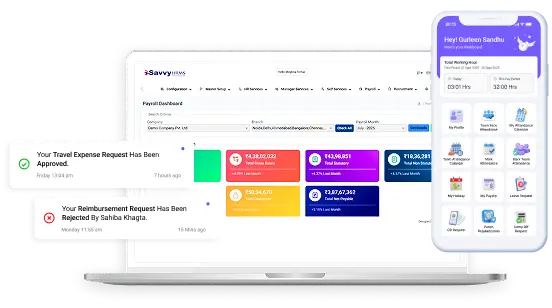
With Savvy HRMS, you can move beyond manual attendance management and connect employee time tracking with payroll, leave, HR operations, and compliance. Explore biometric attendance, face recognition, geofencing, mobile attendance, and other HRMS capabilities designed to make workforce management simpler.









Ready to Simplify Employee Time Tracking?
Book a Savvy HRMS demo today and see how smarter attendance management can work for your organization.
Frequently Asked Questions (FAQs)
1. Which software is used in a biometric attendance system?
Biometric attendance systems use specialized software to connect fingerprint, facial recognition, or other biometric devices with employee attendance records. Popular options include Savvy HRMS, Zoho People, Kredily, Keka, greytHR, Darwinbox, ZingHR, Qandle, factoHR, and Pocket HRMS.
2. Which is the best biometric attendance system?
The best biometric attendance system depends on your workforce size, attendance methods, shift requirements, locations, and payroll needs. Savvy HRMS is a strong option for businesses looking for biometric attendance, face recognition, geofencing, mobile attendance, payroll integration, and broader HRMS management in one platform.
3. What is the best free software for biometric attendance management?
The availability of free biometric attendance software depends on the vendor, features, employee count, and device requirements. Businesses should check whether the software supports their existing biometric hardware, attendance policies, payroll integration, and workforce needs before choosing a free or low-cost option.
4. How much does biometric attendance software cost?
The cost varies based on employee count, features, biometric hardware, integrations, implementation, and support. Vendors may charge per employee, per month, by module, annually, or through customized enterprise pricing. Hardware, installation, maintenance, and integration costs may also apply.
5. What features should I look for in biometric attendance software?
Look for biometric device integration, face recognition, geofencing, geo-tagging, mobile attendance, shift and overtime management, leave and payroll integration, attendance regularization, real-time dashboards, and reporting capabilities.