

10 Best HR Software with AI Integration in India for 2027: Features, Benefits and Comparison


-
AuthorSatyam Chauhan
-
 Last Updated
November 28, 2026
-
 Reading Time
24 Mins
Summary
- Savvy HRMS: Offers integrated HR management, payroll, attendance, statutory compliance and AI-assisted features for employee support and workforce operations.
- Zimyo: Combines core HR, payroll, recruitment and employee management with Zim AI agents.
- Darwinbox: Provides enterprise HCM capabilities with its Cortex AI platform and AI-powered workflows.
- Keka: Combines HR and payroll management with Keka AI for employee assistance, recruitment and workforce insights.
- Zoho People: Offers employee management, attendance, leave and performance features with its Zia AI assistant.
- greytHR: Focuses on Indian payroll, statutory compliance and HR operations, with NAVOS as its AI assistant.
- ZingHR: Supports enterprise workforce management with purpose-built AI agents for different HR activities.
- PeopleStrong: Offers enterprise HCM capabilities with MAAX and AI-powered workforce solutions.
- Deel: Focuses on global hiring, international payroll and contractor management, supported by Deel AI.
- Pocket HRMS: Provides Indian HRMS and payroll features with AI-powered tools such as smHRty and HRMS Copilot.
Choosing the right HR software has become increasingly important for businesses looking to manage their workforce efficiently. From employee records and attendance to payroll, recruitment and performance management, HR teams handle multiple responsibilities every day.
With the growing use of artificial intelligence, HR software is evolving beyond basic employee management and predefined workflows. Modern platforms are introducing AI-powered chatbots, resume screening, workforce analytics, intelligent assistants and automated HR workflows to help businesses reduce repetitive work and make better-informed decisions.
If you are looking for the best HR software in India with AI integration, this guide compares 10 popular platforms based on their core HR features, AI capabilities, strengths and limitations. Whether you run a startup, an SME or a large enterprise, this comparison will help you to understand which HR software may suit your business requirements.
What Does AI in HR Software Actually Do?
AI in HR software refers to the use of artificial intelligence technologies to assist with HR activities such as recruitment, employee support, workforce analytics and administrative tasks. It helps HR teams to process information, identify patterns, generate insights and complete certain tasks with less manual effort.
However, traditional HR software primarily stores employee information and follows predefined workflows while AI-enabled HR software can go a step further by understanding user requests, analysing data and providing recommendations or assistance.
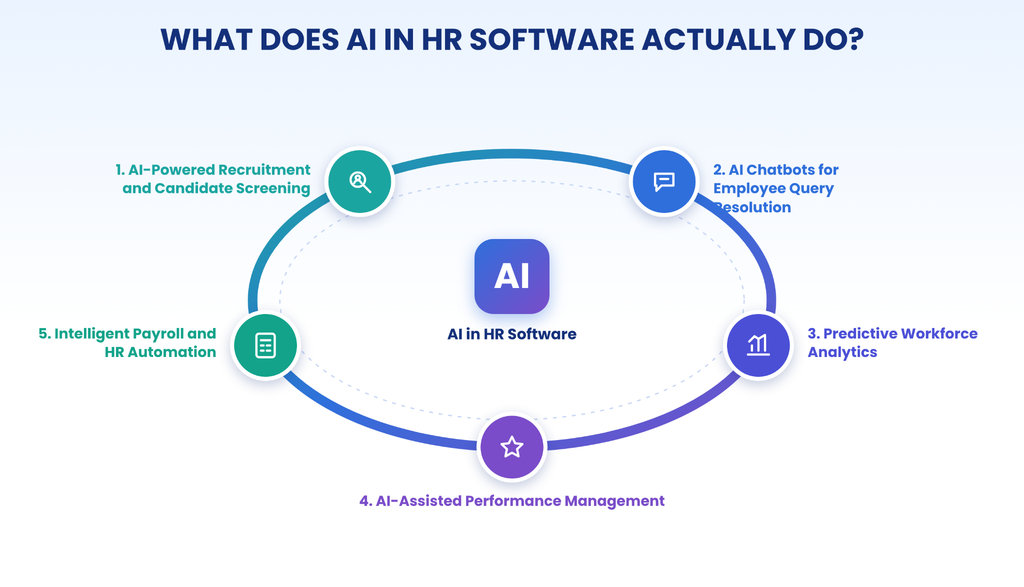
Here are some practical ways AI is being used in HR software.
1. AI-Powered Recruitment and Candidate Screening
Recruitment teams often receive hundreds of applications for a single job opening so reviewing every resume manually can slow down the hiring process.
AI-powered recruitment features can help Core HR teams to:
- Parse resumes and extract relevant candidate information.
- Match candidate profiles against job requirements.
- Identify relevant skills and experience.
- Shortlist candidates for further review.
- Assist with interview scheduling and recruitment communication.
For example, an HR manager hiring a software developer can use AI-assisted screening to identify candidates with relevant programming skills and experience.
However, AI-generated shortlists should be reviewed by recruiters as candidate selection should not rely entirely on automated recommendations.
2. AI Chatbots for Employee Query Resolution
HR teams regularly answer questions about leave balances, attendance policies, salary slips, company policies and employee benefits.
An AI-powered HR chatbot can help employees to find answers without having to contact HR for every routine query.
For example, an employee can ask:
- How many leaves do I have remaining?
- What is the company’s leave policy?
- How can I download my salary slip?
- What documents are required during onboarding?
The AI assistant can retrieve relevant information or guide employees through the required process, subject to their access permissions.
This can reduce repetitive queries and give HR teams more time for employee engagement and strategic work.
3. Predictive Workforce Analytics
HR departments generate large amounts of workforce data related to attendance, performance, recruitment, employee turnover and workforce costs.
AI-enabled analytics can help to analyze this information and identify patterns that may not be immediately visible in standard reports.
For example, HR teams may use workforce analytics to:
- Identify changes in employee turnover patterns.
- Understand attendance trends.
- Analyse workforce performance.
- Identify potential staffing requirements.
- Support workforce planning.
These insights can help managers to make better-informed decisions. However, predictions are only as reliable as the quality and relevance of the underlying data.
4. AI-Assisted Performance Management
Performance management involves setting goals, reviewing employee progress, collecting feedback and conducting appraisals.
AI can support this process by helping managers to summarize feedback, identify performance trends and prepare review documentation.
Some applications include:
- Summarising employee feedback.
- Identifying recurring performance patterns.
- Assisting with goal-setting.
- Preparing performance review summaries.
- Supporting managers with relevant workforce insights.
AI should support the appraisal process, not independently decide an employee’s rating, promotion or compensation.
5. Intelligent Payroll and HR Automation
Payroll processing involves multiple activities, including salary calculations, attendance inputs, leave adjustments, deductions and statutory contributions.
AI-assisted payroll capabilities can help to identify unusual entries, highlight possible discrepancies and support payroll teams during verification.
For example, if an employee’s recorded attendance or salary component differs significantly from the expected pattern, the system may flag it for review.
It is important to distinguish AI-assisted anomaly detection from conventional payroll automation. Automatic salary calculations based on predefined rules are not necessarily AI.
What Should You Look for in AI-Powered HR Software?
Choosing HR software is not just about finding a platform with an AI chatbot. Businesses should evaluate whether the software can manage their essential HR activities and whether its AI capabilities address actual workplace challenges.
Here are some important factors to consider.
1. Core HR Management Capabilities
Start by checking whether the software can manage your everyday HR responsibilities.
Essential modules may include:
- Employee information management.
- Recruitment and onboarding.
- Attendance and leave management.
- Payroll processing.
- Performance management.
- Employee self-service.
- Exit and full and final settlement.
A platform with advanced AI capabilities may still be unsuitable if it cannot manage your basic HR requirements effectively.
2. Practical AI and Automation Features
Check what the AI functionality actually does instead of relying only on product descriptions.
For example, does the AI assistant simply answer employee questions, or can it also retrieve information, initiate requests and complete authorised tasks?
Look for capabilities such as resume screening, employee query resolution, workforce analytics, payroll anomaly detection and intelligent workflow assistance.
Also, check whether these features are included in the standard subscription or require additional purchases.
3. Payroll and Indian Statutory Compliance
For businesses operating in India, payroll and statutory compliance are important considerations.
Your HR software should support relevant requirements such as:
- Employees’ Provident Fund (EPF).
- Employees’ State Insurance (ESI).
- Professional Tax (PT).
- Tax Deducted at Source (TDS).
- Labour Welfare Fund (LWF), wherever applicable.
Check whether the software supports applicable state-specific requirements, statutory calculations, payroll reports and filing-related documentation.
4. Employee Self-Service and Experience
Employee self-service features allow employees to access their HR information without depending on HR teams for every request.
Look for features that allow employees to:
- View and download salary slips.
- Apply for leave.
- Check attendance records.
- Access company policies.
- Update personal information.
- Track requests and approvals.
An AI assistant integrated with employee self-service can make these activities easier by allowing employees to find information through conversational queries.
5. Integration and Scalability
Your HR software should work with the other systems your business already uses.
Check whether it supports integrations with:
- Accounting and ERP systems.
- Biometric attendance devices.
- Recruitment platforms.
- Microsoft and Google applications.
- Expense management systems.
- Other business applications.
Also, consider whether the platform can support additional employees, locations, departments and HR requirements as your organization grows.
6. Data Security and Privacy
HR software stores sensitive employee information, including salary details, bank information, identity documents and performance records.
Before choosing a platform, check its security measures, access controls, encryption practices, audit trails and data protection policies.
For AI-enabled software, understand how employee information is processed, whether third-party AI models are involved and how the platform restricts access to confidential information.
3. Quick Comparison: 10 Best HR Software in India
The following table provides an overview of the 10 HR software platforms covered in this guide.
| HR Software | Main Strength | AI Capabilities |
| Savvy HRMS | Integrated HR management | Verify specific AI functionality |
| Zimyo | AI-driven HR operations | Zim AI agents |
| Darwinbox | Enterprise HCM | Cortex AI platform and agents |
| Keka | HR and payroll management | Keka AI and Copilot |
| Zoho People | HR management | Zia AI assistant |
| greytHR | Payroll and HR operations | NAVOS AI assistant |
| ZingHR | Enterprise workforce management | Purpose-built AI agents |
| PeopleStrong | Enterprise HCM | MAAX and agentic AI capabilities |
| Deel | Global workforce management | Deel AI |
| Pocket HRMS | Indian HRMS and payroll | smHRty and smHRt Agentic HR |
AI features, product editions and availability can change. Businesses should confirm the exact capabilities offered in their selected plans.
Best HR Software with AI Integration
Let’s have a closer look at the 10 HR software platforms, their key capabilities and how their AI features can support different business requirements.
1. Savvy HRMS
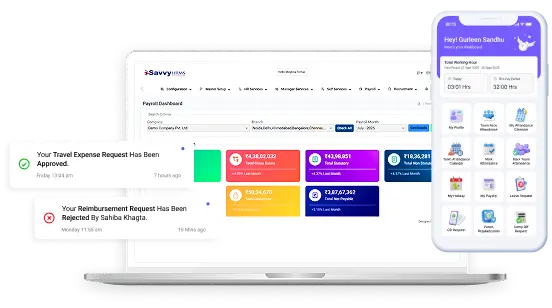
Savvy HRMS is an integrated HR management software designed to help businesses to manage their employee lifecycle and streamline everyday HR operations. It offers multiple HR modules through a unified platform, making it relevant for SMEs and larger organizations looking to manage different HR activities together.
Core HR capabilities
Savvy HRMS offers multiple modules to manage different HR activities, including:
- Core HR and Employee Management: Maintains employee records and centralises employee information.
- Recruitment Management: Helps to manage recruitment activities and candidate information.
- Attendance and Leave Management: Tracks employee attendance, shifts, leave applications and approvals.
- Payroll Management: Supports salary processing, deductions and payroll-related activities.
- Statutory Compliance: Supports Indian statutory requirements, including PF, ESI, Professional Tax and TDS.
- Performance Management: Helps to manage employee goals, appraisals and performance reviews.
- Employee Asset Management: Tracks assets assigned to employees.
- Learning and Development: Supports employee learning and development activities.
- Contract Labour Management: Helps manage contractor registration, workforce attendance and contractor-related processes.
AI capabilities
Savvy HRMS offers a dedicated AI solution with features designed to support different HR activities and reduce repetitive administrative work.
Some of its key AI capabilities include:
- Savvy Bot: An AI-powered chatbot that helps employees access information about leave balances, attendance records, company policies and personal HR information.
- Voice Assistant: Allows HR teams to retrieve employee information, generate reports and approve requests using voice commands.
- Employee Attrition Prediction: Analyses employee work patterns, performance and attendance data to identify potential resignation risks.
- AI Onboarding Automation: Helps automate document submission, verification, approvals and task allocation during employee onboarding.
- Intelligent Appraisal Engine: Supports performance reviews by analysing goals, achievements, feedback and employee performance data.
- Intelligent Salary Processing: Automates salary calculations, deductions, reimbursements and applicable statutory checks.
- Attendance Data Intelligence: Analyses attendance patterns, late arrivals, early departures and absenteeism to provide workforce insights.
- AI Clearance Automation: Tracks employee exit formalities, pending tasks, departmental approvals and asset clearances.
- Embedded AI Workflows: Automatically transfers pending responsibilities and approvals when employees change roles or leave the organization.
- Promotion Forecast AI: Analyses performance history, achievements and behavioural patterns to assist managers with promotion recommendations.
Best for: SMEs and larger Indian businesses looking for an integrated HRMS covering employee management, payroll, attendance and statutory processes.
Pros
- Multiple HR modules available on one platform.
- Supports payroll, attendance and statutory compliance requirements.
- Covers different stages of the employee lifecycle.
- Offers HR management capabilities for SMEs and larger organizations.
Consideration: Businesses with a strict requirement for native AI features should confirm the available capabilities before purchasing.
2. Zimyo
Zimyo is an AI-powered HRMS platform that brings different employee management activities together. It offers solutions covering core HR, payroll, recruitment, attendance, performance management, employee engagement and other HR functions.
Its AI offering, Zim, is designed to help HR teams to handle repetitive tasks through conversational interactions and AI agents.
Core HR capabilities
- Core HR and employee database management.
- Payroll and statutory compliance.
- Attendance and leave management.
- Recruitment and applicant tracking.
AI capabilities
Zimyo’s Zim AI agents support different HR activities. Some of its AI-related capabilities include:
- Answering employee HR queries.
- Supporting payroll-related activities.
- Assisting with employee onboarding.
- Managing helpdesk requests.
Best for: Startups, SMEs and growing businesses looking for an integrated HRMS with AI-assisted HR operations.
| Pros | Cons |
| Offers HR, payroll, attendance and employee engagement features | Some advanced capabilities are available as add-ons |
| Provides AI-based resume screening through its Recruit add-on | AI features may involve additional costs |
| Offers multiple pricing plans | Minimum billing applies to 50 users |
| Includes HR analytics and attrition analytics options | Total cost can increase with additional modules and analytics |
Consideration: Businesses should evaluate which AI agents are available in their selected subscription and whether the workflows match their internal processes.
3. Darwinbox
Darwinbox is an enterprise-focused Human Capital Management (HCM) platform designed to manage workforce operations across the employee lifecycle. It offers HR solutions covering core HR, recruitment, payroll, workforce management, talent management and employee experience.
Its AI strategy includes Darwinbox Cortex, an AI-native HCM platform designed to connect organizational information, HR processes and intelligent agents.
Core HR capabilities
- Core HR and employee records.
- Talent acquisition and recruitment.
- Payroll management.
- Workforce management.
AI capabilities
Darwinbox Cortex introduces several AI-focused capabilities. These include:
- Context-aware AI that uses organizational information.
- AI agents for recruitment and candidate screening.
- Goal generation and career development assistance.
- AI-driven workforce insights.
Best for: Mid-sized and large enterprises looking for an integrated HCM platform with advanced AI and workforce management capabilities.
| Pros | Cons |
| Offers a comprehensive HCM platform for enterprise HR operations | May be more than smaller businesses need |
| Introduces an AI-native HCM platform through Darwinbox Cortex | Cortex was announced with an initial pilot rollout |
| Supports multiple HR functions across the employee lifecycle | Businesses should confirm which AI capabilities are generally available |
| Provides a marketplace for integrations and extensions | Additional integrations may need separate evaluation |
Consideration: Businesses should evaluate implementation requirements, available modules and the maturity and availability of specific Cortex capabilities, as some offerings are being introduced through phased rollouts.
4. Keka
Keka is an HR and payroll software platform designed to help businesses manage employee information, payroll, attendance, recruitment and performance. It combines HR management capabilities with an AI layer that supports employees, managers and HR teams.
Keka AI is designed to go beyond answering questions by assisting with everyday HR tasks and providing workforce insights.
Core HR capabilities
- HR information management.
- Payroll and statutory compliance
- Employee engagement.
- Workforce reporting.
AI capabilities
Keka AI offers capabilities across different HR activities. These include:
- Answering employee questions about leave, payroll and company policies.
- Drafting job descriptions
- Screening candidates
- Analysing workforce trends
Best for: Growing Indian businesses and mid-sized organizations looking for integrated HR, payroll and AI-assisted workforce management.
| Pros | Cons |
| Combines HR, payroll, attendance and performance management | Businesses should check which features are included in each plan |
| Keka AI supports HR teams, managers and employees | AI capabilities may vary by product or plan |
| Offers AI-assisted resume screening and job description creation | AI recommendations still need recruiter review |
| Provides employee query resolution through an AI-powered helpdesk | organizations should assess how well it fits their existing workflows |
Consideration: Confirm which AI capabilities are available in the selected plan and whether they cover your specific HR workflows.
5. Zoho People
Zoho People is a cloud-based HR management platform that helps businesses to manage employee information, attendance, leave, performance and other HR activities.
Its AI assistant, Zia, is designed to make HR information and routine tasks easier to access through conversational interactions.
Core HR capabilities
- Employee database management.
- Employee onboarding and offboarding.
- Attendance and leave management.
- Timesheet & Learning management.
AI capabilities
Zoho People offers Zia AI, which supports several employee and HR activities. Its capabilities include:
- Retrieving relevant employee information
- Summarising company policies
- Generating reports and workforce insights
- Providing voice-based and multilingual interactions
Best for: Small and medium-sized businesses, as well as organizations already using other applications within the Zoho ecosystem.
| Pros | Cons |
| Offers employee database, leave, attendance and performance management | Some capabilities are available only in higher-tier plans |
| Includes the Zia AI bot | AI assistance is not the same as full HR workflow automation |
| Provides integrations with other Zoho applications | Businesses using non-Zoho tools may need integration planning |
| Offers multiple pricing plans and a free edition | Pricing is listed in USD and may involve additional local taxes |
Consideration: Businesses should compare the available editions and check whether the required HR and AI features are included in their chosen subscription.
6. greytHR
greytHR is an HRMS and payroll software platform focused on helping businesses to manage employee administration, attendance, leave, payroll and statutory compliance.
It also offers NAVOS, an agentic AI assistant designed to help users interact with the HRMS through natural-language commands.
Core HR capabilities
- Employee information management
- Leave and attendance management
- Expense and claims management
- Statutory compliance
AI capabilities
greytHR NAVOS is designed to help HR and payroll teams to move from finding information to completing supported HR activities.
Its capabilities include:
- Retrieving employee and HR information
- Accessing and generating reports
- Assisting with payroll-related tasks
- Supporting recruitment and performance management activities
NAVOS works within organizational permissions and workflows, which helps users to perform authorized actions through natural-language prompts.
Best for: Indian SMEs and growing businesses looking for payroll-focused HRMS functionality with AI-assisted HR operations.
| Pros | Cons |
| Strong focus on Indian payroll and statutory compliance | Businesses should check whether all required modules are included in their plan |
| Offers HR, payroll, attendance and recruitment capabilities | Some recruitment and AI features may be add-ons |
| Includes NAVOS, an AI assistant for HR tasks | Users should evaluate its supported actions and permissions |
| Supports employee self-service and payroll workflows | organizations with complex requirements may need additional configuration |
Consideration: Evaluate the available NAVOS functionality and the payroll and compliance requirements relevant to your organization.
7. ZingHR
ZingHR is an enterprise Human Capital Management platform designed to manage workforce operations across different locations and business functions.
It offers HR solutions covering recruitment, attendance, payroll, performance, employee engagement and other employee lifecycle activities.
Its AI approach focuses on purpose-built agents that support and execute tasks across different HR functions.
Core HR capabilities
- Core HR management
- Recruitment and talent acquisition
- Attendance and workforce management
- Travel and expense management
AI capabilities
ZingHR offers AI agents designed for different HR activities. These include:
- AI recruitment assistance.
- Payroll processing and reconciliation through ZingZeroTAP.
- Employee engagement and sentiment analysis.
- Performance management assistance.
Best for: Large enterprises and organizations managing multi-location, shift-based or geographically distributed workforces.
| Pros | Cons |
| Covers multiple stages of the employee lifecycle | Its extensive feature set may require careful implementation planning |
| Offers AI agents for engagement, performance and learning | Businesses should verify which AI agents are available in their selected package |
| Supports workforce management for different employee categories | organizations should assess how well its workflows fit their operations |
| Provides performance, learning and employee engagement tools | Pricing and implementation requirements should be confirmed with the provider |
Consideration: Businesses should evaluate the implementation scope, module availability and integration requirements before selecting the platform.
8. PeopleStrong
PeopleStrong is an enterprise HCM platform designed to manage the employee lifecycle, including recruitment, onboarding, payroll, performance and workforce management.
The company is expanding its AI capabilities through MAAX, its multi-agent architecture, which supports conversational interactions and AI-powered HR workflows.
Core HR capabilities
- Core HR and employee management
- Recruitment and talent acquisition
- Employee onboarding
- Payroll management
AI capabilities
PeopleStrong offers several AI-powered capabilities across its HCM platform. These include:
- AI-assisted recruitment and candidate screening
- Interview scheduling and summarisation
- Conversational HR assistance
- AI-driven employee and workforce insights
Best for: Large businesses and enterprises looking for an integrated HCM platform with AI-enabled workforce management.
| Pros | Cons |
| Offers a broad HCM suite covering recruitment, payroll, performance and learning | May be more suitable for organizations with extensive HR requirements |
| Provides generative AI capabilities across the employee lifecycle | Businesses should confirm the availability of specific AI features |
| Includes conversational AI and workforce insights | AI-generated recommendations need appropriate human oversight |
| Supports integrations and configurable HR workflows | Implementation and configuration may require planning |
Consideration: Confirm the rollout status and availability of individual AI products, integrations and modules before implementation.
9. Deel
Deel is a global HR and workforce management platform designed to help businesses hire, pay and manage employees and contractors across different countries.
Unlike India-focused HRMS platforms, Deel primarily focuses on international hiring, global payroll, contractor management and workforce compliance.
It also offers Deel AI to help businesses to access global HR information and workforce insights.
Core HR capabilities
- Global employee management.
- International payroll
- Contractor management
- Employer of Record (EOR) services
AI capabilities
Deel AI is designed to assist using company workforce information and global HR and compliance knowledge. Its capabilities include:
- Answering global HR and employment-related questions
- Providing information about local employment laws
- Generating workforce reports
- Summarising employee and organizational information
Best for: Indian startups, SaaS companies and enterprises hiring or managing employees and contractors across multiple countries.
| Pros | Cons |
| Supports international hiring and workforce management | Less focused on India-specific HRMS requirements |
| Offers global payroll and Employer of Record services | EOR services can be costly compared with domestic HRMS tools |
| Includes AI-assisted candidate screening and interview workflows | Not every business needs its global hiring capabilities |
| Supports contractor management across multiple countries | Businesses should check country-specific service coverage and pricing |
Consideration: Deel is not a direct substitute for an India-focused statutory payroll platform. Businesses should evaluate its India-specific employment and payroll coverage separately from its international capabilities.
10. Pocket HRMS
Pocket HRMS is an Indian HRMS and payroll software platform designed to help businesses to manage employee information, payroll, attendance and other HR activities.
The platform offers AI-powered solutions, including smHRty and HRMS Copilot, to help employees and HR teams interact with the system using conversational commands.
Core HR capabilities
- Core HR and employee management
- Payroll processing
- Attendance and leave management
- Recruitment management
AI capabilities
Pocket HRMS offers AI-enabled tools for different HR activities. These include:
- smHRty, its AI-powered HR chatbot.
- HRMS Copilot for conversational HR assistance.
- AI agents supporting payroll, attendance, leave and employee management.
- Natural-language interactions for HR tasks.
Best for: Indian SMEs and growing businesses looking for an integrated HRMS with payroll and AI-assisted employee management.
| Pros | Cons |
| Offers HR, payroll, attendance and employee self-service features | Businesses should evaluate the modules required for their workforce |
| Includes smHRty AI chatbot and AI-powered search | AI chatbot capabilities may not cover every employee query |
| Supports machine-learning-based payroll processing | Payroll calculations should still be reviewed for accuracy |
| Offers mobile access and multiple integrations | Businesses should confirm integration compatibility and implementation requirements |
Consideration: Businesses should check the availability of agentic AI features, their rollout status and the modules included in the selected plan.
How to Choose the Right AI-Powered HR Software for Your Business?
The best HR software for one business may not be the right choice for another. A startup with 30 employees may need basic employee management and payroll, while a large enterprise may require multi-location workforce management, advanced analytics and complex integrations.
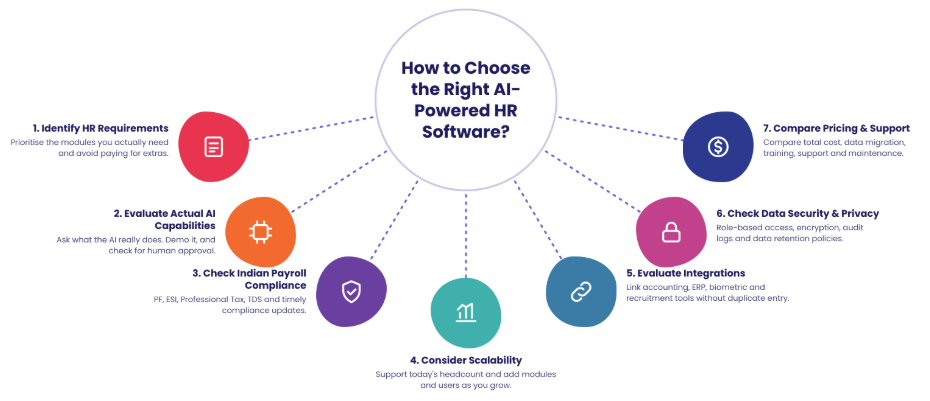
Here are some practical considerations to help you choose.
1. Identify Your HR Management Requirements
Start by identifying the activities you want to manage through the software.
For example, if your main challenge is payroll processing, then prioritize payroll and statutory compliance features. If recruitment is your biggest concern, look for applicant tracking, resume screening and onboarding capabilities.
Avoid paying for multiple modules that your business does not currently need.
2. Evaluate Actual AI Capabilities
Do not select HR software simply because it advertises AI integration. Always ask the vendor what the AI functionality can actually do.
For example:
- Can it screen resumes based on job requirements?
- Can employees ask questions about leave and payroll?
- Can it generate workforce reports?
- Can it identify unusual payroll entries?
- Can it complete authorised HR tasks?
- Does it support human approval before taking important actions?
A product demonstration can help you understand whether the AI features solve your actual problems.
3. Check Indian Payroll and Statutory Compliance
If your business operates in India, check whether the software supports applicable statutory requirements.
Look for payroll calculations, PF, ESI, Professional Tax, TDS, state-specific requirements and statutory reports.
Also, check how frequently the provider updates its compliance rules when regulations change.
4. Consider Employee Strength and Scalability
Choose software that can support your current workforce and future expansion.
A growing business may initially require employee management, attendance and payroll. As it expands, it may need recruitment, performance management, advanced analytics and multi-location support.
Check whether the software allows you to add modules and users without making implementation unnecessarily complicated.
5. Evaluate Integration Options
Your HR software should work smoothly with your existing business applications. Always check its ability to integrate with accounting software, ERP systems, biometric devices, recruitment platforms and other business tools.
This reduces duplicate data entry and helps maintain consistent employee information across systems.
6. Check Data Security and Privacy
Before implementing AI-powered HR software, understand how it handles employee data.
Ask about:
- Role-based access controls.
- Data encryption.
- Audit logs.
- Data storage and processing.
- Third-party AI integrations.
- Data retention policies.
- Human approval mechanisms.
These safeguards are particularly important when AI tools access payroll, employee performance or other confidential information.
7. Compare Pricing and Implementation Support
HR software pricing may depend on employee count, modules, subscription plans and implementation requirements. However, compare the total cost rather than looking only at the starting subscription price.
Also, evaluate implementation assistance, employee data migration, training, customer support and ongoing maintenance.
Is AI-Powered HR Software Worth Investing In?
AI-powered HR software can be a useful investment for businesses that want to reduce repetitive HR work, improve access to employee information and make better use of workforce data.
However, the value depends on how well the software addresses your organization’s actual requirements.
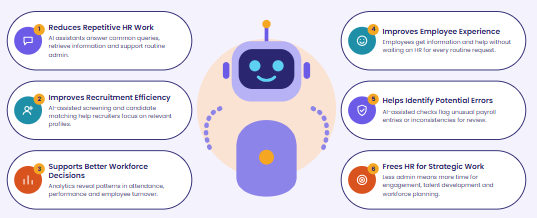
Here are some ways it can benefit businesses.
Reduces repetitive HR work
AI assistants can help to answer common employee queries, retrieve information and support routine administrative activities.
Improves recruitment efficiency
AI-assisted screening and candidate matching can help recruiters to manage large application volumes and focus on relevant profiles.
Supports better workforce decisions
AI analytics can help HR teams to identify workforce patterns and understand changes in attendance, performance and employee turnover.
Improves employee experience
Employees can access information and receive assistance without waiting for HR teams to respond to every routine request.
Helps identify potential errors
AI-assisted checks can flag unusual payroll entries or inconsistencies for further review.
Allows HR teams to focus on strategic activities
By reducing repetitive administrative work, HR professionals can spend more time on employee engagement, talent development and workforce planning.
However, AI should not replace human judgement in important HR decisions. Recruitment, performance evaluations, compensation and employee relations still require appropriate human involvement.
Conclusion
Overall, choosing the right HR software is about finding a platform that fits your business requirements, not simply selecting one with the most features.
For small businesses, ease of use, employee management and payroll may be the main priorities. Growing SMEs may need integrated HR modules, recruitment, attendance and statutory compliance. Large enterprises may require advanced workforce analytics, multi-location management, integrations and AI-driven workflows.
AI can make these systems more useful by helping HR teams to analyse information, resolve employee queries, identify patterns and reduce repetitive work. However, businesses should evaluate the actual AI capabilities, data security and human oversight offered by each platform before investing.
Frequently Asked Questions
What is the best HR software in India?
The best HR software in India depends on your business size, workforce requirements and HR management needs. Platforms such as Savvy HRMS, Zimyo, Darwinbox, Keka, Zoho People, greytHR, ZingHR, PeopleStrong and Pocket HRMS offer different HR management capabilities. Deel is also worth considering for businesses managing international employees and contractors.
How does AI help in HR management?
AI helps HR teams to automate or assist with activities such as resume screening, employee query resolution, workforce analytics, payroll verification and performance management. It can also help employees retrieve HR information and complete supported tasks through conversational interfaces.
What are the benefits of AI-powered HR software?
AI-powered HR software can reduce repetitive administrative work, improve recruitment efficiency, provide workforce insights, simplify employee query resolution and help HR teams identify potential errors. It also allows HR professionals to focus more on employee engagement and strategic workforce planning.
Can AI automate payroll and attendance management?
AI can assist with payroll and attendance management by identifying unusual entries, analysing attendance patterns and flagging potential discrepancies. However, regular salary calculations, attendance rules and statutory deductions are often handled through predefined software rules and automation rather than AI alone.
Is AI-powered HR software suitable for small businesses?
Yes. AI-powered HR software can be useful for small businesses with limited HR resources. Features such as employee chatbots, automated query resolution, resume screening and HR reporting can reduce manual work and help small teams manage employees more efficiently.
What is the difference between HR software and HRMS?
HR software is a broad term for applications that help businesses manage human resource activities. HRMS, or Human Resource Management System, generally refers to an integrated platform that combines multiple HR functions such as employee management, payroll, attendance, recruitment and performance management.