


Salary Account: Meaning, Benefits, Types and Charges in India (2027)



-
AuthorRuchika Rajput
-
 Last Updated
November 27, 2026
-
 Reading Time
13 Mins
Summary
- A salary account is generally a savings account opened through an employer-bank arrangement to credit employees’ monthly salaries.
- Most salary accounts offer a zero-balance facility, but other features depend on the bank.
- Employees can use salary accounts for personal transactions, including shopping, bill payments and money transfers.
- Some banking services, such as debit cards, ATM withdrawals and additional facilities, may involve charges.
- If salary credits stop for a specified period, the bank may convert the account into a regular savings account, subject to its terms.
- Employers and HR teams need accurate employee banking details to ensure smooth salary processing.
A salary account is a bank account that an employer opens for an employee through a banking partner to deposit their monthly salary. It usually offers zero-balance banking, debit card facilities, online transactions and other benefits, depending on the bank.
For employees, a salary account makes it easier to receive and manage monthly income. It can also be used for everyday activities such as shopping, bill payments, fund transfers and ATM withdrawals.
However, before opening a salary account, it is important to understand how it works, what benefits it offers, whether there are any charges and what happens when you change jobs.
In this guide, we will explain everything employees and HR professionals need to know about salary accounts in India.
What Is a Salary Account?
A salary account is a type of savings bank account opened by an employer in partnership with a bank to deposit employees’ monthly salaries. It allows employees to receive their salaries directly into their bank accounts without visiting a bank or collecting physical payments.
Unlike some regular savings accounts, salary accounts generally come with a zero minimum balance requirement. This means employees do not need to maintain a specific amount in their accounts to avoid non-maintenance charges, as long as the account remains eligible for salary account benefits.
The employee can then withdraw money, make online payments, transfer funds and use other banking facilities.
How Does a Salary Account Work?
The process generally involves the following steps:
- Employer partnership: The company partners with a bank to provide salary accounts to its employees.
- Account opening: Employees submit the required personal information and KYC documents.
- Salary processing: The employer calculates monthly salaries through its payroll process.
- Salary credit: The company sends salary payment instructions to the bank through its approved payment arrangement.
- Account usage: Employees receive their salaries and use the account for personal banking activities.
The exact process may differ depending on the employer’s banking arrangement and the bank’s procedures.
Is a Salary Account a Savings Account or a Current Account?
A salary account is generally a type of savings account designed specifically for employees who receive regular salary credits from their employers.
Although banks market it as a separate salary account category, its underlying account structure is usually that of a savings account. The main difference is that salary accounts are opened through employer-bank arrangements and may offer additional benefits.
For example, a regular savings account may require customers to maintain a minimum balance, depending on the account variant. A salary account generally offers a zero-balance facility while eligible salary credits continue.
Here are some common characteristics of a salary account:
- It is generally structured as a savings account.
- It is opened through an employer-bank arrangement.
- It is designed to receive monthly salary payments.
- It usually offers a zero-balance facility.
- It provides access to regular banking services.
Therefore, if someone asks whether a salary account is a savings account or a current account, the answer is that it is generally a specialised savings account, not a current account.
What Are the Benefits of a Salary Account?
A salary account offers several banking benefits that help employees to receive, manage and access their monthly income conveniently. These benefits may include zero-balance banking, debit cards, online banking, fund transfers and special offers on financial products.
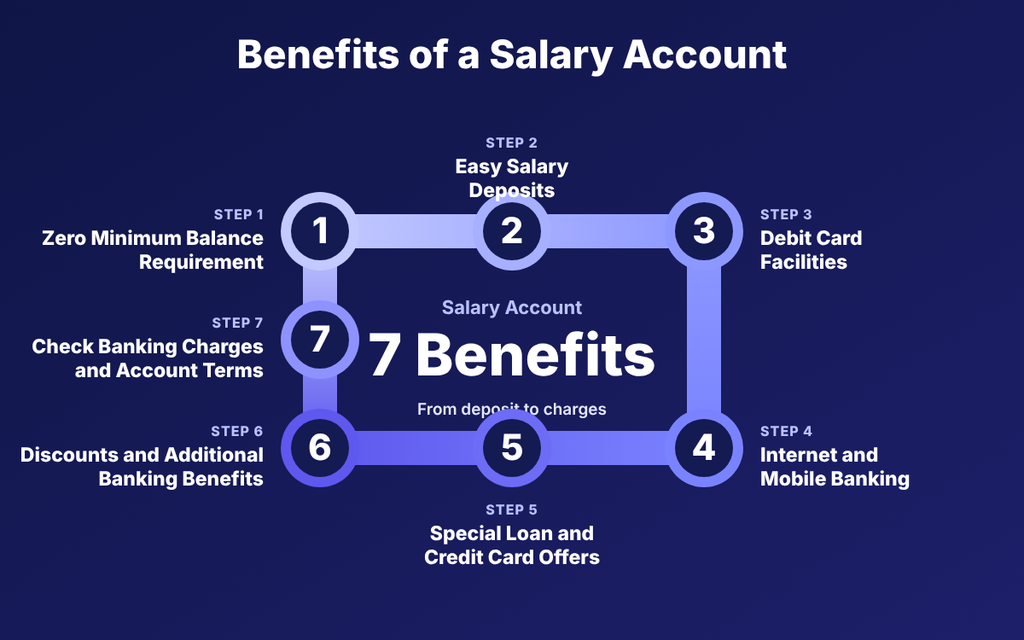
Here are some common benefits of having a salary account.
1. Zero Minimum Balance Requirement
Most salary accounts offer a zero-balance facility, which means employees do not need to maintain a minimum amount in their accounts.
This is useful because employees can withdraw or spend their available salary without worrying about maintaining a prescribed balance to avoid non-maintenance charges.
However, the facility may depend on continued salary credits and the bank’s account terms.
2. Easy Salary Deposits
A salary account allows employers to deposit employees’ monthly salaries directly into their bank accounts.
Employees do not need to visit a bank or collect physical salary payments. Once the employer processes the salary payment, the amount is credited to the registered account through the banking system.
3. Debit Card Facilities
Banks generally provide debit cards with salary accounts. Employees can use these cards to:
- Withdraw cash from ATMs.
- Pay at retail stores.
- Shop online.
- Make contactless payments where supported.
- Access other card-related services.
Some banks may offer different debit card variants based on the employee’s salary range or account category.
4. Internet and Mobile Banking
Salary account holders can access digital banking facilities through their bank’s website or mobile application.
These facilities allow employees to:
- Check account balances.
- Download bank statements.
- Transfer money.
- Pay electricity, mobile and other bills.
- Manage debit card settings.
- Track account transactions.
Digital banking makes it easier to manage monthly income without visiting a bank branch.
5. Special Loan and Credit Card Offers
Some banks offer salary account holders preferential terms on personal loans, home loans, overdraft facilities or credit cards.
For example, a bank may provide pre-approved loan offers or preferential interest rates to eligible salary account customers.
However, approval depends on factors such as income, credit history, repayment capacity and the bank’s eligibility criteria. Having a salary account does not guarantee loan or credit card approval.
6. Discounts and Additional Banking Benefits
Depending on the bank and account variant, employees may receive additional benefits such as:
- Discounts on selected purchases.
- Special offers on debit cards.
- Reduced charges on certain banking services.
- Preferential service benefits.
- Access to investment and insurance products.
Employees should review the bank’s current account terms to understand which benefits are included.
7. Banking charges and salary account terms
Before using a salary account, employees must check the bank’s schedule of charges. While the account may offer zero-balance banking, this does not necessarily mean every banking service is free.
For example, some banks provide free debit cards with selected salary account variants, while others may charge annual fees depending on the card type.
The following table highlights charges employees should check:
| Charge type | When it may apply |
| Account maintenance | If salary account benefits are withdrawn or the account is reclassified |
| Debit card annual fee | Depending on card variant |
| ATM withdrawal | When free transaction limits are exceeded |
| Cheque book | Depending on the number of free cheque leaves |
| SMS alerts | Depending on bank policy |
| Other banking services | Based on the bank’s applicable tariff |
Important: Banks have different fee structures. Employees should check the latest schedule of charges and account terms before opening an account. The Reserve Bank of India also requires banks to communicate applicable service charges and minimum-balance requirements transparently.
How to Open a Salary Account?
Employees can generally open a salary account through their employer’s banking arrangement. The employer coordinates with the bank, while the employee provides the required personal information and completes the KYC process.
Here is the usual process:
Step 1: Check the employer’s banking arrangement
Ask the HR or payroll team which bank provides salary account facilities to the company’s employees.
Step 2: Select the available account variant
Depending on the bank, employees may have different salary account options based on their salary range or employment category.
Step 3: Submit the required documents
Banks generally request documents such as:
- PAN card or Form 60, where applicable.
- Aadhaar or another officially valid identity and address document.
- Recent photograph.
- Employment proof or salary slip, if required by the bank.
The exact requirements may vary by bank and KYC method.
Step 4: Complete KYC verification
The bank verifies the employee’s identity and address before activating the account.
Step 5: Activate banking facilities
Once the account is opened, employees can activate their debit card, mobile banking, internet banking and other available services.
Step 6: Share account details with the payroll team
Employees should provide the correct account number and IFSC code to their employer so that monthly salary payments can be processed correctly.
What Happens to a Salary Account After Resignation?
When an employee resigns or changes jobs, the salary account does not automatically close. The employee can generally continue using the account, but the zero-balance facility and other salary-related benefits may change if regular salary credits stop.
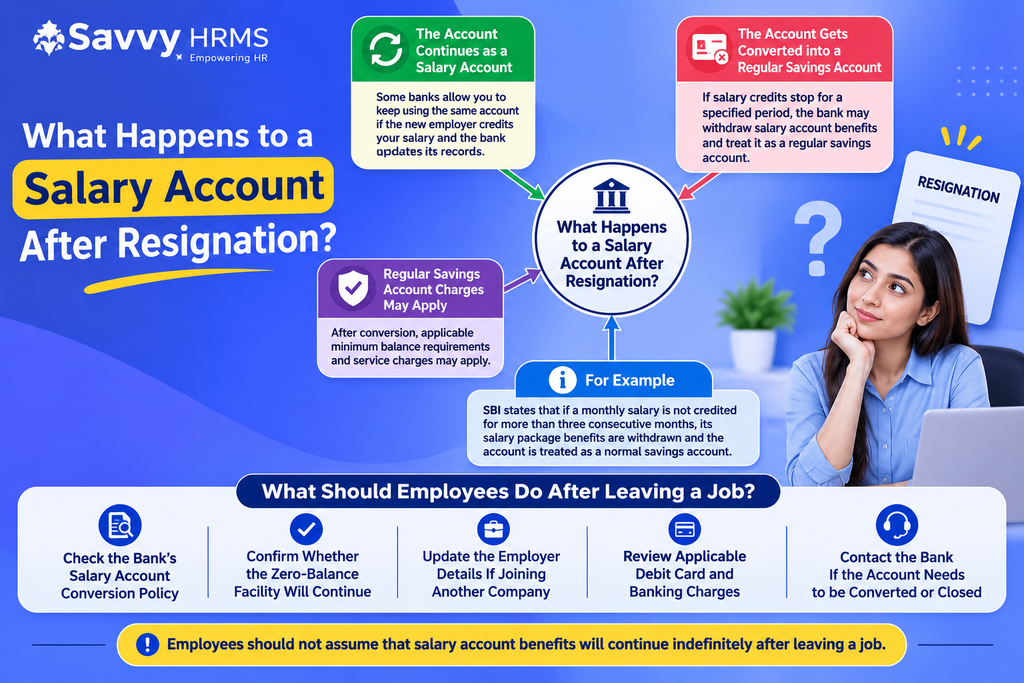
What happens next depends on the bank’s terms and conditions.
Here are some possible situations:
1. The account continues as a salary account
Some banks allow employees to continue using their existing salary account even after changing employers, provided the new employer credits the salary into the same account and the bank updates its records.
2. The account gets converted into a regular savings account
If salary credits stop for a specified period, the bank may withdraw salary account benefits and reclassify the account as a regular savings account.
For example, SBI states that when a monthly salary is not credited for more than three consecutive months, its salary package benefits are withdrawn and the account is treated as a normal savings account, while other banks may follow different timelines.
3. Regular savings account charges may apply
After conversion, the account may become subject to the applicable minimum balance requirements and service charges of the regular savings account variant.
What should employees do after leaving a job?
- Check the bank’s salary account conversion policy.
- Confirm whether the zero-balance facility will continue.
- Update the employer details if joining another company.
- Review applicable debit card and banking charges.
- Contact the bank if the account needs to be converted or closed.
Employees should not assume that salary account benefits will continue indefinitely after leaving a job.
What Is the Difference Between a Salary Account and a Savings Account?
A salary account and a regular savings account are generally designed for different banking needs. A salary account is primarily used to receive monthly salary payments, while a savings account is used to deposit money and manage personal finances.
Here is a comparison:
| Basis | Salary Account | Savings Account |
| Main purpose | Receiving monthly salary | Saving and managing personal money |
| Account opening | Usually through an employer-bank arrangement | Can generally be opened directly by an individual |
| Minimum balance | Generally zero balance while eligible | Depends on the bank and account variant |
| Salary credit | Designed for salary deposits | Can receive salary and other deposits |
| Banking facilities | Debit card, online banking and other benefits | Debit card, online banking and other benefits |
| Additional benefits | May include employer-linked banking offers | Depends on the account variant |
| Conversion | May be converted into a regular savings account | Usually remains a savings account |
Which account should you choose?
If your employer offers a salary account with zero-balance facilities and useful banking benefits, it can be a convenient option for receiving your monthly income.
A regular savings account may be more suitable if you want to open an account independently without relying on an employer-bank arrangement.
How Do Salary Accounts Connect with Employee Payroll Management?
Salary accounts are an important part of the monthly payroll process because they provide the destination for employees’ salary payments. HR and payroll teams need accurate employee banking information to ensure that salaries are transferred to the correct accounts.
For businesses managing multiple employees, maintaining these details manually can become difficult, particularly when employees join, leave or update their bank information.
Here is how salary accounts connect with payroll management.
1. Collecting employee bank details
During onboarding, HR teams collect essential banking information, including the employee’s account number, bank name and IFSC code.
2. Maintaining updated employee records
When employees change their bank accounts, HR teams need to update the information in employee records before the next payroll cycle.
3. Processing monthly salaries
Payroll teams calculate employee earnings, deductions and net payable salaries before preparing salary payment instructions.
4. Reducing salary payment errors
Incorrect account details can lead to failed or delayed salary transfers. Reviewing employee banking information helps reduce such errors.
5. Maintaining payroll records
Businesses need accurate payroll records to track salary payments, reconcile transactions and address employee queries.
How Can Payroll Software Simplify Salary Processing?
Managing payroll involves more than calculating employee salaries. Businesses also need to maintain employee information, manage deductions, prepare salary records and coordinate monthly payments.
Payroll software helps to automate several of these activities by bringing employee salary information and payroll calculations together.
With payroll software, businesses can:
- Maintain employee salary information.
- Calculate monthly earnings and deductions.
- Manage statutory payroll calculations.
- Generate payslips.
- Prepare payroll reports.
- Maintain organised salary processing records.
Savvy HRMS offers payroll management capabilities that help businesses simplify payroll calculations, manage employee salary information and streamline recurring payroll activities.
Conclusion
Overall, a salary account makes it easier for employees to receive their monthly income and manage everyday banking activities. It generally offers zero-balance facilities, digital banking, debit cards and other benefits, making it a convenient option for salaried professionals.
However, employees should understand the account’s terms, applicable charges and conversion rules before choosing a bank. They should also keep their banking details updated with their employer to avoid salary payment issues.
For employers, maintaining accurate employee bank information is equally important. A well-managed payroll process, supported by reliable payroll software, helps businesses organise salary calculations, maintain employee records and streamline monthly salary processing.

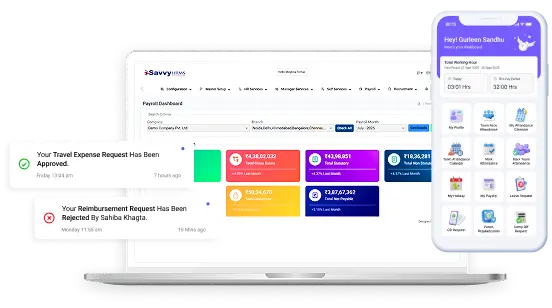









Looking to simplify payroll management in your organisation?
Frequently Asked Questions
1. What is a salary account?
A salary account is generally a savings bank account opened through an employer-bank arrangement to deposit an employee’s monthly salary. It usually offers zero-balance banking and other facilities depending on the bank.
2. What type of account is a salary account?
A salary account is generally a specialised savings account designed for salaried employees. It allows employers to deposit monthly salaries directly into employees’ bank accounts.
3. Can I use my salary account for personal use?
Yes. Employees can use their salary accounts for personal financial activities such as online shopping, bill payments, cash withdrawals, UPI transactions and fund transfers. The account generally works like a regular savings account for everyday banking.
4. What are the disadvantages of a salary account?
Some disadvantages of a salary account include:
• Dependence on an employer-bank arrangement for opening.
• Withdrawal of zero-balance benefits if salary credits stop.
• Possible conversion into a regular savings account.
• Additional charges after account reclassification.
• Banking benefits that may differ between banks.
5. Are there any charges for a salary account?
Most salary accounts offer zero-balance facilities, but certain services may involve charges. These can include debit card annual fees, ATM withdrawals beyond free limits, cheque book services and other banking facilities. Charges depend on the bank and account variant.
6. Can I open a salary account without an employer?
Generally, salary accounts are opened through an employer-bank arrangement. However, some banks may allow existing savings account holders to convert their accounts into salary accounts after providing employment proof and meeting the bank’s requirements.
7. Can I have two salary accounts?
Yes. An individual may hold multiple bank accounts, including accounts originally opened as salary accounts. However, whether an account continues to receive salary benefits depends on employer arrangements and the respective banks’ terms.
8. Can a salary account be converted into a savings account?
Yes. A salary account may be converted into a regular savings account if salary credits stop for the period specified by the bank. The account may then become subject to the minimum balance requirements and charges applicable to the new account variant.