

Vesting Period in 2027: Meaning, Types, ESOP Rules and Examples


-
AuthorS.K. Gupta
-
 Last Updated
November 26, 2026
-
 Reading Time
14 Mins
Summary
- A vesting period is the time an employee must fulfil specified conditions to earn the right to receive or exercise certain benefits.
- In an Employee Stock Option Plan (ESOP), employees earn the right to exercise stock options over a specified period.
- Common vesting arrangements include cliff vesting, graded vesting and milestone-based vesting.
- A vesting schedule explains when and how many stock options become vested.
- In India, ESOPs are subject to applicable legal requirements, including a minimum one-year period between the grant and vesting of options, subject to specified exceptions.
A vesting period is an important part of employee stock ownership plans (ESOPs) and other long-term employee benefits. It defines how long an employee must work for a company or meet specific conditions before gaining the right to receive or exercise those benefits.
For employees, understanding the vesting period helps them know when they become eligible for stock options and what happens if they leave the organization before the period ends. For employers, it can help encourage employee retention and connect rewards with long-term business growth.
But how does a vesting period work, and what are the different types of vesting schedules? This guide explains the vesting period meaning, its role in ESOPs, common types, practical examples and the key rules applicable in India.
What Is the Meaning of a Vesting Period?
A vesting period is the amount of time an employee needs to work for a company or meet certain conditions before they become eligible to receive specific benefits. These benefits may include stock options, company shares or other forms of compensation.
In simple terms, vesting means earning the right to a benefit over time. For example, a company may offer an employee 1,000 stock options but require them to complete a four-year vesting period before they can exercise all the options.
This means the employee earns the right to exercise their stock options gradually, according to the company’s vesting schedule.
Companies use vesting periods to encourage employees to stay longer, reward their contributions and give them an opportunity to benefit from the company’s growth.
However, completing the vesting period does not always mean employees automatically receive shares or money. It depends on the type of benefit offered and the conditions mentioned in the company’s policy or ESOP scheme.
How Does a Vesting Period Work?
A vesting period works through a predefined timeline during which an employee earns the right to receive or exercise an employer-provided benefit.
The exact process depends on the benefit being offered. In an Employee Stock Option Plan (ESOP), for example, the company grants stock options to an eligible employee. These options become vested over time according to the agreed schedule.
Here is how the process generally works:
- Grant of options: The company offers a specified number of stock options to an eligible employee.
- Vesting conditions: The company defines the conditions employees must meet, such as completing a particular period of service or achieving performance targets.
- Vesting begins: The vesting period starts according to the grant terms.
- Options become vested: The employee earns the right to exercise options as they meet the specified conditions.
- Exercise of options: The employee can purchase shares at the predetermined exercise price within the permitted exercise period.
For example, a company grants an employee 800 stock options with a four-year vesting period. If the company follows a schedule in which 25% vests after the first year and the remaining options vest equally over the next three years, the employee can earn the right to exercise all 800 options by the end of the fourth year.
However, the employee must also follow the exercise conditions specified under the ESOP scheme to acquire the shares.
What Is a Vesting Period in ESOP?
A vesting period in an Employee Stock Option Plan (ESOP) is the time an employee must complete the specified service or other conditions before gaining the right to exercise the stock options granted by the company.
ESOPs allow companies to offer employees an opportunity to purchase company shares at a predetermined price, subject to the scheme’s terms and conditions.
However, employees generally cannot exercise all granted options immediately. They must first meet the applicable vesting conditions.
For example, suppose a technology startup grants an employee 2,000 stock options with a four-year vesting period and a one-year cliff.
- During the first year, no options vest until the employee completes the cliff period.
- After completing one year, 25% of the options, or 500 options, become vested.
- The remaining 1,500 options vest over the next three years according to the company’s schedule.
This arrangement allows employees to earn their stock options over time rather than receiving the entire benefit immediately.
What Are the Key Terms Associated with ESOP Vesting?
Understanding a few common ESOP terms makes it easier to understand how the vesting process works.
| Term | Meaning |
| Grant date | The date on which the company grants stock options to an employee. |
| Vesting period | The time during which the employee fulfils the conditions to earn the right to exercise stock options. |
| Vesting schedule | The timeline showing when and how many options become vested. |
| Cliff period | The initial period during which no options vest. Once the cliff is completed, a specified portion vests. |
| Exercise price | The predetermined price at which an employee can purchase shares by exercising vested options. |
| Exercise period | The period during which an employee can exercise their vested stock options. |
One important distinction is that vesting and exercising are not the same. Vesting gives an employee the right to exercise eligible options, while exercising means paying the applicable exercise price to acquire shares.
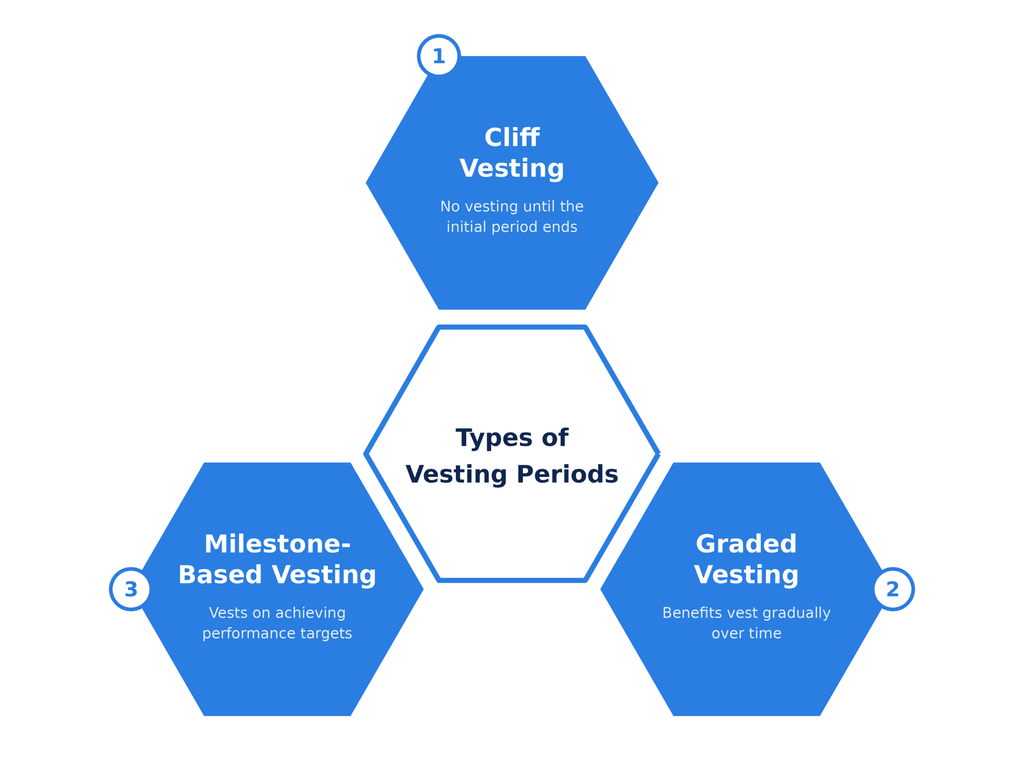
What Are the Different Types of Vesting Periods?
Companies can structure vesting schedules differently depending on their compensation policies, employee retention goals and the type of benefits they offer.
The following are common vesting arrangements used in employee compensation and equity plans.
1. Cliff Vesting
Cliff vesting means employees must complete a specified initial period before any part of their benefits becomes vested.
For example, a company offers an employee 1,200 stock options with a four-year vesting period and a one-year cliff. The employee receives no vested options during the first year. Once they complete one year, 25% of the options (300 options) become vested.
After that, the remaining options vest according to the company’s schedule.
This approach is commonly used in startup ESOP plans to encourage employees to stay with the organization for a minimum period.
2. Graded Vesting
Graded vesting allows employees to earn their benefits gradually over a specified period rather than waiting until the entire vesting period is complete.
For example, a company grants an employee 1,000 stock options with a four-year graded vesting schedule. The company may allow 25% of the options to vest each year.
This means the employee earns 250 options every year, provided they meet the applicable conditions.
Graded vesting gives employees access to a portion of their benefits at different intervals while encouraging them to continue working with the company.
3. Milestone-Based Vesting
Milestone-based vesting allows employees to earn benefits after achieving predefined performance targets or business milestones.
For example, a company may link a portion of an employee’s stock options to achieving specific targets, such as completing a major project, reaching a revenue goal or launching a new product.
Unlike a purely time-based schedule, this arrangement depends on whether the employee or organization meets the specified milestones.
Companies may also combine time-based and performance-based conditions in their compensation plans.
What about immediate vesting?
Immediate vesting means a benefit becomes fully vested as soon as the applicable grant or eligibility conditions are met. However, it should not be treated as a standard ESOP vesting option in India because applicable ESOP rules generally prescribe a minimum one-year period between the grant and vesting of options, subject to specified exceptions.
What Is a Vesting Schedule?
A vesting schedule is a timeline that explains when and how much of an employee’s granted benefits become vested.
While the vesting period tells employees how long the vesting arrangement lasts, the vesting schedule explains how benefits are distributed during that period.
For example, a company may offer an employee 1,600 stock options with a four-year vesting schedule. The schedule may specify that 25% of the options vest after the first year, followed by monthly vesting over the next three years.
A vesting schedule generally includes:
- Total grant: The number of stock options or benefits offered to an employee.
- Vesting commencement date: The date from which the vesting timeline is calculated.
- Cliff period: The initial period before the first set of benefits becomes vested.
- Vesting frequency: How often benefits become vested, such as monthly, quarterly or annually.
- Vesting conditions: The service, performance or other conditions employees must meet.
These details help employees to understand how their benefits accumulate and when they become eligible to exercise their options.
What Is a Vesting Schedule Example?
Let’s understand how a vesting schedule works with a practical example.
Suppose a company grants an employee 1,200 stock options with a four-year vesting period and a one-year cliff. The company follows a schedule in which 25% of the options vest after the first year, while the remaining options vest equally over the next three years.
Here is how the vesting schedule would look:
| Vesting period | Options vested during the period | Total vested options |
| First year | 300 | 300 |
| Second year | 300 | 600 |
| Third year | 300 | 900 |
| Fourth year | 300 | 1,200 |
In this example, the employee receives the right to exercise 300 options after completing the first year. The remaining 900 options become vested over the following three years.
By the end of the fourth year, all 1,200 options have vested, provided the employee has fulfilled the applicable conditions.
This example shows how a vesting schedule distributes stock options over time instead of making the entire grant available immediately.
What Are the ESOP Vesting Rules in India for 2027?
Companies offering ESOPs in India must follow the applicable provisions of the Companies Act, 2013, the Companies (Share Capital and Debentures) Rules, 2014 and, where applicable, SEBI regulations.
For unlisted public companies and private companies, Rule 12 of the Companies (Share Capital and Debentures) Rules, 2014 provides the relevant ESOP framework. However, listed companies must also comply with applicable SEBI requirements.
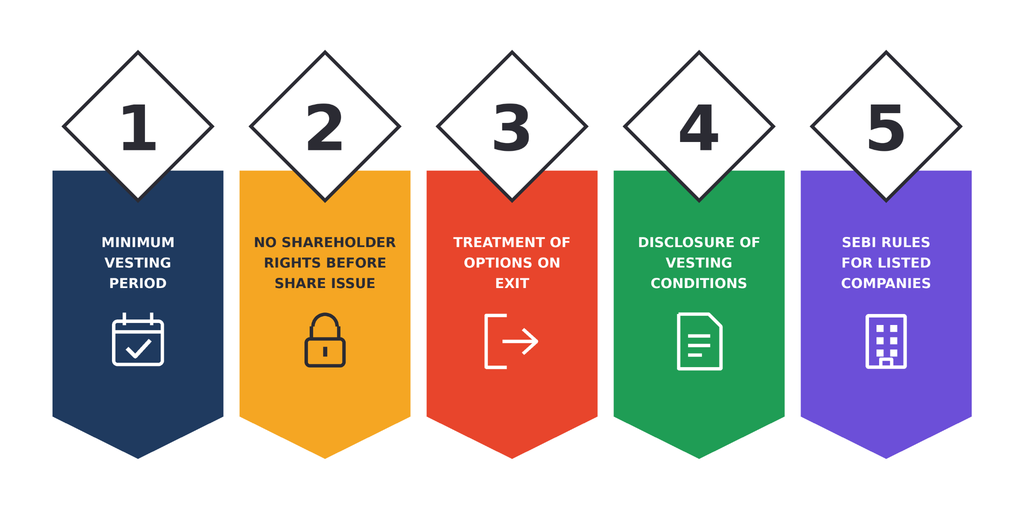
Some important provisions include:
1. Minimum vesting period
Under Rule 12(6)(a), there must generally be a minimum period of one year between the grant of options and their vesting.
An exception applies in certain merger or amalgamation situations where the employee’s earlier holding period can be adjusted against the minimum vesting period.
2. No shareholder rights before share issuance
Under Rule 12(6)(c), employees do not receive voting rights, dividend rights or other shareholder benefits merely because stock options have been granted. These rights arise after shares are issued upon exercise of the options.
3. Treatment of options when employment ends
Under Rule 12(8), unvested options generally expire when an employee resigns or their employment is terminated. Vested options may be exercised within the period specified under the approved ESOP scheme.
The rules also provide specific treatment for the death or permanent incapacity of an employee.
4. Disclosure of vesting conditions
Companies must disclose important ESOP details, including vesting requirements, vesting periods, maximum vesting timelines, exercise prices and exercise periods.
5. SEBI requirements for listed companies
Listed companies must follow the SEBI (Share Based Employee Benefits and Sweat Equity) Regulations, 2021, as amended. Regulation 18 also provides for a minimum one-year vesting period for ESOS, subject to specified exceptions.
For a 2027 publication, these provisions should be rechecked against any amendments or notifications issued after November 2026.
What Happens to Unvested ESOPs When an Employee Leaves?
When an employee resigns or their employment is terminated, the treatment of their stock options depends on the applicable ESOP scheme and relevant legal provisions.
Generally, unvested options may lapse when an employee leaves before completing the required vesting conditions. However, the treatment of vested options can be different.
Here are some common situations:
1. Employee leaves before completing the cliff period
If an employee resigns before completing the cliff period, they generally do not receive any options that were scheduled to vest after the cliff.
2. Employee leaves after partial vesting
If an employee leaves after completing part of the vesting period, they may retain the options that have already vested. However, they must exercise those options within the period specified under the company’s ESOP scheme.
3. Employee leaves after completing the entire vesting period
If all options have vested, the employee may exercise them within the applicable exercise period, subject to the scheme’s terms and conditions.
For companies governed by Rule 12, unvested options generally expire upon resignation or termination, while vested options may be exercised within the period specified under the approved scheme.
Therefore, employees should always review their ESOP grant documents to understand what happens to their vested and unvested options when they leave the organization.
What Is the Difference Between a Vesting Period and an Exercise Period?
A vesting period and an exercise period are two different stages of an employee stock option plan.
The vesting period is the time an employee must complete to earn the right to exercise stock options. The exercise period is the timeframe during which the employee can use those vested options to purchase company shares.
Here are the key differences:
| Basis | Vesting period | Exercise period |
| Meaning | Time required to earn the right to exercise stock options | Time allowed to exercise vested options |
| Purpose | Determines when options become vested | Determines when employees can purchase shares |
| Begins | According to the grant and vesting terms | As specified under the ESOP scheme after vesting |
| Employee action | Fulfil vesting conditions | Pay the exercise price and exercise eligible options |
| Outcome | Options become vested | Shares may be acquired after successful exercise and applicable allotment formalities |
For example, if an employee receives stock options with a four-year vesting period, they must complete the applicable vesting conditions before exercising those options.
Once the options become vested, the employee can exercise them within the permitted exercise period.
What Should Companies Consider When Setting a Vesting Period?
Setting a vesting period requires companies to balance employee interests with their long-term business objectives. A well-planned schedule can make compensation more transparent and encourage employees to remain connected with the organization.
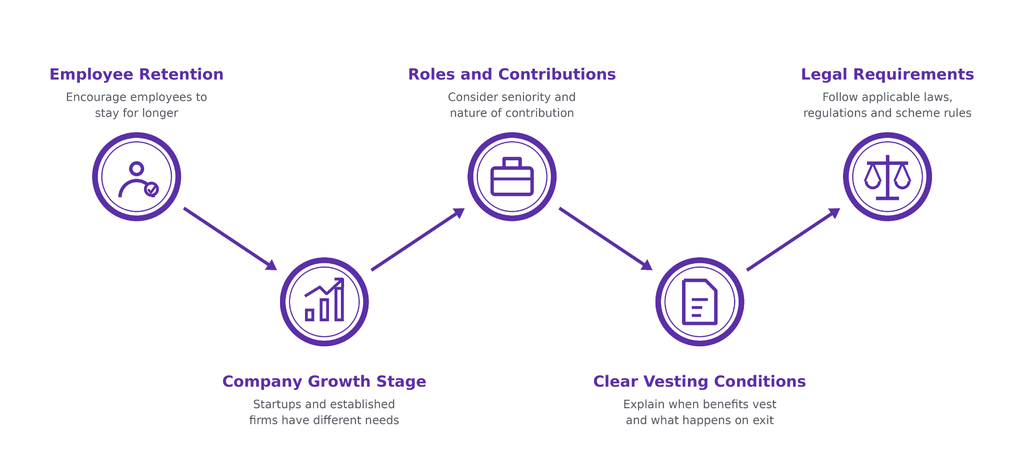
Here are some important factors companies should consider:
1. Employee retention
A vesting schedule can encourage employees to stay with the organization for a longer period. Companies should choose a reasonable timeline that supports retention without making the benefit unnecessarily difficult to earn.
2. Company growth stage
Startups and established organizations may have different compensation requirements. Early-stage companies may use ESOPs as part of their employee compensation strategy, while larger organizations may have more structured equity plans.
3. Employee roles and contributions
Companies should consider employee responsibilities, seniority and the nature of their contributions when designing compensation arrangements.
4. Clear vesting conditions
Employees should understand when their benefits become vested, what conditions they must fulfil and what happens if they leave the organization.
5. Legal and regulatory requirements
Companies must ensure that their vesting arrangements follow applicable laws, regulations and scheme-specific requirements. This is particularly important when designing ESOPs for employees in India.
Conclusion
Overall, A vesting period plays an important role in employee compensation, particularly when companies offer stock options through ESOPs. It determines when employees earn the right to exercise their options and how those benefits become available over time.
Understanding the different types of vesting arrangements, vesting schedules and exercise conditions helps employees to make informed decisions about their compensation. For employers, a clearly structured vesting plan can support employee retention and create a stronger connection between individual contributions and long-term business growth.
Frequently Asked Questions About Vesting Periods
1. What is a vesting period in simple terms?
A four-year vesting period with a one-year cliff is a commonly used example in startup ESOP arrangements. However, the actual duration and vesting frequency depend on the company’s ESOP scheme and applicable regulations.
2. Is a vesting period mandatory for ESOPs in India?
For ESOPs governed by Rule 12 of the Companies (Share Capital and Debentures) Rules, 2014, there must generally be a minimum one-year period between the grant and vesting of options, subject to specified exceptions. Listed companies must follow the applicable SEBI regulations.
3. What is a one-year cliff in ESOPs?
A one-year cliff means employees must complete one year of service before any stock options become vested. Once they complete this period, the first specified portion of their options becomes vested.
4. Can an employee lose vested stock options?
Vested options do not automatically become shares. An employee may lose the opportunity to exercise them if they fail to exercise within the applicable exercise period or if other conditions under the ESOP scheme are not met.
5. What is the difference between vesting and exercising?
Vesting means earning the right to exercise stock options after fulfilling the required conditions. Exercising means using those vested options to purchase company shares at the predetermined exercise price.
6. Can a company change its vesting schedule?
A company may be able to modify an ESOP vesting schedule, but any changes must follow applicable legal requirements, shareholder approvals where required, and the terms of the scheme. Companies should communicate approved changes clearly to affected employees.