Absenteeism Rate: Formula, Calculation and Examples


-
AuthorChandra Shekhar Verma
-
 Last Updated
November 19, 2026
-
 Reading Time
14 Mins
TL;DR
- Absenteeism rate measures the percentage of scheduled working days employees miss during a specific period.
- The absenteeism rate formula is: (Total Absent Workdays ÷ Total Scheduled Workdays) × 100.
- HR teams can calculate absenteeism weekly, monthly, quarterly or annually.
- The monthly absenteeism rate helps organizations to track attendance trends and identify recurring absences.
- Factors such as health issues, workplace stress, family responsibilities and poor work-life balance can contribute to absenteeism.
- Regular attendance monitoring and attendance management software can help HR teams manage employee absences more effectively.
Employee absenteeism is a common workplace challenge that can affect productivity, workforce planning and daily operations. When employees frequently miss scheduled work then HR teams may find it difficult to manage workloads, maintain staffing levels and keep business activities running smoothly.
This is why organizations track the absenteeism rate. It measures the percentage of scheduled working days employees miss during a specific period and helps HR teams to understand attendance patterns. By calculating this metric regularly, businesses can identify recurring absences, compare attendance trends and take steps to improve workforce availability.
But how do you calculate the absenteeism rate, and what does the percentage indicate? In this guide, we’ll explain the absenteeism rate formula, how to calculate it, monthly calculation methods, practical examples and ways to manage employee absenteeism.
What Is Absenteeism Rate?
Absenteeism rate is the percentage of scheduled working days or hours that employees miss during a specific period. It helps organisations measure employee absence, identify recurring attendance patterns and understand how absenteeism affects workforce availability and business operations.
For example, if an employee is scheduled to work 22 days in a month but takes 2 days of unplanned absence, their absenteeism rate is 9.09%.
It is important to distinguish absenteeism from all forms of leave. For instance, an organisation may track approved annual leave separately from unplanned absences. The calculation should follow a clearly defined attendance policy so that monthly and annual comparisons remain consistent.
What Is the Absenteeism Rate Formula?
The absenteeism rate formula calculates the percentage of scheduled working days employees miss during a given period. It divides the total absent workdays by the total scheduled workdays and multiplies the result by 100.
The formula is:
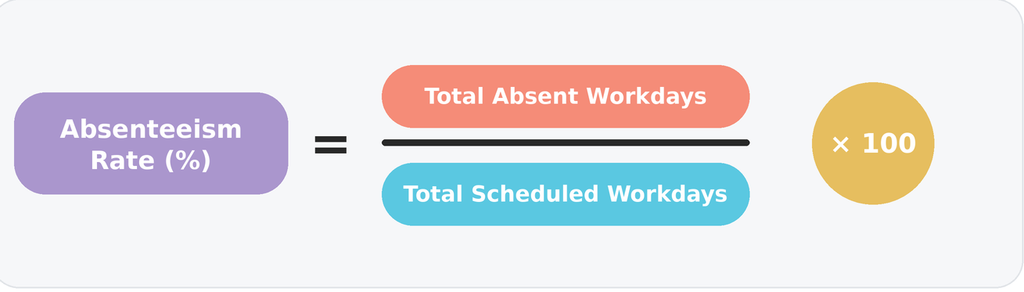
Here is what each component means:
- Total absent workdays: The number of scheduled working days employees missed during the selected period, based on the organisation’s definition of absenteeism.
- Total scheduled workdays: The total number of working days employees were expected to work during that period.
- 100: Converts the calculated value into a percentage.
Example:
Suppose an employee is scheduled to work 22 days in a month and takes 2 days of unplanned absence.
Using the absenteeism percentage formula:
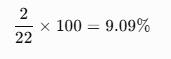
Therefore, the employee’s absenteeism rate for that month is 9.09%.
For organisations, the same principle applies, but the denominator should account for the scheduled workdays of all employees rather than simply using the number of calendar days.
How to Calculate Absenteeism Rate?
Calculating absenteeism rate is straightforward when you have accurate attendance records. You need to know how many working days employees were scheduled for and how many of those days they missed during a particular period.
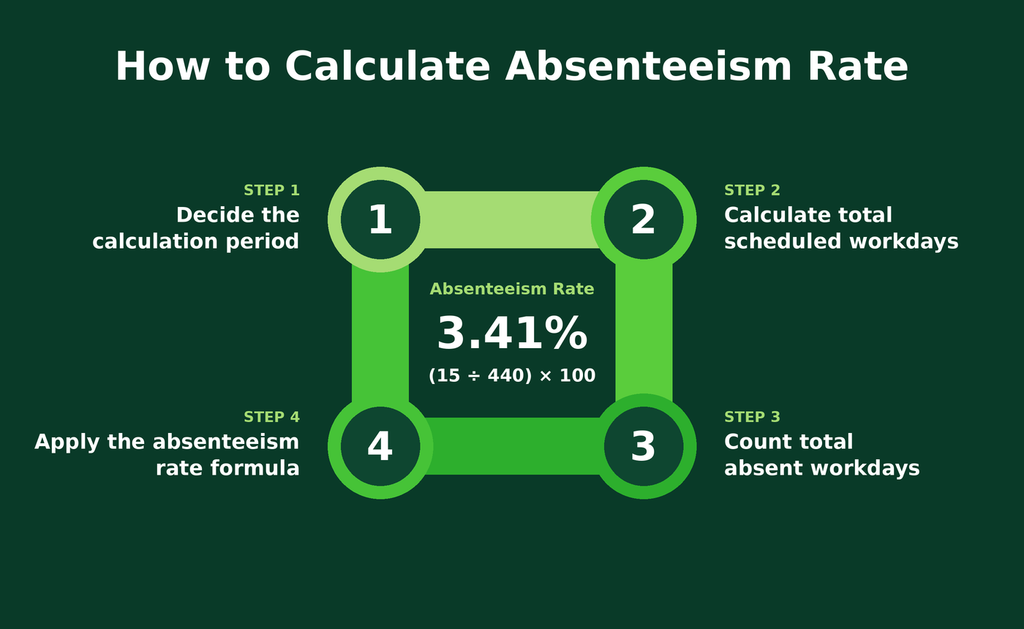
Let’s understand how you can calculate the absenteeism rate as explained below:
Step 1: Decide the calculation period
Start by deciding the period you want to measure. You can calculate absenteeism by weekly, monthly, quarterly or annually, depending on your reporting requirements.
For example, if you want to track monthly absenteeism, use the attendance records for the month you are analyzing. Ensure that both scheduled workdays and absent workdays are counted for the same month.
Step 2: Calculate total scheduled workdays
Next, find out how many days employees were expected to work during that period.
For an individual employee, count their scheduled working days but for a department or the entire organization, add the scheduled working days of all employees.
For example, if a department has 20 employees and each is scheduled to work 22 days, then the total scheduled workdays will be:
20 × 22 = 440 scheduled person-days
While calculating, account for weekly offs, holidays, different shifts and individual work schedules.
Step 3: Count the total absent workdays
Now, check your attendance records to find the total number of scheduled working days employees missed during the same period.
You can refer to attendance reports, leave management records and absence logs for this information.
For instance, if employees in the department collectively missed 15 scheduled working days during the month then the total absent workdays will be 15.
Make sure you follow a consistent policy when deciding which types of absence to include in the calculation.
Step 4: Apply the absenteeism rate formula
Once you have both figures then divide the total absent workdays by the total scheduled workdays and multiply the result by 100.
Suppose:
- Total absent workdays = 15
- Total scheduled workdays = 440
Absenteeism rate = (15 ÷ 440) × 100 = 3.41%
This means employees missed 3.41% of their total scheduled working days during that month. HR teams can use this percentage to compare attendance across departments and identify changes over time.
How to Calculate Monthly Absenteeism Rate?
The monthly absenteeism rate shows the percentage of scheduled working days employees miss during a particular month. To calculate it, divide the total absent workdays by the total scheduled person-days for that month and multiply the result by 100.
The monthly absenteeism rate formula is:
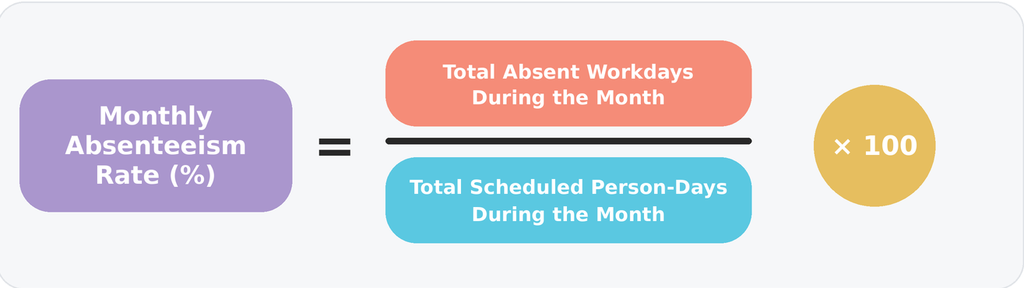
Let’s understand how the monthly absenteeism rate formula works with an example.
Suppose a company has 50 employees, and each employee is scheduled to work 22 days in a month. During that month, employees collectively take 44 days of unplanned absence.
Here is how HR can calculate the monthly absenteeism rate:
| Particulars | Calculation | Result |
| Total employees | Given | 50 |
| Scheduled working days per employee | Given | 22 |
| Total scheduled person-days | 50 × 22 | 1,100 |
| Total absent workdays | Given | 44 |
| Monthly absenteeism rate | (44 ÷ 1,100) × 100 | 4% |
Therefore, the company’s monthly absenteeism rate is 4%.
How to calculate monthly absenteeism when employees have different schedules?
Not every employee follows the same working schedule. Some may work rotational shifts, while others may have different weekly offs or join or leave the organisation during the month.
In such cases, HR should calculate scheduled workdays separately for each employee and then add them together.
For example:
- Employee A: 22 scheduled days.
- Employee B: 20 scheduled days.
- Employee C: 18 scheduled days.
Total scheduled person-days = 22 + 20 + 18 = 60.
If these employees collectively miss 3 scheduled workdays, the monthly absenteeism rate is:
(3 ÷ 60) × 100 = 5%
This approach provides a more accurate result when employee schedules differ.
What Are Some Examples of Absenteeism Rate Calculations?
Absenteeism rate can be calculated at different workforce levels, depending on what HR wants to measure. The formula remains the same, but the attendance data changes based on whether the calculation is for an individual employee, a department or the entire organization.
Let’s understand the absenteeism rate by considering several situations and examples.
Example 1: Individual Employee Absenteeism Rate
Suppose an employee is scheduled to work 22 days in a month but misses 2 working days due to unplanned absence.
Calculation:
(2 ÷ 22) × 100 = 9.09%
The employee’s absenteeism rate is 9.09% for that month.
Example 2: Department-Wise Absenteeism Rate
Suppose a sales department has 20 employees, each scheduled to work 22 days in a month. The department records 15 absent workdays.
- Total scheduled person-days = 20 × 22 = 440.
- Total absent workdays = 15.
Calculation:
(15 ÷ 440) × 100 = 3.41%
The department’s absenteeism rate is 3.41%.
Example 3: Organization-Wide Absenteeism Rate
Suppose an organization has 100 employees, each scheduled to work 22 days in a month. Employees collectively record 88 absent workdays.
- Total scheduled person-days = 100 × 22 = 2,200.
- Total absent workdays = 88.
Calculation:
(88 ÷ 2,200) × 100 = 4%
The organisation’s monthly absenteeism rate is 4%.
These examples show how HR teams can use the same formula to monitor absenteeism at individual, departmental and organisational levels.
| Note: If employees miss only part of a working day, an hours-based calculation may provide a more accurate picture than counting each absence as a full day. |
What Is a Good Absenteeism Rate?
A good absenteeism rate is one that remains relatively low and stable compared with an organization’s historical attendance data and relevant industry benchmarks. As there is no universally accepted percentage because absence patterns differ across industries, job roles, workforce sizes and working conditions.
For example, a manufacturing organization with rotating shifts may experience different attendance patterns from an office-based IT company. Similarly, healthcare organizations may have different workforce requirements as they need continuous staffing.
Instead of relying on a single benchmark, HR teams should consider the following factors:
- Historical attendance data: Compare the current rate with previous months or quarters to identify changes.
- Industry requirements: Consider the nature of work, shift patterns and staffing requirements.
- Department-wise trends: Identify whether absenteeism is concentrated in particular teams or locations.
- Type of absence: Differentiate between planned leave, unplanned absence and recurring absenteeism.
- Workforce availability: Understand whether employee absences are affecting daily operations or productivity.
For example, if an organization’s monthly absenteeism rate increases from 3% to 6% over three consecutive months then HR should investigate the reasons behind the change rather than immediately assuming that the rate is acceptable or unacceptable.
What Are the Common Causes of Employee Absenteeism?
Employees may miss work for different personal or workplace-related reasons. While occasional absences are normal, frequent unplanned absences may point to problems that need attention.
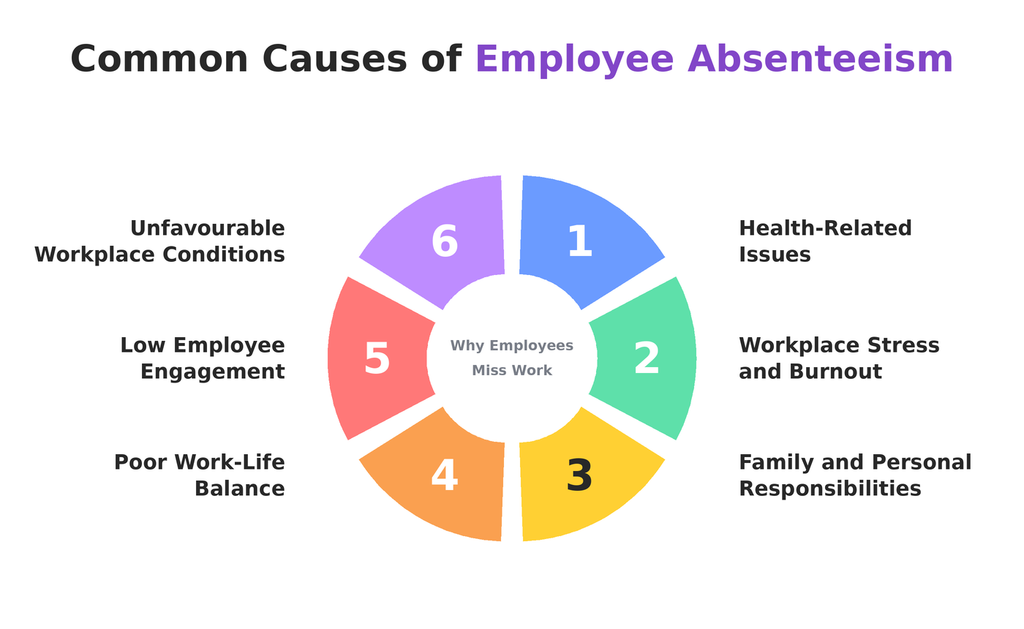
Let’s find common causes of employee absenteeism as shown below:
1. Health-related issues
Illness, injuries or other health problems can make it difficult for employees to come to work. They may also need time off for doctor visits, treatment or recovery.
2. Workplace stress and burnout
Workplace stress can also affect employee attendance. According to Gallup’s State of the Global Workplace 2026 report, 28% of employees in India experienced significant stress during the previous day in 2025.
Heavy workloads, tight deadlines and long working hours can leave employees stressed and exhausted. Over time, this may affect their health and regular attendance.
3. Family and personal responsibilities
Family emergencies, childcare and other personal commitments can sometimes prevent employees from coming to work as scheduled.
4. Poor work-life balance
When employees struggle to balance work with their personal lives, they may feel stressed or overwhelmed as this can lead to more unplanned absences.
5. Low employee engagement
Employees who feel unhappy or disconnected from their work may lose interest and motivation. In some cases, this can result in frequent absences.
6. Unfavourable workplace conditions
Poor facilities, unsafe working conditions or difficult commutes can make it harder for employees to attend work regularly, especially those working on-site or in shifts.
Understanding these causes helps HR teams to identify whether absenteeism is related to individual circumstances, workplace practices or broader organisational issues.
How Does a High Absenteeism Rate Affect an Organization?
A high absenteeism rate can affect daily work and overall business operations. When employees frequently miss work, teams may struggle to complete tasks on time, manage workloads and maintain productivity.
Here are some common effects of high employee absenteeism:
- Reduced productivity: When employees are absent, tasks and projects may take longer to complete.
- Increased workload: Other team members may have to handle extra work to cover for absent colleagues.
- Higher operational costs: Organizations may need to pay for overtime or hire temporary staff to manage the workload.
- Workforce planning challenges: Frequent absences make it harder for managers to plan shifts, assign tasks and manage resources.
- Lower team morale: Employees who regularly cover for absent colleagues may feel stressed or frustrated.
- Service disruptions: Staff shortages can affect service quality and response times, especially in customer-facing roles.
For HR teams, tracking absenteeism helps to identify attendance patterns early. They can then understand the reasons behind frequent absences and take steps to reduce their impact on the workplace.
How Can HR Teams Reduce Employee Absenteeism?
HR teams can reduce avoidable absenteeism by monitoring attendance patterns, understanding the reasons behind employee absences and creating a supportive workplace environment. The focus should be on identifying recurring issues rather than simply penalising employees for missing work.
Here are seven practical ways to manage employee absenteeism.
1. Monitor employee attendance regularly
Track attendance data to understand how frequently employees miss scheduled work. Regular monitoring helps HR identify recurring absences, unusual patterns and departments that may require additional attention.
2. Identify recurring absence patterns
Look for repeated absences, such as frequent Monday or Friday absences, recurring missed shifts or patterns within specific departments. These trends can help managers understand where further investigation or employee support may be needed.
3. Maintain clear attendance and leave policies
Establish clear guidelines explaining attendance expectations, leave procedures, reporting requirements and approval processes. Employees should understand how to communicate absences and whom to contact when they cannot attend work.
4. Address employee stress and burnout
Encourage reasonable workloads, regular breaks and open communication between employees and managers. HR teams should also identify teams experiencing excessive work pressure and explore ways to improve working conditions.
5. Encourage work-life balance
Where business requirements allow, consider flexible working arrangements, shift adjustments and suitable leave options. Giving employees reasonable flexibility can help them manage personal responsibilities without unnecessarily disrupting work.
6. Improve manager-employee communication
Managers should maintain regular communication with employees and understand the reasons behind recurring absences. Supportive discussions can help identify workplace concerns and determine whether any adjustments are needed.
7. Use attendance management software
Manually tracking employee attendance across departments and locations can become difficult as an organisation grows. Attendance management software helps HR teams record employee attendance, monitor absences, manage shifts and generate attendance reports.
With Savvy HRMS, organisations can manage employee attendance through features such as real-time attendance tracking, biometric and face recognition integration, shift management, attendance rules and reporting.
This helps HR teams maintain organised attendance records, identify absence patterns and make more informed workforce planning decisions.
Frequently Asked Questions About Absenteeism Rate
1. How do you calculate absenteeism percentage?
To calculate absenteeism percentage, divide the total number of absent workdays by the total scheduled workdays during a specific period and multiply the result by 100. For example, 5 absent days out of 100 scheduled workdays result in a 5% absenteeism rate.
2. What is the monthly absenteeism rate formula?
The monthly absenteeism rate formula is: (Total Absent Workdays During the Month ÷ Total Scheduled Person-Days During the Month) × 100. It helps HR teams measure the percentage of scheduled working days employees missed during a particular month.
3. Is absenteeism rate the same as absence rate?
Absenteeism rate and absence rate are often used interchangeably to describe missed working time as a percentage of scheduled working time. However, their exact meaning depends on the organisation’s measurement policy and the types of absence included.
4. Should approved leaves be included in the absenteeism rate?
It depends on the purpose of the calculation. If an organisation measures all employee absences, approved leave may be included. However, if it measures unplanned absenteeism, scheduled and approved leave is generally tracked separately to avoid distorting the results.
5. What is considered a high absenteeism rate?
There is no universally accepted threshold for a high absenteeism rate. It depends on industry, workforce requirements, historical attendance patterns and the types of absence being measured. HR teams should compare current rates with their own historical data and relevant industry benchmarks.
6. How often should HR calculate absenteeism rate?
HR teams can monitor attendance daily and calculate absenteeism rates monthly or quarterly. Monthly calculations help identify short-term trends, while quarterly and annual comparisons provide a broader understanding of workforce attendance patterns.
Conclusion
Monitoring absenteeism rate helps organisations understand employee attendance patterns, identify recurring absences and make better workforce planning decisions. By using the correct formula and reviewing attendance data regularly, HR teams can recognise potential issues before they affect daily operations.
However, calculating the percentage is only the first step. Organisations also need to understand why employees are missing work and take appropriate measures to address the underlying causes.
With Savvy HRMS, HR teams can simplify attendance tracking, manage employee shifts and generate attendance reports through an integrated platform. This makes it easier to monitor workforce availability and manage attendance more effectively.
Want to simplify employee attendance management? Explore Savvy HRMS Attendance Management Software and see how automated attendance tracking can help your HR team manage workforce attendance more efficiently. Book a free demo today!