What Is a Virtual Interview? Meaning, Benefits, Process and Best Practices


-
AuthorRuchika Rajput
-
 Last Updated
November 04, 2026
-
 Reading Time
16 Mins
TL;DR
A virtual interview is a remote job interview conducted using video conferencing or online interview platforms. Here are the key things to know:
- Virtual interviews allow recruiters to connect with candidates without requiring face-to-face meetings.
- Common types include live video interviews, panel interviews and pre-recorded interviews.
- The virtual interview process involves scheduling, technical preparation, conducting the interview, evaluating candidates and sharing feedback.
- These interviews help reduce travel expenses, improve scheduling flexibility and expand access to potential candidates.
- Recruiters should prepare structured questions, test their technology and follow consistent evaluation criteria.
- Candidates should check their internet connection, choose a quiet environment and prepare relevant answers before joining.
The recruitment process has changed significantly with the growing adoption of remote and hybrid work. Nowadays, businesses no longer need to conduct every interview in person to connect with potential candidates. Instead, they can use virtual interviews to assess applicants, communicate with candidates and move forward with hiring from different locations.
With remote and hybrid work becoming common, many organizations now use online platforms to interview candidates. This approach allows recruiters and job seekers to connect via a virtual interview without meeting in person. Depending on the hiring requirements, organizations may conduct live video interviews, panel interviews or pre-recorded interviews.
In this blog, you will explore the meaning of virtual interviews, different types, the interview process, benefits, common challenges, questions and answers, and best practices for recruiters and candidates.
What Is a Virtual Interview?
A virtual interview is a job interview conducted remotely using digital communication tools such as video conferencing platforms or online interview software. It allows recruiters, hiring managers and candidates to communicate and evaluate job suitability without being physically present in the same location.
Businesses commonly use virtual job interviews during initial screening, technical assessments and different stages of the recruitment process. Depending on the role and hiring requirements, interviews can be conducted through live video calls or pre-recorded responses.
For example, a company hiring a software developer in Bengaluru can interview a candidate based in Delhi through Microsoft Teams or Google Meet. The recruiter can discuss the candidate’s experience, ask technical questions and evaluate their suitability without arranging an in-person meeting.
What Are the Different Types of Virtual Interviews?
Virtual interviews can be conducted in different formats depending on the organization’s hiring requirements, the role and the stage of recruitment. Some interviews involve real-time conversations, while others allow candidates to record their responses and submit them for evaluation.
Here are the common types of virtual interviews:
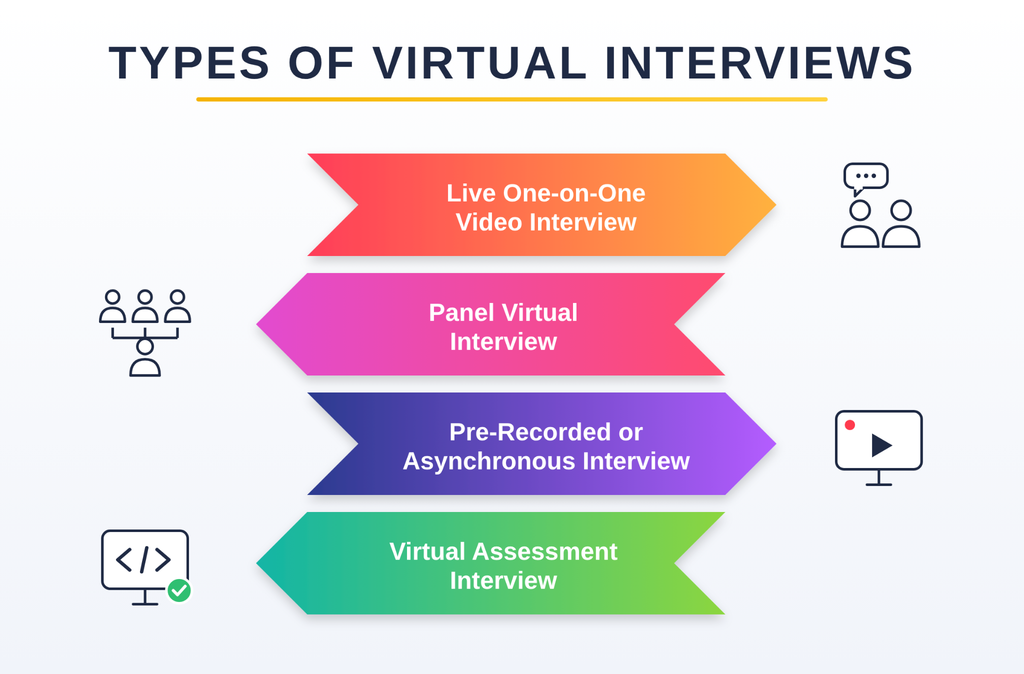
1. Live One-on-One Video Interview
A live one-on-one video interview involves a direct conversation between a recruiter or hiring manager and a candidate through a video conferencing platform.
It is similar to a traditional interview, except both participants connect remotely. Recruiters can ask questions, discuss job responsibilities and understand the candidate’s experience in real time.
Example: An HR manager conducts a 30-minute video call with a candidate to discuss their work experience, technical skills and salary expectations.
2. Panel Virtual Interview
A panel virtual interview involves multiple interviewers evaluating one candidate during the same online meeting. The panel may include Core HR representatives, department managers, technical experts or senior leadership.
Each interviewer can ask questions related to their area of expertize. This approach helps the organization gather different perspectives before making a hiring decision.
Example: A candidate applying for a marketing manager position may be interviewed by an HR manager, marketing head and business manager through Microsoft Teams.
3. Pre-Recorded or Asynchronous Interview
In a pre-recorded interview, candidates receive a set of questions and record their responses using an online interview platform. They submit the recordings for recruiters or hiring managers to review later.
Unlike live interviews, candidates and recruiters do not need to be available at the same time. This format is often used during the initial screening stage when an organization receives applications from a large number of candidates.
Example: A company asks shortlisted candidates to record answers to five questions about their experience and job-related skills. The recruitment team reviews the recordings and selects candidates for the next interview round.
4. Virtual Assessment Interview
A virtual assessment interview combines an online interview with additional activities designed to evaluate a candidate’s abilities. Depending on the job role, candidates may be asked to complete technical tasks, solve business problems, participate in case studies or demonstrate specific skills.
Example: A software developer candidate may attend a video interview while completing a coding exercise shared through an online assessment platform.
How Does a Virtual Interview Process Work?
The virtual interview process involves several steps, starting with interview scheduling and ending with candidate evaluation and feedback. A structured process helps recruiters coordinate interviews, maintain communication and assess candidates consistently.
Here are the six common steps involved in a virtual interview process:
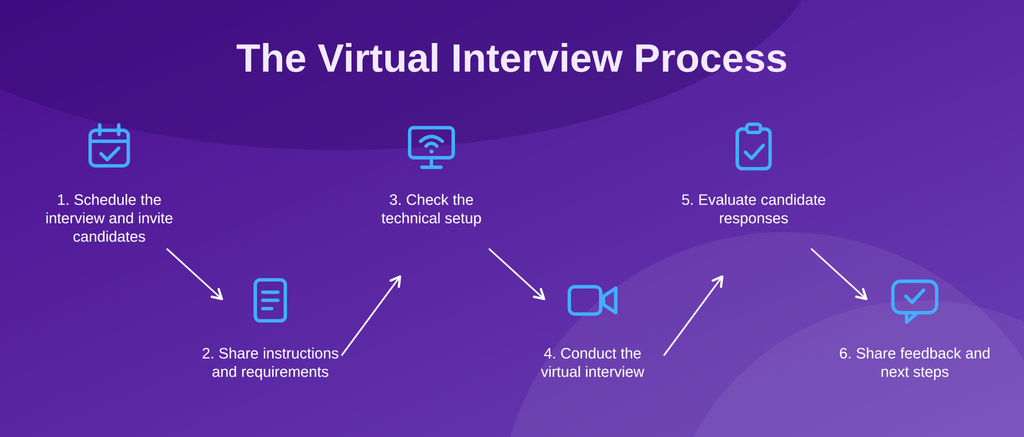
Step 1: Schedule the Interview and Invite Candidates
Once candidates are shortlisted then recruiters coordinate interview schedules with hiring managers and applicants. They select a suitable date and time based on everyone’s availability.
The recruiter then sends an invitation containing important details, such as:
- Interview date and time.
- Video conferencing platform.
- Meeting link and joining instructions.
- Interview duration.
- Interviewer’s name and designation.
- Contact details for technical assistance.
Clear communication at this stage helps candidates prepare and join the interview without confusion.
Step 2: Share Interview Instructions and Requirements
Before the interview, recruiters should inform candidates about the interview format, expected duration, and any preparation requirements.
For example, candidates attending a technical interview may need to keep their portfolio, project details or relevant documents ready.
Recruiters should also explain whether the interview will involve a live discussion, technical assessment or pre-recorded responses.
Step 3: Check the Technical Setup
Both recruiters and candidates should check their technical arrangements before the scheduled interview.
Important things to verify include:
- Stable internet connection.
- Working camera and microphone.
- Proper lighting and a suitable background.
- Updated video conferencing application.
- Access to the interview link.
Testing these requirements beforehand helps minimize interruptions during the conversation.
Step 4: Conduct the Virtual Interview
The interviewer joins the meeting, welcomes the candidate and briefly explains the interview structure.
The discussion generally covers the candidate’s background, relevant experience, technical knowledge, communication abilities and suitability for the position.
Recruiters can ask role-specific and behavioural questions to understand how candidates approach different workplace situations.
For technical positions, they may also include coding exercises, practical tasks or skill assessments.
Step 5: Evaluate Candidate Responses
After the interview, recruiters and hiring managers assess candidates based on their responses and job-related competencies.
They can use a structured evaluation scorecard to record observations about:
- Relevant qualifications and experience.
- Role-specific knowledge.
- Technical and functional skills.
- Problem-solving abilities.
- Communication relevant to the role.
- Performance in assessments.
Using consistent evaluation criteria helps organizations compare candidates more fairly and make informed hiring decisions.
Step 6: Share Feedback and Communicate Next Steps
Once a candidate clears the virtual interview and accepts the offer, the next step is onboarding. An organized onboarding process helps HR teams complete documentation, collect employee details, share company policies and prepare new hires for their roles.
Using Employee Onboarding Software can help streamline these activities and make the transition from candidate to employee smoother.
What Are the Benefits of Virtual Interviews?
Virtual interviews offer several advantages to organizations and job candidates as they make hiring more flexible, reduce travel-related requirements and allow recruiters to connect with applicants across different geographical locations.
Here are some important benefits from both perspectives.
Benefits of Virtual Interviews for Employers
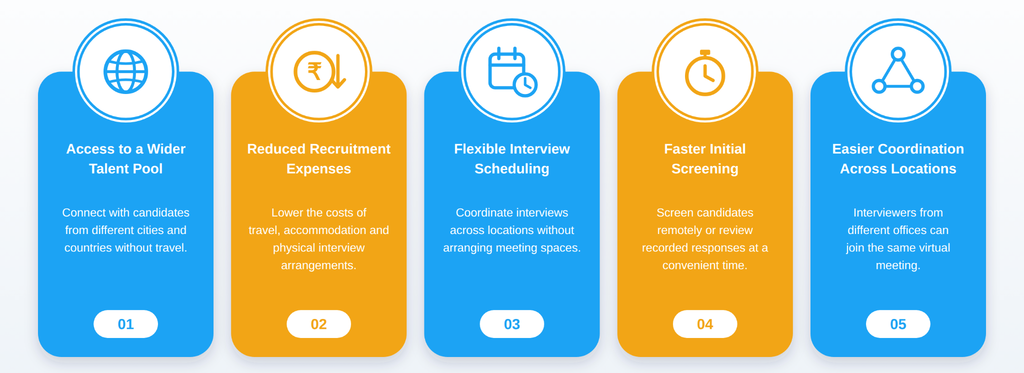
1. Access to a Wider Talent Pool
Virtual interviews allow organizations to connect with candidates from different cities, states and countries without requiring them to travel for an interview.
For example, a company headquartered in Mumbai can interview applicants from Pune, Delhi, Hyderabad or Bengaluru through online platforms. This gives recruiters more flexibility when sourcing and evaluating talent.
2. Reduced Recruitment Expenses
Traditional interviews may involve expenses related to travel, accommodation and physical interview arrangements, particularly when candidates are located in different cities.
Virtual interviews can reduce many of these logistical expenses by allowing recruiters and candidates to connect remotely.
3. Flexible Interview Scheduling
Recruiters can coordinate interviews across different locations without arranging physical meeting spaces. This is particularly useful when hiring managers, interview panel members and candidates have different schedules.
Online meetings also make it easier to arrange multiple interview rounds.
4. Faster Initial Screening
Recruiters can conduct initial interviews remotely and evaluate shortlisted candidates without spending time coordinating physical meetings.
Pre-recorded interviews can also help hiring teams review candidate responses at a convenient time. However, the overall time to hire still depends on the organization’s selection process and decision-making.
5. Easier Coordination Across Multiple Locations
Businesses operating across multiple offices can involve interviewers from different locations in the same virtual meeting.
For example, an organization with offices in Chennai, Delhi and Hyderabad can arrange a panel interview without requiring everyone to travel to a single location.
Benefits of Virtual Interviews for Candidates
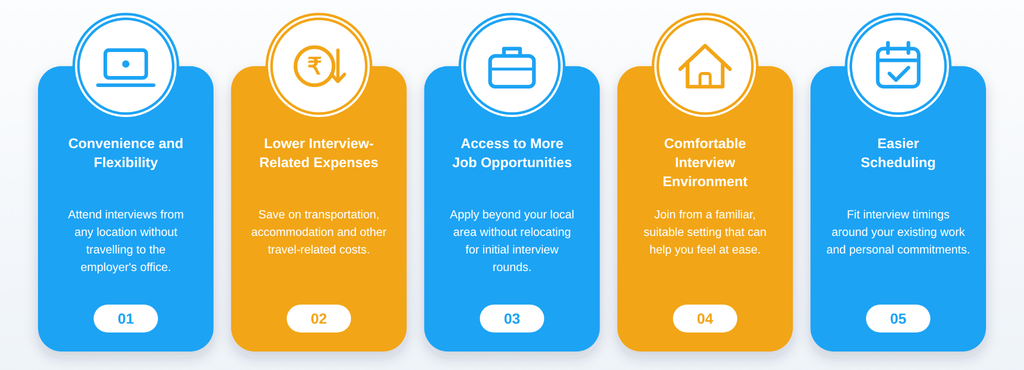
1. Convenience and Flexibility
Candidates can attend interviews from any location without travelling to the employer’s office. This makes the process more convenient, particularly for applicants who are currently employed or living in another city.
2. Lower Interview-Related Expenses
Candidates can save on transportation, accommodation and other travel-related expenses, especially when attending interviews with companies in different cities.
3. Access to More Job Opportunities
Virtual interviews allow candidates to apply for opportunities beyond their immediate geographical area. They can connect with employers in different locations without relocating or travelling for the initial interview rounds.
4. Comfortable Interview Environment
Candidates can participate from a familiar and suitable environment, which may help them feel more comfortable during the conversation.
However, they should still maintain a professional setup and minimize distractions.
5. Easier Scheduling
Online interviews make it easier for candidates to coordinate interview timings around their existing work and personal commitments.
What Are the Challenges of Virtual Interviews?
Although virtual interviews make recruitment more convenient, they also come with certain challenges. Technical difficulties, communication barriers and limited face-to-face interaction can sometimes affect the interview experience.
Understanding these challenges helps recruiters and candidates prepare better.
| Challenge | How it affects the interview | Possible solution |
| Internet connectivity issues | Interrupts communication and causes delays | Check internet stability and keep an alternative connection available |
| Audio and video problems | Makes conversations difficult to follow | Test the camera, microphone and platform before joining |
| Background distractions | Affects concentration and professionalism | Choose a quiet location with a suitable background |
| Limited non-verbal communication | Makes it harder to understand certain visual cues | Ask clear questions and allow candidates time to respond |
| Technical unfamiliarity | Candidates may struggle to join or use the platform | Share joining instructions in advance |
| Privacy and security concerns | Unauthorized access or recording may affect candidate privacy | Use secure platforms and communicate recording policies |
| Accessibility limitations | Some candidates may face difficulties using video-based tools | Provide reasonable accommodations and alternative interview arrangements |
Recruiters should also avoid relying entirely on video-based communication when evaluating candidates. A structured assessment process that focuses on job-related skills and competencies provides a more consistent basis for hiring decisions.
Virtual Interview vs In-Person Interview: What’s the Difference?
Virtual and in-person interviews serve the same purpose, which is helping employers assess candidates before making hiring decisions. However, they differ in how the interaction takes place, the technology required and the overall interview experience.
Here is a comparison of both formats:
| Comparison factor | Virtual Interview | In-Person Interview |
| Interview location | Conducted remotely | Conducted at a physical location |
| Communication | Through video or online platforms | Face-to-face interaction |
| Travel requirements | Usually not required | May be required |
| Scheduling | Flexible across locations | Requires physical coordination |
| Interview expenses | Generally lower logistical expenses | May involve travel and venue expenses |
| Geographical reach | Connects candidates across locations | More dependent on physical accessibility |
| Technical requirements | Requires internet and suitable devices | Usually requires fewer digital tools |
| Interaction | Digital communication | Direct face-to-face interaction |
| Assessment | Online discussions and digital assessments | In-person discussions and practical assessments |
When Should an Organization Choose Virtual Interviews?
Virtual interviews are useful when an organization:
- Hires candidates from different geographical locations.
- Conduct initial screening for multiple applicants.
- Has distributed or remote hiring teams.
- Needs to coordinate interviews across different offices.
- Wants to reduce travel-related requirements.
When Are In-Person Interviews More Suitable?
In-person interviews may be more appropriate when:
- The position requires physical demonstrations or on-site assessments.
- Candidates need to interact with specialized equipment.
- The role involves working in a specific physical environment.
- Face-to-face discussions are important for a particular assessment stage.
Many organizations also combine both formats. For example, they may conduct initial screening through video calls and arrange an in-person interview during the final selection stage.
What Tools Are Used for Virtual Interviews?
Virtual interviews depend on digital tools that help recruiters communicate with candidates, coordinate schedules and evaluate applicants.
Some commonly used tools include:
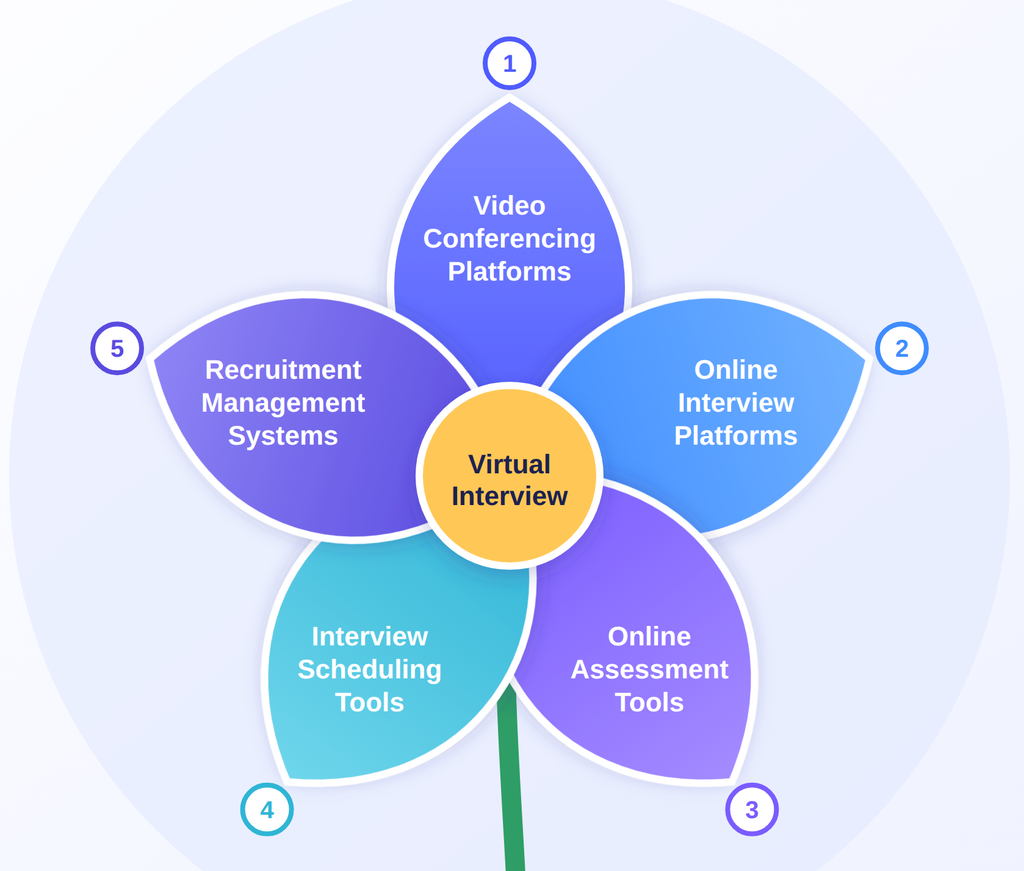
1. Video Conferencing Platforms
Tools such as Zoom, Google Meet and Microsoft Teams allow recruiters and candidates to conduct live video interviews, share screens and communicate remotely.
2. Online Interview Platforms
Dedicated interview platforms help organizations conduct live or pre-recorded interviews. Some platforms also offer features for reviewing candidate responses and organizing interview assessments.
3. Online Assessment Tools
Recruiters can use online assessment tools to evaluate technical knowledge, problem-solving abilities and role-specific skills. These tools are particularly useful for technical and specialized positions.
4. Interview Scheduling Tools
Scheduling tools help recruiters coordinate interview timings, check availability and share meeting invitations with candidates and interviewers.
5. Recruitment Management Systems
A Recruitment Management System helps HR teams organize candidate information, manage recruitment activities, track hiring progress and coordinate different stages of the recruitment process.
By bringing recruitment information and activities into a more organized workflow, these systems can help HR teams maintain better visibility into candidate progress.
What Are Common Virtual Interview Questions and Answers?
Virtual job interviews generally include questions about a candidate’s background, professional experience, skills and suitability for the position.
Although questions vary depending on the job role, here are some common virtual interview questions and answer examples with guidance on how to answer them.
1. Tell Me About Yourself.
Sample answer:
“I have experience in [your professional field] and have worked on projects involving [relevant skills or responsibilities]. In my previous role, I was responsible for [specific responsibility or achievement]. I am now looking for an opportunity where I can apply my experience, develop my skills and contribute to the organization’s goals.”
Tip: Keep your introduction brief and focus on experience relevant to the position.
2. Why Are You Interested in This Position?
Sample answer:
“I am interested in this position because it aligns with my professional experience and career goals. I have reviewed the job responsibilities and believe my skills in [relevant area] would help me contribute to the team. I am also interested in the opportunity to learn and take on new responsibilities.”
Tip: Connect your skills and interests with the actual job requirements.
3. What Are Your Strengths?
Sample answer:
“One of my key strengths is problem-solving. In my previous role, I handled situations where I had to identify issues, evaluate possible solutions, and coordinate with team members to complete tasks effectively. I also consider communication and adaptability important strengths.”
Tip: Mention strengths that are relevant to the position and support them with examples.
4. How Do You Manage Challenges While Working Remotely?
Sample answer:
“I manage remote work challenges by maintaining a clear task schedule, communicating regularly with team members and prioritizing important responsibilities. If I face a problem, I try to resolve it independently and seek support when necessary.”
Tip: Demonstrate time management, accountability and communication skills.
5. Why Should We Hire You?
Sample answer:
“I believe my experience and skills match the requirements of this position. I have worked on responsibilities similar to those mentioned in the job description, and I am confident that I can contribute through my knowledge, willingness to learn and ability to work with a team.”
Tip: Highlight your relevant qualifications and explain how you can contribute to the role.
6. How Do You Handle Teamwork and Communication?
Sample answer:
“I believe effective teamwork requires clear communication, collaboration and accountability. In my previous experience, I regularly coordinated with team members, shared updates and discussed challenges to ensure that tasks were completed on time.”
Tip: Provide a real example of how you have worked with others to achieve a shared goal.
What Mistakes Should You Avoid During a Virtual Interview?
Small mistakes can affect the overall interview experience, even when a candidate has the right qualifications and experience. Both recruiters and candidates should be aware of common issues and take steps to avoid them.
| Common mistake | Why to avoid it | Better approach |
| Joining without testing technology | Technical problems can interrupt the interview | Test the platform, camera and microphone beforehand |
| Providing unclear instructions | Candidates may struggle to join the meeting | Share complete joining details in advance |
| Interrupting candidates | Can affect communication and candidate comfort | Allow candidates sufficient time to respond |
| Asking unrelated questions | Makes candidate evaluation less relevant | Prepare role-specific questions |
| Ignoring accessibility requirements | May create unnecessary barriers | Provide suitable accommodations |
| Reading memorized answers | Responses may sound unnatural | Prepare key points and answer naturally |
| Joining late | Creates a poor first impression | Join a few minutes early |
| Ignoring follow-up communication | Leaves candidates uncertain about the outcome | Share updates and feedback within the communicated timeline |
Avoiding these mistakes helps recruiters conduct more organized interviews and allows candidates to present their skills and experience effectively.
Conclusion
Virtual interviews have become a useful part of modern recruitment by allowing organizations to connect with candidates across different locations. They offer greater scheduling flexibility, reduce travel-related requirements and support remote hiring activities.
However, an effective virtual interview requires more than a video conferencing platform as recruiters need a structured interview process, relevant questions, consistent evaluation criteria and clear communication with candidates. Similarly, candidates should prepare their technology, environment and responses to participate confidently.
By combining the right interview practices with suitable recruitment and HR technology, organizations can create a more organized and candidate-friendly hiring experience.
Frequently Asked Questions
1. What Is the Meaning of a Virtual Interview?
A virtual interview is conducted online through video conferencing or online communication platforms. It allows recruiters and candidates to discuss job requirements, evaluate skills and complete different interview stages without meeting in person.
2. Is an Online Interview the Same as a Virtual Interview?
Yes, the terms online interview and virtual interview are generally used interchangeably. Both refer to interviews conducted remotely using digital communication tools. However, virtual interviews can include live video calls, pre-recorded interviews and other online assessment formats.
3. What Are the Different Types of Virtual Interviews?
Common types include live one-on-one video interviews, panel interviews, pre-recorded or asynchronous interviews and virtual assessment interviews. Organizations choose a format depending on the job role, hiring stage and evaluation requirements.
4. How Long Is a Virtual Interview?
The duration depends on the position, interview format and hiring stage. An initial screening interview may take around 15–30 minutes, while technical, managerial or final-round interviews may take longer.
5. How Early Should You Join a Virtual Interview?
It is generally recommended to join a virtual interview 5–10 minutes before the scheduled time. This gives you enough time to check your internet connection, camera, microphone and meeting link. Avoid joining too early, as the interviewer may still be preparing for the meeting.
6. What Are the Advantages and Disadvantages of Virtual Interviews?
Virtual interviews offer benefits such as flexible scheduling, reduced travel requirements, lower logistical expenses and access to candidates across locations. However, they may also involve technical problems, communication barriers, privacy concerns and limited face-to-face interaction.
7. Which Platforms Are Commonly Used for Virtual Interviews?
Commonly used platforms include Zoom, Google Meet and Microsoft Teams. Organizations may also use dedicated online interview platforms for pre-recorded interviews, candidate assessments and interview management.