


TL;DR
- Cloud HR software helps small businesses centralize and automate core HR processes from one platform.
- Businesses with under 100 employees generally need simple, affordable, and easy-to-use HR automation.
- Businesses with 100+ employees may need advanced workflows, analytics, permissions, integrations, and scalability.
- Key features to evaluate include core HR, payroll, attendance, leave, recruitment, onboarding, performance, reporting, and employee self-service.
- Popular options include Savvy HRMS, Keka HR, greytHR, ZingHR, Sage HR, and PeopleStrong.
- The right HRMS should support your current requirements as well as future business growth.
- Compare pricing, implementation, integrations, security, scalability, and support before choosing.
- Avoid selecting software based only on price or the number of features.
- For growing businesses, a scalable cloud HRMS can reduce manual work, improve employee experience, and streamline HR operations.
Imagine a small business with 60 employees. The HR team is still managing attendance through spreadsheets, collecting leave requests through email, and spending hours checking payroll inputs every month. As the company grows toward 100 employees, these manual processes become increasingly difficult to manage accurately and consistently.
Now imagine that the same business crosses 100 employees. HR has more departments, managers need better visibility, employees expect self-service access, and payroll and compliance require greater control. This is where cloud HR software can become an important part of the company’s daily operations.
The right cloud HR software can centralize employee information, automate repetitive HR tasks, connect attendance with payroll, simplify leave management, and provide employees with digital self-service. However, the requirements of a 50-employee company may differ considerably from those of a 150- or 300-employee organization.
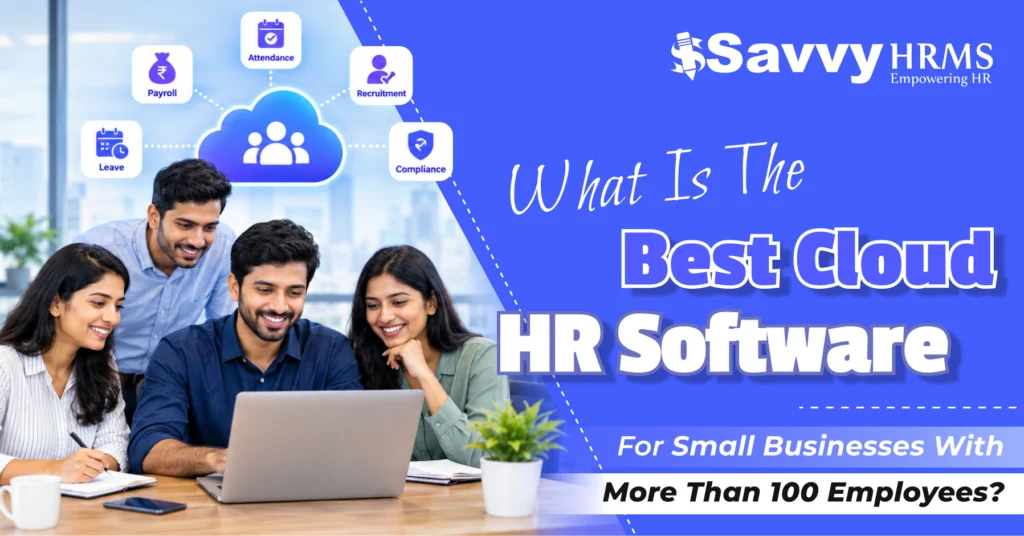
This guide explores the best cloud HR software for small businesses and compares options for companies operating below and above the 100-employee mark.
What Is Cloud HR Software for Small Businesses?
Cloud HR software is a web-based human resource management system that allows businesses to manage employee information, attendance, leave, payroll, recruitment, performance, documents, and other HR activities through an online platform. Unlike traditional software installed on a local computer, cloud HR systems can generally be accessed from supported devices with an internet connection.
For small businesses, cloud HR software provides a centralized environment where HR teams, managers, and employees can access relevant information according to their permissions. Instead of maintaining separate spreadsheets and disconnected systems, businesses can bring important HR processes together in one platform.
Cloud HR software can also support business growth. A company may initially need employee records, attendance, leave, and payroll, but later require recruitment, performance management, employee self-service, analytics, expense management, and workflow automation. A scalable cloud HRMS can allow businesses to add capabilities as their workforce and processes become more complex.
Why Small Businesses Need Cloud-Based HR Software
Small businesses often have limited HR teams managing multiple responsibilities such as employee records, attendance, leave, payroll, recruitment, and onboarding. As the workforce grows, manual processes can become time-consuming and difficult to manage efficiently.
Cloud-based HR software helps businesses centralize and automate these processes while improving accessibility and employee experience.
Key benefits include:
- Less manual work: Automates repetitive HR tasks and approvals.
- Centralized data: Keeps employee records and documents organized.
- Faster processes: Simplifies attendance, leave, payroll, and onboarding.
- Employee self-service: Lets employees manage routine HR requests independently.
- Better accuracy: Reduces errors caused by manual data entry.
- Easy accessibility: Allows authorized users to access HR information online.
- Scalability: Supports growing employee numbers, teams, and locations.
- Better reporting: Provides useful workforce insights and HR reports.
For businesses approaching or crossing 100 employees, scalable cloud HR software can also support more advanced requirements such as performance management, recruitment automation, analytics, workflows, and stronger access controls.
What to Look for in Cloud HR Software for Small Businesses
Choosing the best cloud HR software for a small business requires looking beyond the number of features. The software should match the organization’s workforce size, HR processes, budget, industry requirements, and expected growth.
Key factors to evaluate include:
- Core HR: Centralized employee records, documents, organizational structures, and employee information.
- Attendance management: Attendance tracking, shifts, work hours, regularization, and integrations with attendance devices.
- Leave management: Leave policies, balances, requests, approvals, and holiday calendars.
- Payroll: Salary processing, deductions, payslips, reimbursements, and applicable statutory requirements.
- Employee self-service: Employee access to payslips, documents, leave requests, personal information, and HR services.
- Recruitment: Applicant tracking, hiring workflows, interview management, and onboarding.
- Performance management: Goals, reviews, feedback, performance tracking, and development processes.
- Reporting and analytics: Workforce reports, dashboards, attendance insights, payroll information, and HR metrics.
- Mobile accessibility: Mobile access for employees, managers, and HR teams.
- Integrations: Connections with payroll, accounting, attendance, recruitment, productivity, and other business systems.
- Security and permissions: Role-based access, controlled employee data access, authentication, and auditability.
- Scalability: Ability to support increasing employees, locations, departments, and HR complexity.
The best cloud HR software for small businesses is therefore not necessarily the platform with the longest feature list. It is the platform that provides the capabilities the organization actually needs while remaining practical to implement and operate.
Best Cloud HR Software for Small Businesses
There is no single HR platform that is automatically suitable for every small business. Employee count, payroll requirements, geography, industry, HR maturity, integrations, and growth plans can all influence the choice.
The following 6 cloud HR software options can be evaluated by small and growing businesses based on their functional coverage and organizational requirements.
1. Savvy HRMS
Overview
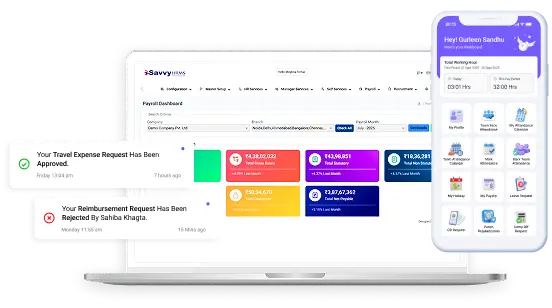
Savvy HRMS is a cloud-based HR management platform designed to help businesses centralize and automate multiple HR processes. Its platform brings together core HR activities such as employee management, attendance, leave, payroll, recruitment, performance, and statutory compliance.
For small and growing businesses, Savvy HRMS provides a broad collection of HR modules within one platform. Its available modules include attendance, leave, payroll, recruitment, performance management, learning and development, travel and expense, helpdesk, task management, employee assets, surveys, visitor management, canteen management, biometric attendance, and mobile access.
Key Features
- Centralizes employee information and core HR processes within one cloud-based platform.
- Automates attendance tracking, shift management, and employee time-related processes.
- Supports leave management with digital requests, approvals, and policy-based workflows.
- Provides payroll management capabilities alongside statutory compliance processes.
- Supports recruitment and onboarding activities for growing organizations.
- Includes performance management capabilities for structured employee performance processes.
- Provides learning and development tools for employee capability-building initiatives.
- Includes travel, expense, reimbursement, helpdesk, task, asset, and survey management.
- Offers mobile accessibility for HR activities and employee self-service requirements.
Implementation and Support Reality
Implementation should be evaluated according to the organization’s employee data, HR policies, payroll configuration, attendance setup, workflows, integrations, and reporting requirements. Businesses should clarify the data-migration process, implementation timeline, training responsibilities, support channels, customization requirements, and post-go-live assistance before deployment to understand the complete implementation experience.
2. Keka HR
Overview
Keka is a cloud HR platform covering employee management, hiring, onboarding, workforce operations, employee support, payroll-related processes, workflows, reporting, and people analytics. It is designed for growing organizations and supports employee lifecycle management through connected HR processes.
Key Features
- Centralized HRIS for employee records, documents, reporting structures, and data.
- Supports hiring, interviews, offers, onboarding, and recruitment workflow management.
- Connects attendance, timesheets, and time-off processes with payroll operations.
- Provides workflow automation for onboarding, employee changes, and recurring HR tasks.
- Offers employee self-service for payslips, leave, documents, and personal information.
- Provides reporting, people analytics, access controls, and organizational visibility.
Implementation and Support Reality
Keka describes guided onboarding and workflow setup as part of its implementation approach. Businesses should still validate migration requirements, configuration responsibilities, integrations, training, support contacts, service-level expectations, and the level of assistance available during and after go-live before selecting the platform.
3. greytHR
Overview
greytHR is a cloud-based HR and payroll platform covering employee information, onboarding, leave, attendance, payroll, employee self-service, workflows, reporting, and compliance-related processes. It is positioned as a full-suite HRMS for organizations looking to consolidate multiple HR activities.
Key Features
- Centralized employee database for records, documents, and HR information.
- Supports employee lifecycle activities from onboarding through exit processes.
- Provides attendance, leave, workforce management, and employee self-service capabilities.
- Supports payroll processing and statutory payroll requirements for Indian organizations.
- Offers HR dashboards, reports, workflows, and analytics capabilities.
- Provides integrations with selected third-party business and HR systems.
Implementation and Support Reality
Implementation requirements can vary depending on payroll configuration, employee data, attendance systems, integrations, and organizational workflows. Businesses should confirm the migration process, configuration timeline, implementation assistance, training, support structure, and post-launch service expectations before signing up for a specific plan.
4. ZingHR
Overview
ZingHR is an enterprise-oriented HCM platform covering recruitment, onboarding, workforce management, payroll, performance, learning, engagement, analytics, and other employee lifecycle processes. Its platform focuses heavily on automation, workforce management, payroll, and technology-enabled HR operations.
Key Features
- Supports recruitment and digital onboarding across the employee lifecycle.
- Provides payroll processing and statutory compliance capabilities.
- Offers attendance, workforce management, and time-related automation.
- Includes performance management with goals, KPIs, OKRs, and feedback.
- Provides learning, employee engagement, analytics, and workforce insights.
- Supports integrations with business systems and HR technology infrastructure.
Implementation and Support Reality
ZingHR’s broader HCM capabilities can require careful implementation planning, particularly where businesses have multiple locations, entities, employee categories, integrations, or complex workflows. Organizations should confirm implementation ownership, configuration, data migration, integrations, training, support availability, and expected deployment timelines for their specific requirements.
5. Sage HR
Overview
Sage HR is a cloud-based HR platform aimed at growing businesses and provides modules for core HR, leave management, performance, shift scheduling, timesheets, expenses, and recruitment. Its modular approach allows businesses to select capabilities according to their operational requirements.
Key Features
- Provides centralized employee records and core HR management.
- Includes leave and absence management for employee time-off processes.
- Supports performance goals, one-to-ones, and 360-degree feedback.
- Provides shift scheduling and timesheet management capabilities.
- Supports expense management through digital submission and workflows.
- Offers recruitment tools for applicant and hiring pipeline management.
Implementation and Support Reality
Sage HR offers a modular approach and provides product resources, customer support, learning resources, and product guidance. Businesses should assess which modules they require, how existing employee data will be migrated, what integrations are needed, and what support is included for configuration and ongoing administration.
6. PeopleStrong
Overview
PeopleStrong is a broad HCM platform covering recruitment, onboarding, core HR, payroll, leave and attendance, performance, learning, career development, succession, compensation, analytics, and other workforce processes. Its broad functionality makes it relevant for organizations with more complex workforce management requirements.
Key Features
- Centralizes employee information through a cloud-based HR platform.
- Supports recruitment and onboarding across the employee lifecycle.
- Provides payroll, leave, attendance, and workforce management capabilities.
- Includes performance, learning, career, and succession management tools.
- Offers compensation management and workforce analytics capabilities.
- Supports employee experience, collaboration, and broader HCM requirements.
Implementation and Support Reality
PeopleStrong offers a broad HCM environment, so implementation scope can depend heavily on the modules, employee population, payroll configuration, integrations, and organizational structure involved. Businesses should clarify implementation methodology, data migration, configuration, training, integration support, timelines, and post-go-live support before deployment.
| Cloud HR Software | Core HR | Payroll | Attendance & Leave | Recruitment | Performance | Analytics | Employee Self-Service | Best Fit to Evaluate |
| Savvy HRMS | Yes | Yes | Yes | Yes | Yes | Yes | Yes | Small, growing, and large businesses looking for broad HR coverage |
| Keka HR | Yes | Yes | Yes | Yes | Yes | Yes | Yes | Growing organizations needing connected HR workflows |
| greytHR | Yes | Yes | Yes | Yes | Yes | Yes | Yes | Businesses seeking integrated HR and payroll operations |
| ZingHR | Yes | Yes | Yes | Yes | Yes | Yes | Yes | Organizations evaluating broader HCM and automation |
| Sage HR | Yes | Through available setup/integrations | Yes | Yes | Yes | Yes | Yes | Growing businesses wanting modular HR capabilities |
| PeopleStrong | Yes | Yes | Yes | Yes | Yes | Yes | Yes | Organizations evaluating broader HCM and workforce management |
Feature availability, plan limitations, integrations, pricing, and implementation arrangements can change. Businesses should verify the current configuration and commercial terms directly with each provider before making a purchase decision.
Cloud HR Software for Under 100 vs. Over 100 Employees: What Changes?
The 100-employee mark is not a universal technical threshold. However, it can be a useful planning point because HR processes often become more structured as the workforce grows.
For Businesses With Under 100 Employees
A company with fewer than 100 employees may prioritize simplicity, affordability, ease of implementation, and essential HR automation.
General priorities include:
- Employee database
- Attendance and leave
- Payroll
- Payslips
- Employee self-service
- Basic recruitment
- Onboarding
- Essential reports
- Mobile accessibility
- Simple approval workflows
For these businesses, an HRMS should ideally reduce manual work without creating unnecessary administrative complexity. A platform with modular functionality can be useful because the company can start with essential HR functions and expand later.
For Businesses With More Than 100 Employees
Once an organization moves beyond 100 employees, HR teams may need greater process control and visibility.
Common requirements can include:
- Advanced attendance and shift management
- Multi-location HR management
- More detailed permissions
- Automated workflows
- Performance management
- Recruitment automation
- Advanced payroll controls
- Compliance management
- HR analytics
- Employee engagement
- Integrations
- Workforce planning
- Manager self-service
The important consideration is not simply the number of employees. A 70-person manufacturing company with multiple shifts may have more complex HR requirements than a 150-person office-based company.
Therefore, employee count should be treated as one evaluation factor rather than the only deciding factor.
What Are the Key Features Small Businesses Should Prioritize in Cloud HR Software?
1. Core HR Management
The HRMS should provide a centralized employee database where HR teams can manage employee information, documents, job details, reporting structures, and other essential records.
2. Attendance and Leave Management
Automated attendance and leave management can reduce spreadsheet dependency. Businesses should look for support for shifts, policies, approvals, attendance regularization, and relevant integrations.
3. Payroll Management
Payroll should connect logically with employee data, attendance, leave, deductions, reimbursements, and applicable statutory requirements. This reduces repeated data entry and reconciliation work.
4. Employee Self-Service
Employees should be able to complete common tasks such as viewing payslips, requesting leave, updating selected information, submitting expenses, and accessing documents without depending entirely on HR.
5. Workflow Automation
Automated approvals, reminders, notifications, checklists, and task assignments can help HR teams standardize recurring processes.
6. Recruitment and Onboarding
Growing businesses should consider whether the HRMS can support hiring, candidate management, offer processes, document collection, onboarding, and employee creation.
7. Performance Management
As teams grow, informal performance discussions may become difficult to manage consistently. Goals, reviews, feedback, OKRs, KPIs, and performance records can provide more structure.
8. Reporting and Analytics
HR leaders should have access to relevant workforce information without depending on manual spreadsheet preparation for every report.
9. Security and Permissions
Employee data is sensitive business information. Role-based access, authentication, permissions, audit trails, and appropriate security controls should be part of the evaluation.
10. Scalability
The system should be able to support additional employees, departments, locations, policies, workflows, and integrations as the organization grows.
How Much Does Cloud HR Software Cost for Small Businesses?
The cost of cloud HR software can vary significantly depending on the provider, employee count, modules, payroll requirements, implementation scope, integrations, and pricing model.
Some providers use employee-based pricing, while others structure pricing around modules, plans, minimum employee counts, or customized enterprise packages. Implementation and integration costs may also differ.
For a small business, comparing only the monthly subscription price can therefore be misleading.
Instead, calculate the potential total cost of ownership, including:
- Software subscription
- Payroll or HR modules
- Implementation
- Data migration
- Integrations
- Additional users or employees
- Customization
- Training
- Support
- Optional modules
- Hardware or biometric integrations where applicable
A low-cost HRMS may not necessarily be economical if important capabilities require additional purchases. Similarly, a platform with a higher subscription price may provide more of the functions a growing company actually needs.
Before purchasing, ask vendors for a clear breakdown of what is included in the selected plan and what is charged separately.
What Are the Benefits of Using Cloud HR Software as Your Business Grows?
1. Reduced Manual HR Work
Cloud HR software automates repetitive tasks such as employee data entry, attendance processing, leave approvals, payroll inputs, report preparation, and routine queries. This allows HR teams to spend less time on administration and more time on strategic workforce activities.
2. Centralized Employee Information
A cloud HRMS stores employee records, documents, attendance, leave, payroll details, and other information in one centralized platform. This reduces dependency on multiple spreadsheets and helps HR teams access accurate employee information whenever required.
3. Better Employee Experience
Employee self-service allows employees to complete routine HR activities without depending entirely on HR teams. They can submit leave requests, access payslips, update selected information, view documents, and track requests through a convenient digital platform.
4. Faster HR Processes
Cloud HR software simplifies recurring HR workflows by automatically routing requests to the appropriate managers or HR teams. Notifications, approvals, reminders, and automated processes can reduce delays and help organizations complete everyday HR activities more efficiently.
5. Better Visibility
Dashboards and reports provide HR teams and managers with centralized visibility into workforce information. Businesses can monitor attendance, leave, payroll data, employee trends, and other HR metrics, helping them access relevant information for workforce planning.
6. Easier Business Expansion
A scalable cloud HRMS can support increasing employee numbers, additional departments, new locations, and evolving HR processes. Businesses can gradually expand their HR capabilities without replacing their entire system as workforce requirements become more complex.
7. Improved Process Consistency
Standardized workflows help businesses manage recurring HR activities consistently across teams and locations. By using defined policies, approval processes, notifications, and digital records, HR teams can reduce process variations and maintain greater operational consistency.
8. Better Data Availability
Centralized HR information allows authorized users to access updated workforce data without repeatedly collecting information from different spreadsheets, emails, or departments. This can reduce information gaps and make routine HR reporting and decision-making more efficient.
How to Choose the Right Cloud HR Software for Your Business
Start with your current HR challenges rather than starting with a vendor’s feature list.
Step 1: Define Your Employee Count
Identify your current workforce and expected growth over the next two to three years. A company with 70 employees expecting to reach 250 employees should evaluate software differently from a company expecting stable headcount.
Step 2: List Your Current HR Processes
Document how you currently manage:
- Employee records
- Attendance
- Leave
- Payroll
- Recruitment
- Onboarding
- Performance
- Expenses
- Documents
- Compliance
- Employee queries
This makes it easier to identify which processes should be automated first.
Step 3: Separate Essential and Optional Features
Do not purchase modules simply because they exist. Identify your essential requirements first and then evaluate advanced features.
Step 4: Check Scalability
Ask whether the software can support more employees, departments, locations, workflows, integrations, and reporting requirements as your company grows.
Step 5: Evaluate Implementation
Ask who handles implementation, how employee data is migrated, how HR policies are configured, how users are trained, and what happens after go-live.
Step 6: Test the Employee Experience
The HR team is not the only group using the system. Employees and managers may use it for leave, attendance, payslips, approvals, documents, performance, and other processes.
Step 7: Compare the Complete Cost
Compare the total cost of the solution rather than only its advertised starting price.
Step 8: Verify Security and Compliance Requirements
Review access controls, data protection measures, authentication, audit capabilities, integrations, and relevant compliance support.
Step 9: Request a Relevant Demo
A generic product demo may not reveal whether the software fits your processes. Ask vendors to demonstrate your actual workflows, such as:
Employee joins → Onboarding → Attendance → Leave → Payroll → Payslip → Performance → Exit
This gives you a much clearer picture of how the HRMS would work in your organization.
Common Mistakes to Avoid When Choosing Cloud HR Software
| Common Mistake | What to Consider Instead |
| Choosing only based on price | Compare features, scalability, implementation, and total cost. |
| Ignoring future growth | Choose software that can support increasing employees and locations. |
| Selecting too many features | Prioritize features that match your actual HR requirements. |
| Overlooking employee experience | Check whether employees and managers can easily use the platform. |
| Not checking integrations | Verify compatibility with payroll, attendance, accounting, and other systems. |
| Ignoring implementation support | Understand data migration, training, setup, and post-launch support. |
| Comparing vendors without a checklist | Evaluate every HR software using the same requirements. |
Conclusion
The best cloud HR software for small businesses depends on employee count, HR complexity, payroll requirements, business structure, budget, integrations, and growth plans. Companies under 100 employees may prioritize simplicity and essential automation, while businesses above 100 employees may need stronger workflows, analytics, permissions, and scalability.
Options such as Savvy HRMS, Keka HR, greytHR, ZingHR, Sage HR, and PeopleStrong provide different combinations of HR, payroll, workforce, talent, analytics, and employee experience capabilities. The right choice should be based on your organization’s actual requirements rather than employee count alone.
If your business is growing from 50 to 100 employees or beyond, evaluate an HRMS not just for what it can do today, but for how effectively it can support your next stage of growth.



Ready to simplify HR management as your business grows?
Explore Savvy HRMS and see how its integrated HR modules can help you manage your workforce from one platform.
Frequently Asked Questions (FAQs)
1. What is the best cloud HR software for small businesses?
The best cloud HR software depends on employee size, HR requirements, payroll needs, budget, integrations, and future growth plans. Businesses should compare features, scalability, ease of use, implementation, and support before selecting a platform.
2. Is cloud HR software suitable for businesses with fewer than 100 employees?
Yes. Cloud HR software can be suitable for businesses with fewer than 100 employees by helping automate employee management, attendance, leave, payroll, onboarding, and employee self-service while reducing manual HR work.
3. What HR features should small businesses look for in cloud HR software?
Small businesses should prioritize core HR, attendance, leave management, payroll, employee self-service, recruitment, onboarding, performance management, reporting, security, integrations, and scalability based on their specific requirements.
4. What changes when a business grows beyond 100 employees?
As businesses grow beyond 100 employees, they may require more advanced workflows, permissions, reporting, performance management, recruitment automation, multi-location support, analytics, integrations, and stronger workforce management capabilities.