


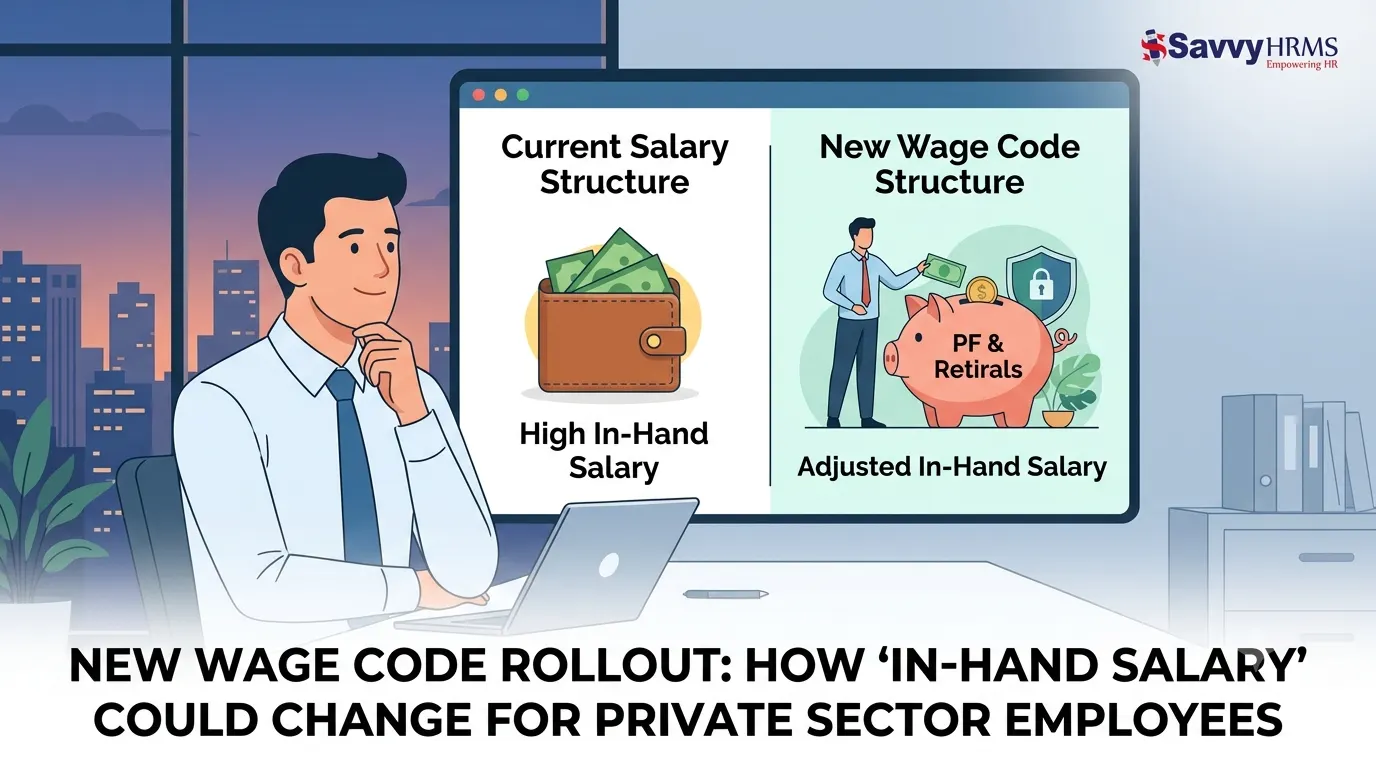
Private sector employees across India are starting to notice something odd on their payslips: a bigger chunk going toward PF, and a smaller number landing in their bank account. This isn’t a payroll error. It’s the early effect of India’s new Labour Codes reshaping how “wages” are defined, and it’s set to touch nearly every salaried employee in the country.
Where the Rollout Stands Right Now
India’s four new Labour Codes were brought into force on 21 November 2025, consolidating 29 existing central labour laws into four unified codes and introducing a standard definition of “wages” for the first time. But passing a law and enforcing it uniformly are two different things. As of April 2026, the central rules stand implemented, though most states are still working through their own implementation timelines, since labour is a subject on which both the central and state governments can legislate. That means the practical impact of the new wage code is landing at different speeds depending on where a company and its employees are based.
Several detailed central and state-level rules necessary for full implementation were still being notified even months after the codes technically took effect, and the Ministry of Labour and Employment continues to issue clarifications, with its most recent authoritative FAQ document published in mid-March 2026. For HR and payroll teams, this rolling, state-by-state notification process is exactly why the wage code has been harder to plan around than a single fixed deadline.
| Payroll compliance shouldn’t depend on someone in HR manually tracking every state notification. Savvy HRMS payroll software flags regulatory updates automatically, so your salary structures stay compliant as rules evolve. |
The 50% Rule: The Real Reason Salaries Are Changing
The single biggest driver behind changing take-home pay is what’s commonly called the 50% wage rule. Under the Code on Wages, “wages” now include basic pay, dearness allowance, and retaining allowance, and these components together must add up to at least 50% of an employee’s total CTC.
This matters because many private companies have historically structured salaries with a low basic pay and a large share of “special allowances” or similar heads, precisely to keep statutory contributions like PF lower. Under the new rule, CTC structures that worked perfectly well under the old regime may now violate the uniform wages definition, forcing companies to rebuild salary structures so that basic-plus-DA clears the 50% threshold.
The knock-on effect is real money: when basic salary doubles, say from ₹15,000 to ₹30,000 a month, employer PF contributions roughly double too, and gratuity accrual rises at the same rate. Scaled across a workforce of a few hundred employees, that’s a meaningful annual cost increase that finance and HR need to model in advance rather than absorb by surprise.
How This Actually Hits In-Hand Salary
For employees, the effect shows up directly on the payslip. Because a larger share of salary now gets allocated to basic pay, PF deductions go up, which can bring the in-hand, take-home amount down slightly, even though the employee’s overall CTC hasn’t changed. More of the same CTC is essentially shifting into retirement and exit benefits rather than disappearing, since higher PF and gratuity translate into deferred savings, not lost income.
That distinction matters for how HR communicates this internally. Employees seeing a lower number in their bank account without context may assume they’ve taken a pay cut, when in reality the money is moving into long-term savings they’ll access later, whether through PF withdrawal rules or gratuity payouts.
| When compensation structures shift industry-wide, explaining the “why” to employees is half the battle. Savvy HRMS keeps salary, PF, and gratuity data transparent and audit-ready, so your team can show employees exactly where their money is going. |
Beyond Take-Home Pay: Other Changes Employees Should Know
The wage code’s ripple effects go beyond the paycheck itself:
- Gratuity for fixed-term employees: Gratuity now becomes applicable for fixed-term employees after just one year of service, rather than the earlier five-year continuous service requirement, extending a benefit that was largely reserved for permanent staff.
- Overtime calculations: The Ministry clarified in March 2026 that overtime allowance is factored into the 50% wage floor computation, meaning industries with heavy overtime, like manufacturing or logistics, need to re-audit their CTC structures carefully.
- Timely wage payments: Employers must now pay wages within fixed timelines depending on the wage period; monthly employees, for instance, must be paid before the 7th of the following month.
- A national wage floor: The Code introduces a national floor wage that no state can set its minimum wage below, creating a genuine national baseline for multi-state employers, even as individual states retain the ability to set higher local minimums.
- What doesn’t count as wages: The Ministry has clarified that performance-based incentives, ESOPs, and reimbursement-based payments are not automatically treated as wages under the new definition, so not every compensation component gets pulled into the 50% calculation.
What Should HR Teams Do Now?
The impact on any individual employee depends heavily on how their existing compensation structure is built, so blanket assumptions about “everyone loses X amount” don’t hold up; each salary structure needs individual assessment. That makes this less of a one-time fix and more of an ongoing compliance exercise as state rules continue rolling in.
Manual payroll systems simply aren’t built to handle this level of complexity reliably, particularly when hybrid gratuity computations are needed for employees who joined before the code took effect versus after. Practical next steps for HR and payroll teams include recalculating PF and gratuity bases against the revised wage definition, auditing salary structures against the 50% threshold, and tracking state-specific notifications rather than assuming central rules apply uniformly everywhere.
The Takeaway for Employees and Employers
The new wage code isn’t a one-off salary cut; it’s a structural rebalancing of how compensation is built, with more of every rupee flowing into retirement and statutory benefits. For private sector employees, that means slightly lower take-home pay in many cases, but stronger long-term financial security. For HR teams, it means the real work is just beginning: state rules are still landing, and getting salary structures compliant now avoids a scramble later.










Don't let a wage code overhaul turn into a payroll fire-drill. Run accurate, compliant payroll every cycle with Savvy HRMS.