


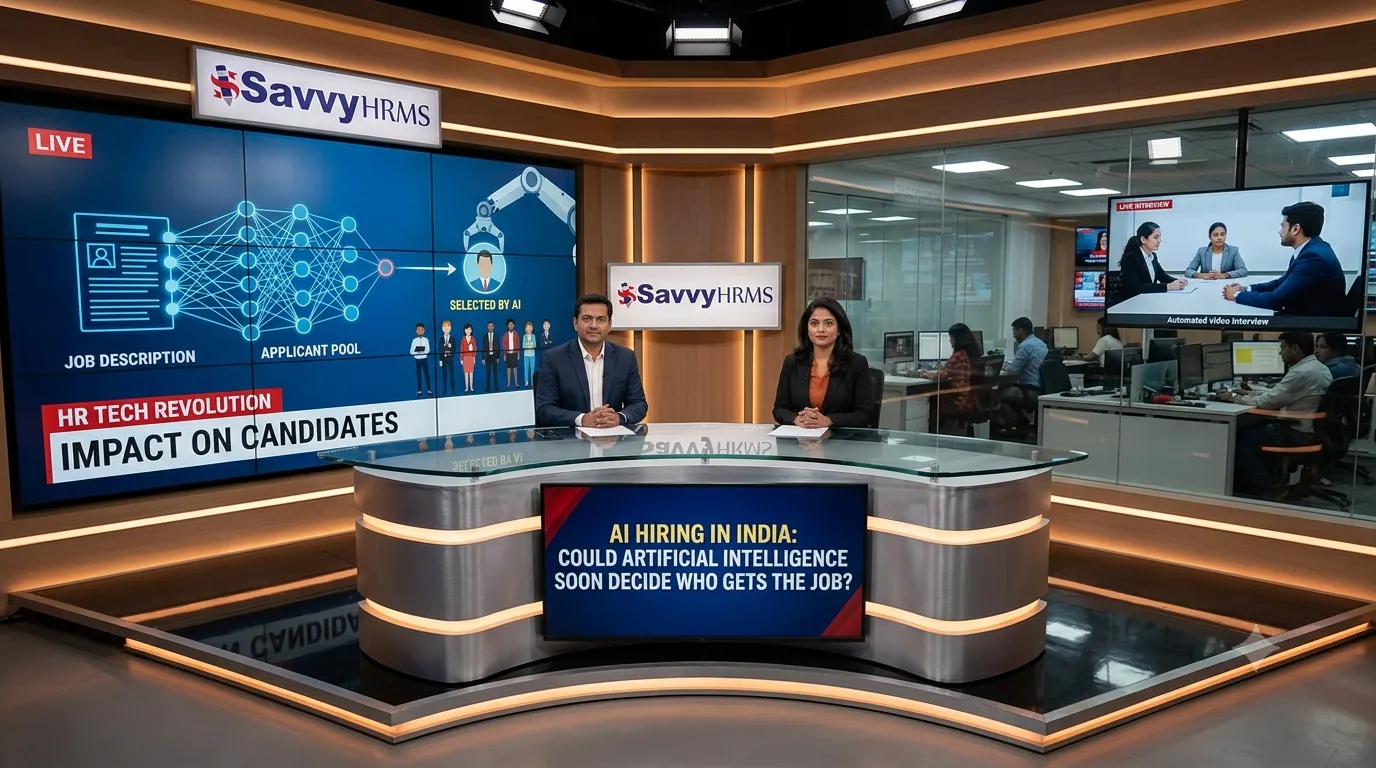
You apply for a job, upload your resume, answer a few questions, and then wait. But what if the first person, or rather, the first “system, to judge your application isn’t a recruiter at all?
Artificial intelligence is already becoming part of the hiring process in India. Companies are using AI to screen resumes, match candidates with job descriptions, automate communication, schedule interviews, and analyse candidate information. What once took recruiters hours can now happen in seconds.
That sounds efficient. But it also raises a bigger question: if AI can decide which candidates move forward, how long before it starts influencing who actually gets the job?
Where AI Hiring Stands Right Now
AI has moved beyond being a futuristic idea in recruitment. Many modern hiring platforms already use automation and AI-powered features to help recruiters manage large volumes of applications.
The reason is simple. Hiring can become confusing when a company receives hundreds or even thousands of applications for a single position. Manually reviewing every resume takes time, and recruiters still have interviews, employee management, payroll, and other HR responsibilities to handle.
AI can help reduce that workload by identifying candidates who appear to match the requirements of a role. It can look at skills, qualifications, experience, and other information in a candidate profile and help recruiters create a shortlist.
The important distinction is that AI-assisted hiring does not always mean AI-controlled hiring. In many organisations, the recruiter still makes the final decision. But the technology may already be influencing which candidates the recruiter gets to see.
| Make recruitment faster without losing the human touch. Explore smarter recruitment management with Savvy HRMS. |
The Resume May No Longer Be Judged by a Human First
For years, candidates have worried about making their resumes attractive to recruiters. Now, they may also need to make them understandable to algorithms.
AI-powered recruitment systems can compare resumes with job descriptions and identify relevant skills, experience and qualifications. A candidate whose profile closely matches the requirements may be highlighted, while another candidate could be pushed further down the list.
This can make recruitment faster, particularly for companies dealing with a large number of applications.
But there is a catch.
A candidate may have the right potential without using exactly the same language as a job description. Someone who changed careers, gained experience through freelance work, or developed skills outside a traditional degree or corporate job may not always look like the “perfect match” to an automated system.
A recruiter might see potential where an algorithm sees a mismatch.
Why Indian Employers Are Interested in AI Recruitment
For Indian businesses, the attraction of AI hiring is not difficult to understand.
Companies are hiring at different scales and across increasingly specialised roles. Recruiters need to identify suitable candidates quickly while keeping the hiring experience manageable.
AI can potentially help with:
- Screening large numbers of applications faster.
- Matching candidate skills with job requirements.
- Automating repetitive recruitment communication.
- Scheduling interviews and assessments.
- Organising candidate information.
- Supporting recruiters with data-driven insights.
The goal isn’t necessarily to remove humans from recruitment. In many cases, it is to allow HR teams to spend less time on repetitive administrative work and more time interacting with candidates.
That distinction could become increasingly important as AI becomes more common in HR.
| Still managing recruitment manually? Bring hiring, candidate management and HR processes together with Savvy HRMS. |
But Can AI Actually Be Fair?
This is where the conversation gets complicated.
One of the biggest arguments in favour of AI hiring is that machines can be more objective than humans. An algorithm doesn’t get tired after reviewing 500 resumes, and it doesn’t consciously favour a candidate because of a personal impression.
But AI systems learn from data, and data can reflect existing human decisions.
If historical hiring data contains certain patterns or biases, an AI system trained on that information could potentially reproduce them. That means a technology designed to make hiring more objective could unintentionally create another layer of bias.
The problem is not necessarily that the AI is “trying” to discriminate. The issue is that the system may be making decisions based on patterns that organisations themselves need to examine.
This makes regular monitoring and human oversight important.
What Happens If a Good Candidate Gets Rejected by an Algorithm?
This may be one of the biggest concerns for job seekers.
Imagine two candidates applying for the same position. One has a traditional career path and a resume that closely matches the job description. The other has strong practical experience but comes from a less conventional background.
A human recruiter might decide to interview both.
An automated system, however, could rank one candidate significantly higher than the other based on the information it has been trained or programmed to evaluate.
The candidate who gets filtered out may never get the chance to explain their experience.
That is why AI should ideally be used to support recruitment decisions, not replace judgement completely.
| Use technology to shortlist smarter while keeping recruiters in control of the hiring decision. See how Savvy HRMS can simplify recruitment management. |
Could AI Decide Who Gets the Job?
Technically, AI can influence several stages of the hiring journey. It can help determine which resumes are shortlisted, which candidates receive assessments, and which profiles appear most relevant.
But the final hiring decision involves more than matching information.
Recruiters may need to consider communication, problem-solving ability, cultural fit, leadership potential, adaptability, and how a candidate might perform in the actual workplace.
These are difficult things to judge purely through data.
So, the more realistic future may not be an AI system sitting at the end of a recruitment process and simply declaring, “You’re hired.”
Instead, AI could become the system that helps determine which candidates humans spend their time evaluating.
And that is already a significant amount of influence.
Candidates May Need to Change How They Approach Job Searches
The growth of AI hiring could also change the way people apply for jobs.
Candidates may need to pay closer attention to the skills and requirements mentioned in job descriptions. Resumes may increasingly need to clearly communicate relevant experience rather than depending on vague descriptions of responsibilities.
But this does not mean candidates should simply fill their resumes with keywords.
As recruitment technology becomes more sophisticated, employers are likely to look at a broader range of information, including demonstrated skills, assessments, experience, and candidate responses.
For job seekers, the bigger lesson may be simple: make your actual skills easier to understand, not just your resume longer.
What Should HR Teams Do Before Depending on AI?
AI can bring speed and efficiency to recruitment, but organisations still need to understand how the technology is being used.
HR teams should know what information an AI system evaluates, how candidates are ranked and where human review is required.
They should also regularly check whether the system is producing unexpected patterns in candidate selection.
Most importantly, recruiters should not assume that an AI-generated recommendation is automatically the correct one.
AI can process information quickly. Human recruiters can provide context.
The strongest hiring process may need both.
| Ready to make recruitment more organised and efficient? Let Savvy HRMS help your HR team manage the hiring journey from one platform. |
The Takeaway for Employers and Job Seekers
AI is unlikely to disappear from recruitment. If anything, its role is likely to grow as businesses look for faster and more data-driven ways to find talent.
For employers, the opportunity is significant. AI can reduce repetitive work, speed up screening, and help recruiters manage large candidate pools.
For job seekers, however, the rise of AI means that the first impression may increasingly be created by a system before it is seen by a person.
That doesn’t necessarily mean humans are losing control of hiring. But it does mean the definition of a “recruiter” is changing.
The real question for Indian businesses is therefore not simply whether AI can decide who gets the job.
It is whether businesses should allow AI to make that decision without enough human oversight.
Because when the decision is about people, faster isn’t always better. The real value of AI hiring will depend on whether it can make recruitment not only quicker, but also more transparent, skills-focused and fair.
For HR teams, the future may not be about choosing between AI and people. It may be about building a hiring process where technology handles the heavy lifting, while humans remain responsible for the decisions that matter most.