


Annual CTC Meaning: What It Is and How It Is Calculated


-
AuthorRuchika Rajput
-
 Last Updated
June 29, 2026
Last Updated
June 29, 2026
-
 Reading Time
7 Mins
Reading Time
7 Mins
You just received a job offer. The offer letter says your annual CTC is ₹8,00,000. You feel excited until your first salary hits your bank account, and it’s only ₹52,000. Suddenly, the math doesn’t add up.
Sound Familiar? You are not alone.
This confusion around the annual CTC meaning is one of the most common pain points for employees in India, whether you are a fresher stepping into your first job or a seasoned professional switching companies. Understanding what CTC actually means, what goes into it, and how your take-home salary is derived from it can save you from a lot of financial surprises.
In this guide, we break down everything you need to know, so the next time you see a CTC figure, you know exactly what it means for your wallet.
What’s the Annual CTC Meaning?
Let’s start with the basics.
CTC stands for Cost to Company. Annual CTC meaning, in the simplest terms, is the total amount a company spends on an employee in a year. This includes not just the salary that lands in your bank account, but every single rupee the company spends on you, including benefits, contributions, allowances, and perks.
So when a company says your annual CTC is ₹8 lakhs, they are not saying you will take home ₹8 lakhs. They’re saying it costs them ₹8 lakhs per year to have you on their team.
Think of it this way: if your employer pays for your health insurance, contributes to your Provident Fund (PF), gives you a meal allowance, or provides a cab facility, all of that adds up to your CTC.
Annual CTC is essentially the full-package cost, not the cash-in-hand figure. This distinction is absolutely crucial to understand before you negotiate your next offer.
What Are the Key Components of CTC?
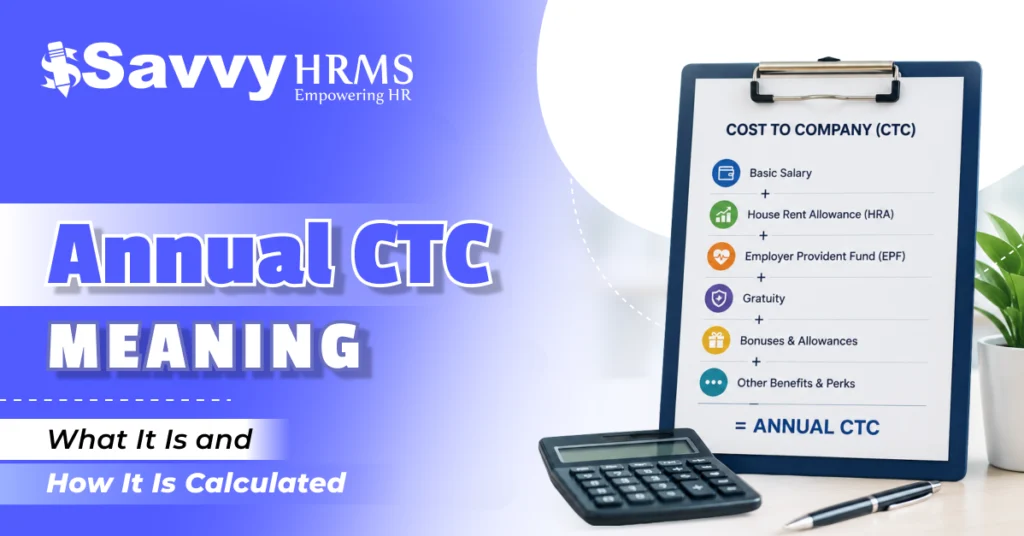
Now that the annual CTC meaning is clear, let’s look at what actually makes up that total number. CTC is generally split into several components, and knowing each one helps you understand your salary structure better.
1. Basic Salary
This is the foundation of your salary. Basic salary is usually 40 – 50% of your total CTC and is fully taxable. It also determines how much your PF contribution will be, so a higher basic means higher PF deductions too.
2. House Rent Allowance (HRA)
If you live in a rented home, HRA is a major component to pay attention to. It’s generally 40 – 50% of your basic salary and comes with tax exemption benefits, provided you actually pay rent and submit the relevant documents.
3. Special Allowances
This is a catch-all category that employers use to fill the gap between your basic salary and the total CTC. It’s fully taxable but gives employers flexibility in structuring salaries.
4. Provident Fund (PF) Contribution
Both you and your employer contribute 12% of your basic salary to the EPF (Employees’ Provident Fund). Here’s the catch: both sides of this contribution are usually shown as part of your CTC, even though one half is your own money being deducted.
5. Gratuity
Gratuity is a benefit paid to employees who have completed at least 5 years with a company. Even though you might not see this money for years, it’s factored into your annual CTC from day one.
6. Medical and Health Benefits
Some employers include health insurance premiums, medical reimbursements, or wellness benefits in the CTC. These are valuable, but not the cash you receive directly.
7. Performance Bonus / Variable Pay
Many companies split your package into a fixed component and a variable component. The variable pay depends on your performance and is not guaranteed, but it’s included in the CTC calculation.
8. Other Perks and Benefits
This can include meal coupons, internet allowance, cab facilities, gym memberships, stock options, and more. All of these add to your CTC even though they are non-cash benefits.
How Is Annual CTC Calculated in Salary?
Here’s where it all comes together. The annual CTC calculation isn’t a mystery once you see the formula laid out clearly.
Annual CTC = Fixed Pay + Variable Pay + Benefits + Employer’s PF Contribution + Gratuity + Other Perks
Let’s walk through a practical example:
| Component | Monthly (₹) | Annual (₹) |
| Basic Salary | 25,000 | 3,00,000 |
| HRA | 12,500 | 1,50,000 |
| Special Allowance | 8,000 | 96,000 |
| Medical Allowance | 1,250 | 15,000 |
| Performance Bonus | – | 50,000 |
| Employer’s PF (12% of Basic) | 3,000 | 36,000 |
| Gratuity | 1,202 | 14,423 |
| Total CTC | ₹6,61,423 |
Now, your actual in-hand salary would be your basic + HRA + allowances minus the deductions (employee’s PF, professional tax, income tax, etc.).
So from this ₹6.6 lakh CTC, you might actually take home somewhere around ₹45,000 – ₹48,000 per month, which is around ₹5.4 – ₹5.7 lakhs annually. That’s a noticeable gap, and it’s completely normal.
The key takeaway: always ask for the breakup, not just the headline CTC number, when you’re evaluating a job offer.
Difference Between CTC, Gross Salary, and Net Salary
| Parameter | CTC | Gross Salary | Net Salary |
| Full Form | Cost to Company | Gross Earnings | Take-Home Pay |
| What It Includes | Basic + Allowances + Employer PF + Gratuity + Perks + Bonuses | Basic + HRA + Allowances + Bonuses | Gross Salary minus all deductions |
| What It Excludes | Nothing, it’s the total package | Employer PF, Gratuity, Non-cash perks | PF, TDS, Professional Tax |
| Who Uses It | Employers (for budgeting & offers) | HR & Payroll teams | Employees (actual income) |
| Taxable? | Not directly | Partially taxable | Already tax-deducted |
| Example (₹6L CTC) | ₹6,00,000 | ₹5,20,000 (approx) | ₹4,40,000 (approx) |
| Where You See It | Offer letter | Payslip (top section) | Payslip (bottom line) / Bank account |
Common Misconceptions About Annual CTC
Let’s break some of the most common myths people have about annual CTC, because these misunderstandings can seriously impact how you plan your finances.
❌ Misconception 1: “My Annual CTC ÷ 12 = My Monthly Salary”
This is the most widespread myth. If your annual CTC is ₹6 lakhs, most people assume they will get ₹50,000 per month. In reality, after deductions, your take-home could be ₹38,000 – ₹42,000. Employer contributions and benefits expand the CTC figure without adding to your pocket.
❌ Misconception 2: “Higher CTC Always Means a Better Offer”
Not necessarily. A company offering ₹10 LPA with 30% variable pay is very different from one offering ₹9 LPA with 100% fixed pay. Always compare the fixed component, not just the headline number.
❌ Misconception 3: “Gratuity Is Part of My Regular Earnings”
Gratuity is included in your CTC, but you only receive it when you leave a company after completing 1 or 5 years of service (depending on the employment type). Don’t divide it into your monthly cash flow.
❌ Misconception 4: “Non-Cash Benefits Don’t Matter”
They absolutely do, just not in the way people think. A health insurance policy worth ₹5 lakhs or a meal allowance worth ₹20,000/year adds real value to your package, even if it’s not cash in hand.
❌ Misconception 5: “CTC and In-Hand Salary Are the Same”
This one we have covered in detail, but it’s worth repeating: they are never the same. The gap between CTC and take-home salary can range from 15% to 30%, depending on your tax bracket, company policy, and salary structure.
Conclusion
Understanding the annual CTC meaning isn’t just about being financially literate; it’s about making smarter career decisions. When you know how your CTC is structured, you can negotiate better, plan your taxes more effectively, and avoid the shock of your first paycheck looking very different from what you expected.
Here’s your quick recap:
- Annual CTC = The total cost the company bears for you in a year
- It includes basic salary, HRA, allowances, employer’s PF, gratuity, bonuses, and perks
- Gross salary is what you earn before deductions; net salary is what you actually take home
- Always ask for a detailed salary breakup, not just the CTC figure
- Don’t fall for common myths: variable pay, gratuity, and employer contributions can make your CTC look bigger than your actual cash earnings
Whether you’re negotiating a new offer or trying to understand your current pay structure, this knowledge puts you in control. And if your HR team or payroll software isn’t giving you clear answers, it might be time to switch to a smarter HRMS like Savvy HRMS, one that makes salary transparency easy for both employers and employees.











Want to simplify payroll and salary structuring for your team?
Savvy HRMS helps businesses manage CTC breakdowns, payslips, and compliance, all in one place.