



India’s workforce is changing faster than ever before. From manufacturing plants in Noida to IT offices in Bengaluru, organizations are facing one common challenge – keeping their employees skilled, engaged, and future-ready.
According to the LinkedIn Workplace Learning Report, 94% of employees say they would stay longer at a company that invests in their learning and development. Yet, many HR teams still struggle to run structured, measurable training programs.
This is where Training and Development in HRM becomes a business-critical function – not just an HR checkbox.
In this guide, you will learn:
- What training and development in HRM actually means
- The difference between training and development
- 10 types of training programs used in modern organizations
- 5 stages of an effective training process
- 5 best practices to maximize training ROI
- How Savvy HRMS makes the entire process seamless
What is Training and Development in HRM?
Training and Development in HRM refers to the set of educational, skill-building, and growth-oriented activities that an organization uses to improve the knowledge, performance, and potential of its employees.
- Training is focused and short-term. It targets specific skills or knowledge gaps that employees need to perform their current job better. For example, training a factory worker on a new machine, or a sales executive on CRM tools.
- Development is broader and long-term. It focuses on the overall professional growth of employees – preparing them for future roles, leadership responsibilities, or cross-functional opportunities.
Together, both initiatives form the backbone of a strong Learning and Development (L&D) strategy.
Simple Formula: Training fixes today’s skill gap. Development builds tomorrow’s leaders.
Why Training and Development Matters in HRM: Key Statistics
Before diving into the types and stages, here’s why organizations cannot afford to ignore Training and Development (T&D) :
| # | Statistic | Source |
| 1 | Companies that invest in employee training see 24% higher profit margins | Association for Talent Development (ATD) |
| 2 | 74% of employees feel they are not reaching their full potential at work due to lack of development | Gallup |
| 3 | Organizations with strong L&D cultures are 92% more likely to innovate | Deloitte Human Capital Trends |
| 4 | Employee turnover is 34% lower in companies with strong learning cultures | LinkedIn Learning Report 2025 |
These numbers make one thing clear – Training and Development is not a cost. It is a competitive advantage.
Purpose of Training and Development in HRM
Why do organizations invest heavily in employee training? Here are five key purposes:
1. Boost Employee Retention
High-performing employees are always looking for growth opportunities. When an organization invests in their learning, it signals that it values its people. This sense of belonging and investment reduces attrition significantly. In India’s competitive job market – especially in IT, manufacturing, and FMCG sectors – retention through L&D is a proven strategy.
2. Build a Leadership Pipeline
Strong organizations do not hire leaders from outside every time – they grow them from within. Structured training and development programs help HR teams identify high-potential employees early and equip them with the skills needed for leadership roles. As SHRM research highlights, organizations with leadership development programs are better positioned to achieve long-term business goals.
3. Empower Employees at the Workplace
Well-trained employees feel more confident and autonomous. They take ownership of their responsibilities, show more initiative, and contribute more meaningfully to organizational goals. Empowered employees drive innovation – and innovation drives growth.
4. Enhance Employee Engagement
Disengaged employees cost organizations money. Training and development activities create a stimulating environment where employees feel challenged and valued. Engaged employees consistently deliver better performance and are significantly less likely to leave. Savvy HRMS’s Survey Tool allows HR teams to measure engagement levels and identify where additional learning support is needed.
5. Increase Workplace Collaboration
Group training sessions, workshops, and e-learning programs bring employees together across departments. Collaborative learning builds inter-team relationships, creates shared understanding, and drives operational efficiency.
Role of HR in Training and Development
The HR department acts as the architect of the entire training ecosystem. The key responsibilities include:
- Identifying Training Needs: Conducting Training Needs Identification (TNI) through skill gap assessments, performance reviews, and employee surveys.
- Designing Training Programs: Creating structured programs that are aligned with organizational goals and individual career paths.
- Budgeting and Scheduling: Planning Annual Training Plans (ATP) with monthly or quarterly schedules and managing training budgets effectively.
- Vendor and Trainer Management: Coordinating with internal subject matter experts or external trainers and managing conference room bookings and logistics.
- Tracking Attendance and Participation: Ensuring employees attend required sessions and maintaining accurate training records.
- Measuring Effectiveness: Evaluating training outcomes through pre-tests, post-tests, and performance metrics to calculate ROI.
With a tool like Savvy HRMS’s Learning & Development module, HR teams can automate all of these steps from a single dashboard – saving time, reducing manual errors, and improving training quality.
10 Types of Training and Development in HRM
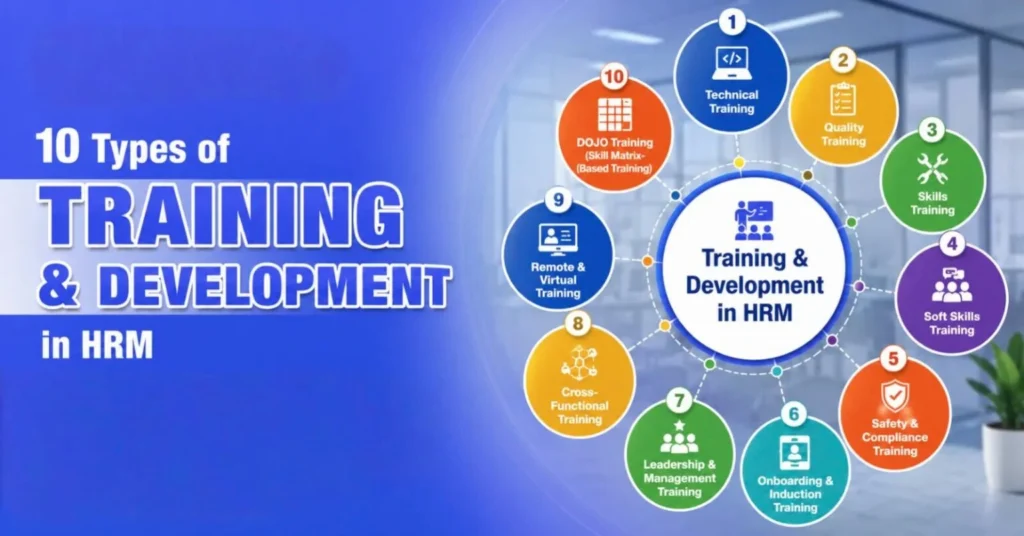
One of the biggest gaps in most training blogs is that they only cover 5 types. Here is a complete breakdown of all 10 types used by modern organizations:
1. Technical Training
Role-specific training on tools, systems, or processes. For example, training retail staff on POS systems, factory workers on CNC machines, or finance teams on ERP software. This is the most common form of training in manufacturing and IT companies.
2. Quality Training
Training employees on ISO standards, Six Sigma, or Total Quality Management (TQM) practices. Industries like pharmaceuticals, automotive manufacturing, and food processing rely heavily on this to ensure consistent product and service quality.
3. Skills Training
Focused on job-specific skills, whether it is operating machinery, improving sales techniques, or mastering a programming language. Usually conducted using in-house trainers and practical exercises.
4. Soft Skills Training
Communication, leadership, teamwork, time management, problem-solving, and conflict resolution fall under this category. Soft skills training is especially important for managers, customer-facing roles, and team leaders.
5. Safety and Compliance Training
A non-negotiable in industries like manufacturing, healthcare, construction, and chemicals. Covers fire safety drills, first aid, hazmat protocols, workplace injury prevention, and regulatory compliance. In India, compliance with the Factories Act, POSH Act, and other labor laws makes this type mandatory for many organizations.
6. Onboarding and Induction Training
The first training experience for any new employee. A structured onboarding program sets the tone for how the employee perceives the organization. It covers company culture, policies, department-specific workflows, and role expectations. Savvy HRMS’s Learning & Development module allows HR teams to create scheduled induction topics by department, track attendance, and monitor induction profile completion status.
7. Leadership and Management Training
Designed for current and future managers. Covers topics like delegation, performance management, strategic thinking, and people management. Organizations that invest in leadership training build a stronger internal talent pipeline and reduce dependency on external hiring.
8. Cross-Functional Training
Training employees in functions outside their primary role. A marketing executive learning basic finance, or an operations manager learning HR compliance basics. This builds organizational agility and creates more versatile team members.
9. Remote and Virtual Training
Post-COVID, virtual training has become a standard practice. Online courses, video modules, live webinars, and self-paced e-learning platforms allow organizations to train remote teams without logistical challenges. Savvy HRMS’s cloud-based LMS enables training access anytime, anywhere – ideal for organizations with multi-location setups.
10. DOJO Training (Skill Matrix-Based Training)
A specialized approach used widely in manufacturing. DOJO training involves systematic, hands-on skill development aligned to specific job roles using a skill matrix. Managers assess employee capabilities against role requirements, identify gaps, and assign targeted training. Savvy HRMS offers a built-in DOJO Training module that supports QR-based attendance tracking, Annual Training Plans (ATP), and skill gap reporting – making it a standout feature for manufacturing and industrial organizations.
5 Stages of Training and Development in HRM
A well-designed training program follows a structured lifecycle. Here are the five stages:
Stage 1: Training Needs Assessment (TNA)
The starting point of any training initiative is understanding what needs to be trained. HR teams gather data through:
- Performance appraisal results
- Employee self-assessments
- Manager feedback
- Skill matrix analysis (especially relevant for DOJO Training)
- Organizational growth goals
Savvy HRMS Advantage: The platform’s skill matrix and performance management module help HR teams identify individual and team-level skill gaps, making TNA data-driven rather than assumption-based.
Stage 2: Define Training Objectives
Once the need is clear, HR defines specific, measurable learning outcomes.
For example: “All new sales executives will be able to navigate the CRM and close a demo call independently within 30 days of joining.”
Clear objectives prevent vague training programs and make evaluation much easier later.
Stage 3: Design the Training Program
The design phase involves deciding:
- Training format (classroom, virtual, on-the-job, DOJO, simulation)
- Duration and schedule
- Trainer (internal expert or external vendor)
- Training content and materials
- Pre-test assessment to measure baseline knowledge
Savvy HRMS allows HR to set up training programs from scratch, choose flexible dates, reserve conference rooms, check attendee availability, and distribute training budgets – all in one place.
Stage 4: Conduct the Training Program
The plan is executed. Key considerations during delivery:
- Create an environment that encourages participation and engagement
- Use multiple learning formats for different learning styles (visual, hands-on, group discussion)
- Track attendance digitally using QR-based attendance in Savvy HRMS’s training module
- Allow employees to self-nominate for relevant sessions through the employee calendar feature
Stage 5: Evaluate and Follow-Up
Training evaluation is critical to justify ROI and improve future programs. Savvy HRMS supports this through:
- Pre-test and post-test assessments to measure knowledge gain
- Skills gap analysis reports
- Training completion and attendance reports
- TNI report analysis to plan future training cycles
The evaluation phase feeds back into Stage 1, making training a continuous improvement loop rather than a one-time event.
5 Best Practices for Training and Development in HRM
1. Get Management Buy-In
Training programs succeed when leadership actively supports and participates in them. When the management team champions learning, it signals to the entire workforce that growth matters. This cultural shift is what separates organizations that train occasionally from those that build truly learning-focused cultures.
2. Create a Formal Annual Training Plan (ATP)
Ad hoc training does not work. An Annual Training Plan ensures that every employee receives structured, scheduled learning throughout the year. Savvy HRMS allows HR to build quarterly or monthly ATPs, track execution, and monitor adherence across departments.
3. Define Clear Metrics Before You Start
Training without measurement is guesswork. Before any program begins, define your success metrics:
- Course completion rate
- Pre-test vs. post-test score improvement
- Employee performance improvement post-training
- Training ROI (performance output vs. training cost)
- Employee satisfaction with training content and delivery
4. Use Multiple Training Modes
Different employees learn differently. A factory worker benefits more from hands-on DOJO training and demonstrations. An IT professional may prefer self-paced video modules. An HR manager might gain more from a live workshop. Offering blended learning – combining classroom, virtual, and on-the-job methods – significantly improves learning outcomes.
5. Measure and Act on Trainee Satisfaction
Post-training surveys are one of the most underused tools in L&D. Use Savvy HRMS’s Survey Tool to collect structured feedback from participants after every session. The data will tell you what worked, what did not, and what needs to be improved for the next cycle.
How Savvy HRMS Simplifies Training and Development
Managing training manually – through spreadsheets, emails, and WhatsApp reminders, is inefficient and error-prone. Savvy HRMS offers a purpose-built Learning Management System that helps HR teams across India run world-class training programs with zero chaos.
Here is what makes Savvy HRMS’s L&D module stand out:
| Feature | What It Does |
| DOJO Training | Skill matrix-based training for manufacturing and industrial workforce |
| Induction Programs | Department-wise onboarding with checklists and attendance tracking |
| Training Programs & Sessions | Easy setup, budget allocation, and room booking |
| Employee Calendar | Self-nomination for courses, HOD suggestions, and organized scheduling |
| Pre & Post Assessments | Measure knowledge gain with customizable test templates |
| Reports & Analytics | Skills gap analysis, training completion, TNI reports |
| Mobile App Access | Training access anytime, anywhere via the Savvy HRMS mobile app |
Trusted by 1,000+ organizations including Haldiram, Indiamart, Kajaria, Hero Motors, and Sona BLW – Savvy HRMS has proven that structured training management leads to measurable workforce improvement.
“Working with Savvy HRMS has made managing our HR processes easy. Their smooth integration with SAP and fully customizable learning & development modules, combined with dynamic policies and 100% automation, has transformed how we handle our HR.” – Mr. Zaheer Khan, IT Head, Hero Motors
Training and Development vs. Learning and Development: Is There a Difference?
Many HR professionals use these terms interchangeably, but there is a subtle distinction:
| Training & Development | Learning & Development | |
| Focus | Specific skills and job performance | Holistic growth and continuous learning |
| Timeframe | Short to medium term | Long term |
| Outcome | Improved job performance | Career growth + organizational capability |
| Who Drives It | HR and direct managers | HR + employees (self-directed learning) |
In modern HR, L&D is the evolution of T&D – it includes formal training programs but also encourages self-paced learning, mentorship, and career development planning.
Frequently Asked Questions (FAQs)
Q1. What is Training and Development in HRM?
Training and Development in HRM refers to structured activities designed to improve the knowledge, skills, and performance of employees. Training focuses on immediate job-related skills, while development focuses on long-term professional growth.
Q2. What are the 10 types of training and development in HRM?
The 10 types are: Technical Training, Quality Training, Skills Training, Soft Skills Training, Safety and Compliance Training, Onboarding and Induction Training, Leadership and Management Training, Cross-Functional Training, Remote and Virtual Training, and DOJO Training.
Q3. What are the 5 stages of training and development in HRM?
The five stages are: Training Needs Assessment (TNA), Define Training Objectives, Design the Training Program, Conduct the Training Program, and Evaluate and Follow-Up.
Q4. What is the role of HR in training and development?
HR identifies training needs, designs programs, manages trainers and schedules, tracks participation, measures outcomes, and continuously improves the training process based on data and feedback.
Q5. How does an HRMS help in training and development?
An HRMS like Savvy HRMS centralizes training planning, automates scheduling and attendance tracking, enables pre and post-test assessments, provides analytics reports, and reduces the manual workload of HR teams significantly.
Q6. What is DOJO Training in HRM?
DOJO Training is a skill matrix-based training approach popular in manufacturing industries. It maps employee skills to role requirements, identifies gaps, and assigns targeted training to bridge those gaps. Savvy HRMS offers a dedicated DOJO Training module for this purpose.
Q7. How do you measure training effectiveness?
Measure through pre-test and post-test scores, training completion rates, employee performance improvement post-training, manager feedback, and employee satisfaction surveys.
Conclusion
In today’s competitive business environment, organizations that invest in Training and Development in HRM are the ones that attract better talent, retain top performers, and build future-ready workforces.
Whether you are running a 50-person startup or managing 25,000 employees across multiple manufacturing plants, a structured L&D strategy – backed by the right technology – is what separates average organizations from exceptional ones.
Savvy HRMS’s Learning & Development module gives HR teams everything they need to plan, execute, track, and improve employee training – from DOJO skill matrix training to virtual induction programs, all in one cloud-based platform.
Ready to transform your employee training process?
Book a Free Demo with Savvy HRMSand see how 1,000+ organizations are building skilled, engaged workforces with our L&D module.