

How Learning Management Software Improves Employee Development and Productivity


-
AuthorRuchika Rajput
-
 Last Updated
May 12, 2026
Last Updated
May 12, 2026
-
 Reading Time
7 Mins
Reading Time
7 Mins
Is your organization struggling to address the skills gap among employees to adapt to new skills, changing technologies, and shifting workplace needs? The answer to this question is not a simple one for different organizations.
What is a Learning Management System? The answer to this question will be discussed in this blog, along with the features, the benefits, and the future of learning management systems, and the selection of the right one for an organization.
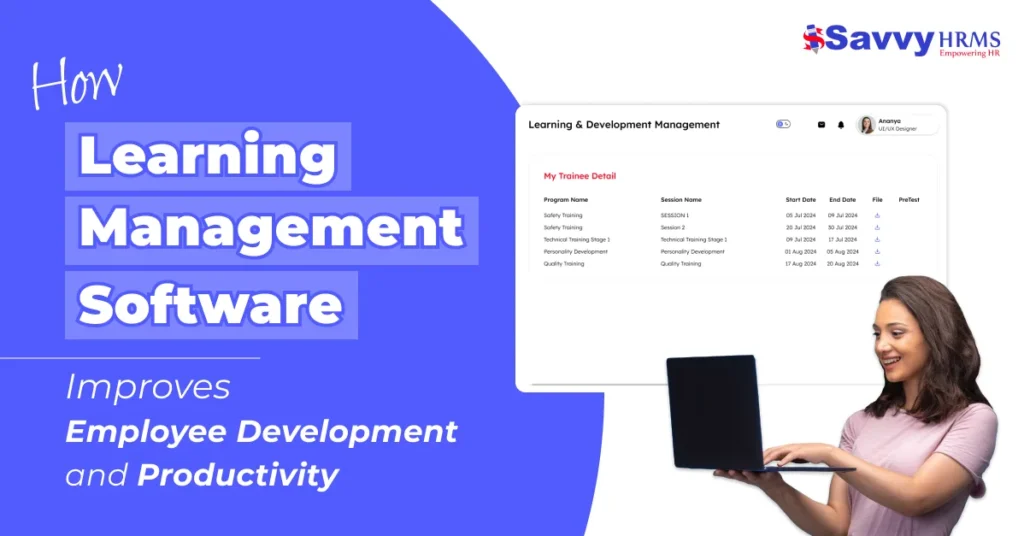
This blog will also cover the basic features of a learning management system, such as dojo training, induction programs, employee assessments, training sessions, etc., along with the integration of the learning management system with various modules such as attendance management, leave management, payroll software, etc.
What is a Learning Management System (LMS)?
A Learning Management System can be defined as a technology that organizations utilize for creating, managing, delivering, and tracking their training programs. LMS plays an important role in employee training and development.
A Learning Management System can also be integrated with HR tools like attendance management, leave management, payroll software, and performance management, thus making it easy for businesses to manage their employees as well as their performance.
Key Elements of a Learning Management System include:
- A combined system that can manage employees’ training and development.
- Enables organizations to easily distribute training content.
- Tracks employees’ progress, certifications, and results.
- Enables online courses, tests, and interactive content.
- Easily integrates with other modules.
Why Businesses Need a Learning Management System?
Modern organizations need learning management systems for the following reasons:
1. Centralized Employee Learning
The learning management system offers the business a platform to conduct all the training programs and learning materials for the employees in the best possible manner.
2. Improved Skill Development
The learning management system allows organizations to offer employees opportunities to learn new skills and improve their performance by staying up to date with the ever-changing requirements of the industry.
3. Consistent Training for the Entire Business
For businesses with various departments and locations, the learning management system offers the best way to ensure all employees receive the same training and learning opportunities.
4. Better Performance Management
The learning management system integrates with the performance management system, enabling the business to track the learning progress of the employees and assess their skill development.
5. Increased Employee Engagement
The learning management system offers the best way for employees to increase their participation in the training programs through quizzes and assessments.
6. Compliance and Policy Training
For businesses, it is important to train employees on the company’s policies and ensure they receive the necessary training and certifications at the right time.
7. Data-Driven Decision Making
The learning management system offers the best way for the business to track the performance and make the best decisions for the employees.
What are the Key Features of Learning Management System?
1. Dojo Training
Employees can be provided with hands-on learning experiences through dojo training, where they are allowed to practice real-life situations through learning exercises and collaborative learning techniques.
This helps employees improve their skills and confidence, and enhances problem-solving and collaborative learning within the organization.
2. Induction Programs
A learning management system can assist organizations in providing employees with induction programs, where employees are provided with training modules and learning exercises through automated onboarding courses.
This helps organizations provide employees with training programs, and HR leaders are relieved of the burden of providing training programs for employees.
3. Training Programs and Sessions
Organizations can provide employees with training programs and learning sessions through the learning management system, where employees can be trained and helped to improve their skills and grow professionally.
Employees can be provided with learning materials, and managers can track learning sessions and attendance.
4. Employee Calendar
An LMS has an employee calendar that enables employees to access all the training sessions, workshops, and learning events that are going to take place in the future.
It helps teams organize themselves, manage schedules, and ensure that all the training programs are completed on time.
5. Employee Assessments
Employee assessments help organizations track the performance of retaining knowledge through quizzes, assignments, and tests carried out after training programs are completed.
Employee assessments help organizations track the performance of learning and improve training programs for better results.
6. Reports and Analytics
Reports and analytics help organizations track the performance of learning and training programs and the effectiveness of training programs for employees.
What are the Benefits of Using a Learning Management System?
1. Improved Employee Productivity
An LMS encourages employees to develop the skills and knowledge they need to do their jobs effectively, hence increasing their productivity.
2. Improved Employee Development
An LMS facilitates the continued learning of employees, hence improving their skills and career growth within the organization.
3. Reduced Training Costs
An LMS reduces the cost of training employees through the reduction of travel costs, classroom sessions, and printed materials.
4. Improved Workforce Management
An LMS, when used in combination with attendance management software, leave management software, payroll software, and performance management software, improves the management of employees.
5. Scalable Learning Solutions
An organization can scale up the training of employees using an LMS without increasing the workload.
6. Data-Driven Training Improvements
An organization uses the reporting tools of an LMS to evaluate the results of the training of employees, hence improving the training process.
How to Choose the Right Learning Management System?
Step 1: Determine Organizational Training Needs
Organizations should begin by determining their training needs for their employees before selecting a suitable learning management system.
Step 2: Determine Important Features
Organizations should also select an LMS that has important features for training programs, employee assessment, analytics, calendars, and onboarding tools for the complete development of their employees.
Step 3: Consider Integration with HR Systems
The LMS should also integrate well with other HR systems, including attendance management, leave management, payroll management, and performance management systems.
Step 4: Consider User-Friendly Design
A user-friendly design is also important for an LMS so that it can be easily used by the employees for their training programs without having any IT expertise.
Step 5: Check Customization and Scalability
Organizations should consider using an LMS that is scalable and can accommodate the growth of the organization, including additional employees and training programs, and changing organizational needs.
Step 6: Analyze Reporting and Analytics
Using an LMS with strong reporting and analytics allows organizations to track the effectiveness of training programs and align learning initiatives with organizational objectives.
Step 7: Evaluate Vendor Support and Security
Suitable vendor support, security, and protection are important factors for organizations considering using an LMS for long-term organizational needs.
What are the Future Trends in Learning Management Systems?
Learning technologies are constantly changing as organizations focus on digital transformation and employee development. New learning management systems are being designed with more automation, personalization, and analytics features for a smarter learning experience.
Some of the emerging LMS trends are as follows:
- Personalized learning paths with AI
- Microlearning and bite-sized learning
- Mobile learning for remote employees
- Gamification in learning
- Incorporation of HR tools like payroll systems and performance management systems
Conclusion
A modern learning management system is an important factor in improving employee development as well as enhancing productivity within an organization.
Incorporated with other HR management tools, including attendance management, leave management, payroll management, performance management, and learning management systems, can enable organizations to develop efficient, skilled, and productive employees.
Learning management systems like Savvy HRMS can integrate cutting-edge HR management capabilities with strong learning management features, enabling businesses to simplify their training processes, manage their workforce effectively, and enhance organizational development.
Schedule a demo with Savvy HRMS today and learn more about developing efficient employees for your organization.