

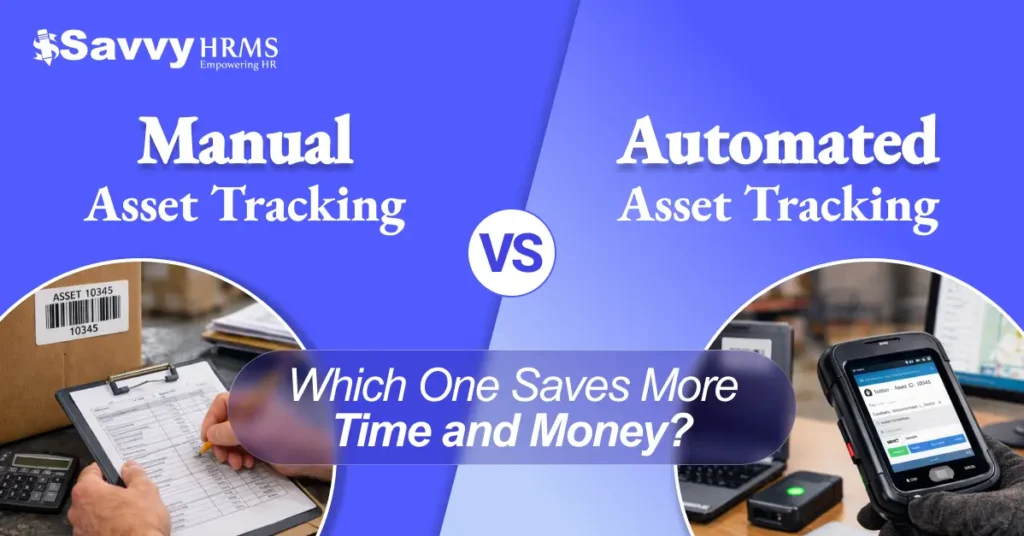
Manual vs. Automated Asset Tracking: Which One Saves More Time and Money?


-
AuthorRuchika Rajput
-
 Last Updated
March 11, 2026
Last Updated
March 11, 2026
-
 Reading Time
7 Mins
Reading Time
7 Mins
Asset management is an important aspect to consider in running a successful business. Assets can include anything from laptops to machines. This helps to ensure accountability and the reduction of losses.
In this blog post, you will learn about the advantages and disadvantages of manual and automated asset tracking. Additionally, we will look at which method is cost-effective and saves time.
If you are planning to switch to automated asset tracking and purchase asset management software, this post will provide you with the information you need to make a smart and ROI-based decision for your organization.
What Is Manual Asset Tracking and Automated Asset Tracking?
Manual Asset Tracking
Manual asset tracking refers to the use of recording and tracking the company’s assets through the use of a spreadsheet or manual records.
Key Characteristics:
- Spreadsheets or manual records
- Requires manual data entry
- Depends on human intervention for updates and verification
- Lack of real-time information
- Prone to errors and duplication
- Long auditing and reporting cycles
Automated Asset Tracking
Automated asset tracking involves using asset management software, barcode systems, RFID tags, and cloud-based systems to digitally monitor assets in real time.
Key Characteristics:
- Real-time tracking and updates
- Barcode and RFID technologies
- Centralized asset information management
- Automated alerts and notifications
- Cloud-based systems
- Integration with payroll management software, attendance management software, and leave management software
Manual vs. Automated Asset Tracking: Key Differences
Comparison Table:
| Factor | Manual Asset Tracking | Automated Asset Tracking |
| Data Entry | Entered manually in spreadsheets or registers; requires frequent updates. | Captured automatically using barcode and RFID within asset management software. |
| Accuracy | Prone to human errors, duplication, and outdated records. | System-driven validation ensures correct and updated records. |
| Time Required | Time-consuming updates and lengthy audit preparation. | Instant updates and faster audit-ready reporting. |
| Cost | Low upfront cost but higher hidden costs due to errors and losses. | Higher initial investment but better long-term cost savings. |
| Scalability | Difficult to manage as assets and teams grow. | Easily scalable across departments and multiple locations. |
| Reporting | Manual report preparation with risk of inconsistencies. | Real-time dashboards and automated reports. |
| Integration | Standalone system with no HR or payroll integration. | Integrates with HRMS, payroll software, attendance management software, and leave management software. |
| Asset Visibility | Limited visibility into asset location and status. | Real-time tracking and centralized visibility. |
| Security | Limited monitoring and control over asset movement. | Role-based access and digital tracking logs. |
| Depreciation Tracking | Manual calculations with risk of financial errors. | Automated depreciation tracking for accurate accounting. |
| Employee Accountability | Manual handover records may cause confusion. | Digital allocation tracking linked to employee records. |
| Maintenance | Maintenance schedules are tracked separately or missed. | Automated reminders reduce downtime and improve lifecycle management. |
Key Differences:
1. Accuracy and Error Reduction
Manual tracking of assets is based on human input, which creates a higher possibility of error, duplication, and deletion of data. Automated tracking of assets reduces the possibility of errors, duplication, and deletion of data.
2. Time Efficiency
Manual tracking of assets, coupled with spreadsheet management, may require a lot of time, sometimes days, to update the spreadsheet and track physical data. Automated tracking of asset updates in real-time, thereby saving a lot of administrative time.
3. Real-Time Visibility
Manual tracking of assets does not provide real-time visibility of asset locations and status. Automated tracking of assets provides real-time visibility of asset locations and status.
4. Reporting and Compliance
Manual tracking of assets, combined with spreadsheet management, requires a lot of time to prepare compliance reports, reduce reports, and other reports. Automated tracking of assets provides instant compliance reports, depreciation reports, and other reports.
5. Scalability
Manual tracking of assets becomes disorganized as the number of assets grows. Automated tracking of assets scales up effortlessly.
6. Integration Capabilities
Manual tracking of assets operates in isolation, whereas automated tracking of assets integrates with payroll management software, attendance management software, leave management software, performance management software, and other software.
Which One Is the Best Choice for Your Organization?
The choice between a manual and an automated asset tracking system depends on the size and complexity of your organization. While a small startup may depend on a manual system, a larger business will need to automate asset tracking.
An automated asset tracking system, using asset management software, is more efficient and cost-effective. It saves more time and money in the long run. It is a better choice for organizations, and here’s why:
- Reduces asset loss and misplacement
- Saves administrative hours
- Improves financial planning and depreciation tracking
- Supports multi-location operations
- Improves accountability through digital logs
- Provides instant reporting for audits
- Integrates with payroll software and attendance management software easily
By choosing an automated asset tracking system, a business shifts from a reactive to a proactive management style.
What are the Challenges Faced by Manual Asset Tracking?
Manual asset tracking may look simple, but it presents various operational challenges:
1. High Risks of Human Errors
There is a high probability of human error during the manual entry of data into the spreadsheets.
2. Data Duplication and Inconsistencies
There is a possibility of duplication and inconsistencies in the data entered into the spreadsheets.
3. Time-Consuming Audits
Audits conducted on the physical records and the manual cross-checking of the data entered into the spreadsheets are time-consuming task.
4. Poor Asset Visibility
There is a lack of real-time information on the location and allocation of the assets.
5. Difficulty in Tracking Depreciation
There is a complex process involved in the manual calculation of depreciation on the assets.
6. Limited Scalability
There is a possibility that the manual systems may not be effective with the increased volume of assets.
7. Increased Asset Theft
This means that assets are more prone to being misplaced, misused, or lost without being detected.
8. Lack of Integration
Manual tracking does not integrate with HR, payroll software, or attendance management software.
9. Inefficient Reporting Process
Generating reports requires manual compilation of data, resulting in delays and inefficiency in the decision-making process.
10. Dependency on Specific Employees
Information regarding assets is usually dependent on specific employees, making it a problem when employees change roles or leave the organization.
As organizations grow, these challenges combine, leading to financial losses and inefficiencies.
What are the Benefits of Using Automated Asset Tracking?
1. Real-Time Asset Monitoring
This feature of automated asset tracking ensures timely and correct information regarding the location and status of assets. This helps in timely and accurate decision-making for the organization.
2. Improved Accuracy
Automated data entry and validation reduce errors in maintaining accurate records of assets. This ensures correct and consistent financial reporting.
3. Faster Audits
With the help of asset management software, audit reports can be generated in an instant. This saves days of manual verification and preparation of audit reports.
4. Enhanced Accountability
Automated systems ensure accurate records of asset allocation to employees, departments, and locations. This helps in maintaining accountability and preventing misuse of assets.
5. Cost Optimization
Automated asset tracking helps in improving costs by preventing loss and underutilization of assets. This ensures timely and accurate decision-making for the organization.
6. Smooth HR Integration
Automated asset tracking systems can easily integrate with payroll management systems, attendance management systems, leave management systems, and performance management systems.
7. Data-Driven Decision Making
With the help of accurate and timely information, accurate and timely decisions can be made regarding the investment of assets.
Why Savvy HRMS Is the Best Choice for Asset Management Software?
Savvy HRMS offers a single platform for all the needs of the business, including automated asset tracking, HR, and payroll, through a single integrated solution.
Savvy HRMS offers smooth integration of payroll software, attendance management software, leave management software, and performance management software, ensuring the smooth running of the business and a clear view of the workforce.
It offers cloud-based asset management software, including real-time information, data storage, and reporting, ensuring the needs of growing organizations are met.
Conclusion
Manual tracking of assets, while it may work in the short term, is a barrier to growth, results in more mistakes, and wastes valuable time. Automated tracking of assets, however, brings accuracy, efficiency, and cost savings in the long term.
Investing in asset management software does not just safeguard company assets but also improves the overall effectiveness of HR processes, making it a valuable tool in decision-making.
Book a free demo with Savvy HRMS today to make a smarter move towards an automated asset tracking system.