


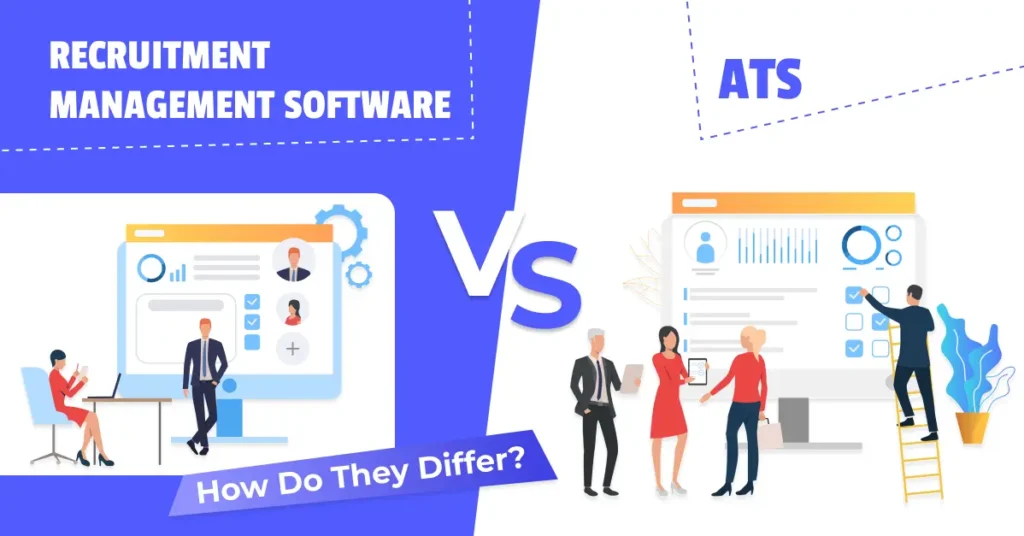

Is Recruitment Management Software different from an Applicant Tracking System?
This makes such an important question for HR teams to have answered.
While both of these software options are designed to support the recruitment process, there is great variation regarding the scope and functionality of the two products that impact how a business will utilize either of these recruiting technologies to improve their business goals.
This knowledge provides guidance to all human resources professionals, as well as hiring managers and owners, in their search for the right software solution based on their individual recruiting needs, the number of hires they are intending to make, and their longer-term organizational growth strategies.
In this blog post, we will define and distinguish between Recruitment Management Software and Applicant Tracking System, which one is right for your company, and discuss why Savvy HRMS is the best all-in-one HR software solution for you.
What Is Recruitment Management Software?
Recruitment Management Software is a comprehensive solution for the full lifecycle of hiring, including all steps, from workforce planning & requisition to onboarding new hires.
Key Features include:
- Manages job postings and approval processes, and delivers a complete workforce planning process.
- Publish your job openings across several job boards and social media platforms.
- Track candidates as they progress through all of the different stages of the recruitment process.
- Automate scheduling interviews with candidates and facilitate communications between candidates and interviewers.
- Support the offer process and onboarding of new hires.
- Integrate with attendance management systems, leave management systems, and payroll systems.
- Analytics and reporting features provide metrics for hiring performance.
What Is an ATS (Applicant Tracking System)?
An Applicant Tracking System (ATS) is an automated recruitment tool used primarily for collecting, organizing, and tracking job applications.
ATS’s main functions include:
- Storing resumes and candidate profiles.
- Using keywords to filter resumes based on specified job criteria.
- Tracking applicants as they move through the hiring process.
- Enabling recruiters to quickly compile shortlists.
- Providing a centralized database of candidates.
- Automation of most basic forms of candidate communication.
Recruitment Management Software vs ATS: Complete Comparison
| Feature | Recruitment Management Software | ATS |
| Scope | Manages the complete recruitment lifecycle from planning to onboarding. | Focuses only on tracking and managing job applications. |
| Job Requisition Management | Supports job requests, approvals, and employee planning. | Limited to job posting without approval workflows. |
| Resume Parsing | Extracts and structures candidate data automatically. | Filters resumes mainly using keywords. |
| Interview Scheduling | Automates interview scheduling and panel coordination. | Provides basic scheduling with manual effort. |
| Candidate Communication | Sends automated and personalized updates at each stage. | Limited communication, mostly status updates. |
| Reporting & Analytics | Offers detailed hiring metrics and performance reports. | Provides basic and limited reports. |
| Onboarding Support | Supports onboarding and candidate transition to HR systems. | No onboarding functionality. |
| Integration with HR Software | Smoothly integrates with HR, payroll, and attendance systems. | Limited or no HR software integration. |
| Customization & Scalability | Highly scalable and customizable for growing businesses. | Limited scalability and customization. |
| Best For | Ideal for growing and enterprise organizations. | Suitable for small teams and recruiters. |
Key Differences Between Recruitment Management Software and ATS
1. Scope of Hiring Process
While recruitment software manages the complete hiring process from start to finish, applicant tracking systems (ATS) focus primarily on organizing and tracking job applications through the ATS.
2. Workforce Planning Capability
Recruitment software includes personnel planning capabilities and also offers the ability to approve personnel requests; however, ATS generally begins once a job has been posted.
3. Recruitment Automation
Recruitment software automates all system-related activities for hiring (such as interviews, candidate communications, and onboarding), while ATS primarily automates actions related to resume filtering.
4. Candidate Experience
Recruitment software offers a smooth candidate experience with prompt communication throughout the candidate lifecycle, while ATS only provides limited opportunities for any communication with candidates as they go through an applicant tracking system (ATS).
5. Data & Analytics
Recruitment software provides a detailed recruitment dashboard and analytic reporting, including performance measurement capabilities; whereas, the reporting functionality within an ATS will have a very limited feature set.
6. Integration with HR Software
Recruitment Software integrates with all key HR applications, including payroll, time & attendance, and leave management, while the majority of ATS will not integrate with any of these common Human Resource Applications.
7. Scalability
Recruitment Software has the ability to grow as the business grows, whereas ATS generally struggles to support recruiting workflows in larger and more complex organizations.
How to Choose Which One Is Best for Your Organization?
1. Recruitment Volume
If you hire large numbers of employees on an ongoing basis, recruitment management software allows you to automate much of your process and gain control over it.
2. Company Size
Smaller businesses may be able to work with an ATS to manage their hiring processes; larger and more complex organizations derive more benefit from using recruitment management solutions.
3. Complexity of Your Hiring Process
Organizations that use multiple approval levels for recruiting and have several separate recruiters need to use recruitment management software.
4. Need for Integrating Other Systems
If you are using payroll and leave management systems, you will have a smoother integration when using recruitment management software.
5. Budget
ATS tools tend to have lower costs, but recruitment management solutions typically provide a higher return on your long-term investment.
6. Plans for Growth
Companies experiencing fast growth should invest in scalable recruitment management solutions upon initial entry into the market.
7. Candidate Experience
Employer branding and candidate experience are important to many employers; hence, recruitment management software is a better option.
8. Maturity of Your HR Function
Companies that are focused on digital transformation of HR practices should select recruitment management tools as opposed to basic ATS.
Challenges and Their Solutions While Implementing Recruitment Management Software or ATS
| Challenge | Solution |
| User Adoption | Provide structured training, simple user guides, and ongoing support to help HR teams adapt quickly. |
| Data Migration | Use phased relocation with data validation to ensure accurate transfer of candidate and hiring data. |
| Customization Complexity | Choose flexible HR software that allows configurable workflows without heavy technical dependency. |
| Integration Issues | Select recruitment management software that integrates smoothly with payroll, attendance, and leave management systems. |
| High Initial Cost | Start with essential modules and scale gradually based on hiring and business needs. |
| Change Management Resistance | Communicate benefits clearly and involve HR contributors early in the implementation process. |
| Process Alignment | Map existing recruitment processes before implementation to avoid operational disturbances. |
| Data Security Concerns | Use secure HR software with role-based access and compliance-ready data protection features. |
Why Choose Savvy HRMS?
Savvy HRMS is a complete human resource system (HRMS) that includes all aspects of human resources, not just recruiting, but is often referred to as employee life-cycle management.
Savvy combines recruiting management software, applicant tracking system (ATS) functionality, attendance tracking software, leave tracking software, and payroll software into a single source of truth, creating smarter, faster, and more effective HR operations.
The main advantages of using Savvy HRMS include:
- Full recruiting with ATS capability.
- Easy-to-use integration with payroll & attendance tracking software.
- Automate interview scheduling & candidate communication through an automated scheduling assistant (ASA) within the system.
- Real-time recruiting analytics and reports.
- Easy-to-use interface for HR departments and recruiters.
- Scalable HR software designed for Indian enterprises.
Conclusion
ATS can help manage applicant tracking, but doesn’t provide the complete recruitment solution with recruitment control, analytics, and integration with other human resources systems to provide the flexibility and scalability that your organisation will need. Using recruitment management software allows organisations to take a more strategic and automated approach to recruiting, especially when integrated with payroll systems, leave management systems, and attendance management systems.
Savvy HRMS is an easy-to-use, complete human resource management system that combines all of these features so you can spend less time managing your recruiting and more time helping candidates have a better experience and grow your organisation.
Get a free demo of Savvy HRMS now to experience a complete HR system for smarter recruiting through a single HR platform.