



If you’ve spent any time researching HR software, you’ve probably noticed that “HRMS” and “HRIS” get used almost interchangeably – even by vendors who should know better. They’re not the same thing, though the confusion is understandable, because both systems overlap in what they store and manage.
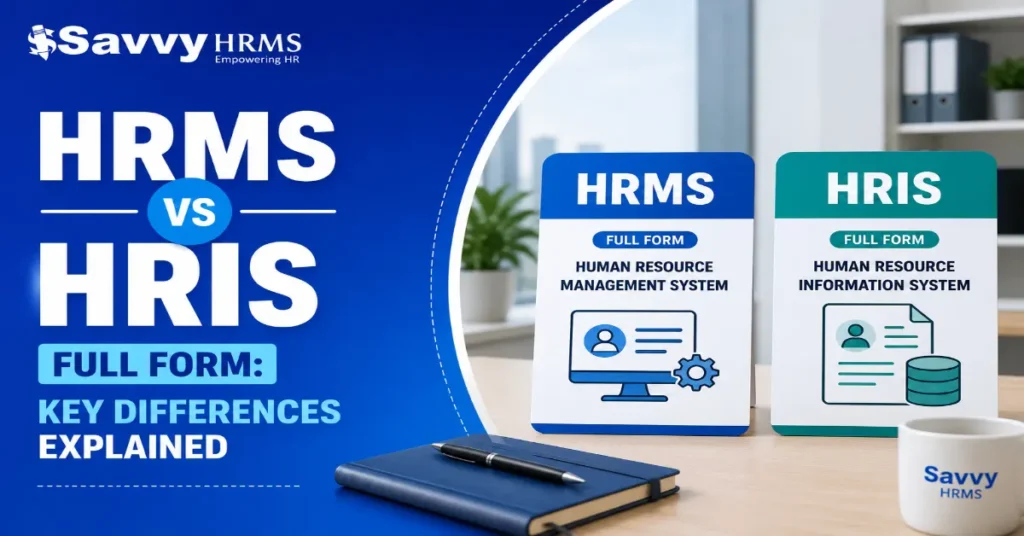
HRMS stands for Human Resource Management System, and HRIS stands for Human Resource Information System. The short version: HRIS is primarily a data and records system, while HRMS is a broader, more active platform that runs payroll, attendance, and performance workflows on top of that data. Understanding this distinction actually matters – it changes what you should expect from a vendor demo, and it affects what you’re paying for.
This guide breaks down both terms properly, shows where HCM (Human Capital Management) fits into the picture, and – since most comparison articles are written for a US audience – covers what actually changes for Indian businesses running statutory compliance, multi-state payroll, and local employee self service needs.
HRMS Full Form and HRIS Full Form – Quick Answer
HRMS Stands For: Human Resource Management System
An HRMS is software built to manage the employee lifecycle actively. It doesn’t just store information – it processes it. Payroll runs, attendance gets marked, leave requests move through approval chains, and performance reviews get scheduled, all inside the platform.
HRIS Stands For: Human Resource Information System
An HRIS is, at its core, a system of record. It holds employee data – personal details, employment history, documents, org structure – and makes that data searchable and organized. Think of it as the foundation layer that other HR processes build on top of.
Quick definition for reference: HRMS stands for Human Resource Management System, and HRIS stands for Human Resource Information System. HRIS is primarily a data-storage and record-keeping system, while HRMS adds active management functions like payroll, attendance, and performance tracking on top of that data foundation.
HRMS vs HRIS at a Glance (Comparison Table)
| Parameter | HRIS | HRMS |
| Full Form | Human Resource Information System | Human Resource Management System |
| Core Focus | Employee data storage and record-keeping | Active management of HR processes |
| Data Type | Largely static (employee records, documents) | Dynamic (attendance logs, payroll runs, performance data) |
| Key Functions | Employee database, document storage, basic self service | Payroll, attendance, leave, recruitment, performance management |
| Automation Level | Limited – mostly data organization | High – process-driven workflows |
| Best For | Small teams needing organized records | Growing businesses needing end-to-end HR operations |
| Typical Users | HR admins, compliance teams | HR managers, payroll teams, employees (via self service) |
The overlap between these two is real – most modern platforms, including Savvy HRMS, bundle HRIS-style record-keeping inside a full HRMS. So in practice, you’re rarely choosing one in isolation; you’re deciding how much active process automation you actually need beyond basic data storage.
What Is HRIS? Meaning, Features & Examples
An HRIS is best understood as the employee database layer of your HR tech stack. It answers the question “who works here, and what do we know about them?” – reliably and in one place, instead of scattered across spreadsheets and email threads.
Core HRIS Modules
- Centralized employee database – personal details, employment contracts, job history
- Document management – offer letters, ID proofs, policy acknowledgments
- Basic employee self service – employees can view their own profile, download documents, update contact details
- Org chart and reporting structure
- Basic compliance tracking – statutory registers, audit trails
Who Should Use an HRIS?
Smaller organizations, or businesses in early growth stages where payroll and attendance are still handled through separate tools (or manually), often start here. An HRIS makes sense when the immediate pain point is disorganized employee data – not necessarily process automation. But this is usually a transitional stage. As headcount grows past 50-100 employees, the gaps in an HRIS-only setup – no integrated payroll, no attendance-linked leave calculation – start costing real HR hours.
What Is HRMS? Meaning, Features & Examples
An HRMS takes everything an HRIS does and builds active operational workflows on top of it. It’s less “filing cabinet” and more “control panel” – the system doesn’t just hold your employee data, it uses that data to run actual HR operations.
Core HRMS Modules
- Payroll processing – salary calculation, deductions, payslip generation
- Attendance and time tracking – biometric or app-based punch-in, shift scheduling
- Leave management – leave balances, approval workflows, policy enforcement
- Recruitment and onboarding – applicant tracking through to employee record creation
- Performance management – goal setting, review cycles, feedback tracking
- Employee self service portal – payslip downloads, leave applications, tax declarations, attendance regularization, all handled by the employee directly
That last point deserves emphasis, because it’s where most HR teams actually feel the difference day to day. An employee self service portal inside an HRMS means employees aren’t emailing HR every month asking for their payslip or checking their leave balance – they log in and pull it themselves. For HR teams handling hundreds of repetitive queries a month, this alone often justifies the upgrade from HRIS to HRMS.
Who Should Use an HRMS?
Businesses with active payroll cycles, shift-based attendance, or more than a handful of HR processes running in parallel. If you’re currently juggling a separate payroll vendor, a manual attendance register, and a spreadsheet-based leave tracker, an HRMS consolidates all of it – and usually reduces the number of tools your HR team has to reconcile every month.
6 Key Differences Between HRMS and HRIS
1. Scope of Functionality
HRIS scope stays within data management – storing, organizing, and retrieving employee information. HRMS scope extends into operational execution: running payroll, tracking attendance, managing recruitment pipelines.
2. Data Type – Static vs Dynamic
This is one of the more overlooked distinctions. HRIS data tends to be static – records that don’t change often (date of joining, department, contract type). HRMS handles dynamic, transactional data – daily attendance punches, monthly payroll runs, ongoing performance scores – data that’s generated continuously and needs processing, not just storage.
3. Automation & Workflow Depth
An HRIS might notify you that a document is missing. An HRMS automates the entire workflow around it – routing approvals, triggering payroll holds for incomplete documentation, escalating pending leave requests. The depth of automation is the practical difference HR teams notice first.
4. Cost & Implementation Complexity
HRIS platforms are generally simpler to implement and cost less, because the scope is narrower. HRMS platforms cost more upfront but typically replace multiple point solutions (payroll software, attendance hardware integrations, leave trackers), which often evens out the total cost of ownership.
5. Analytics & Reporting Capability
HRIS reporting is usually limited to headcount and demographic reports. HRMS platforms generate operational analytics – payroll cost trends, attendance patterns, attrition by department – because they’re generating the underlying transactional data in the first place.
6. Scalability for Growing Teams
An HRIS can outgrow its usefulness quickly once payroll, attendance, and compliance complexity increase. HRMS platforms are built to scale with that complexity, which is why most businesses eventually migrate from HRIS-only tools to a full HRMS as they grow past the early-stage headcount.
HRMS vs HRIS vs HCM – The Complete Picture
Where HCM Fits in the HR Tech Stack
HCM, or Human Capital Management, sits a layer above HRMS. Where HRMS focuses on operational HR processes (payroll, attendance, leave), HCM extends into strategic workforce planning – succession planning, workforce analytics, compensation benchmarking, and long-term talent strategy. In practice, HCM platforms usually include everything an HRMS does, plus strategic and predictive tools aimed at leadership and workforce planning teams rather than day-to-day HR admins.
Quick 3-Way Comparison
| System | Primary Purpose | Typical User |
| HRIS | Employee data storage | HR admin, compliance |
| HRMS | HR process automation | HR managers, payroll teams, employees |
| HCM | Strategic workforce management | HR leadership, business strategy teams |
Most mid-sized Indian businesses don’t need a full HCM suite – the strategic planning layer only becomes necessary at larger scale. An HRMS covers the operational needs of the vast majority of growing companies.
HRMS & HRIS for Indian Businesses – What’s Different?
This is where most global comparison articles fall short – they’re written for markets without India’s statutory compliance layer, so they skip it entirely. For an Indian HR team, this is often the deciding factor between systems.
PF, ESI & Statutory Compliance Automation
Provident Fund (PF) and Employee State Insurance (ESI) calculations aren’t optional add-ons in India – they’re legal requirements with strict filing deadlines. A basic HRIS typically won’t calculate or file these automatically. An HRMS built for the Indian market, on the other hand, should handle PF and ESI computation directly within payroll runs, generate the required statutory reports, and reduce the manual reconciliation work that otherwise falls on HR or finance teams every month.
Multi-State Payroll & Labour Code Handling
Professional Tax rates, minimum wage rules, and labour regulations vary by state in India. A business operating across Maharashtra, Karnataka, and Delhi, for instance, can’t run payroll on a single fixed rule set – the system needs to apply state-specific rules automatically. This is a genuinely India-specific complexity that most global HRMS platforms handle poorly, because it simply doesn’t exist in single-jurisdiction markets like the US or UK.
GST-Compliant Vendor & Expense Management
Reimbursements, vendor payments for contract staff, and expense claims often carry GST implications that need to be tracked and reported correctly. HR platforms designed for the Indian market build this into expense workflows rather than treating it as a finance-team afterthought.
For Indian businesses, this compliance layer isn’t a “nice to have” feature – it’s frequently the actual reason companies move from a basic HRIS to a proper HRMS in the first place.
Real Cost Difference – HRIS vs HRMS Pricing in India
Pricing varies significantly by vendor, employee count, and feature depth, so treat the following as a general indication rather than a fixed quote – always confirm current pricing directly with vendors.
Typical HRIS Pricing Range
Basic HRIS tools with limited functionality (employee database, document storage, simple self service) tend to sit at the lower end of the HR software market, since the feature scope is narrower and there’s no payroll processing engine involved.
Typical HRMS Pricing Range
Full HRMS platforms cost more per employee per month, reflecting the broader scope – payroll processing, compliance automation, attendance integrations, and self service functionality. For most growing businesses, though, this replaces the combined cost of a separate payroll vendor, attendance hardware/software, and leave tracking spreadsheet – so the net cost difference is often smaller than it first appears.
How to Decide: HRIS or HRMS for Your Business?
Choose HRIS If You Need…
- Primarily a centralized, organized employee database
- Payroll and attendance are already handled elsewhere and working fine
- A smaller team where manual processes are still manageable
- A lower-cost entry point into structured HR record-keeping
Choose HRMS If You Need…
- Integrated payroll with statutory compliance (PF, ESI, PT)
- Attendance-linked leave and payroll calculation
- An employee self service portal so staff can access payslips and apply for leave without HR intervention
- Growing headcount where manual reconciliation across tools is becoming a bottleneck
Quick Decision Checklist
- Do you currently use more than two separate tools for payroll, attendance, and leave?
- Is your HR team spending significant time each month answering repetitive payslip or leave-balance queries?
- Are you struggling with state-specific compliance calculations?
- Is your headcount growing past 50 employees?
- Do you need self service functionality so employees can access their own HRMS employee self service pay slip without emailing HR?
If you answered yes to two or more of these, an HRMS is very likely the better fit over a standalone HRIS.
Common Myths About HRMS and HRIS
Myth 1: “They’re the Same Thing”
They overlap, but they’re not identical. Every HRMS includes HRIS-style data management as a foundation – but not every HRIS includes HRMS-level process automation like payroll and attendance. The confusion mostly comes from vendors using the terms loosely in marketing copy.
Myth 2: “HRIS Can Run Payroll”
Some HRIS tools offer very basic payroll add-ons, but this isn’t the same as a payroll engine built to handle statutory compliance, tax calculations, and multi-state rules. If payroll accuracy and compliance matter to your business – and for any Indian company, it should – a purpose-built HRMS payroll module is a safer foundation than a bolted-on HRIS add-on.
Frequently Asked Questions
Is HRMS the same as HRIS?
No. HRIS is primarily a data storage and record-keeping system, while HRMS builds active process automation – payroll, attendance, performance management – on top of that data. Most modern HRMS platforms include HRIS functionality as a base layer.
Which is better for small businesses – HRIS or HRMS?
It depends on complexity, not just size. A very small team with simple payroll needs might manage fine with an HRIS. But if payroll compliance, attendance tracking, or self service access are recurring pain points, an HRMS typically pays for itself in saved HR hours even at smaller headcounts.
Does HRMS include payroll and attendance?
Yes. Payroll processing and attendance tracking are core HRMS functions, not add-ons. This is one of the clearest practical differences from a standard HRIS, which usually doesn’t include either.
What comes after HRMS – is HCM the next step?
For most growing businesses, no – HRMS covers operational HR needs adequately. HCM becomes relevant mainly for larger organizations that need strategic workforce planning, succession planning, and predictive analytics on top of day-to-day HR operations.
Conclusion: Which HR System Is Right for You?
The HRMS vs HRIS decision usually isn’t about picking the “better” system in the abstract – it’s about matching the system to where your business actually is. Small, simple teams can get by with an HRIS. But once payroll compliance, attendance-linked leave, and repetitive employee queries start eating into HR bandwidth, an HRMS with proper employee self service functionality tends to be the more sustainable choice.
For Indian businesses specifically, the compliance layer – PF, ESI, multi-state payroll – often makes this decision less about preference and more about necessity.










Ready to simplify your HRMS and HRIS operations?
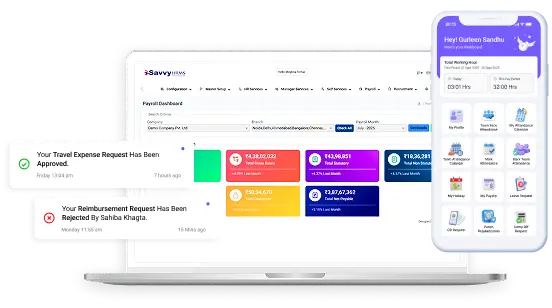
Book a free demo of Savvy HRMS today and experience smarter, faster, and more efficient HR management.