




The Employee PF (EPF) is one of the most important retirement savings schemes for salaried employees in India. Managed by the Employees’ Provident Fund Organisation (EPFO), it helps employees build a financial collection during their working years while also offering tax benefits and long-term security.
Whether you are starting your first job, changing employers, or planning for retirement, understanding employee PF is important. In this guide, we explain how EPF works, who is eligible, how contributions are calculated, withdrawal rules, and the benefits employees receive in 2026.
Blog overview
- What Employee PF (EPF) is, how it works, and why it is important for every salaried employee.
- The eligibility criteria for employees to become members of the Employee Provident Fund.
- Which employers are required to register for EPF and their key responsibilities.
- How EPF contributions are calculated and how the scheme helps build long-term savings.
- The steps to get started with EPF, activate your UAN, and manage your account.
- The key benefits of Employee Provident Fund, including retirement savings, tax benefits, and financial security.
- The eligibility criteria and rules for partial and full EPF withdrawals.
- Important tips to help salaried employees make the most of their EPF benefits in 2026.
What is Employee PF or EPF?
Employee PF (EPF), or Employee Provident Fund, is a government-backed retirement savings scheme under the Employees’ Provident Funds and Miscellaneous Provisions Act, 1952. It is managed by the Employees’ Provident Fund Organisation (EPFO).
Under this scheme, both the employee and the employer contribute a fixed percentage of the employee’s salary every month. These contributions accumulate over time and earn interest, creating a retirement collection for the employee.
Key features of EPF include:
- Monthly contributions from both employee and employer
- Interest is credited annually by EPFO
- Tax benefits under applicable income tax provisions
- Portable account through Universal Account Number (UAN)
- Partial withdrawals allowed for specific needs such as medical treatment, education, home purchase, or marriage
- Lump-sum amount available at retirement
Standard EPF contributionDeduct employee PF contributions
In most cases, the standard contribution is 12% of Basic Salary + Dearness Allowance (DA) from the employee. The employer also contributes 12%, although a part of the employer’s contribution is allocated to the Employees’ Pension Scheme (EPS).
Typical monthly EPF contribution
| Component | Contribution |
| Employee contribution | 12% |
| Employer contribution | 12% |
| Employer share to EPS | 8.33% |
| Employer share to EPF | 3.67% |
Source: https://www.epfindia.gov.in/
What Is the Eligibility for EPF for Employees?
An employee becomes eligible for EPF when they work in an establishment covered under the EPF Act.
Employee eligibility criteria
- Employees working in an EPF-covered establishment are eligible.
- Employees earning up to ₹15,000 per month in basic salary + DA are generally mandatorily covered.
- Employees earning above ₹15,000 per month may also join EPF with the consent of both employer and employee.
- Both permanent and temporary employees can be covered.
- Contract employees working for an EPF-covered establishment may also be eligible.
Important note
If an employee has already been a member of EPF in a previous job, they usually continue their EPF membership in the new job, regardless of salary.
Who Is Eligible to Register for EPF as an Employer?
Employers must register for EPF if their establishment meets the coverage criteria under the EPF Act.
Employers required to register
- Establishments employing 20 or more employees are generally required to register for EPF.
- Certain establishments with fewer than 20 employees may also be covered if notified by the government.
- Employers can voluntarily register for EPF even if they have fewer than 20 employees, subject to EPFO approval.
Employer responsibilities
- Obtain EPF registration from EPFO
- Enroll eligible employees
- Deduct employee PF contributions from salary
- Add employer contributions
- Deposit contributions within the prescribed due date
- File monthly and annual EPF returns
- Maintain employee PF records
How does EPF work?
The Employee Provident Fund works as a monthly savings mechanism where both the employee and employer contribute regularly.
EPF working process
1. Employee joins an EPF-covered company
When an employee joins an organization registered under the EPF Act, the employer enrolls them in the Employee Provident Fund scheme and generates or links their existing Universal Account Number (UAN).
2. Monthly salary deduction
Every month, 12% of the employee’s Basic Salary and Dearness Allowance (DA) is deducted as the employee’s EPF contribution and credited to their provident fund account.
3. Employer contribution
The employer contributes an amount equal to the employee’s contribution. A portion is allocated to the Employees’ Pension Scheme (EPS), while the remaining amount is credited to the EPF account.
4. Deposit to EPFO
The employer deposits both the employee’s and employer’s contributions with the Employees’ Provident Fund Organisation (EPFO) within the prescribed due date every month.
5. Interest accrual
EPFO declares an annual interest rate, and the accumulated EPF balance earns interest every year, helping employees steadily increase their retirement savings over time.
6. Corpus growth
With regular monthly contributions from both the employee and employer, along with annual interest earnings, the EPF balance grows into a substantial retirement collection over the years.
Example of EPF calculation
Monthly example:
| Particulars | Amount |
| Basic Salary + DA | ₹30,000 |
| Employee EPF (12%) | ₹3,600 |
| Employer EPF share | ₹1,101 |
| Employer EPS share | ₹2,499 |
| Total monthly contribution | ₹7,200 |
Over the years, this amount is collected with interest and becomes a significant retirement collection.
How to get started with EPF?
If you are joining a new company, getting started with employee PF is usually simple.
Steps to start EPF
1. Join an EPF-covered organization
Start by joining an organization registered under the EPF Act. If you are eligible, your employer will initiate your enrollment in the Employee Provident Fund scheme.
2. Submit KYC documents
Provide important KYC documents, including your Aadhaar card, PAN card, bank account details, and other required information to complete your EPF registration process.
3. Get your UAN
If you are a new EPF member, your employer will generate a Universal Account Number (UAN). Existing members can continue using their previously allotted UAN.
4. Activate UAN
Visit the EPFO Member Portal to activate your UAN using your registered mobile number and Aadhaar details, enabling access to various online EPF services.
5. Link Aadhaar and bank account
Link your Aadhaar and bank account with your UAN to ensure smooth EPF withdrawals, online claim processing, and faster verification of your account details.
6. Check EPF passbook
Log in to the EPFO passbook portal using your UAN to view monthly contributions, employer deposits, interest credited, and your updated EPF balance anytime.
Documents required
- Aadhaar card
- PAN card
- Bank account details
- Mobile number linked with Aadhaar
- Previous UAN (if applicable)
How does EPF benefit employees?
EPF offers several financial and retirement benefits to salaried employees.
Some of the benefits of Employee PF include:
1. Retirement savings
EPF helps employees build a disciplined retirement collection through regular monthly contributions from both the employee and employer, ensuring greater financial stability and long-term security after retirement.
2. Employer contribution
Along with the employee’s monthly contribution, the employer also contributes an equal amount, significantly increasing the overall savings and helping employees accumulate a larger retirement fund.
3. Compounded interest
The EPF balance earns interest every year at the rate declared by EPFO, allowing savings to grow steadily through the power of compounding over time.
4. Tax benefits
- Employee contribution may qualify for deduction under Section 80C.
- Interest earned is generally tax-free, subject to applicable conditions.
- Maturity amount is generally tax-free if withdrawal conditions are met.
5. Financial security
EPF acts as a financial safety net by providing employees with savings that can support them during retirement, unemployment, emergencies, or other important life events.
6. Partial withdrawal facility
Employees can withdraw EPF partially for specific purposes such as:
- Medical treatment
- Higher education
- Marriage
- Home purchase or construction
- Home loan repayment
- Renovation of house
7. Portability
The Universal Account Number (UAN) allows employees to smoothly transfer their EPF balance when changing jobs, ensuring uninterrupted savings without the need to open a new account.
What is the eligibility to withdraw EPF?
EPF withdrawal can be full or partial, depending on the situation.
Full EPF withdrawal eligibility
- Retirement at the age of 58 years
- Permanent disability
- Unemployment for two months or more
- Migration abroad for permanent settlement or employment
Partial EPF withdrawal eligibility
| Purpose | Typical condition |
| Medical treatment | No minimum service in many cases |
| Marriage | Usually after 7 years of service |
| Education | Usually after 7 years of service |
| Home purchase | Usually after 5 years of service |
| Home construction | Usually after 5 years of service |
| Home loan repayment | Usually after 10 years of service |
| House renovation | Usually after 5 years from construction |
Tax on EPF withdrawal
- If EPF is withdrawn after 5 years of continuous service, it is generally tax-free.
- If withdrawn before 5 years, the amount may be taxable, subject to applicable rules.
- TDS may apply if the withdrawal exceeds the prescribed limit and PAN is not furnished.
Important EPF tips for salaried employees in 2026
- Always activate your UAN.
- Keep Aadhaar, PAN, and bank details updated.
- Check your EPF passbook regularly.
- Transfer EPF balance when changing jobs instead of withdrawing it.
- Avoid premature withdrawal unless necessary.
- Understand the tax implications before making a withdrawal.
Conclusion
The Employee Provident Fund (EPF) is one of the most valuable financial benefits available to salaried employees in India. It not only encourages disciplined savings but also provides retirement security, tax benefits, and financial support during important life events.
By understanding how employee PF works, its eligibility criteria, contribution structure, and withdrawal rules, employees can make informed financial decisions and maximize the long-term benefits offered by the Employee Provident Fund.

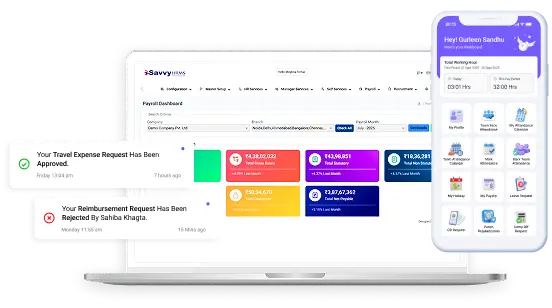









Simplify EPF Management with Savvy HRMS
Manage employee PF, payroll, and statutory compliance effortlessly with Savvy HRMS. Book a demo today and simplify your HR operations.
FAQs
1. What is Employee PF (EPF), and how does it work?
Employee PF (EPF) is a government-backed retirement savings scheme managed by the Employees’ Provident Fund Organisation (EPFO). Both the employee and employer contribute a fixed percentage of the employee’s salary every month, and the accumulated amount earns annual interest to help build long-term financial security.
2. Who is eligible for Employee PF (EPF) in India?
Employees working in EPF-covered establishments are generally eligible for Employee PF. Employees earning up to ₹15,000 per month in Basic Salary and Dearness Allowance (DA) are generally covered mandatorily, while higher-paid employees may also join with the consent of both the employer and employee.
3. How is the Employee PF (EPF) contribution calculated?
In most cases, both the employee and employer contribute 12% of the employee’s Basic Salary plus Dearness Allowance (DA). A portion of the employer’s contribution is allocated to the Employees’ Pension Scheme (EPS), while the remaining amount is credited to the employee’s EPF account.
4. When can an employee withdraw their EPF balance?
Employees can make a full EPF withdrawal upon retirement, permanent disability, prolonged unemployment, or permanent migration abroad. Partial withdrawals are permitted for specific purposes such as medical treatment, higher education, marriage, home purchase, home construction, home loan repayment, or house renovation, subject to EPFO eligibility conditions.
5. What are the key benefits of Employee PF (EPF)?
Employee PF helps salaried employees build retirement savings through regular contributions, earn compounded interest, receive employer contributions, enjoy eligible tax benefits, transfer their EPF balance seamlessly when changing jobs using UAN, and access partial withdrawals for specified life events.