

8 Best Human Capital Management (HCM) Software for Managing the Complete Employee Lifecycle in 2026


-
AuthorSalilendra Kumar
-
 Last Updated
August 18, 2026
Last Updated
August 18, 2026
-
 Reading Time
17 Mins
Reading Time
17 Mins
Best Human Capital Management software isn’t just about picking a tool that runs payroll or tracks attendance anymore. Managing an employee today means managing their entire journey, from the moment they apply for a job to the day they leave the organization. That journey includes recruitment, hiring, onboarding, employee records, attendance, payroll, benefits, performance, learning, engagement, career development, workforce planning, and offboarding. If your HR team is still juggling spreadsheets, a separate payroll vendor, and a recruitment tool that doesn’t talk to any of it, you already know how much time gets lost stitching all of this together.
This guide compares 8 HCM platforms that Indian businesses commonly evaluate: Savvy HRMS, Darwinbox, Keka, greytHR, PeopleStrong, Zoho People, ZingHR, and factoHR. Among these, Savvy HRMS stands out for businesses that want broad employee-lifecycle coverage in one place; it offers 20+ HR modules, bringing core HR, payroll, attendance, recruitment, performance, and more together on a single platform. That said, the right fit still depends on your company’s size, complexity, and goals, so let’s walk through how each platform actually performs.
Our Evaluation Methodology
We evaluated all 8 platforms against the same set of practical criteria, the things HR leaders actually run into during selection and implementation.
- Employee lifecycle coverage: Does the platform manage hire-to-retire, or just a slice of it? This matters because fragmented systems create data gaps at exactly the moments (onboarding, exits) where accuracy matters most.
- Core HR: The strength of the employee database, org charts, and document management, since this is the foundation every other module builds on.
- Payroll and payroll compliance: How well the platform automates salary processing and statutory obligations, because payroll errors directly affect employee trust.
- Recruitment and onboarding: Whether hiring flows directly into employee records without re-entry.
- Attendance and leave management: Real-time tracking matters for accurate payroll and for distributed or field-based teams.
- Performance management: Goal-setting, reviews, and appraisal cycles that connect to compensation decisions.
- Learning and development: Whether the platform supports upskilling as part of the employee record, not as a separate system.
- Employee engagement: Surveys, recognition, and communication tools that affect retention.
- Workforce planning and analytics: Dashboards and reporting that help leadership make staffing and cost decisions.
- Employee self-service: How much routine work employees and managers can handle themselves, freeing up HR bandwidth.
- Automation and AI capabilities: Whether repetitive tasks are actually reduced, not just digitized.
- Integrations: Compatibility with accounting, biometric, and other enterprise systems already in use.
- Scalability: Can the platform grow with the organization from 100 to 5,000+ employees?
- User experience: Adoption depends heavily on whether the interface feels intuitive to non-technical employees.
- Implementation and customer support: How realistic the rollout timeline is, and how responsive the vendor is afterward.
- Pricing and value: Whether the module depth justifies the cost for the organization’s size.
We relied on official vendor websites, product pages, and publicly available analyst or review sources for each platform. Where information wasn’t publicly confirmed, we’ve noted that rather than guessing.
What Are the Benefits of Using Human Capital Management (HCM) Software?
The direct answer: HCM software centralizes employee data and automates HR processes across the entire employee lifecycle, which reduces manual work, improves compliance, and gives leadership better visibility into their workforce.
Here’s what that looks like in practice:
1. Centralized Employee Data
Instead of scattered spreadsheets and disconnected files, HR software gives you one system of record. HR, payroll, and managers always work from the same accurate, up-to-date employee information at any given time.
2. Complete Employee Lifecycle Management
Recruitment, onboarding, performance, and offboarding no longer live in separate, disconnected tools. Everything connects on one platform, so employee data flows smoothly from hiring through to exit without manual re-entry.
3. Payroll Automation
Salary calculations, deductions, and disbursements happen with far less manual intervention. This reduces human error, saves HR teams significant processing time each month, and ensures employees are paid accurately and on schedule.
4. Payroll Compliance
Statutory contributions and filings are calculated and tracked systematically rather than manually. This lowers the risk of missed deadlines or miscalculations, helping organizations stay audit-ready throughout the year.
5. Employee Self-Service
Employees can check payslips, apply for leave, and update personal records without emailing HR for every small request. This reduces routine administrative queries and gives employees more control over their own information.
6. HR Analytics and Reporting
Data-backed insights replace guesswork around attrition, workforce cost, and productivity trends. Leadership gets real-time visibility into what’s actually happening across the organization instead of depending on outdated exports.
7. Scalability
As the organization grows or expands into new locations, the same platform can generally absorb added complexity. This means businesses avoid switching systems every time headcount or geography increases.
Think of it this way: an HR team of five managing 800 employees across three cities cannot realistically track everything in Excel without something eventually slipping: a missed compliance deadline, a delayed reimbursement, an inaccurate headcount report. HCM software exists to close those gaps.
8 Best Human Capital Management (HCM) Software
No single HCM platform is perfect for every business. The right choice depends on your employee count, HR complexity, geography, compliance needs, required modules, budget, and growth plans. Here’s how these 8 platforms compare.
1. Savvy HRMS
Savvy HRMS is a comprehensive HR platform built around 20+ integrated modules, covering the full employee lifecycle from recruitment and onboarding through payroll, attendance, performance, and employee self-service. Its breadth of coverage and focus on Indian payroll and compliance requirements make it a strong option for businesses that want to consolidate multiple HR processes on one platform rather than stitching together several point solutions.
Core Services
- Core HR and centralized employee database with document management and org structure tracking
- Payroll processing with automated salary calculations and statutory deduction handling
- Attendance management with mobile, GPS, and biometric-based tracking options
- Leave management with configurable policies and approval workflows
- Recruitment module to manage job postings, candidate tracking, and hiring workflows
- Onboarding module for structured, paperless new-hire processes
- Performance management with goal setting, KRA/KPI tracking, and appraisal cycles
- Employee self-service portal and mobile app for payslips, attendance, and leave requests
- HR analytics and reporting dashboards for workforce visibility
Implementation and Support Reality
Implementation generally involves data migration, configuration of payroll and leave policies, and training sessions for HR teams and employees. As with most HR platforms, the transformation is smoother when historical data is clean before migration, and ongoing support is available for post-go-live queries and adjustments.
Best For
Savvy HRMS is best suited for growing and large businesses that need multiple HR modules working together rather than a single-purpose tool. Because of its emphasis on Indian statutory requirements, including state-specific compliance handling, it’s a particularly relevant option for Indian businesses prioritizing payroll accuracy and compliance, alongside broader lifecycle needs like recruitment, performance, and engagement. Organizations looking to reduce the number of separate HR vendors they manage will find its module breadth useful for consolidation.
2. Darwinbox
Darwinbox is a cloud-based, AI-driven HCM platform aimed at mid-size to large enterprises, known for its broad talent management suite and recent investment in AI-native capabilities across the employee lifecycle.
Core Services
- Core HR, workforce records, and org management for enterprise-scale organizations
- Recruitment and onboarding workflows integrated into the employee lifecycle
- Payroll and workforce analytics with expanding native payroll coverage across countries
- Performance and talent management, including goal setting and reviews
- AI-driven features embedded across talent, analytics, and employee support functions
- Employee engagement and self-service tools accessible via mobile
Implementation and Support Reality
Enterprise rollouts generally involve phased configuration, data migration, and change management support, given the platform’s depth and the scale of organizations it generally serves.
Best For
Darwinbox is best suited for large enterprises, particularly those with 1,000+ employees and multi-country operations, that want a globally recognized, analyst-reviewed HCM suite with strong investment in AI-driven talent capabilities.
3. Keka
Keka is a modern HR and payroll platform popular with Indian SMBs and mid-market companies, built around a unified CoreHR system with modules for hiring, performance, time tracking, and payroll.
Core Services
- CoreHR as the central data hub connecting all other modules
- Payroll automation with Indian statutory compliance (PF, ESI, PT, TDS)
- Time tracking, attendance, and shift scheduling for operational teams
- Recruitment and structured onboarding workflows
- Performance management with OKRs and continuous feedback
- Employee engagement tools including pulse surveys and recognition
Implementation and Support Reality
Keka is generally positioned as easy to implement and train teams on, though exact rollout timelines vary by organization size, payroll complexity, and the number of modules being deployed.
Best For
Keka works well for Indian SMBs and mid-market companies (roughly 50 – 1,000 employees) that need centralized core HR, time tracking, and statutory payroll compliance without heavy enterprise-level customization.
4. greytHR
greytHR is a long-standing cloud-based payroll and HR platform from Greytip Software, widely used by small and mid-market Indian businesses for its payroll depth and compliance focus.
Core Services
- Payroll processing designed to run quickly regardless of employee count
- Statutory compliance automation covering PF, ESI, PT, and other Indian requirements
- Leave and attendance management with biometric and GPS integration options
- Employee self-service portal reducing routine HR queries
- Onboarding and exit workflow management
- Reports and analytics gallery with pre-configured and custom reporting
Implementation and Support Reality
greytHR is positioned around fast payroll setup and offers tiered plans (Basic, Pro, Enterprise), with customer support available via phone, email, and chat, though specific onboarding timelines depend on the plan and employee count.
Best For
greytHR suits small and mid-size Indian businesses whose primary need is dependable, compliance-heavy payroll processing alongside core HR functions like leave and attendance.
5. PeopleStrong
PeopleStrong is an AI-powered HCM suite focused on large enterprises across the Asia-Pacific region, built around what it calls a “Talent Operating System” spanning hiring to exit.
Core Services
- Core HR and workforce management across multi-entity, multi-location organizations
- AI-powered recruitment engine for high-volume hiring
- Payroll and workforce management with configurable, entity-specific policies
- Talent management covering performance, learning, and internal mobility
- Time and attendance tracking with geo-fencing support
- Employee experience tools including a mobile-first self-service app
Implementation and Support Reality
PeopleStrong follows a structured implementation process involving a discovery blueprint, sandbox-based data migration and validation, and role-based training before go-live, which suits organizations that can dedicate time to a phased rollout.
Best For
PeopleStrong is best suited for large enterprises, especially those with multi-entity or cross-border operations in the Asia-Pacific region, that need deep talent management capabilities alongside core HR and payroll.
6. Zoho People
Zoho People is a highly customizable, cloud-based HR platform from Zoho Corporation, popular for its flexibility and integration with the broader Zoho software ecosystem.
Core Services
- Core HR with employee database and extensive custom form and module building
- Attendance and leave management with biometric integration
- Onboarding and offboarding workflow automation
- Performance management with configurable review cycles
- Learning management system for employee training and development
- Payroll available through integration with Zoho Payroll rather than as a fully native module
Implementation and Support Reality
Zoho People’s drag-and-drop customization means configuration can start quickly, but building out complex custom workflows may require more admin time than platforms with pre-built HR modules.
Best For
Zoho People fits small to mid-sized businesses, especially those already using other Zoho applications, that value deep customization and don’t need heavyweight native payroll or enterprise-scale talent management.
7. ZingHR
ZingHR is a mobile-first, cloud-based HCM platform built for enterprises, with a strong focus on payroll automation, statutory compliance, and AI-driven workforce intelligence.
Core Services
- Extensive module set bridging hire-to-retire HR processes on a single platform
- Payroll automation with multi-state and multi-geography statutory compliance
- Attendance and workforce tracking via dedicated mobile apps
- Performance management with continuous, digitized appraisal cycles
- AI-driven automation aimed at reducing transactional HR work
- Employee self-service across leave, payroll, and task management
Implementation and Support Reality
ZingHR is generally positioned toward larger, multi-location enterprises, so implementation typically involves configuring compliance rules across states and, where relevant, multiple countries.
Best For
ZingHR is best suited for large enterprises with 1,000+ employees and multi-state or multi-country operations that need heavy payroll automation and compliance depth alongside broader HCM functionality.
8. factoHR
factoHR is an AI-powered HRMS built specifically around Indian payroll and statutory compliance, offering 15+ modules for small to large Indian businesses.
Core Services
- Payroll processing with native PF, ESI, PT, and TDS compliance handling
- Attendance tracking with biometric and GPS-based geo-fencing
- Leave management integrated with attendance and payroll data
- Recruitment, onboarding, and exit management workflows
- Performance appraisal cycles connected to payroll for increments and arrears
- Employee self-service mobile app for payslips, leave, and personal details
Implementation and Support Reality
factoHR emphasizes data migration support, mapping, validation, and parallel testing when moving from spreadsheets or another HRMS, though exact timelines depend on payroll complexity and employee count.
Best For
factoHR is well suited for Indian businesses, from SMEs to larger organizations, whose primary requirement is deep, India-specific statutory payroll compliance combined with core HR and attendance management.
How Do We Evaluate These 8 HCM Platforms?
Here’s the scoring framework we used to structure this comparison. It weights complete employee lifecycle coverage most heavily, since that’s the core promise of HCM software as opposed to narrower point solutions.
| Factor | Weight |
| Complete Employee Lifecycle Coverage | 20% |
| Core HR & Employee Management | 15% |
| Payroll & Payroll Compliance | 15% |
| Recruitment & Onboarding | 10% |
| Performance & Talent Management | 10% |
| Employee Experience & Self-Service | 8% |
| Workforce Planning & Analytics | 7% |
| Automation & AI in HR | 5% |
| Integrations | 4% |
| Implementation & Support | 3% |
| Scalability & Overall Value | 3% |
| Total | 100% |
Lifecycle coverage and core HR carry the most weight because fragmented systems are usually where organizations run into trouble, data doesn’t sync, records go old, and manual work creeps back in. Payroll compliance is weighted heavily too, since compliance errors carry real financial and legal consequences. Automation, integrations, and implementation matter, but they’re refinements on top of a platform that already covers the lifecycle well; that is why platforms with broad module coverage, like Savvy HRMS, tend to score well on this framework.
How Is HCM Different From HRIS and HRMS?
Short answer: HRIS focuses on storing employee records, HRMS adds process automation like payroll and attendance on top of that, and HCM goes further to include the full talent lifecycle, recruitment, performance, learning, and workforce planning, in one connected platform.
| Platform/Concept | Primary Focus | Typical Capabilities | Best Suited For |
| HRIS | Employee data and records | Employee database, document storage, basic reporting | Organizations needing a system of record for HR data |
| HRMS | HR process automation | Payroll, attendance, leave, employee self-service, plus core HRIS features | Organizations needing day-to-day HR operations automated |
| HCM | Full employee lifecycle management | Everything in HRMS, plus recruitment, performance, learning, engagement, and workforce planning | Organizations needing hire-to-retire management in one platform |
In practice, vendors don’t always use these terms consistently; a platform marketed as “HRMS” may include talent management features typically associated with HCM, and vice versa. It’s worth checking the actual module list rather than depending on the label alone.
How Do You Know Whether Full HCM Software Is Right for Your Organization?
Direct answer: your organization likely benefits from full HCM software once HR processes become too fragmented or complex to manage reliably across disconnected tools.
Here are the practical signs to watch for:
- Employee count is increasing, and spreadsheets are becoming error-prone
- HR uses multiple disconnected systems for payroll, attendance, and recruitment
- Employee data is scattered across departments or file locations
- Payroll takes several days of manual effort each cycle
- Recruitment data doesn’t flow into onboarding or employee records
- Performance reviews are inconsistent across teams or happen only once a year
- Managers lack visibility into their team’s attendance, leave, or performance
- HR reporting requires manually combining data from multiple sources
- Compliance processes are becoming harder to track accurately
- Employees frequently ask HR for information they should be able to self-serve
- Leadership needs workforce planning data that currently doesn’t exist in one place
- HR wants to automate repetitive administrative tasks
- The business is expanding into multiple locations or states
Quick checklist: If you’re checking off four or more of the above, it’s a reasonable signal to start evaluating full HCM platforms rather than adding another point solution.
What Does HR Software Implementation Cost, and How Can You Measure ROI?
Direct answer: implementation cost varies significantly based on employee count, number of modules, payroll complexity, and how much customization and data migration is required; there’s no fixed number, and vendors generally price based on your specific requirements.
Cost is generally influenced by:
- Employee count and organizational complexity
- Number of modules being implemented
- Payroll complexity, including multi-state or multi-country compliance
- Volume and condition of data being migrated
- Integrations with existing accounting, ERP, or biometric systems
- Degree of customization required
- Training needs across HR and employee populations
- Ongoing support and service-level requirements
- Choice of implementation partner
- Contract structure and term length
Pricing structures across vendors commonly include per-employee-per-month pricing, per-module pricing, flat subscription tiers, annual contracts, or custom enterprise quotes for larger organizations. We haven’t included specific price figures in this guide because published pricing varies by vendor and often requires a direct quote based on your requirements.
Measuring ROI comes down to tracking measurable operational improvements before and after implementation:
- Reduction in manual HR hours spent per payroll cycle
- Faster payroll processing time and fewer payroll errors
- Faster onboarding cycle time for new hires
- Employee self-service adoption rate
- Reduced administrative costs tied to HR headcount or overtime
- Faster recruitment-to-hire turnaround
- Improved reporting turnaround time for leadership requests
- Fewer compliance-related issues or penalties
- Overall HR team productivity, measured by tasks handled per HR staff member
A simple way to frame ROI: (Value of time saved + Value of errors avoided + Value of compliance risk reduced) − Total cost of ownership = ROI.
It’s not a precise formula, but it gives HR and finance teams a shared way to evaluate whether the investment is paying off.
It’s worth noting that software can automate, calculate, track, and support compliance processes, but employers remain legally responsible for compliance. No HCM platform automatically guarantees legal compliance; it reduces the manual effort and error risk involved in staying compliant.
Conclusion
Choosing HCM software isn’t about finding the platform with the longest feature list; it’s about finding the one that actually fits how your organization hires, pays, manages, and grows its people. Across the 8 platforms compared here, each has a reasonably clear niche: Darwinbox and PeopleStrong lean enterprise and AI-forward, Keka and greytHR are strong Indian SMB and mid-market picks, Zoho People suits businesses wanting deep customization, and ZingHR and factoHR lean into payroll-heavy compliance needs.
For businesses that want to manage the complete employee lifecycle, recruitment through offboarding, without stitching together multiple vendors, Savvy HRMS is worth serious consideration. Its 20+ modules, India-focused compliance handling, and unified approach to core HR, payroll, attendance, recruitment, and performance make it a practical fit for growing and large enterprises looking to consolidate their HR stack. If that sounds like where your organization is headed, it’s a reasonable next step to request a Savvy HRMS demo and see how its modules map to your specific HR processes.

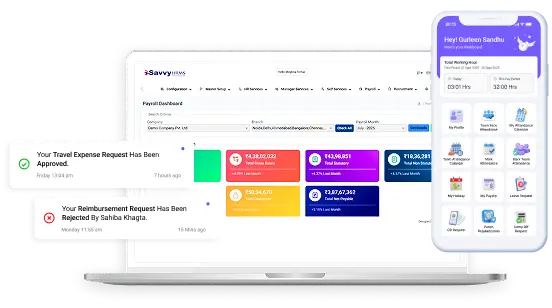









One Platform. 20+ HR Modules. Complete Employee Lifecycle Management.
See how Savvy HRMS can help your business reduce manual work, simplify HR processes, and manage employees from hire to exit.
Frequently Asked Questions (FAQs)
Which is the best HCM software?
There’s no single “best” HCM software for every business; it depends on company size, budget, and compliance needs. For organizations wanting broad employee-lifecycle coverage in one platform, Savvy HRMS is a strong option with 20+ modules spanning payroll, attendance, recruitment, and performance. Enterprises with global operations may lean toward Darwinbox or PeopleStrong, while payroll-first businesses often consider greytHR or factoHR.
What is human capital management software?
Human Capital Management (HCM) software is a platform that manages the complete employee lifecycle, from recruitment and onboarding through payroll, attendance, performance, learning, engagement, and offboarding, in one connected system, rather than relying on separate, disconnected tools for each function.
How is HCM different from HRMS and HRIS?
HRIS focuses mainly on storing employee records. HRMS builds on that by automating day-to-day processes like payroll and attendance. HCM goes further, adding recruitment, performance management, learning, and workforce planning, so the entire employee lifecycle is managed on one platform.
How much does HCM software cost?
Cost varies based on employee count, number of modules, payroll complexity, and customization needs. Most vendors price per employee, per module, or through custom enterprise quotes, so it’s best to request a quote based on your organization’s specific requirements rather than expecting a fixed number.