

Fringe Benefits: Meaning, Types, Examples and Tax Implications in India


-
AuthorSalilendra Kumar
-
 Last Updated
November 26, 2026
-
 Reading Time
17 Mins
Summary
- Fringe benefits are additional financial and non-financial benefits employees receive apart from their regular salaries.
- Common types of fringe benefits include health insurance, retirement contributions, paid leave, transportation, meal vouchers, housing and professional development.
- Fringe benefits help employees manage expenses, improve work-life balance and build financial security.
- Employers offer fringe benefits to attract talent, improve employee satisfaction and encourage workforce retention.
- India abolished the separate Fringe Benefits Tax (FBT) regime with effect from 1 April 2009.
- Under the current Income-tax Act, 2025, applicable employee benefits may be taxable as perquisites depending on their nature and the prescribed tax rules.
- HRMS and payroll software help organisations streamline employee records, payroll processing and benefit-related HR activities.
Employees receive more than just a monthly salary from their employers. Health insurance, meal vouchers, transportation facilities, paid leave, retirement contributions and professional development opportunities are some additional benefits companies provide to support their workforce and these additional facilities are commonly known as fringe benefits.
Fringe benefits form an important part of an employee’s total compensation package. They help employees to manage personal expenses, maintain work-life balance and access resources that support their professional and financial well-being.
In India, it is also important to understand that the separate Fringe Benefits Tax (FBT) regime was abolished in 2009 as employee benefits are now considered under the applicable salary and perquisite taxation provisions.
This guide explains the meaning of fringe benefits, their different types, practical examples, tax implications in India and how employers can manage them effectively.
What Are Fringe Benefits?
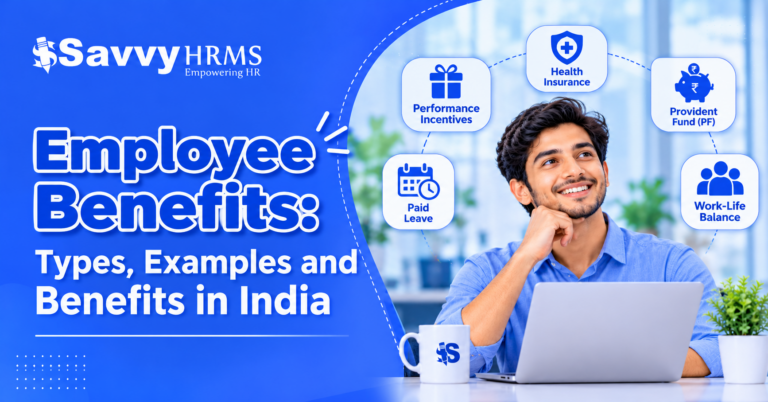
Fringe benefits are additional financial and non-financial benefits that employers provide to employees apart from their regular salary or wages. These benefits may include health insurance, retirement contributions, transportation facilities, paid leave, meal allowances, company-provided accommodation and professional development opportunities.
Employers offer fringe benefits to improve employees’ overall compensation, support their well-being and create a more attractive workplace.
For example, an employee earning ₹50,000 per month may also receive health insurance coverage, subsidised meals, transportation facilities and paid annual leave. These additional facilities form part of the employee’s overall benefits package.
Unlike basic salary, fringe benefits may not always be provided as direct cash payments. Some benefits are offered as services, reimbursements, insurance coverage or access to company facilities.
Key characteristics of fringe benefits include:
- Additional compensation: They supplement an employee’s regular salary.
- Financial and non-financial value: They may reduce personal expenses or provide access to useful services.
- Employer-sponsored: They are generally provided under company policies or employment agreements.
- Different eligibility conditions: Some benefits are available to all employees, while others depend on job roles, seniority or company policies.
- Different tax treatment: Their taxability depends on the type of benefit and applicable tax provisions.
What Are the Different Types of Fringe Benefits?
Fringe benefits can be divided into several categories depending on the purpose of the benefit and the needs of employees. Some support financial security, while others focus on healthcare, convenience, career development and work-life balance.
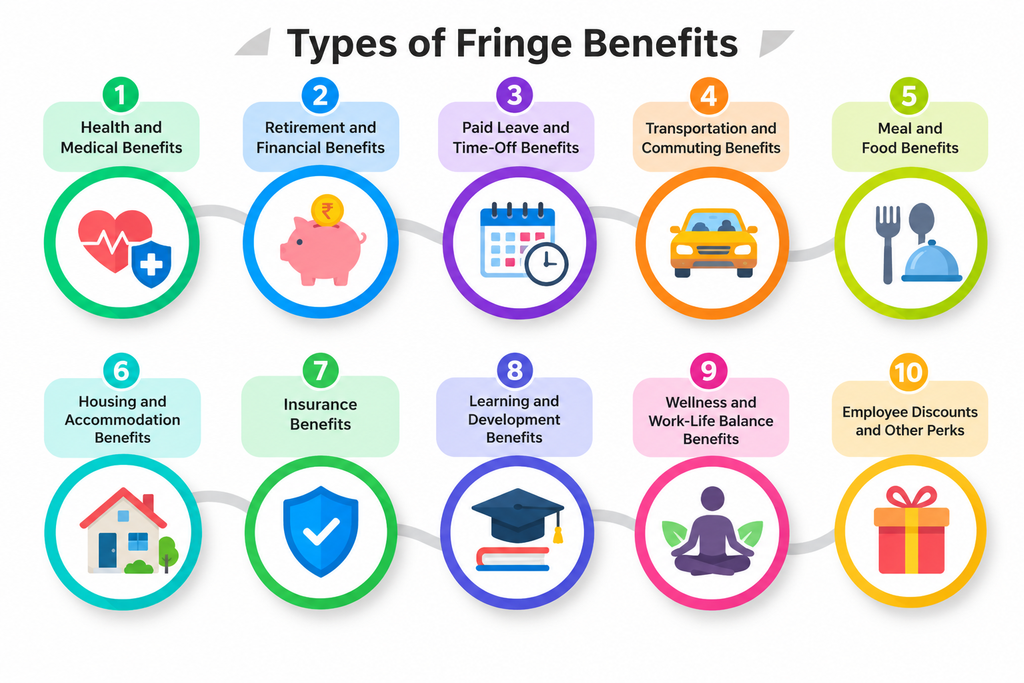
Here are some common types of fringe benefits employers provide.
1. Health and Medical Benefits
Health and medical benefits help employees to manage healthcare expenses and access medical services when required. These benefits are particularly valuable because unexpected medical expenses can create financial pressure for employees and their families.
Common examples include:
- Group health insurance for employees and their families.
- Medical check-up programmes.
- Preventive healthcare services.
- Access to healthcare consultations.
- Employer-sponsored wellness initiatives.
For example, a company may provide group medical insurance covering employees, their spouses and dependent children. This gives employees financial support against eligible medical expenses, subject to the policy’s terms and coverage limits.
2. Retirement and Financial Benefits
Retirement and financial benefits help to employees build long-term financial security. Employers may contribute towards retirement savings or offer financial incentives as part of their compensation structure.
Common examples include:
- Employees’ Provident Fund (EPF) contributions.
- Gratuity benefits.
- National Pension System (NPS) contributions, where applicable.
- Employer-sponsored retirement plans.
- Performance-linked bonuses and incentives.
For example, employers covered under the applicable EPF provisions contribute towards employees’ provident fund accounts. The accumulated savings help employees build financial security for their future.
3. Paid Leave and Time-Off Benefits
Paid leave allows employees to take time away from work without losing their eligible salary. These benefits help employees manage personal responsibilities, health requirements and family commitments.
Common examples include:
- Casual leave.
- Earned or annual leave.
- Sick leave.
- Maternity leave.
- Paternity leave, where provided under company policy.
- Bereavement leave.
- Compensatory off.
For instance, an organization may provide 18 days of earned leave and 12 days of casual leave annually. Employees can use these benefits according to the company’s leave policy and applicable statutory requirements.
4. Transportation and Commuting Benefits
Transportation benefits help employees to manage their daily commute between home and the workplace. They are especially useful for employees working in locations with limited public transportation or irregular working hours.
Common examples include:
- Company-provided cab facilities.
- Employee transportation services.
- Transport allowance.
- Company-provided vehicles.
- Reimbursement of eligible official travel expenses.
For example, a company operating night shifts may provide cab facilities to employees to support safer and more convenient commuting.
The tax treatment of transport-related benefits depends on the arrangement and applicable tax provisions.
5. Meal and Food Benefits
Meal benefits help employees access food during working hours without having to manage the entire expense themselves. Employers may provide meals directly or offer eligible meal vouchers and food coupons.
Common examples include:
- Subsidised office cafeteria meals.
- Meal vouchers.
- Food coupons.
- Company-sponsored refreshments.
- Meal facilities during extended working hours.
For example, an organization may provide subsidised lunch at its office cafeteria or eligible meal vouchers to employees for food expenses.
6. Housing and Accommodation Benefits
Housing and accommodation benefits help employees to manage living expenses, particularly when they relocate for work or are transferred to another city.
Common examples include:
- Company-provided accommodation.
- Rent-free residential facilities.
- House Rent Allowance (HRA).
- Temporary accommodation during relocation.
- Housing-related assistance under company policy.
For example, an employer may provide rented accommodation to an employee transferred from Mumbai to Bengaluru. This can reduce the employee’s relocation and housing burden.
HRA and rent-free accommodation have different tax treatments, so they should not be considered interchangeable.
7. Insurance Benefits
Insurance benefits provide employees with financial protection against specific risks. Employers may offer insurance coverage as part of their employee benefits programme.
Common examples include:
- Group term life insurance.
- Personal accident insurance.
- Group health insurance.
- Disability insurance.
- Travel insurance for eligible business travel.
For example, a company may provide group term life insurance to employees so that their nominated beneficiaries receive financial support in the event of the employee’s death, subject to the policy terms.
8. Learning and Development Benefits
Learning and development benefits help employees improve their skills, gain industry knowledge and prepare for future responsibilities.
Common examples include:
- Professional certification programmes.
- Technical training.
- Leadership development programmes.
- Online learning subscriptions.
- Conference and workshop participation.
- Tuition assistance, where offered.
For example, an IT company may sponsor cloud computing certifications for employees to help them develop skills relevant to their roles.
9. Wellness and Work-Life Balance Benefits
Wellness benefits focus on employees’ physical, mental and overall well-being. They encourage healthier workplace habits and help employees to balance their professional and personal responsibilities.
Common examples include:
- Gym memberships.
- Yoga and fitness sessions.
- Employee assistance programmes.
- Mental wellness initiatives.
- Flexible working arrangements.
- Recreational activities.
- Wellness workshops.
For example, an organization may provide access to counselling services and fitness programmes to help employees manage workplace stress and maintain their well-being.
10. Employee Discounts and Other Perks
Some employers offer additional privileges that make everyday purchases and workplace experiences more convenient or affordable.
Common examples include:
- Discounts on company products.
- Corporate memberships.
- Employee referral incentives.
- Company-sponsored events.
- Gift vouchers and recognition rewards.
- Access to recreational facilities.
For example, an electronics company may offer employees special discounts on selected products manufactured or sold by the organization.
The tax treatment of gifts, vouchers and incentives depends on their value, nature and applicable provisions.
What Are Some Common Examples of Fringe Benefits?
Fringe benefits can vary depending on an organization’s industry, employee requirements, compensation structure and workplace policies. Some companies focus on financial and healthcare benefits, while others provide additional facilities to improve employee convenience and work-life balance.
The following table highlights common fringe benefits offered in Indian workplaces.
| Fringe benefit | Example | Purpose |
| Health insurance | Group medical insurance for employees and dependants | Provides healthcare coverage |
| Retirement benefits | Employer EPF contributions and eligible retirement plans | Supports long-term financial security |
| Paid leave | Annual leave, sick leave and casual leave | Supports personal and health requirements |
| Transportation | Office cabs and eligible transport facilities | Makes commuting convenient |
| Meal benefits | Subsidised meals and eligible food vouchers | Reduces food expenses |
| Housing benefits | Company-provided accommodation and HRA | Supports housing requirements |
| Life insurance | Group term life insurance | Provides financial protection |
| Learning benefits | Training, workshops and certifications | Develops employee skills |
| Wellness benefits | Gym memberships and counselling programmes | Supports employee well-being |
| Employee discounts | Discounts on company products and services | Provides additional savings |
Example: Consider an employee working at a software company who receives a monthly salary along with health insurance, meal vouchers, paid annual leave, cab facilities and access to professional certification programmes.
Although these benefits do not necessarily increase the employee’s monthly cash salary, they add value to the overall compensation package.
What Is Fringe Benefits Tax (FBT)?
Fringe Benefits Tax (FBT) was a separate tax introduced by the Indian government on certain benefits and facilities provided by employers to their employees. Under this system, the tax liability was primarily placed on employers rather than individual employees.
The government introduced FBT through the Finance Act, 2005. It covered specified employer expenses and benefits, including employee welfare, entertainment, transportation, accommodation and certain other facilities.
The main objective was to tax certain benefits that employees received in addition to their regular salaries, including benefits that could be difficult to value individually.
However, the FBT system was later abolished in 2009.
Why Was Fringe Benefits Tax Introduced?
Before FBT, certain employee benefits were difficult to assess and tax consistently because they were provided in different forms rather than as direct salary payments.
For example, an employer might provide employees with company vehicles, subsidised meals, accommodation or recreational facilities instead of increasing their monthly salaries.
FBT was introduced to bring specified employer expenditure on such benefits within the tax framework.
Some key reasons behind its introduction were:
- To bring certain non-cash employee benefits within the tax system.
- To address difficulties in valuing benefits received by employees.
- To establish a taxation mechanism for specified employer-provided facilities.
- To improve consistency in the taxation of certain employee-related expenses.
Why Was Fringe Benefits Tax Abolished in India?
The government abolished Fringe Benefits Tax through the Finance (No. 2) Act, 2009, with effect from 1 April 2009.
One of the main reasons was the compliance burden FBT placed on employers. The government also restored the taxation of relevant fringe benefits as perquisites in employees’ hands under the income-tax framework.
The change shifted the taxation approach from a separate employer-level FBT system to the taxation of applicable benefits as part of employees’ salary income.
Is Fringe Benefits Tax Applicable in India?
No. The separate Fringe Benefits Tax (FBT) regime is no longer applicable in India. It was abolished with effect from 1 April 2009 through the Finance (No. 2) Act, 2009.
However, this does not mean that all employee benefits are tax-free. Certain benefits provided by employers may still be taxable in employees’ hands as perquisites under the applicable income-tax provisions.
As of November 2026, the Income-tax Act, 2025 is in force from 1 April 2026. Section 17 addresses perquisites, while Rule 15 of the Income-tax Rules, 2026 provides for their valuation.
Income Tax India+2
For employers and employees, the distinction is important:
- Earlier: Employers were liable to pay FBT on specified fringe benefits.
- Currently: Applicable benefits are considered under the employee’s salary and perquisite taxation provisions.
- Tax treatment: Whether a benefit is taxable depends on its nature, value, eligibility conditions and applicable exemptions.
Therefore, when discussing fringe benefits tax in India, it is important to distinguish the historical FBT regime from the current taxation of employee benefits.
How Are Fringe Benefits Taxed in India?
Although the separate FBT regime has been abolished, certain employer-provided benefits are still taxable as perquisites under the Indian income-tax framework.
A perquisite is generally a benefit or facility provided by an employer to an employee in addition to monetary salary. Depending on the applicable provisions, its value may be included in the employee’s taxable salary.
Under the current Income-tax Act, 2025, Section 17 defines perquisites. Rule 15 of the Income-tax Rules, 2026 explains how the value of specified perquisites is calculated.
Examples of Taxable and Exempt Employee Benefits
The tax treatment depends on the specific benefit and applicable conditions. The following examples illustrate some common situations.
| Employee benefit | General tax treatment |
| Rent-free accommodation | Generally taxable as a perquisite, subject to applicable exceptions |
| Employer-provided motor car | Tax treatment depends on its official and personal use and applicable valuation rules |
| Free meals at the workplace | Exempt up to the prescribed limit and subject to conditions |
| Gifts and vouchers | Generally taxable if the aggregate value reaches the prescribed threshold |
| Employer contributions to specified retirement funds | Taxable to the extent applicable statutory limits are exceeded |
| ESOPs and sweat equity shares | Taxable as perquisites at the applicable stage and under prescribed valuation rules |
| Employer-provided medical facilities | Treatment depends on the type of facility and applicable provisions |
1. Rent-Free Accommodation
When an employer provides residential accommodation to an employee free of cost or at a concessional rate, its prescribed value is generally treated as a taxable perquisite.
The valuation depends on factors such as whether the property is owned or rented by the employer, the city in which it is located and the employee’s salary.
2. Employer-Provided Motor Cars
If an employer provides a vehicle for an employee’s personal use or mixed official and personal use, the applicable perquisite valuation rules may apply.
However, vehicles used exclusively for official duties may have no taxable perquisite value when the prescribed conditions and documentation requirements are satisfied.
3. Free Meals and Food Vouchers
Meals provided during working hours at the office or business premises, or through eligible paid vouchers usable at eating joints, are not taxable up to ₹200 per meal under the applicable Rule 15 conditions.
Benefits exceeding the prescribed exemption or not meeting the relevant conditions may have different tax treatment.
4. Gifts and Vouchers
Gifts, vouchers or tokens provided by employers may be taxable depending on their aggregate value during the tax year.
Under Rule 15 of the Income-tax Rules, 2026, their value is nil if the aggregate value is below ₹15,000 during the tax year. This is a valuation threshold, not a blanket exemption for every type of employee reward.
5. Employer Contributions to Retirement Funds
Employer contributions to specified retirement funds may also have tax implications.
For example, the aggregate employer contribution to an employee’s recognized provident fund, NPS account under Section 80CCD(1) and approved superannuation fund is subject to the applicable ₹7.5 lakh annual threshold under the relevant perquisite provisions. Tax may also apply to specified annual accretions attributable to taxable contributions.
Important: Employers should evaluate each benefit separately instead of assuming that all fringe benefits are taxable or tax-free. The applicable tax treatment can also differ depending on the employee’s circumstances and the selected tax regime.
What Are the Advantages of Fringe Benefits for Employees and Employers?
Fringe benefits create value for both employees and employers as employees receive additional financial and non-financial support, while organizations can use these benefits to improve workplace satisfaction, attract talent and build a positive working environment.
Here are some important advantages.
Advantages for Employees
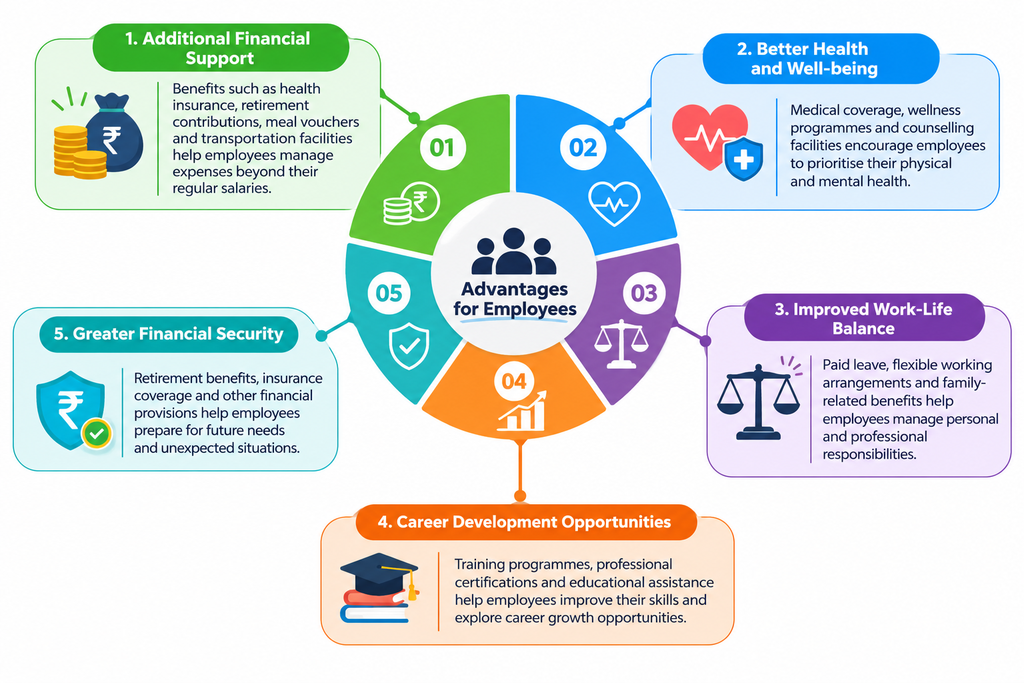
1. Additional financial support
Benefits such as health insurance, retirement contributions, meal vouchers and transportation facilities help employees to manage expenses beyond their regular salaries.
2. Better health and well-being
Medical coverage, wellness programmes and counselling facilities encourage employees to prioritize their physical and mental health.
3. Improved work-life balance
Paid leave, flexible working arrangements and family-related benefits help employees to manage personal and professional responsibilities.
4. Career development opportunities
Training programmes, professional certifications and educational assistance help employees to improve their skills and explore career growth opportunities.
5. Greater financial security
Retirement benefits, insurance coverage and other financial provisions help employees to prepare for future needs and unexpected situations.
Advantages for Employers
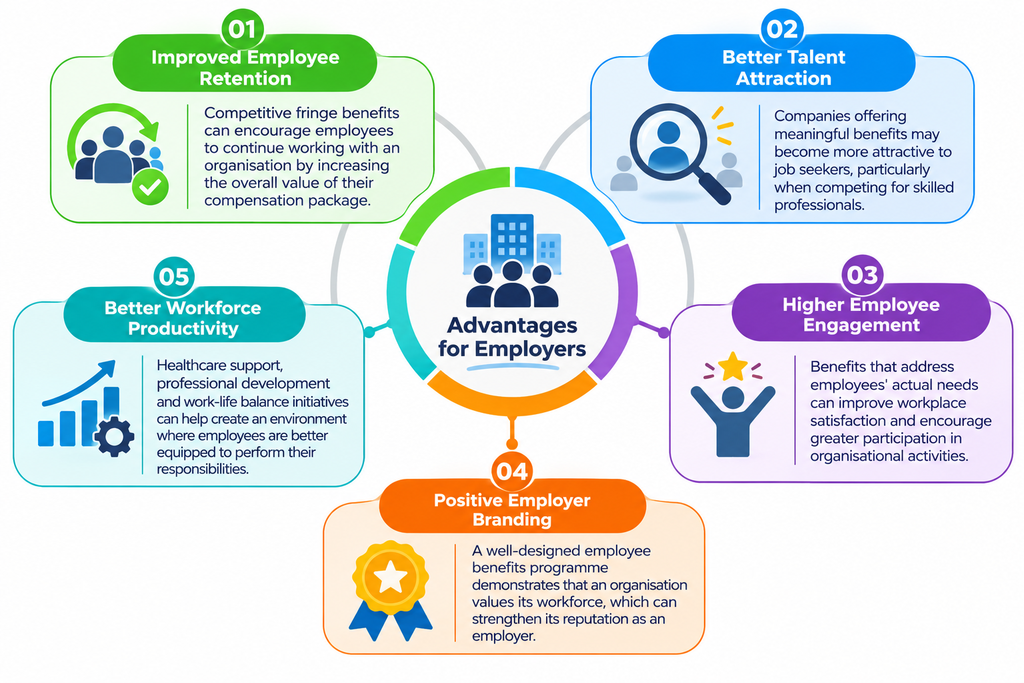
1. Improved employee retention
Competitive fringe benefits can encourage employees to continue working with an organization by increasing the overall value of their compensation package.
2. Better talent attraction
Companies offering meaningful benefits may become more attractive to job seekers, particularly when competing for skilled professionals.
3. Higher employee engagement
Benefits that address employees’ actual needs can improve workplace satisfaction and encourage greater participation in organizational activities.
4. Positive employer branding
A well-designed employee benefits programme demonstrates that an organization values its workforce, which can strengthen its reputation as an employer.
5. Better workforce productivity
Healthcare support, professional development and work-life balance initiatives can help to create an environment where employees are better equipped to perform their responsibilities.
What Is the Difference Between Fringe Benefits and Perquisites?
Fringe benefits and perquisites are closely related concepts because both refer to additional benefits employees receive apart from their regular monetary salary. However, they are not always interchangeable.
Fringe benefits is a broader compensation and HR term, while perquisites have a specific meaning under income-tax legislation.
Here are the major differences:
| Basis | Fringe benefits | Perquisites |
| Meaning | Additional financial and non-financial employee benefits | Specific benefits or amenities provided by employers in connection with employment |
| Scope | Broad HR and compensation concept | Defined under income-tax provisions |
| Examples | Health insurance, wellness programmes, paid leave and transport facilities | Rent-free accommodation, employer-provided vehicles and ESOPs |
| Purpose | Improve employee compensation and overall well-being | Provide additional benefits or facilities to employees |
| Tax treatment | Depends on the nature of each benefit | Governed by applicable income-tax provisions |
| Indian tax context | General term used in employee benefits management | Covered under Section 17 of the Income-tax Act, 2025 |
The important distinction is that not every fringe benefit is automatically a taxable perquisite. The tax treatment depends on the specific benefit and the applicable provisions.
How Can HRMS Software Help Manage Employee Benefits?
As organizations grow, managing employee benefits through spreadsheets and separate systems can create administrative challenges. HR teams may find it difficult to track employee information, coordinate payroll management activities, manage leave records and maintain accurate documentation.
An integrated Human Resource Management System (HRMS) helps centralize several HR activities within one platform.
For example, HRMS software can support:
- Employee management: Maintain employee profiles, employment information and relevant records.
- Payroll management: Process salary components and account for applicable taxable benefits and deductions.
- Leave management: Track leave balances, requests, approvals and available leave entitlements.
- Attendance management: Maintain attendance records, shift allowance information and working-hour data.
- Employee self-service: Allow employees to access relevant information, view payslips and submit HR requests.
Conclusion
Overall, Fringe benefits are an important part of employee compensation because they provide additional financial support, improve workplace well-being and help organizations create a more attractive working environment.
From health insurance and retirement contributions to transportation, paid leave and professional development, different types of fringe benefits address different employee requirements.
For Indian employers, understanding the distinction between fringe benefits, Fringe Benefits Tax and taxable perquisites is equally important. Although the separate FBT regime was abolished in 2009, applicable employee benefits continue to be governed by income-tax provisions.
By designing relevant benefit programmes and using integrated HRMS and payroll software, organizations can manage employee information, streamline HR operations and create a better employee experience.
Frequently Asked Questions About Fringe Benefits
1. What are fringe benefits in simple words?
Fringe benefits are additional financial or non-financial facilities employees receive from their employers apart from their regular salaries. Examples include health insurance, paid leave, retirement contributions, meal vouchers, transportation facilities and professional development programmes.
2. What are the most common types of fringe benefits?
Common types of fringe benefits include health insurance, retirement benefits, paid leave, transportation facilities, meal benefits, housing assistance, life insurance, learning opportunities, wellness programmes and employee discounts.
3. What are some examples of fringe benefits in India?
Examples of fringe benefits in India include employer-provided health insurance, EPF contributions, gratuity, company transportation, subsidised meals, paid leave, accommodation facilities, group life insurance and professional training programmes.
4. Is Fringe Benefits Tax applicable in India?
No. The separate Fringe Benefits Tax (FBT) regime was abolished in India with effect from 1 April 2009. However, certain employer-provided benefits may still be taxable as perquisites under the applicable income-tax provisions.
5. Who pays Fringe Benefits Tax?
Historically, employers were responsible for paying Fringe Benefits Tax on specified employee-related expenses and benefits. However, India abolished this separate tax in 2009 and restored the taxation of applicable benefits as perquisites in employees’ hands.
6. Are all fringe benefits taxable in India?
No. Not all fringe benefits are taxable. Their tax treatment depends on the type of benefit, its value, the applicable exemption conditions and the relevant income-tax provisions. Some benefits may be fully taxable, partially exempt or tax-free.